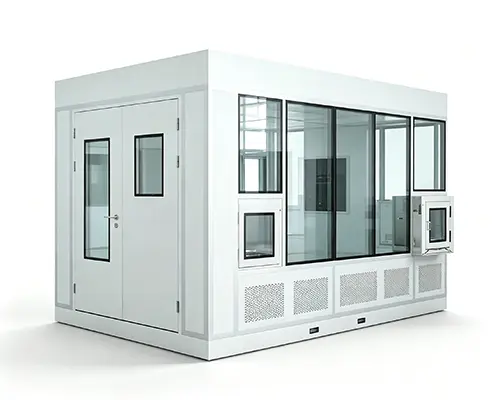
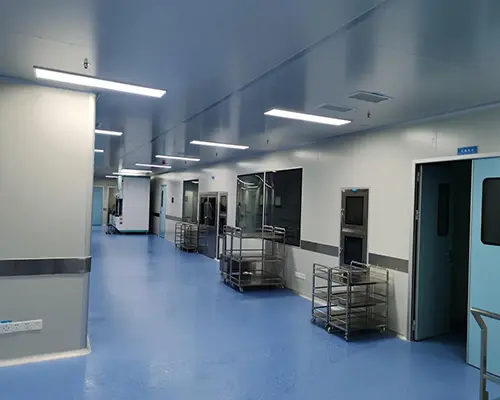
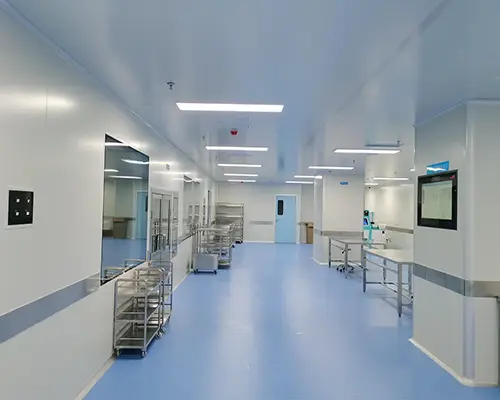
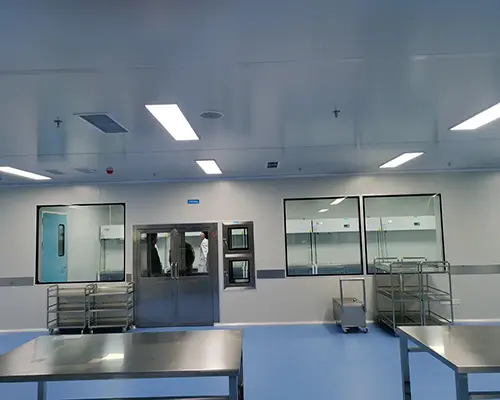
Explore hardwall cleanrooms designed to support USP <797> sterile compounding and USP <800> hazardous drug handling, with site-specific HVAC, pressure control, HEPA filtration, qualification, and documentation.
Compliance: This system is dedicated to complying with both USP 797 sterile compounding and USP 800 handling of hazardous drugs, adhering to site-specific certification protocols.
Cleanliness Class: This consists of the ISO 7 buffer/C-SEC including ISO Class 7 or 8 ante-room, ISO 5 primary engineering control (PEC).
Minimum Particulate Count: Maximum 0.5μm particle count is ISO 5/7/8 = ≤3520/352000/3520000 particles/m3.
Pressure Differential: The USP 797 buffer room has a positive ≥+5 Pa and the USP 800 C-SEC has a negative pressure differential of -2.5 to -7.5 Pa relative to surrounding areas.
Air Changes: The minimum air change required for USP 800 C-SEC is 30 complete air changes per hour, with HEPA-filtered air and airflow balancing as per the specific application.
Airflow Pattern: The air flows differently in a controlled negative pressure environment to avoid cross-contamination as well as the hazard of drugs present.
Air Treatment: Final H13 or H14 HEPA filters should be installed in this filtration system; it can provide uni-directional ISO 5 airflow at the PEC working zone.
Exhaust System: The USP 800 C-SEC process includes the use of external exhaust system with fans, efficient system of airflow and filtration devices along with special changeover housings.
Environmental Conditions: Temperature controlled below or equal to 20 degrees Celsius where necessary for sterile compounding; relative humidity controlled below or equal to 60 percent.
Hardwall and Monitoring: Sealed, non-shedding, cleanable enclosure featuring continuous monitoring of the pressure, visual and audible alarms, and supply/exhaust interlock.
The cleanroom for compounding non-hazardous sterile products has filters on the air supply and is configured for contamination controls through the design of the room.
Buffer room is considered ISO Class 7
Selected Primary Engineering Control will have the environment of ISO Class 5.
Air supply method will be Terminal, via Ducted, HEPA Filtered Units.
C-SEC will maintain positive pressure compared to the surrounding areas which have lower classifications than ISO Class 7.
Cleanroom surfaces must be as low-Shed as possible and smooth as well as being able to be easily cleaned.
Containment of Hazardous Drugs
C-SEC for Compounding Hazardous Drugs has been designed for negative pressure in order to prevent any Hazardous materials from migrating into surrounding areas.
C-SEC will maintain a negative pressure that is between 0.010 to 0.030 in. H2O Column
Approximately the pressure of a 2.5 to 7.5 Pa
Minimum air changes per hour to maintain the C-SEC is 12.
C-SEC will have an exhaust system and an exterior venting and must not return air into the room.
C-SEC will be integrated with the appropriate Primary Engineering Control designed for Containment.
Engineered Relationships of Pressure
Compounding activity determines the direction of the pressure. USP <797> sterile preparation area's pressure is always positive to allow for product protection, while USP <800> Hazardous Drug preparation has negative pressure in order to protect the personnel and environment.
USP <797>Positive Pressure of > 0.020 in. H2O Column, and approximately 5 Pa.
USP <800>Negative Pressure of 0.010 to 0.030 in. H2O Column.
Combined SuiteIndependent Positive and Negative Pressure Zones.
HEPA Filtration
HEPA filters should be used to filter airborne particles from the air supplied to the cleanroom. Filters, filter location, and filter coverage will depend on the classification and airflow pattern.
Dedicated Exhaust Systems
Hazardous drug cleanrooms can be connected to a separate exhaust system, which exhausts outside the building. This is done at an approved location that will be designated by the Project Engineer.
Pressure Monitoring
The differential pressure monitor allows for constant monitoring of pressure. They have audible and visual alarms that will indicate to operating staff when the pressure is going out of tolerance.
Construction for Cleanability
Sealing of all wall and ceiling areas to maintain cleanliness, flush surfaces, and appropriate coatings allow for routine cleaning and disinfecting of the cleanroom.
Contamination & Containment
USP <797> Suite
Sterile Compounding Configuration as per standards set forth in USP <797>; The configuration for sterile compounding of Non-hazardous medications will follow the guidelines and specifications based upon positive pressure and passive air filtration. The USP <797> Suite is designed to contain non-hazardous medications while allowing for the sterile compounding of the medication within the suite.
ISO Class 7 Buffer Room
ISO Class 7 or ISO Class 8 Ante-room
ISO Class 5 Primary Engineering Control (PEC)
5.0 Pa (minimum) positive airflow
HEPA Filtered Supply Air
Ante-Room→Buffer Room→ISO Class 5 PEC
USP <800> Suite
Sterile Compounding Configuration as per standards set forth in USP <800>; The configuration for sterile compounding of Hazardous Medications will follow the guidelines and specifications based upon negative pressure and active air filtration. The USP <800> Suite is designed to contain hazardous medications while allowing for the sterile compounding of the medication within the suite.
ISO Class 7 Compounding Space (C-SEC) for Sterile Compounding
ISO Class 5 Containment Primary Engineering Control (C-PEC)
Negative Pressure of 2.5 – 7.5 Pa (typical)
12 Minimum Air Changes per Hour (minimum)
Externally Vented Exhaust System
Ante-Room→Negative C-SEC→ISO Class 5 C-PEC
Combined Suite
Combined Suite; configuration for a positive-pressure room and negative-pressure room within one coordinated compounding facility.
Independent Pressure Zones
Controlled Personnel Movement
Defined Material/Waste Routes
Dedicated Hazardous Drug Exhaust
Continuous Pressure Monitoring
Shared Support→Independent Zones→Dedicated PECs
Modular Layout
Modular Layout; designed based upon the available space and workflow.
PEC Integration
PEC Integration; interfaces for LAFWs, BSCs, CAIs, and CACIs.
Pressure Control
Pressure Control; continuous monitor with visual and audible alarm.
Material Transfer
Material Transfer; optional pass-throughs and designated transfer pathways.
Site-Specific Configuration
Site-Specific Configuration; Room Classification, Pressure Relationships, Air-Change Rates and Exhaust Capacities will be established based upon the specific compounding process utilized, the selected primary engineering controls, and the results of Site Condition Evaluations.
The cleanrooms available to our customers are designed and constructed to provide the required compliance to USP <797>, USP <800> and to the applicable ISO 14644 Standard. Final Compliance will depend on installation, Qualification, Operating Procedures, and on-going Facility Control.
Qualification & Documentation
An Overview of Contamination Control
A cleanroom must meet specific ISO classifications for air cleanliness and pressure relationships. For example, ISO Class 7 cleanrooms are typically used for sterile compounding, with required elements including the following:
Buffers that meet ISO Class 5 requirements (room air) must be filtered to provide a HEPA-filtered environment.
Positive pressure, which helps prevent contaminants from adjacent room areas, must be maintained between ISO Class 7 buffer rooms and the surrounding room.
ISO Class 7 cleanrooms must have cleanable and smooth interior surfaces that produce little to no shedding.
Whereas a cleanroom for non-hazardous sterile compounding utilizes HEPA-filtered air and positive pressure to limit the influx of air contaminants, a cleanroom for hazardous drug compounding utilizes secondary engineering controls (C-SEC) to maintain negative pressure to help eliminate airborne hazardous materials from contaminating surrounding space.
A minimum of 12 air changes per hour must occur in C-SEC.
A dedicated exhaust system for the hazardous drug room must discharge outside the building to a location determined by the project engineer.
A containment primary engineering control (PEC) must be properly configured with the pressure direction of the cleanroom and C-SEC. For example, USP <797> generally requires the use of positive pressure for the protection of a product (minimum of 5 Pa); USP <800>, on the other hand, requires the use of negative pressure (minimum of 2.5–7.5 Pa) to provide environmental and personnel protection.
Composite Suites?
The composite Suite consists of alternating independent pressure zones. The two zones (negative pressure and positive pressure) may operate independently, while air can be delivered from either zone into the other zone.
HEPA Filters
HEPA filters are installed in a cleanroom to trap airborne particulates before those particulates reach the surface of the supplying air supply and before they have the chance to accumulate within the air supply piping. HEPA filters are selected based on the classification and airflow pattern of the cleanroom.
Dedicated Exhaust and Pressure MonitoringA dedicated exhaust system for hazardous drug compounding, along with continued pressure monitoring, may be required. An external discharge must be provided from an exhaust system and the location determined by the project engineer.
Builds for Cleanable Construction
Routine cleaning and disinfecting are made easier through construction methods that ensure cleanable surfaces through the use of sealed wall and ceiling interfaces, flush surfaces, and compatible finishes.
FAQ
Will all Hardwall Cleanrooms produced by Deiiang conform to USP<797>and USP<800>standards?
Deiiang manufactures Hardwall Cleanrooms that are capable of being configured to meet the requirements for sterile compounding per USP<797>and hazardous-drug handling under USP<800>. The final configuration of each cleanroom is based on intended use, standards for risk assessment, facility configuration, and local codes. Compliance with regulations will depend on proper installation of the equipment, the quality of operations performed at the Cleanroom and the on-going control of the environment
What types of room classifications and pressure relationships exist with Deiiang's Cleanrooms?
A basic installation includes an ISO Class 7 Buffer Room/Containment Secondary Engineering Controls (C-SEC), an ISO Class 7 or 8 Ante-Room, and ISO Class 5 Primary Engineering Controls (PEC). Buffer Rooms that handle non-hazardous drug products under USP<797>are normally maintained at a positive pressure. In contrast, C-SECs that handle hazardous drugs, as defined by USP<800>, are maintained at pressures from -2.5 to -7.5 Pa; with respect to adjacent areas. The final pressure relationship of each Cleanroom will be verified during site qualification.
What methods does a Deiiang Cleanroom employ to prevent hazardous drug exposure?
The Deiiang USP<800>Hardwall Cleanroom employs a sealed, non-shedding enclosure to contain hazardous drug contaminants, controlled inward airflow, and a negative pressure cascade. The C-SEC is connected to an external vent system. Other optional features include redundant exhaust fans, safe-change filter housings, room-pressure alarms, and supply-exhaust interlocks - subject to site specific hazard analysis.
What types of qualification determination are completed before final closeout?
Qualification Testing may include Airborne Particle Counting in accordance with ISO 14644-1; HEPA filter Integrity Testing; Airflow Volume and Change Rate; Room Pressure Testing; Airflow Visualization Studies; Temperature and Relative Humidity Measurements; and Testing of Alarms and Interlocks. All required documentation will be provided in accordance with the contracted project scope, including Certifications, Air Particle Counts, Equipment Manuals and Calibration Records.
What types of Environmental Monitoring and Safety Controls are offered?
The Environmental Monitoring/Safety Controls include Continuous Differential Pressure Monitoring; Local/Remote Audible/Visible Alarms; Temperature Monitoring; Humidity Monitoring; and Status Indication of Supply and Exhaust Air Components. Monitoring Locations, Alarm Limits and Data Storage will be established based on Contamination Control Policies, Procedure and Certification Program of USP.
What documentation and post-sale support are available from Deiiang?
Deiiang offers Approved Drawings; Material Specifications; HVAC and Pressure-Balance Data; HEPA Filter Test Reports; Particle Count Reports; Equipment Manuals; and Calibration Records, within the agreed upon project definition. Preventative Maintenance; Replacement Filters; Troubleshooting; Recertification Support; and On-Site Services are also available to assist Facilities with Continuing Qualification and Preparation for Inspections and Audits.
 +86 13638632902
 Jason@cleanroomequips.com


 MENU
MENU