wap_menu MENU
X
Trusted by
companies like
FLIR Logo 1
electrolux Logo 3
abb Logo 4
bmw Logo 5
i-dent Logo 6
SINOPEC Logo 7
CATL Logo 8
INOVANCE Logo 9
EVE Logo 10
HONDA Logo 11
FOXCONN Logo 12

GMP Core Requirements

GMP Core Requirements
ISO 14644 Cleanroom ClassificationGMP / cGMP Compliance
HEPA / ULPA Filtration EfficiencyTemperature, Humidity & Pressure Differential Control
Air Change Rate (ACH) DesignParticle Counting & Microbiological Monitoring
ESD Anti-Static ControlMaterial Compatibility & Corrosion Resistance
ISO 9001 / 14001 CertificationOHSAS 18001 Occupational Health Management
Industry Certifications: ISO 13485 (Medical Devices), IATF 16949 (Automotive), AS 9100D (Aerospace) and cGMP Standards

Fastest, Most Comprehensive GMP Cleanroom Manufacturer.

25+ Years,       700M Parts,
300K Clients
100% of Fortune 100 Auto Companies.
100
Auto Leader.

Applicable industries and scenarios

Pharmaceutical aseptic/non-sterile, biological products, cell and gene therapy, aseptic filling, solid dosage forms, auxiliary areas. Grade mapping: Grade A/B/C/D ↔ ISO 5/7/8 (Notes are for reference only, based on risk assessment).

Microbial contamination icon

Microbial & Cross-Contamination

Viable particles from personnel, materials, or airflow can proliferate in sterile zones, leading to endotoxin risks and product recalls. Even a single colony-forming unit (CFU) in injectables can be fatal.

Cleaning validation icon

Cleaning & Disinfection Validation

Residues from detergents, disinfectants, or previous batches may persist on surfaces. Inadequate validation leads to false negatives in swab tests and regulatory citations under FDA & EU GMP.

Personnel gowning icon

Personnel Behavior & Gowning

Human error remains the #1 contamination source. Improper gowning, excessive movements, or poor aseptic technique can release thousands of particles per minute, jeopardizing Grade A / ISO 5 zones.

Data integrity icon

EM Data Integrity & Audit Trails

Regulatory bodies demand 21 CFR Part 11 compliance. Gaps in continuous monitoring, manual data entry errors, or lack of audit trails often result in warning letters and production shutdowns.

HVAC icon

HVAC & Pressure Differential Drift

Unstable differential pressure between adjacent rooms allows unidirectional airflow reversal. Even brief deviations can compromise sterile barriers, leading to viable particle ingress and batch rejection.

Raw material bioburden icon

Raw Material & Component Bioburden

Excipients, packaging, or single-use systems may introduce hidden bioburden or endotoxins. Incoming material control with rapid microbiological methods (RMM) is critical yet often under-implemented.

Our GMP Cleanroom Solution

HVAC System

HVAC System

Deiiang delivers engineered cleanroom HVAC solutions tailored to GMP and ISO 14644 standards. Our systems provide precise temperature, humidity, and pressure differential control with multi-stage HEPA filtration, ensuring stable contamination-controlled environments for pharmaceutical, biotech, and electronics manufacturing. We offer full design, validation, and commissioning support to accelerate your project deployment.

Learn More
  • 3-stage filtration with H13/H14 HEPA filters, achieving 99.97% efficiency at 0.3 μm to meet ISO 5–8 cleanliness classes

  • Precision temperature (±0.5°C) and humidity (±3% RH) control with positive pressure gradient design for GMP compliance

  • Energy-efficient EC fan technology with variable frequency control, reducing operational energy consumption by up to 40%

GMP Cleanroom HVAC System.webp
Materials and Construction

Materials and Construction

GMP Cleanroom Materials and Construction: Select non-shedding, non-porous, and chemically resistant finishes that tolerate frequent disinfection; design for seamless, airtight envelopes with flush transitions to prevent particle traps, support pressure control, and enable validated cleaning and maintenance per cGMP.

Learn More
  • Materials: Smooth, seamless, non-shedding, low-VOC, cleanroom-rated finishes (e.g., SS 304/316, HPL, PVC/PP, epoxy/PU).

  • Materials: Resistant to disinfectants/sterilants, corrosion, and abrasion; antistatic and fire-rated where required.

  • Installation: Airtight continuity—sealed penetrations, coved/welded joints, flush doors/windows, gasketed interfaces.

  • Installation: Verified tolerances and QA—compatible sealants, flatness/slope (to drains), documented IQ/OQ and clean-build controls.

 Materials and Construction of GMP Cleanroom.webp
People/Logistics/Buffer

People/Logistics/Buffer

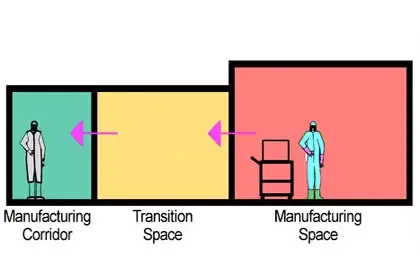
GMP Cleanroom People/Logistics/Buffer: Configure segregated personnel and material flows via PAL/MAL and buffers with pressure cascades, interlocks, and unidirectional routing to prevent cross‑contamination; use robust, cleanable, non‑shedding finishes that withstand frequent disinfection and traffic, enabling compliant, maintainable operations.

Lean More
  • Smooth, non‑porous, chemically resistant finishes; impact‑resistant panels/guards for trolleys; SS 304/316 for pass‑throughs and hardware.

  • Low‑VOC, low‑particle, antistatic where needed; resinous/PU floors with integral coves and matte, scratch‑tolerant topcoats.

  • Flush doors/windows/pass‑throughs with sealed frames; welded/coved joints; fully sealed penetrations; door interlocks and gaskets.

  • Verified airtightness and pressure hold; compatible cleanroom sealants; flatness for cart traffic; documented IQ/OQ and clean‑build controls.

GMP Cleanroom Personnel  Flow.webp
Environmental Monitoring EMS

Environmental Monitoring EMS

GMP Cleanroom Environmental Monitoring (EMS): Networked, cleanable, flush‑mounted sensors (particles, temp/RH, pressure, airflow) with compliant data capture and alarms; locate per risk map to avoid turbulence and enable reliable, validated readings.

Learn More
  • 316L SS flush sensor plates; smooth, non‑shedding, chemical‑resistant.

  • Cleanroom‑rated, low‑outgassing cables/conduits; GMP gaskets, IP65/66 enclosures.

  • Flush mounts; sealed penetrations with hermetic glands; no crevices.

  • EMC‑safe routing (separate power/signal, shield/ground); accessible calibration points; documented IQ/OQ.

cleanroom Environmental Monitoring EMS.webp
Pollution control

Pollution control

GMP Cleanroom Pollution Control: Capture and contain particulates, aerosols, vapors, and waste via HEPA/ULPA, local exhaust, pressure cascades, closed waste handling, and validated decontamination to prevent cross‑contamination and protect people and environment.

Learn More
  • 316L SS or PP/PVDF ducts/housings; BIBO HEPA/ULPA; chemical‑resistant gaskets.

  • Smooth, non‑shedding, cleanable finishes; antistatic/ATEX where solvents/dusts.

  • Fully welded, airtight ducts; sealed penetrations; sloped, contained drains.

  • Isolation dampers, pressure taps; safe‑change filter access; explosion relief; IQ/OQ.

GMP Cleanroom Pollution Control.webp

Fastest, Most Comprehensive GMP Cleanroom Manufacturer.

25+ Years,       700M Parts,
300K Clients
100% of Fortune 100 Auto Companies.
100
Auto Leader.

GMP (Good Manufacturing Practice) Class A and class b cleanrooms are specialized environments designed to ensure the highest level of cleanliness and control during the manufacturing of pharmaceutical products, particularly sterile drugs and medical devices. These environments follow strict guidelines to prevent contamination, ensuring that products are produced safely and comply with regulatory requirements.

Learn more about Deiiang cleanrooms

Frequently Asked Questions (FAQ)
What is a CGMP cleanroom?

A CGMP cleanroom is a controlled environment that adheres to current Good Manufacturing Practices (cGMP) standards, ensuring that products, particularly in the pharmaceutical and biotechnology industries, are manufactured in a sterile and contamination-free setting. These cleanrooms are designed to minimize the risk of contamination and ensure product quality and safety.

What is the difference of cGMP and GMP?

The primary difference between cGMP (current Good Manufacturing Practices) and GMP (Good Manufacturing Practices) lies in the emphasis on the "current" aspect of cGMP, which incorporates the latest technologies and practices to ensure product quality and safety. cGMP requires manufacturers to stay updated with advancements in manufacturing processes and quality control.

What is GMP for clean rooms?

GMP for clean rooms refers to the specific guidelines and standards that govern the operation and maintenance of clean rooms in manufacturing facilities, particularly in the pharmaceutical and medical device industries. These guidelines ensure that the clean rooms are designed, maintained, and operated to prevent contamination and ensure product integrity.

What is cGMP system?

A cGMP system is a comprehensive framework that includes policies, procedures, and practices designed to ensure that products are consistently produced and controlled according to quality standards. This system encompasses all aspects of production, from raw material sourcing to final product testing, ensuring compliance with regulatory requirements.

What is the difference between GMP and cGMP?

The difference between GMP and cGMP primarily lies in the focus on current practices. While GMP refers to the established guidelines for manufacturing processes, cGMP emphasizes the need for manufacturers to adopt the latest technologies and practices to enhance product quality and safety.

What is the difference between GMP and cGMP Slideshare?

The difference between GMP and cGMP as presented in Slideshare or similar platforms typically involves the level of detail and examples provided. cGMP presentations often highlight the importance of current practices and innovations in manufacturing, while GMP presentations may focus on the foundational principles and regulations.

What are the 5 main components of GMP?

The five main components of GMP include quality management, personnel training, facility and equipment maintenance, documentation and record-keeping, and quality control and assurance. These components work together to ensure that products are manufactured consistently and meet quality standards.

What is the difference between ISO 9001 and cGMP?

The difference between ISO 9001 and cGMP lies in their focus and application. ISO 9001 is a quality management standard applicable to various industries, emphasizing customer satisfaction and continuous improvement. In contrast, cGMP specifically addresses the manufacturing practices in regulated industries, ensuring product safety and efficacy.

Why choose Deiiang's modular cleanroom?

When precision is paramount, choosing the right controlled environment is a critical business decision. Deiiang offers more than just a cleanroom; we provide a scientifically engineered solution tailored to your specific industry needs. Here is why Deiiang stands out as the partner of choice for professionals worldwide:

1. Tailored Material Expertise

We understand that different industries require different contamination control strategies. That is why we offer a versatile range of structural options designed for specific applications:

  • Hardwall Modular Cleanrooms: Constructed with robust aluminum profiles and high-clarity acrylic panels, offering superior durability and a rigid structure ideal for long-term static environments.

  • Softwall Modular Cleanrooms: Featuring aluminum profiles with anti-static PVC curtains, providing an economical and flexible solution perfect for spot-cleaning or enclosing specific machinery.

  • Sandwich Panel Cleanrooms: Utilizing premium handmade glass-magnesium rock wool sandwich panels, delivering exceptional thermal insulation and fire resistance for rigorous pharmaceutical or electronic manufacturing standards.

2. Engineering Authority & Design

Your project is backed by our professional design team. We don't just sell products; we engineer workflows. Our experts analyze your space and requirements to create a layout that optimizes airflow and efficiency, ensuring you meet ISO standards without guesswork.

3. Unbeatable Value & Cost-Efficiency

We believe high standards shouldn't come with prohibitive costs. Deiiang leverages advanced manufacturing processes to offer an industry-leading price-to-performance ratio. You get top-tier contamination control that fits within your operational budget.

4. Global Reach with Speed

Time is money in manufacturing. We utilize efficient fast-shipping logistics networks to deliver globally. Our streamlined supply chain ensures your cleanroom arrives on schedule, minimizing downtime and accelerating your project timeline.

5. Simplified User Experience (Plug-and-Play)

Complex construction shouldn't be a barrier. Our modular design philosophy emphasizes "Simple Installation." The pre-engineered modular assembly allows for quick setup with minimal tools, reducing installation costs and allowing your team to focus on what they do best—production.

Choose Deiiang for a cleanroom solution that combines technical expertise with practical, cost-effective design.

What is our service process?

From Design to Delivery: Our Professional Process

Service Flowchart - Requirements Analysis -> Professional Design -> Production -> Global Shipping -> Modular Installation

1. Professional Design Team

Many clients are often confused about layout. Deiiang has a professional design team that will provide you with the optimal layout plan free of charge, based on your site plan and process flow, ensuring reasonable airflow and maximizing space utilization.

2. Efficient Global Shipping

To address the time-sensitive challenges of overseas sourcing, we have optimized our logistics channels, utilizing efficient express shipping services directly to major ports worldwide. We scientifically pack all components to minimize shipping volume, saving on freight costs and ensuring safe arrival of goods.

Home

PHONE

Email

Inquiry