+86 13638632902
 Jason@cleanroomequips.com


 MENU
US Federal Standard 209E
Federal Standard 209E was a United States standard that specified the cleanliness levels of cleanrooms and controlled environments. It was primarily used in industries where the control of particulate contamination is critical, such as semiconductor manufacturing, pharmaceuticals, and aerospace.
In 2001, Federal Standard 209E was superseded by ISO 14644, which provides a more comprehensive and internationally recognized framework for cleanroom classification and testing. ISO standards offer a more global approach to cleanroom cleanliness, aligning with international practices.
While Federal Standard 209E is no longer the primary standard in use, its legacy continues in the cleanroom industry, and understanding this standard can still be beneficial for those familiar with historical practices in cleanliness and contamination control.
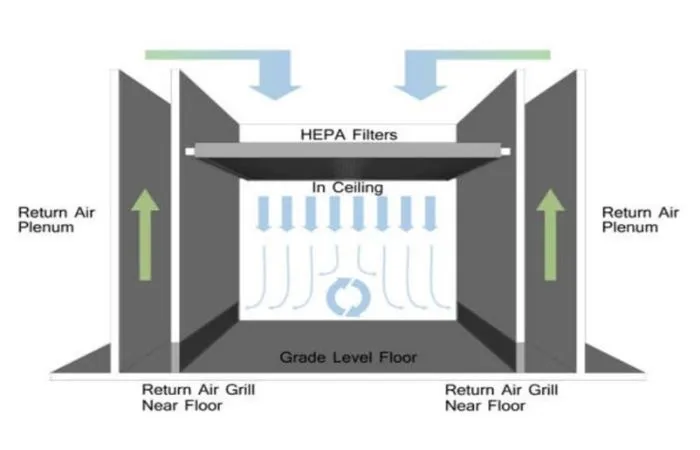
US Federal Standard 209E
| ||||||||||||||||||||||||||||||||||||||||||||||||||||||||||||||||||||||||||||||||||||
| ||||||||||||||||||||||||||||||||||||||||||||||||||||||||||||||||||||||||||||||||||||
| ||||||||||||||||||||||||
| ||||||||||||||||||||||||||||||||||||

nTe5dGLGU8E
FAQ
What is clean room classification?
Clean rooms are classified according to the criteria set by the International Organization for Standardization. The classification system uses a prefix ISO 1 to ISO 9, which indicates the permissible number of particles in a cubic meter of air in terms of specific sizes. The higher the classification, the cleaner the room.
What are the cleanroom classifications?
Clean rooms can also be classified under the FS 209E, where class 1 indicates the highest level of cleanliness, while class 10000 indicates the lowest level of cleanliness. ISO 14644-2: ISO 1, ISO 2, ISO 3, ISO 4, ISO 5, ISO 6, ISO 7, ISO 8, ISO 9. FS 209E: Class 1, Class 10, Class 100, Class 1000, Class 10000.
What is the FDA classification of clean rooms?
Class A clean rooms have a classification of ISO 5, whereas Class B clean rooms are classified under ISO 6. Class C clean rooms maintain a classification of ISO 7, while Class D clean rooms are classified under ISO 8.
What is a Class 7 or 8 clean room?
Class 7 clean room has a maximum allowable particle count of 352,000 particles per cubic meter, whereas a Class 8 clean room has a maximum allowable particle count of 3,520,000 particles per cubic meter.
What is class 1000 clean room?
A Class 1000 clean room is defined according to the Federal Standard 209E (FS209E). In a Class 1000 clean room, the air quality is controlled to ensure an acceptable number of air particles; for pollution at a size of 0.5 μm, it is permitted to contain 1,000 particles per cubic foot (approx. 35,300 particles per cubic meter).
What is a class 10 clean room?
Just as Class 1000 clean rooms, Class 10 clean rooms are defined according to the Federal Standard 209E (FS209E). In this case, for pollution at a size of 0.5 μm, the number of air particles per cubic foot is allowed to be 10 (approx. 353 particles per cubic meter).
What are the lSO 6 standards?
The main specifications of ISO 6 clean rooms are:
For pollution at a size of 0.5 μm it is permitted to have 1,000,000 particles per cubic meter (approx. 35,300 particles per cubic foot);
For pollution at a size of 5.0 μm it is permitted to have 29,300 particles per cubic meter (approx. 1,000 particles per cubic foot).
ISO 6 is identified as a clean room type with requirements concerning the airborne particle contamination. Therefore, it serves as a guidance for those industries that need regulated environments but do not require higher cleanliness as it is at ISO 5 or even higher clean rooms.
What is lSO 14644 clean room classification?
ISO 14644 as an international standard provides a set of specifications concerning clean rooms and controlled environments conformed to. The ISO standards include a series of approaches defining the air cleanliness classification based on airborne particle contamination level. The ISO clean room classes start with ISO Class 1, which is the cleanest, and finish with ISO Class 9, which is the least clean one.
What is GMP Class A and B cleanroom environments?
GMP Class A and Class B clean room environments are determined in such a way that: Class A: there cannot be more than 3,520 particles of size larger than or equal to 0.5 μm and more than 20 of particles of size larger than or equal to 5.0 μm in a cubic meter of the static clean room air. The dynamic clean room air is subject to the same rule. Class B: it allows having almost the same air pollution level as Class A, however, it makes a difference between static and dynamic clean room air pollution.
What is lSO 14644 clean room classification?
ISO 14644 clean rooms and GMP clean rooms are based on different cleanroom standards and serve different purposes, however. ISO (International Organization for Standardization) and GMP (Good Manufacturing Practice) are both important frameworks that establish standards for cleanrooms, but they serve different purposes and focus on different aspects of cleanroom management and operation.