+86 13638632902
 Jason@cleanroomequips.com


 MENU
MENUcompanies like











Need a Handheld Dust & Particle Monitor solution?
Deiiang provides professional Handheld Dust & Particle Monitor solutions
Specifications & Models
Two Mass Channels Without the Bench
Two Mass Channels Without the Bench
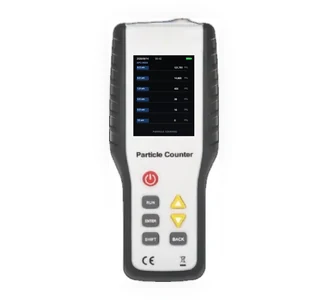
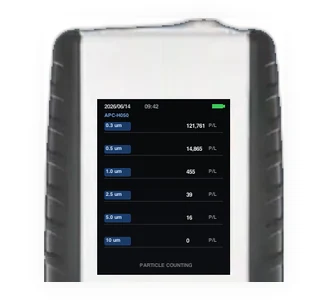
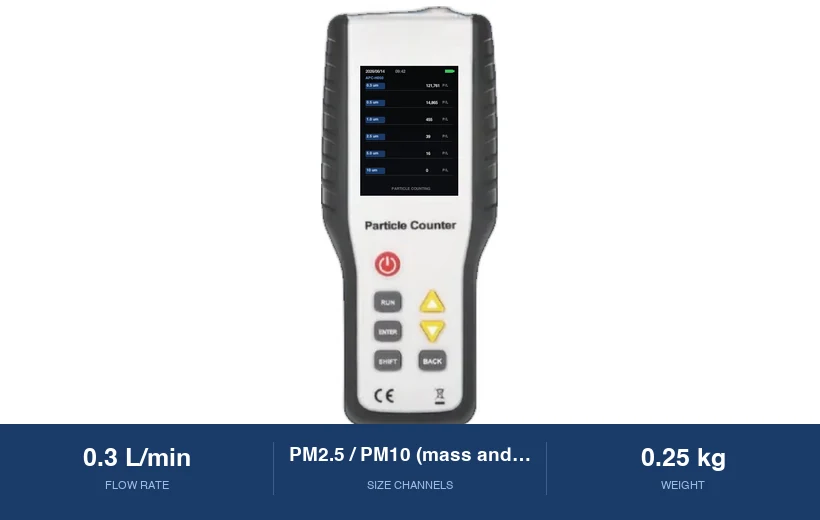
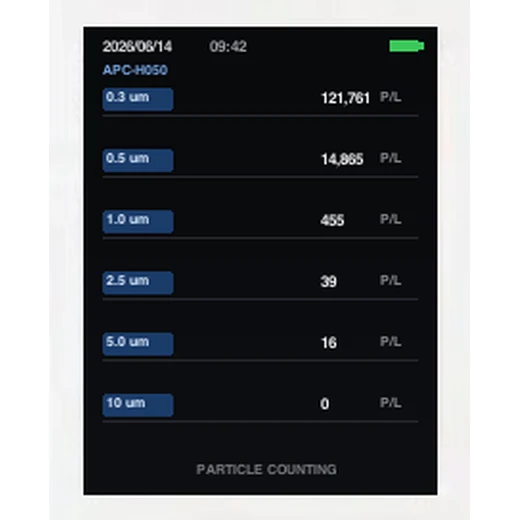
The APC-H050 puts a laser-diode optical engine and a fan-driven sample path into a body that weighs 250 g. It reports PM2.5 and PM10 as mass concentration, and it will show raw particle counts instead when a number matters more than an index.
- Counting efficiency — 50% ± 10% at 0.3 μm, rising to 100% above 1.5× the channel size.
- Zero count — one particle or fewer in five minutes on a zero filter, so a clean room reads as clean.
- Laser life — 20,000 h MTBF; at two hours of daily use that is more than a decade of service.
Temperature and relative humidity come from the same sample stream, so the reading on screen describes the air the instrument just pulled in.
0.3 L/min Is Enough for a Walk-Through
0.3 L/min Is Enough for a Walk-Through
A survey instrument does not need a cubic foot a minute. The internal fan draws a nominal 0.3 L/min, which is fast enough to see a filter loading up between two visits and quiet enough to run while somebody is talking.
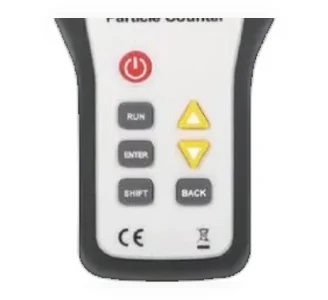
- Sampling time — 1 s to 99 min 59 s, programmable, with one-key zeroing before each survey.
- Where it earns its keep — indoor air screening, filter change verification, HVAC walk-throughs and warehouse air quality.
- What it is not — the H050 screens. It does not classify a cleanroom to ISO 14644-1; the six-channel counters in the same range do that.
Used as a screening tool, it decides where a full particle count should be spent, which is usually the difference between a two-day survey and a two-week one.
Pocket Weight, Shift-Long Battery
Pocket Weight, Shift-Long Battery
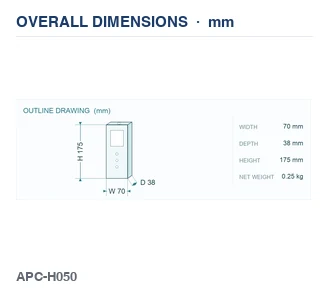
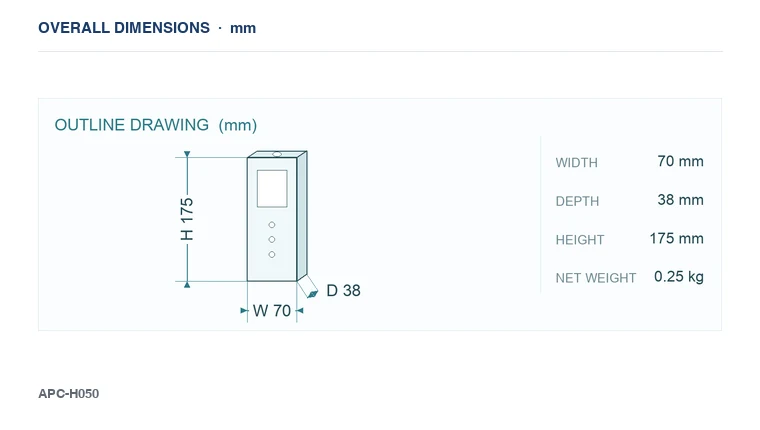
The instrument is 175 × 70 × 38 mm and takes a single 18650 cell, chargeable from any USB port in the building. A full charge covers a six-hour shift with the backlight on.
- 999 records — scroll back on the instrument itself, no laptop needed to answer "what did it read in the corridor".
- USB 2.0 — the log leaves as a plain table that opens in any spreadsheet.
- ABS body, IP40 — dust protection for plant rooms and return-air plenums, not for washdown areas.
Colour display rated for low cleanroom lighting, so the reading is legible with the lights dimmed for a photolithography step.
FAQ
Both, within limits. It reports PM2.5 and PM10 as mass concentration, which is what a dust monitor does, and it will also show raw particle counts if you switch modes. What it will not do is give you a six-channel count for an ISO 14644-1 classification — for that you need one of the counters in the same range.
No, and we would rather say so now than have you find out in an audit. The H050 has two mass channels and an indicative ISO reference, which is enough to screen a room before a formal count but not enough to certify it. Use it to decide where the certification engineer should spend time.
Six hours from a single 18650 cell with the backlight on, which covers a shift of walk-throughs. It charges from any USB port, so a power bank in a jacket pocket is a realistic spare. The cell is a standard size and is replaceable rather than sealed in.
999 records, with date and time, and you can scroll back through them on the display without a laptop. That matters more than it sounds: the question "what did it read in the corridor an hour ago" usually gets asked while you are still standing in the corridor.
Yes. The climate sensors sit on the sample path, so the temperature and humidity on screen describe the air the instrument has just pulled in, not the air around the operator. That is a small detail until you are comparing a reading taken at floor level with one taken at ceiling level.
250 g and 175 × 70 × 38 mm, so it goes in a pocket rather than a case. The body is ABS to IP40, which handles dust and the odd knock. It is not a washdown instrument — if the area gets hosed, take a sealed model instead.