+86 13638632902
 Jason@cleanroomequips.com


 MENU
MENUcompanies like











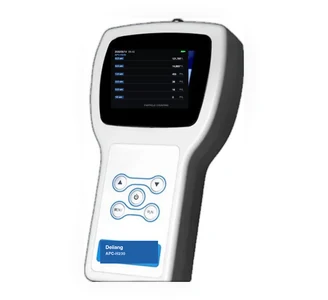
Need a Handheld Particle Counter, High Capacity solution?
Deiiang provides professional Handheld Particle Counter, High Capacity solutions
Specifications & Models
The Same Optics, Built for Volume
The Same Optics, Built for Volume
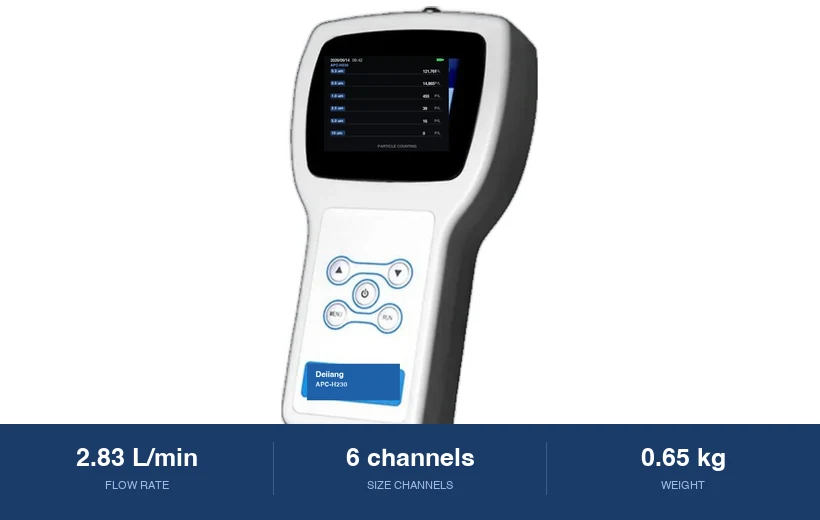
The measuring engine is the six-channel bench used across the handheld range; what changes is everything around it. A rolling buffer of one million records and a 4,000 mAh pack turn the instrument from a survey tool into a monitoring instrument.
- Rolling buffer — the oldest record is overwritten only when the memory is actually full, so a missed download never costs data.
- Timed start — overnight or unattended runs begin at a set time and stop themselves.
- Per-channel factors — one calibration factor per size, editable after service without returning the instrument.
Metrology-grade stability is the reason sites that calibrate annually can run the same instrument for a year of rounds without re-verification.
Monitoring Rounds That Do Not Stop for a Download
Monitoring Rounds That Do Not Stop for a Download
A round of forty points produces forty records, and a year of rounds produces a number large enough that most instruments need emptying every few weeks. This one does not.
- Flow — 2.83 L/min ± 5%, with counts shown per m³, per ft³ or raw.
- Typical use — routine monitoring rounds, continuous room surveys, cleanroom trend data and contract testing.
- Battery — 7 h per charge, charged directly from mains.
Trend data is only worth keeping if it is continuous. A million records is what makes a year of daily rounds continuous.
A Million Records, Seven Hours, One Charge
A Million Records, Seven Hours, One Charge
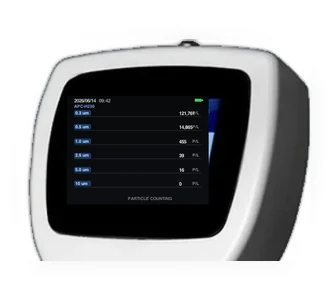
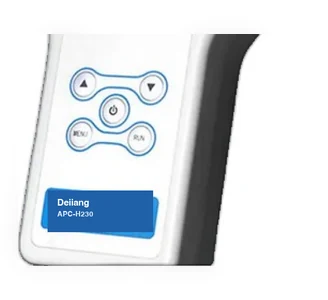
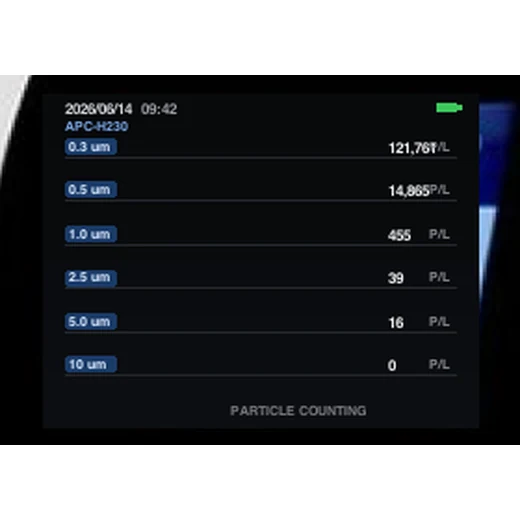
The 2.4″ colour display carries a numeric keypad for site tagging, so each record arrives with a location instead of a timestamp alone. That is the difference between a log and a dataset.
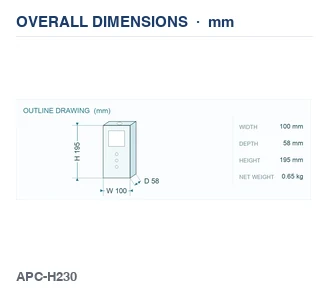
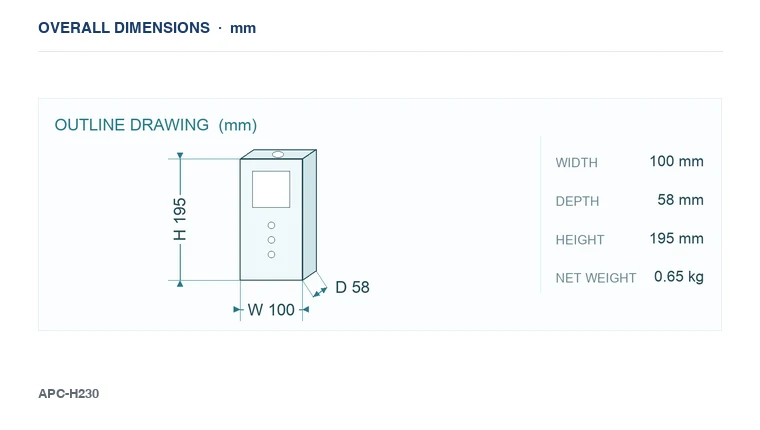
- Body — ABS + PC, IP54, 195 × 100 × 58 mm at 0.65 kg.
- Interface — USB 2.0 and RS-232 for direct export to the Deiiang reporting tool.
- Standards — ISO 14644-1, EU GMP Annex 1 and ISO 21501-4, with a PSL calibration certificate.
Export the whole buffer as one file at the end of a quarter, or one room at a time; the instrument does not care which.
FAQ
A year of daily rounds without a download. Forty points a day, six days a week, is about twelve thousand records a month — the buffer holds years of that. Downloads become a quarterly chore instead of a weekly one.
The oldest records are overwritten, and only then. A rolling buffer means a missed download costs you the oldest month, not the whole set. Most sites never reach the point where it matters.
Yes. The timed start begins a run at a set time and stops at the set duration, which is how overnight or weekend sampling is normally done. Pair it with mains power and the seven-hour pack becomes a backup rather than a limit.
You can edit one calibration factor per channel on the instrument. That is meant for a metrology laboratory that has just issued new factors, not for correcting a reading you do not like. The factors are recorded so the change is traceable.
Same optics, same six channels, same flow. The difference is endurance: a million records instead of ten thousand, seven hours instead of six, and a keypad for tagging sites. If you monitor rather than certify, the H230 is the one that stops interrupting your rounds.
Yes, and that is a common use. A testing house needs the instrument to hold a lot of records across several client sites, and to survive being carried between them. The aluminium-free ABS body keeps the weight at 0.65 kg, which matters more at the tenth site of the day.