+86 13638632902
 Jason@cleanroomequips.com


 MENU
MENUcompanies like











Need a Micro-Flow Handheld Particle Counter solution?
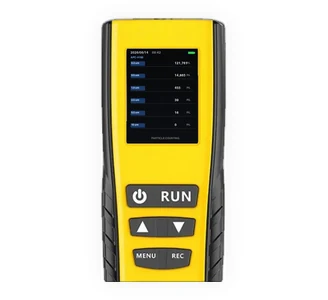
Deiiang provides professional Micro-Flow Handheld Particle Counter solutions
Specifications & Models
Six Channels on a Low-Flow Bench
Six Channels on a Low-Flow Bench
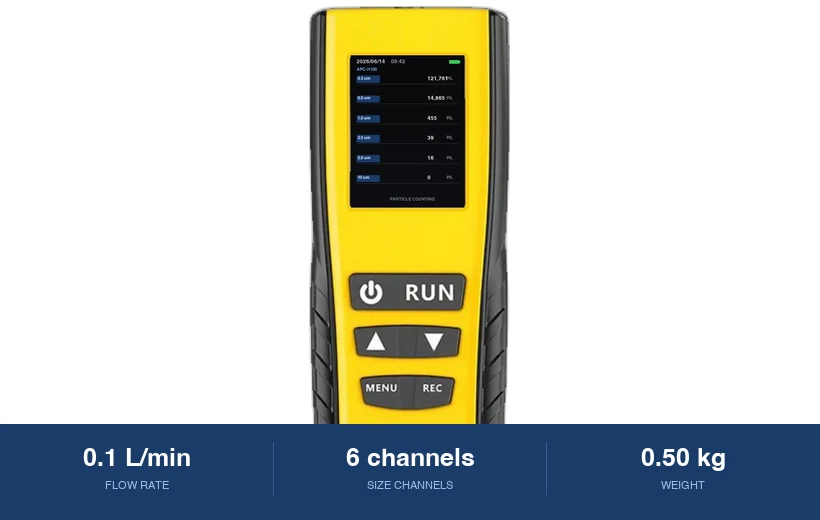
The optical bench is the same six-channel design used across the range, but the pump behind it moves a tenth of a litre a minute. Small flow, small disturbance, and a sample head that can sit inside an isolator without changing the airflow pattern that was validated.
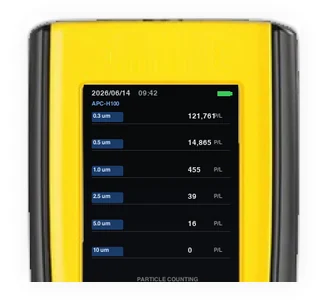
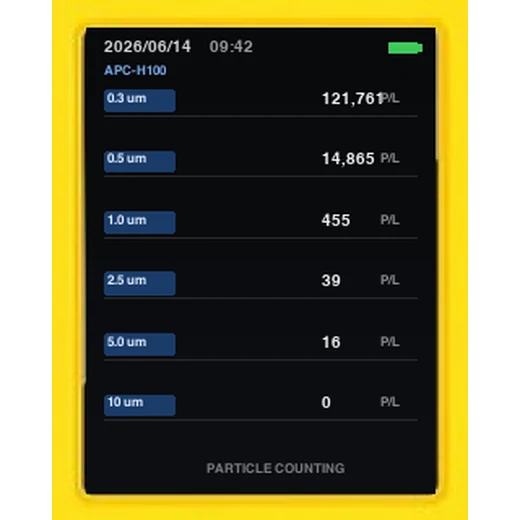
- Six channels — 0.3 / 0.5 / 1.0 / 2.5 / 5.0 / 10 μm, reported per m³, per ft³ or as a raw count.
- Counting efficiency — 50% ± 10% at 0.3 μm and 100% above 1.5× the channel size, per ISO 21501-4.
- Coincidence loss — 5% at 35,000,000 particles/m³, so a dirty background does not saturate the count.
Counts and mass units sit on the same screen. Switching between them is a menu step, not a reconfiguration.
Where a Full 1 CFM Would Be Too Much
Where a Full 1 CFM Would Be Too Much
Inside a glove port or under a laminar hood, the instrument itself becomes the disturbance. At 0.1 L/min the sample is slow but the zone stays as validated, which is the only way the number means anything.
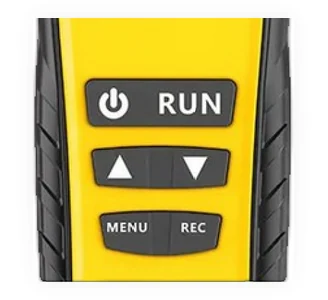
- Sampling time — 1 s to 99 min 59 s; one-key RUN stops itself at the end of the set time.
- Typical points — isolator spot checks, glove-port sampling, laminar hood verification and fill-line monitoring.
- Isokinetic error — the low-flow head keeps it small at the short probe distances these points actually use.
For a Grade A point the limiting factor is never the counter; it is how long the operator can hold position. The 0.1 L/min head buys that time.
A Million Records in a 128 MB Card
A Million Records in a 128 MB Card
The card holds roughly one million records, which is a year of daily rounds before anything has to be moved off the instrument. Export is USB or RS-232, into the Deiiang report template in one step.
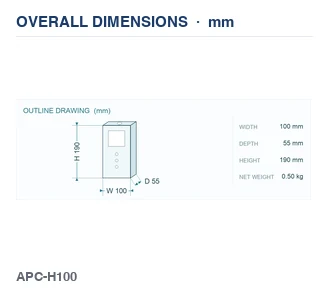
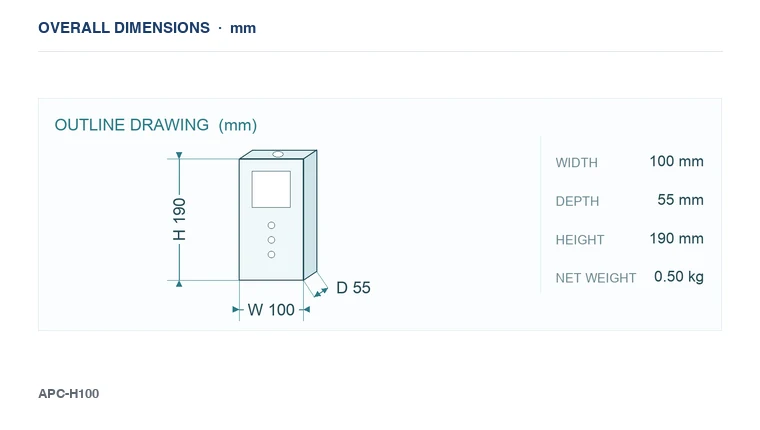
- Body — ABS + PC, IP54, 190 × 100 × 55 mm at 0.50 kg.
- Battery — 7.4 V / 2,000 mAh, six hours, charged from mains through the instrument.
- Standards — ISO 14644-1, EU GMP Annex 1 and ISO 21501-4, calibration traceable with a PSL certificate.
The report template is the same one used by the benchtop instruments, so a room can be classified with one and monitored with the other.
FAQ
Because inside an isolator or under a laminar hood, the instrument is the disturbance. At 0.1 L/min the airflow pattern you validated stays as it was, and the sample head fits through a glove port. The trade is time: a point takes longer to reach a useful volume.
Long enough that you should plan the visit. The sample time runs from 1 second to 99 minutes and stops itself at the set time, so the practical answer is that you decide the volume and let the instrument sit. Most glove-port checks are set for the volume the procedure asks for, not for a fixed minute count.
The card is 128 MB and holds roughly one million records, so in practice you will download it when convenient rather than when necessary. Export is USB or RS-232, straight into the Deiiang report template.
It makes it slower, not less accurate. Counting efficiency is the same as the larger models — 50% ± 10% at 0.3 μm, 100% above 1.5× the channel size — and zero count is one particle or fewer in five minutes. What changes is how much air passes the beam per minute.
At short probe distances the velocity mismatch is small, and the low-flow head keeps it smaller still. That is why this model is usually specified with a short probe held close to the surface being checked, rather than with a long sample line.
Choose the H100 when the zone cannot tolerate the sample flow, and the H200 when you need 2.83 L/min for classification work. A pharmaceutical site often owns both: the H100 for isolators, the H200 for the room around them.