+86 18186671616
 Jason@cleanroomequips.com


 MENU
companies like











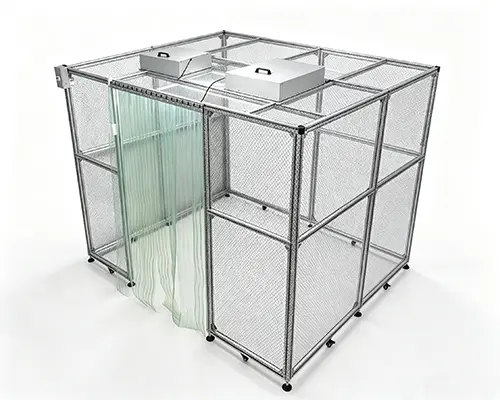
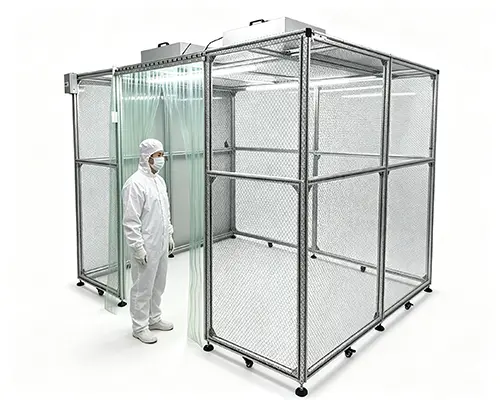
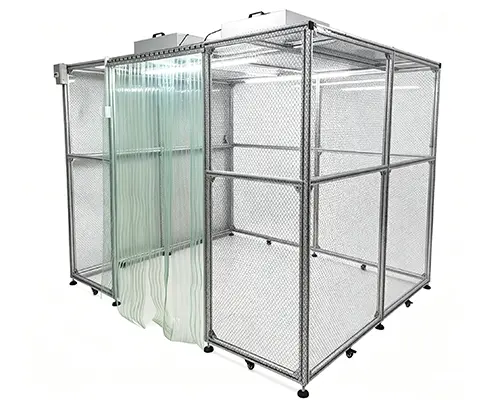
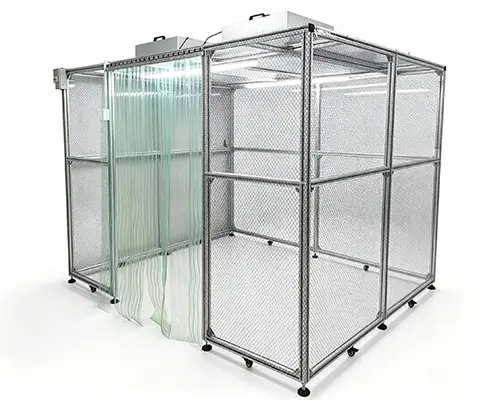
Photos of this Anti-static Softwall Cleanrooms
Key features
Specifications and Models
Features and advantages

Utilizes an efficient filtration method to eliminate all particles and bring about pure air.

Solid framework constructed with the ability to withstand heavy loads and sustain a long lifespan.

Modular design allows cleaning and maintenance to be performed with ease, saving money and resources.

Size and design can be modified to suit diverse working situations.

Sustainably designed curtains to minimize static electricity and allow easy access to the material.

Transparent curtains allow observing the work process and maintaining the required level of light in the workshop.
Application scenarios
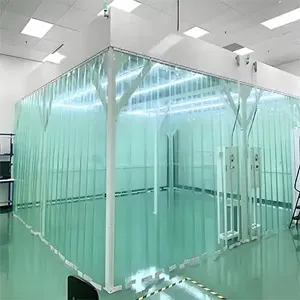
Semiconductor & Wafer Processing
Pain Point: Damage to sensitive devices can occur through electrostatic discharge while handling, probing, inspecting or packaging. Additionally, sub-micron particles can contaminate and attract other contaminants, thus significantly reducing yields.
Solution: H14 HEPA filtration coupled with ESD-safe PVC curtains having a surface resistance of 10⁶-10⁹ Ohms comprise Deiiang Anti-static Softwall Cleanrooms. Localized clean zones of ISO 5 to ISO 8 are generated by grounded frames, static-dissipative flooring and optional ionizers without a hardwall construction.
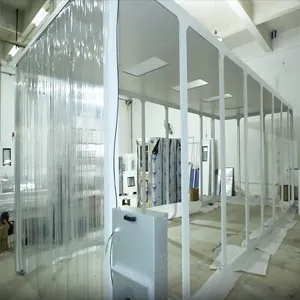
Electronics & PCB Assembly
Pain Point: Static electricity due to operators, tools and packaging can damage integrated circuits, printed circuit boards, sensors and other ESD sensitive components, either immediately or on latent basis.
Solution: Deiiang Anti-static Softwall Cleanrooms provide static-dissipative curtains and flooring along with equipotential bonding and ESD grounding. Balanced charge is maintained by optional ionizing bars, while HEPA filtered airflow is used to control particles during assembly, testing, soldering and rework.
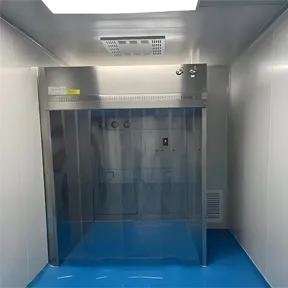
Lithium Battery & Energy Storage
Pain Point: During battery cell production, submicron particles along with accumulated electrostatic charges can contaminate the separators and electrodes and disrupt precision assembly and increase the potential for defects.
Solution: Deiiang Anti-static Softwall Cleanrooms provide controlled local environments for processing electrodes, assembly of cells, inspection and packaging. Separators and electrode cells remain free of contamination and electrostatic charge respectively through grounded structural frames, ESD enclosures and optional control of relative humidity. FFUs provide continuous removal of the airborne contamination.
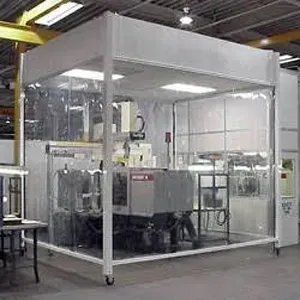
Precision Optics & Laser Technology
Pain Point: Electrostatic charges attract dust to LCOS (Liquid Crystal on Silicon), Precision Sensors and Optics resulting in defective coatings, misalignment of components and measurement of submicron quantities.
Solution:Deiiang Anti-static Softwall Cleanrooms utilize low-vibration EC/DC FFUs and ESD-safe PVC curtains that do not yellow over time to maintain a stable and clean processing environment. During coating, alignment, calibration, and inspection processes, ionizers are provided as an optional static charge neutralizer.
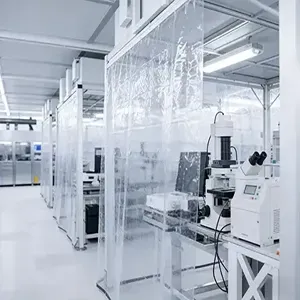
Medical Electronics & Precision Devices
Pain Point: The simultaneous control of particulate contamination and ESD presents significant challenges for the production of implantable electronic devices, diagnostic sensors, and precision medical devices while maintaining the flexible nature of cleanrooms.
Solution: Deiiang Anti-static Softwall Cleanrooms feature integrated ESD protection and smooth, non-shedding surfaces, and HEPA-filtered airflow. These cleanrooms can be easily reconfigured or moved while maintaining the requirements of ISO 14644-1, FDA, and GMP.
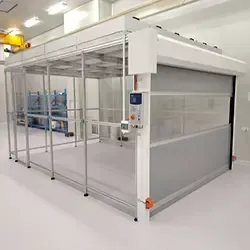
Display, LED & Microelectronics Manufacturing
Pain Point: The assembly and inspection of displays, LEDs, and microelectronics can result in dead pixels, bonding defects, contamination, and failure of electrical and/or electronic components due to dust and electrostatic discharge.
Solution: Deiiang Anti-static Softwall Cleanrooms are designed to deliver filtered airflow to work stations. These cleanrooms provide electronic equipment and anti-static flooring that, in combination with grounded equipment, minimize the accumulation of static. The flexible design enables the cleanroom to be rapidly changed to accommodate changes in production.
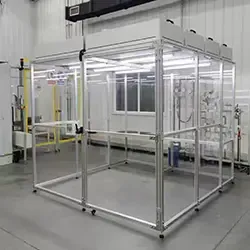
Aerospace & Defense Electronics
Pain Point: Highly sensitive avionics, navigation systems, and defense electronics are easily disrupted by particulate contamination and electrostatic discharge during assembly, integration, testing, and maintenance.
Solution: Deiiang Anti-static Softwall Cleanrooms are designed to provide a localized cleanroom environment with controlled ESD for sensitive workstations. This is achieved through grounded frames and HEPA-filtered airflow that protect sensitive assemblies without requiring a permanent construction of cleanrooms.
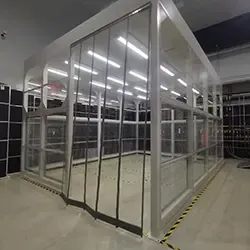
R&D Laboratories & Pilot Production
Pain Point: To build an R&D laboratory or experimental pilot production line, some control of particles and ESD is often required, while permanent cleanrooms construction can be not only expensive, but time-consuming and rigid to modify as a project evolves.
Solution: Quickly installed, expandable and relocated Portable Deiiang Anti-static Softwall Cleanrooms offer an easy solution to create reusable, adjustable and controlled zones of cleanliness. They have the capability to integrate grounding and can be outfitted with a modular configuration for particle, humidity or static voltage monitoring.
As-built inspection
Anti-static cleanroom as-built verification: check ISO 14644-1 particle counting, HEPA filter, airflow and air change, and pressure and temperature monitoring. Measures should be taken from ESD curtain and flooring resistance, earth continuity and equipotential bonding, and flow visualization.
Use measuring tools for monitoring of particle, airflow, and static electricity levels
Let the FFU and ESD systems operate for some time
Measure particle counts according to ISO 14644-1 at correct sampling points
Make tests for HEPA filter efficiency, monitoring of airflow speed, air change, and flow visualization
Check level of resistance of any kind of ESD curtain and flooring set against ESD
Measure ESD grounding and equipotential bonding systems
Check of electrode efficiency
Be aware of working conditions: temperature, relative humidity, etc.
Check curtain installation, sealing inside the cleanroom, and electric safety
FAQ
Modular cleanrooms are prefabricated systems that can be configured and built to control specific levels of contamination. These systems are designed to be user-friendly and flexible, quick to implement and can be further modified as your requirements change. They are regularly used by the pharmaceutical, biotech, and electronics industries.
Cleanrooms require even greater protocol compliance when dealing with waste to maintain a clean environment and prevent contamination. Waste is generally divided into the following categories: Non-hazardous waste Hazardous waste Biohazardous waste The waste is contained in the proper waste streams with compliant labels, and is managed in accordance with regulations. Effective compliance with waste management plans requires frequent training.
To monitor cleanroom conditions, you need to install various types of sensors and control systems to monitor the conditions of the process including temperature, humidity, and other parameters. It is critical that all parameters be continuously monitored and maintained at their specified levels. Deviations outside the limits will trigger an alarm. Data logging systems are installed to capture data to meet regulatory and quality assurance goals.
Practices for effective cleanroom maintenance include cleaning schedules and the usage of cleaning agents resulting in no residue. These practices include: Regularly checking equipment and surfaces Training employees on appropriate gowning Watching for consistent changes in environmental factors Adherence to these practices permits contamination risks to remain minimal.
The function of cleanroom monitoring systems is to control cleanroom environment by keeping it consistent and staying within given set of standards. These systems help to maintain the quality of the product and comply with industry requirements by monitoring variables of temperature and humidity, control of particulates, etc. They also help by informing users of changes that occur outside given standards.
In cleanrooms, changes in temperature cause changes in the integrity of the product and risk of contamination. Temperature changes may affect the stability of the product being processed, cause condensation or affect the functioning of delicate equipment. It is important to have cleanrooms where the temperature does not change.
Cleanroom layout depends on many factors, such as the processes to be done, the equipment to be used, and the personnel flow. Other factors to consider are:Airflow patternsEquipment placementPersonnel and materials access routesControlling airflow patterns and creating a good layout is important for lowering the risk of cross-contamination and reducing the time it takes to complete the process.
The purpose of cleanroom commissioning is to test the cleanroom for fulfillment of the design specifications and completion of the construction and also ensure that the cleanroom is ready for use and complies with the regulatory standards. The process generally includes the following steps: Testing of HVAC systems Testing for cleanliness of the environment Test of the construction, along with the installation The sequence of the steps may vary.
Vinyl, epoxy resin, and rubber are floor types that can be used in cleanrooms. These types of flooring are durable, chemically resistant, and easy to clean. They are useful for maintaining cleanrooms.
Anti-static flooring Ionization systems Personnel wearing anti-static clothing Static electricity can affect the safety of the equipment and the integrity of the product.
Installing a cleanroom depends on the size and design, but on average it is done in a few months. There are many variables in cleanrooms that affect how long it takes to get the job done, including how much customers want it tailored to their preferences and how efficient the contractors are.
The size of a modular cleanroom depends on the application and the requirements set by the industry. They can range from a few hundred square feet to many thousands. Because of their design, they can be made to fit any need for a process or even a configuration of equipment that is large or small.
Need a Anti-static Softwall Cleanrooms solution?
Tell us your cleanroom class, working area and timeline — we reply with a detailed technical proposal within 24 hours.