+86 18186671616
 Jason@cleanroomequips.com


 MENU
companies like











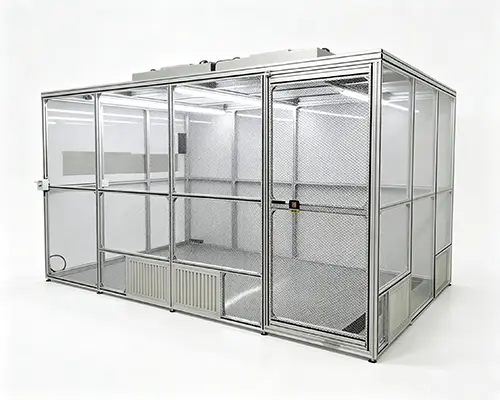
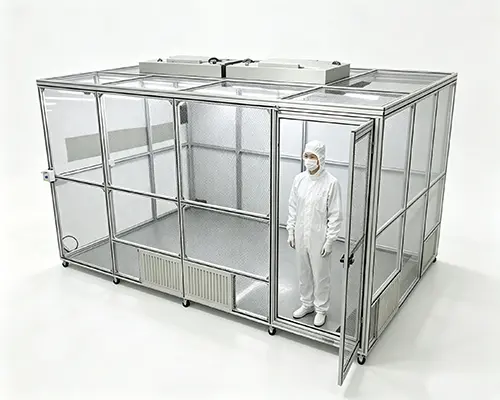
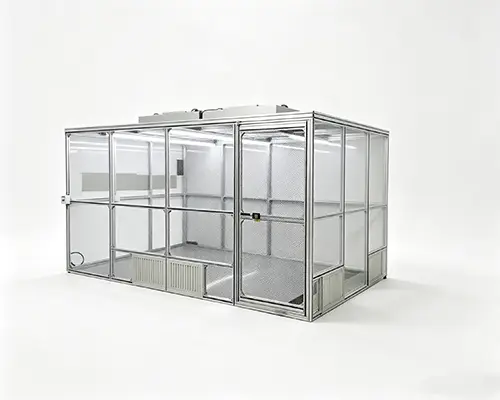
Photos of this Portable Softwall Cleanrooms
Key features
Specifications & Models
Application scenarios
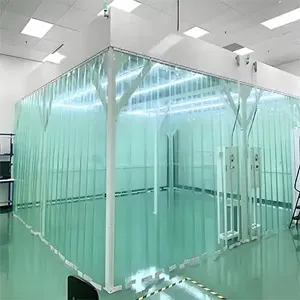
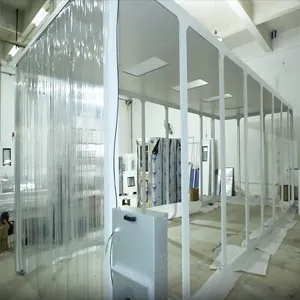
Semiconductor & Precision Electronics
Pain Point: Wafer handling, sensor assembly and electronic packaging require controls around localized particles and ESD, and permanent construction of cleanrooms is costly and rigid when layouts of production change.
Solution: Deiiang portable softwall cleanrooms create isolated controlled zones of ISO 5 - ISO 8 in and around processes. Quick and flexible installation, relocation, and expansion of the cleanroom require modular FFU’s, HEPA H13/H14 filters, Anti-Static PVC curtains and lockable casters.
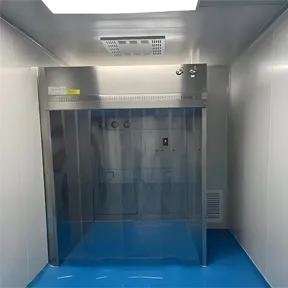
Medical Device Assembly & Packaging
Pain Point: The use of fixed cleanrooms on production lines of medical devices is rigid and costs money because of the space required. New devices and increased capacity usually change production lines and cleanrooms are affected by these changes.
Solution: Portable Deiiang softwall cleanrooms provide positive pressure environments for the assembly, inspection and packaging of devices. Because of their modular design and lockable casters, cleanrooms can be quickly moved and resized to as needed.
Pharmaceutical Processing & Packaging
Pain Point: The limitations of sampling, production and packaging become clear when controlled environments are used temporarily, but an entire production room becomes too expensive and too inflexible because of the conditioning of the space.
Solution: Deiiang portable softwall cleanrooms use a “room within a room” configuration to focus HEPA airflow on critical processes. This configuration provides a controlled area of ISO 5 - ISO 8 and flexibly reduces the demand for FFU’s during cleanroom installation.
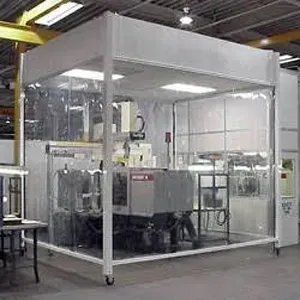
Precision Optics & Laser Technology
Pain Point: Dust and airborne particles can disrupt alignment of precision measurements and assembly of lasers and lenses, and sensitive equipment may need to remain in their current places.
Solution: Portable Deiiang softwall cleanrooms can be setup around optical equipment or workstations. Local control of contamination consists of FFUs, HEPA filtration and anti-static clear PVC curtains. This solution does not require significant changes to the structure of the building.
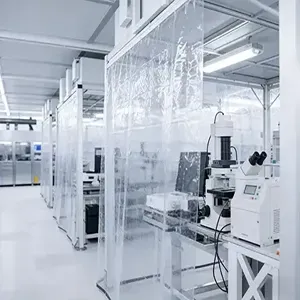
Biotechnology & R&D Laboratories
Pain Point:Laboratories may not have the budget or time to construct a permanent cleanroom for short term projects. They may also lack the available space.
Solution: Deiiang portable softwall cleanrooms are easy to set up within laboratory walls to construct controlled areas of ISO 5-ISO 8. The modular design can be easily moved within a building or from one location to another as the research laboratories needs may change.
Features and advantages

Industrial grade 4080 aluminum profiles or SUS304 stainless steel frames make unmatched structural support. Prefabricated components allow for an easy installation, disassembly, and relocation and future expansion without any modifications to the original design of the structure.

Airflow is vertically directed to the desired location using low noise, AC, or EC, fan filter units. The airflow and number of units can be configured to provide airflow from 20 to 600 changed per hour and airflow speed within the range of 0.2 to 0.45 m/s to create the required level of cleanliness.

H13 or H14 HEPA filters obtain a minimum efficiency of 99.95% or 99.995% of the most penetrating particle, respectively. These types of filters help control the air pollution of a given space and allow compliance with the required classification of cleanrooms based on ISO 14644.

2 mm PVC curtains with permanent anti-static properties and a surface resistance of 10^6 - 10^9 Ω are available. The flexible curtains minimize the introduction of particles and attracting dust. The curtains also help protect electronic components that are sensitive to static.
The enclosure and FFU placement can be configured to meet the ISO 5, ISO 6, ISO 7 or ISO 8 classification for cleanrooms. This minimizes the cost and the demand for energy to build a large, full-scale permanent cleanroom.

An advanced control system can be added to manage FFU groups, control the speed of airflow, monitor the status of each unit and provide alerts if necessary. This system can optimize the airflow of each unit according to the demand of the operation in order to maintain positive pressure of 5 to 20 Pa.

The modular ceiling grid facilitates the mounting of FFUs, HEPA filters and cleanroom LED lighting. The sealed connection points restrict the passage of unfiltered air and the removable ceiling components allow the user to remove the ceiling to gain access for inspection, maintenance and other possible future upgrades of the system with minimal hassle.
Heavy-duty swivel casters facilitate the movement of the enclosure in and out of position within the production, assembly or laboratory zones. Integrated brakes facilitate the system in maintaining a fixed position during operation, making the cleanroom suitable for use in temporary activities or projects, a moving/variable process line and a reusable clean zone.
As-built inspection
As-built assessment of Portable Softwall Cleanrooms: to confirm that the ISO 5 to ISO 8 standard has been complied with using the ISO 14644-1 regulation, to examine airborne particle count, HEPA filter, FFU performance, air flow patterns and face velocity, speed, efficacy and the device, in addition to temperature, humidity, calibrated measuring instruments and correct sampling spots.
Utilize calibrated monitoring devices
Stabilize the system for 24 hours
Minimize personnel presence during testing
Confirm ISO 5 to ISO 8 standard of particles
Select appropriate sampling spots
Test HEPA filter and FFU functionalities
Calculate air velocity, stability and efficiency
Evaluate pressure differential, temperature and humidity
Take records of the curtain, air duct and FFU situations
Follow smoke flow assessment procedures
Analyze modular frame and anti-static PVC coverings
Confirm that the wheels and locks are operational
Check electrical, control panel, illumination system and earthing
FAQ
Deiiang Portable Softwall Cleanrooms are designable and testable for ISO 5 to ISO 8 classes of airborne cleanliness, in accordance with ISO 14644-1. Tests could include counting particles, checking the integrity of HEPA filters, measuring airflow and verifying the differential pressure. Compliance will depend upon the approved design, method of installation, operational state and site conditions. Project-specific test reports and records of approvals would be provided.
As-built handover could include the classification of airborne particles as defined in ISO 14644-1, testing the integrity of HEPA filters by an approved aerosol method, testing the airflow of each FFU (Filter Fan Unit) and face velocity, airflow rate, differential pressure, temperature, relative humidity, and smoke visualization. Tests are performed using calibrated apparatus and the reports and calibration certificates are included in the handover package.
Class selection is dependant on the process, contamination risk, product requirement, level of occupancy, and applicable regulations. ISO 5 is normally used for higher sensitive particle processes. Configurations from ISO 6 to ISO 8 are used progressively for less critical processes. Deiiang evaluates room dimensions, equipment heat load, personnel, and surrounding environment and advises on the quantity and grade of HEPA filters, airflow rate, layout of FFUs, and the number of filters. The user is responsible for confirming regulations.
Particles are controlled through the use of a ceiling-located fan filter unit (FFU). This unit distributes air through a set of HEPA H13 or H14 filter(s). Airborne particles in the controlled zone are diluted using positive pressure and airflow that moves downwards. This airflow pressurizes the control zone and provides a means for particles to move to designated low level return paths or to the curtain gaps. The precise performance of the cleanroom is evaluated after construction since the cleanliness of the controlled area can be affected by human activity (including door opening and closing) as well as the equipment and background activity in the vicinity.
In order to control static, antistatic PVC curtains can be utilized for applications that require ESD control. To achieve ESD control, the curtains, frame and associated equipment should be bonded and grounded as per the approved ESD-control plan and surface-resistance performance should be as per the specifications. Curtains can also be cleaned using appropriate, low-lint materials and approved cleaning agents. Curtain system material data and test records can be made available upon request.
The cleanroom can be relocated and/or expanded. This involves modulating the length and width of the cleanroom and/or moving the cleanroom to a new location. Before securely relocating the cleanroom, safety procedures must be implemented to disconnect electric supplies from the FFUs, frame and casters. After the cleanroom has been relocated and/or expanded, it is necessary to perform an inspection, clean the cleanroom and assess the airflow to ensure that the specified ISO classification and performance of the cleanroom are not compromised.
Softwall systems mostly control particles. They rely on the host facility for temperature and humidity control. Additional control over temperature, humidity, and dehumidification and humidification systems is available, but would be sized based on a site heat-load and moisture-load assessment. Softwall enclosures are not completely sealed. Therefore, the degree of achieved stability is dependent on the room, the process, and how frequently the enclosure is accessed.
Curved airflow distribution units (FPUs) and cleanroom curtains need to be cleaned on a regular basis. The pre-filters, filters, gaps between the curtains, curtain thermal breaks, and position and clearance of the curtains need to be inspected. The casters and brakes need to be checked, along with the wiring, lighting, and grounding. HEPA filters need to be checked and the airflow of the FPU needs to be inspected. The curtain fabric needs to be classified. HEPA integrity and airflow, pressure drop, and protective seals tests need to be done in accordance with the site quality plan and to validate the cleanroom after major repairs and filter replacement.
Deiiang can provide replacement/spare parts of all the components of the supplied system, including FPUs, curtain sections, luminaires, control parts and caster assemblies, control parts, and FPU components. Preventive maintenance, safety checks, and remote technical support can be done according to the service contract. Spare parts and maintenance schedules are included in the installation manual.
Yes. Depending upon the agreed project scope, the documentation package can include approved drawings, equipment specifications, filter certificates, material data sheets, operation and maintenance manuals, instrument calibration certificates, airborne-particle results, HEPA integrity reports, airflow and pressure records and a summary of the commissioning. For regulated applications, documented responsibilities should be agreed upon prior to the manufacturing of the equipment.
A portable softwall cleanroom provides localized control of particles, but this does not provide suitability for aseptic or sterile processing. These processing activities require a documented strategy for controlling contamination, microbial control, qualified cleaning and disinfection, personnel control, and a Commitment to fulfill GMP or regulatory requirements. Deiiang can provide the enclosure to support a defined process. However, this must be confirmed by a project specific assessment and a qualification program.
Deiiang provides design of cleanrooms, construction, selection of filters, guidance for cleanroom installation, performance testing, and documentation. Recommendations are provided based on the process risk, size and occupancy of cleanrooms, equipment to be housed in the cleanroom, and the conditions of the client's facility, rather than a generic design. Customers can evaluate careful acceptance criteria and documented performance prior to being handed over to the client.
Need a Portable Softwall Cleanrooms solution?
Tell us your cleanroom class, working area and timeline — we reply with a detailed technical proposal within 24 hours.