+86 13638632902
 Jason@cleanroomequips.com


 MENU
MENUX
A comprehensive upgrade of the existing surgical operating department within the hospital‘s active surgical building, executed under the strict mandate of “no suspension of clinical services, no interruption of emergency and critical care.” In accordance with the current national standards including the Architectural Technical Code for Hospital Clean Operating Department (GB 50333-2013), the project elevates the original operating rooms into an internationally advanced comprehensive clean operating department — achieving Class 100 / Class 1,000 cleanliness (with localized laminar airflow) for selected operating rooms and Class 10,000 for the remaining rooms, while comprehensively enhancing information technology and intelligent management capabilities.
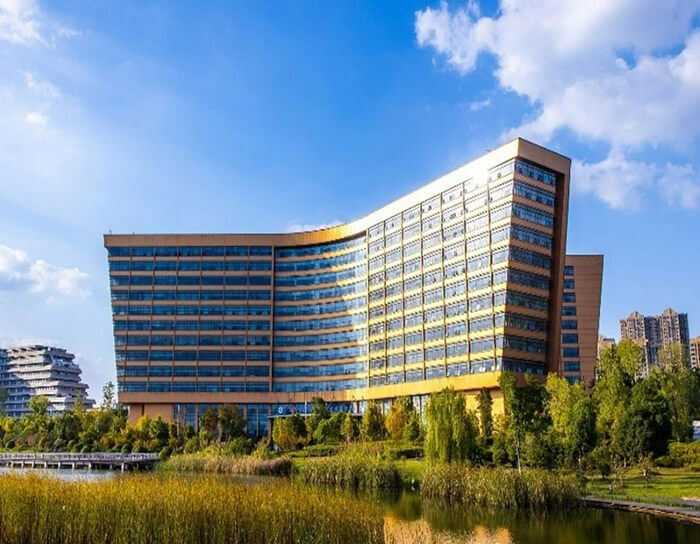
Wuhan Union Hospital (also known as Union Hospital, Tongji Medical College, Huazhong University of Science and Technology) is one of China’s leading tertiary general hospitals. It plays a key role in healthcare, education, and research in Central China and nationwide. With a complete surgical system and a very high annual surgical volume—including many complex and critical cases—the hospital sets stringent requirements on operating room cleanliness, environmental stability, and intelligent management. The surgical department involved in this project is one of the hospital’s core clinical hubs, undertaking a large number of high-risk, high-difficulty procedures.
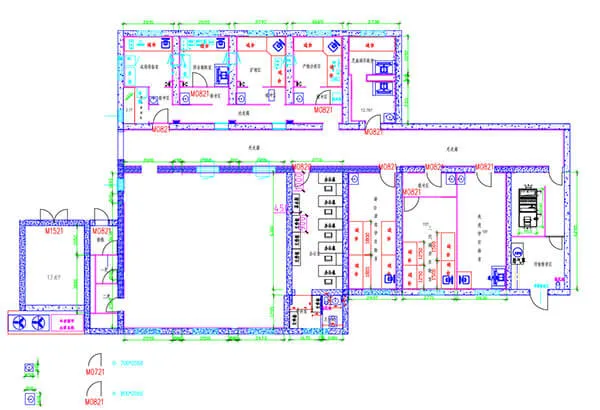
The Wuhan Union Hospital Operating Room Cleanroom Renovation Project is a comprehensive upgrade of the existing surgical department within the hospital’s surgery building, implemented under the strict constraint that clinical services—especially emergency and critical care—must remain uninterrupted. In line with the latest “Technical Code for Hospital Clean Operating Department” and related standards, the project aims to:
The renovation upgrades the surgical department into a modern integrated clean surgical center with graded OR configurations, optimized airflow, clearly defined pressure cascades, safe and reliable medical gas systems, and real-time, visualized environmental and equipment monitoring.
During the project planning phase, our team engaged in multiple rounds of in-depth discussions with the hospital's Equipment Department, Infrastructure Office, Surgical Anesthesiology Department, Infection Control Department, and Information Technology Department. We thoroughly analyzed the hospital's projected surgical volume growth over the next 5 to 10 years, along with specialty development plans, to determine the optimal configuration of operating rooms — including hybrid ORs, laparoscopic rooms, orthopedic rooms, and day-surgery suites. The circulation pathways for medical staff, clean and contaminated materials, supplies, and patients were meticulously coordinated, alongside infection control requirements and electromechanical capacity planning.
A primary challenge was the constrained existing building conditions: limited floor-to-ceiling height, complex original equipment room layouts, and densely packed utility shafts — all while needing to meet stringent cleanliness standards, noise and vibration control requirements, energy efficiency targets, and user comfort expectations. To address this, Deiiang's specialized healthcare cleanroom design team led a multidisciplinary optimization effort involving structural, HVAC, electrical, intelligent systems, plumbing, and medical process engineering specialists.
Using BIM (Building Information Modeling), the team conducted comprehensive clash detection for MEP coordination, identifying and resolving conflicts in ductwork, cable tray, and medical gas pipeline elevations and routing well before construction began — significantly reducing the risk of later-stage design changes and ensuring seamless integration within the tight ceiling cavities.
The construction phase presented the project's greatest difficulty. Located in the hospital's core area, the site was surrounded by highly sensitive clinical departments, imposing extremely strict limits on noise, dust, vibration, and any disruption to power and HVAC systems. In response, Deiiang's project team developed a detailed construction organization plan and comprehensive emergency response protocols.
▸ Zoned & Phased Construction: Based on the surgical schedule, the operating department was divided into multiple construction blocks. A "vacate-and-rotate" strategy was employed — first renovating backup operating rooms to serve as transitional buffer space, then progressively rotating remaining rooms through the upgrade cycle, ensuring minimal disruption to ongoing surgeries.
▸ Staggered & Nighttime Operations: High-noise and high-dust activities — demolition, drilling, heavy equipment hoisting — were scheduled during nighttime hours and weekends, with each procedure communicated and confirmed with clinical departments in advance. Lower-impact tasks such as finishing work and conduit installation were carried out during daytime hours under strict low-noise protocols.
▸ Infection Control & Environmental Containment: Rigorous physical isolation was established between construction zones and active hospital areas — sealed enclosures, buffer anterooms, and negative-pressure exhaust systems ensured zero migration of dust, noise, or odors. All personnel followed strict gowning, hand hygiene, and tool disinfection protocols upon entry and exit.
▸ Quality & Safety Assurance: The project deployed experienced medical-grade cleanroom construction crews who rigorously implemented the three-tier inspection system and a "model-first" demonstration approach. Critical processes — cleanroom duct fabrication and welding, insulation installation, HEPA filter mounting, medical gas pipeline welding with non-destructive testing, and electrical grounding with insulation resistance testing — were supervised through full-time, on-site witness inspection.
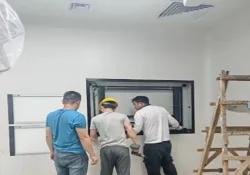
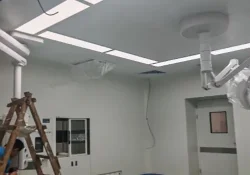
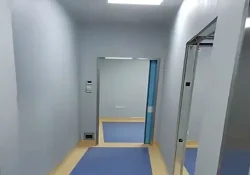
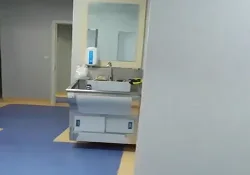
Following construction completion, a systematic, fully integrated commissioning process was undertaken. Key testing activities included: air volume, pressure differential, and noise level testing and balancing for the HVAC and ventilation systems; air-tightness, purity, and pressure stability verification for the medical gas systems; full-load trial operation and emergency power switchover testing for the electrical infrastructure; integrated data commissioning and interface validation with the hospital's information platform for the intelligent systems; and third-party certified testing for cleanliness classification, airborne viable particles, settling bacteria, and illumination levels.
A notable challenge emerged during the fine-tuning of the pressure differential gradient within the existing building envelope. Initial third-party measurements revealed minor pressure fluctuations in certain localized zones — a common difficulty when retrofitting cleanroom environments into older structures with inherent architectural constraints.
To resolve this, Deiiang's technical specialists convened a joint consultation with the third-party testing agency and the hospital's Infection Control Department. Through meticulous recalibration — re-verifying supply and return air volumes, precisely fine-tuning branch damper openings and fan VFD parameters, and locally enhancing sealing details — all operating rooms and buffer zones achieved pressure differentials, temperature, humidity, and noise levels that met or exceeded both design specifications and regulatory requirements. The project passed its final completion inspection and all health authority compliance checks in a single, successful submission.