+86 18186671616
 Jason@cleanroomequips.com
 MENU
MENUCleanroom Requirements: Standards, Design & Compliance
Defining the Controlled Environments of Modern Technology | Product Designer: Jason.peng
Many clients equate cleanroom requirements strictly with ISO air cleanliness classes. However, high-efficiency filtration is merely the end result. True compliance requires engineering five interconnected systems into a single controlled ecosystem. Success relies heavily on understanding how these distinct layers—from HVAC mechanics to human behavior—interact physically and operationally.
Experience has taught us a hard lesson: You can install a premium HEPA system and still fail validation if your architectural finishes are subpar. We once retrofitted a facility that failed certification simply because the wall sealants were shedding micro-particles. This illustrates why comprehensive cleanroom requirements must be treated as a holistic engineering challenge, whether for pharma or semiconductor fabs.
The 5 Systemic Cleanroom Requirements
- Air Purity: Active particle management via HEPA/ULPA filtration
- Environmental Control: Precision T/RH stability and pressure cascades
- Building & Materials: Aseptic, non-outgassing, and static-dissipative surfaces
- Personnel & Operations: Gowning protocols (SOPs) and behavior management
- Testing & Validation: DQ/IQ/OQ/PQ lifecycle compliance
In semiconductor fabrication, a stray 50nm particle destroys yield; in GMP pharmaceuticals, a single colony-forming unit (CFU) triggers a batch recall. Accurately defining your cleanroom requirements is the only barrier between reliable production and catastrophic yield loss. It is about engineering certainty into an uncertain environment.

Global Cleanroom Standards Overview
Regulatory confusion often stems from the complex interplay between ISO, GMP, EU, and FDA guidelines. However, mastering ISO 14644 provides the structural framework for roughly 80% of global cleanroom requirements. The following analysis clarifies the hierarchy of these standards.
ISO 14644 – The Global Baseline Standard
ISO 14644 serves as the universal baseline for contamination control. Developed by the International Organization for Standardization, it establishes a unified protocol for classification and monitoring. Crucially, ISO mandates the minimum performance threshold—it represents the starting line for compliance, not the final operational objective.
The Particle Control Logic
The ISO classification logic relies on a specific mathematical correlation between allowable particle concentration and particle size. The governing equation is:
Where Cn = maximum particle count, N = ISO class number, D = particle size in μm
For example, an ISO Class 5 environment restricts particulate load to 3,520 particles ≥ 0.5μm per cubic meter. This equates to approximately 100 particles per cubic foot, aligning with legacy Federal Standard expectations.
Why ISO Is Just the Beginning
A common engineering pitfall is assuming ISO compliance guarantees regulatory approval. A pharmaceutical facility might pass ISO Class 7 particle counts yet fail GMP inspection due to insufficient pressure cascades, improper airlocks, or porous finish materials.
At Deiiang™, we emphasize a critical distinction: "ISO measures air cleanliness, but regulations measure process risk." This gap is where industry-specific cleanroom requirements must be integrated into the design phase.
ISO Cleanroom Classifications Explained
| ISO Class | ≥0.1μm (particles/m³) | ≥0.2μm (particles/m³) | ≥0.3μm (particles/m³) | ≥0.5μm (particles/m³) | ≥1μm (particles/m³) | ≥5μm (particles/m³) |
|---|---|---|---|---|---|---|
| ISO 1 | 10 | 2 | - | - | - | - |
| ISO 2 | 100 | 24 | 10 | 4 | - | - |
| ISO 3 | 1,000 | 237 | 102 | 35 | 8 | - |
| ISO 4 | 10,000 | 2,370 | 1,020 | 352 | 83 | - |
| ISO 5 | 100,000 | 23,700 | 10,200 | 3,520 | 832 | 29 |
| ISO 6 | 1,000,000 | 237,000 | 102,000 | 35,200 | 8,320 | 293 |
| ISO 7 | - | - | - | 352,000 | 83,200 | 2,930 |
| ISO 8 | - | - | - | 3,520,000 | 832,000 | 29,300 |
| ISO 9 | - | - | 35,200,000 | 8,320,000 | 293,000 |
Table Explanation: Lower ISO classes indicate higher cleanliness requirements. The "-" symbol indicates that particle count for that size is not restricted or is too high to be meaningful at that classification level. ISO 1-4 are considered ultra-clean environments, ISO 5-6 are clean environments, and ISO 7-9 are controlled environments.
ISO vs FED STD 209E (Legacy Reference)
Industry veterans often communicate in terms of "Class 100" or "Class 10,000" standards. Although the FED STD 209E system was officially superseded by ISO 14644 in 2001, its terminology remains deeply ingrained in engineering culture.
For practical cross-reference, the approximate equivalencies are:
- Class 100 ≈ ISO 5
- Class 1,000 ≈ ISO 6
- Class 10,000 ≈ ISO 7
- Class 100,000 ≈ ISO 8
Why does this persist in SEO and specifications? Engineers frequently search using legacy terms like "Class 100 cleanroom requirements." At Deiiang™, our documentation bridges this generation gap to ensure clarity across all stakeholder experience levels.
ISO vs Fed Std 209E Comparison
While Fed Std 209E is officially obsolete, understanding this conversion helps bridge communication gaps with experienced engineers
Environmental Control Requirements
Many projects fail not due to filtration, but due to unstable thermodynamics. Even with top-tier HEPA integration, a ±3°C temperature swing or 20% RH fluctuation will compromise process integrity. Precise environmental control defines the operational success of a "cleanroom" versus a standard conditioned space.
Key Environmental Parameters in Cleanrooms
For most industrial applications, the following operational ranges are standard design targets:
Temperature
Typical range: 20–24°C (68–75°F)
Tolerance: ±1–2°C depending on application
Critical for: Process stability, operator comfort, material expansion
Humidity
Typical range: 30–60% RH
Tolerance: ±5–10% depending on application
Critical for: Static control, microbial growth, material properties
Pressure
Typical differential: +5–15 Pa
Cascade rule: Cleaner area = higher pressure
Critical for: Containment, cross-contamination prevention
Air Changes
ISO 5: 240–600+ per hour
ISO 7: 30–70 per hour
ISO 8: 10–25 per hour
A strategic insight from our lead designer Jason.peng: "Scalability is often overlooked. If your roadmap suggests a move from ISO 7 to ISO 5, we size HVAC for 50 air changes rather than 30. While the CAPEX increases by 15-20%, it eliminates 60-70% of future retrofit costs and downtime."
Airflow Design & Contamination Control Logic
Airflow design dictates contamination removal efficiency. Installing HEPA filters without analyzing flow vectors often creates turbulence and dead zones, which merely redistribute particles rather than extracting them.
Designers must select the appropriate flow regime based on criticality:
Unidirectional (Laminar) Flow
How it works: Air moves in parallel streams at constant velocity (typically 0.45 m/s ±20%)
Best for: ISO 3-5 cleanrooms, critical zones, protection of product/process
Energy cost: High (300-600 air changes/hour)
Non-Unidirectional (Turbulent) Flow
How it works: Air mixes throughout the room, supplied through diffusers
Best for: ISO 6-8 cleanrooms, less critical areas
Energy cost: Moderate (10-70 air changes/hour)
Cleanroom airflow principles:
Effective contamination control follows a three-step physics principle: Source Capture → Clean Air Dilution → Return Air Extraction. Success depends on accurately calculating specific particle generation rates and thermal loads.
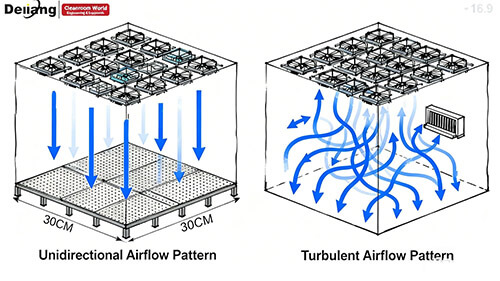
Laminar airflow carries contamination away from work zone to return air vents
Calculations must account for total thermal gain (equipment, personnel, lighting). The engineering rule of thumb dictates approximately 150-200 CFM of additional airflow for every 1kW of equipment heat load to maintain isothermal conditions. These precise calculations distinguish engineered solutions from generic installations.
```
Industry-Specific Cleanroom Requirements
Generic standards often fail when applied to specific industries. A design that succeeds for semiconductor fabrication may be disastrous for pharmaceutical production. Mastering these sector-specific nuances is the defining factor between a compliant facility and an operational liability.
Pharmaceutical & GMP Cleanroom Requirements
In GMP environments, the adversary is biological. Unlike inert dust, a single microorganism can replicate and contaminate an entire production run. Therefore, pharmaceutical cleanroom requirements prioritize sterility assurance, cleanability, and resistance to aggressive biocides over simple particle counts.
The EU GMP Annex 1 (2022 revision) has fundamentally shifted the baseline, mandating:
- Contamination Control Strategy (CCS): A living document linking risk assessment to facility design.
- Quality by Design (QbD): Integrating compliance into the physical architecture.
- Continuous Monitoring: Real-time viability data replacing static snapshots.
Critical engineering features for GMP compliance:
- Flush, coved corners (minimum 25mm radius) to eliminate bio-burden traps.
- Monolithic, non-porous surfaces resistant to Spor-Klenz, VHP, and phenolic disinfectants.
- Inert materials that provide zero nutritional substrate for microbial growth.
- Strict positive pressure cascades to physically repel external contaminants.
- Dual-channel monitoring tracking both 0.5μm and 5.0μm macro-particles.
Pharma vs. Semiconductor Priorities
Pharmaceutical
Focus: Viable (Living) Contamination
Semiconductor
Focus: Nano-particles & ESD
Distinct failure modes dictate distinct design philosophies.
Semiconductor & Electronics Cleanrooms
Semiconductor facilities operate at the edge of physics. With air change rates often exceeding 500-600 ACH in ISO 3-4 zones, the air volume is replaced every few seconds. This necessitates advanced heat recovery systems to maintain operational viability.
In a fab where a single 20nm particle acts like a boulder on a highway, killing a $500 chip, yield protection is paramount. Cleanroom requirements here focus obsessively on molecular contamination and electrostatic discharge. A single contamination event can cost millions in scrapped wafers and weeks of downtime.
Critical control parameters for wafer fabrication:
Nano-Scale Particle Control
Modern lithography requires ISO 3-5 environments, monitoring particles down to 0.1μm. The allowable limits are razor-thin:
This is approximately 28 particles per cubic foot. In contrast, standard office air contains millions of particles in the same volume.
ESD (Electrostatic Discharge) Mitigation
Static discharge is a silent yield killer. Mitigation requires a multi-layered approach:
- Conductive flooring systems (Resistance range: 10⁶–10⁹ ohms)
- Grounded, static-dissipative workstations
- Active overhead ionization to neutralize airborne charge
- Continuous monitoring of electrostatic field potentials
The Shrinking Tolerance Window
Class 1 (ISO 3)
0.1μm concern
Beyond ISO 1
0.01μm concern
As node sizes decrease, contamination protocols must exponentially tighten.
Specialized Applications (Medical / Food / Lab)
Beyond gigafabs and pharma, many sectors require controlled environments tailored to specific risks. Medical device assembly, food packaging, and R&D labs each present unique cleanroom requirements that prioritize process integrity over absolute particle counts.
Cross-Industry Requirements Matrix
| Industry | Target ISO Class | Primary Risk | Core Regulation | Material Focus | Typical ACH |
|---|---|---|---|---|---|
| Pharmaceutical | ISO 5-8 | Microbial Viability | EU GMP / FDA cGMP | Chemical Resistance | 20-240+ |
| Semiconductor | ISO 3-5 | Particles / ESD | IEST / SEMI | Low Outgassing / ESD | 240-600+ |
| Medical Device | ISO 7-8 | Bioburden / Pyrogens | ISO 13485 / FDA QSR | Durability | 15-50 |
| Food Processing | ISO 8-9 | Pathogens / Allergens | FSMA / HACCP | Food Grade (FDA) | 10-25 |
| Research Lab | ISO 6-8 | Cross-Contamination | GLP | Solvent Resistance | 20-70 |
Medical Devices
Class II and III medical devices (implants, instruments) typically demand ISO 7 environments. The primary objective is mitigating bioburden and particulate matter that could trigger inflammatory responses or mechanical failure in the final device.
Food Processing
High-care food zones (ISO 8-9) focus on eliminating pathogens like Listeria and managing allergen segregation. Surfaces must be FDA 21 CFR compliant and capable of withstanding high-pressure washdowns and caustic cleaning cycles.
Research Labs
Lab specifications vary by function. A tissue culture suite requires ISO 7 sterility, whereas a nanotech lab prioritizes ISO 3-4 particulate control with vibration dampening and temperature stability within ±0.1°C.
Conclusion: Industry-specific cleanroom requirements drive every decision from material selection to validation protocols. Adopting a generic approach invites non-compliance, product failures, and costly regulatory intervention.
Cleanroom Design & Construction Requirements
Design and construction represent the transition from theoretical specifications to physical reality. Success in this phase relies less on the initial design brief and more on the execution of architectural details that prevent contamination ingress.
Architectural & Layout Requirements
A functional layout acts as a passive contamination control system. It must enforce a logical flow of personnel, materials, and waste. The goal is a "clean traffic system" where higher cleanliness zones are protected by buffers, ensuring contamination never migrates upstream.
Core layout principles include:
Unidirectional Flow
Personnel and materials must follow a linear progression from "dirty" to "clean." A compliant sequence typically follows:
Street → Changing Room → Secondary Gowning → Airlock → Clean Corridor → Critical Zone
Pressure Cascade
Pressure differentials create an invisible air barrier. The cleanest room maintains the highest positive pressure, forcing air outward.
ISO 5 Room (+25 Pa) → ISO 7 Room (+15 Pa) → Gowning (+10 Pa) → Ambient (0 Pa)
Zoning Strategy
Zones should be segregated by risk level:
- Critical Zone (ISO 5): Exposed product handling.
- Controlled Zone (ISO 7): Process support areas.
- Support Zone (ISO 8): Staging and prep.
- Transition Zone: PAL/MAL (Personnel/Material Airlocks).
Cleanroom Layout Flow Diagram

Pressure cascade ensures air flows from cleaner to less clean areas
Engineering data confirms that optimized layouts reduce personnel movement in critical zones by 30-50%. Since humans are the primary contamination vector, reducing foot traffic is as effective as increasing filtration efficiency.
Cleanroom Material Requirements (Panels, Floors, Ceilings)
This is a critical decision point for project ROI – specifically the choice between prefabricated cleanroom vs modular cleanroom systems. Materials must be evaluated not just as surfaces, but as active components of the contamination control system.
Inferior materials inevitably lead to particle shedding, chemical off-gassing, and degradation under cleaning protocols—factors that directly compromise compliance.
Essential performance criteria for cleanroom envelopes include:
1Non-shedding integrity
Surfaces must be inherently particle-free. This excludes standard drywall or fiberglass. We require materials that generate zero particulate matter under abrasion or vibration.
2 Cleanability profile
Materials must feature ultra-smooth finishes (Ra < 0.8 μm) to prevent biofilm adhesion and must withstand daily saturation with sporicidal agents like VHP or chlorine.
3Seal integrity
Panel joints and ceiling grids must maintain airtight seals to sustain pressure differentials. Maximum allowable leakage is typically < 0.01 cfm/ft² at 0.3" w.g.
4Chemical compatibility
Surfaces must resist process chemicals (acids/solvents) and cleaning regimes without crazing, staining, or leaching contaminants.
At Deiiang™, experience dictates that modular cleanroom construction is superior for facilities requiring adaptability. The capability to reconfigure layouts or upgrade utilities without generating dust or demolition debris can reduce lifecycle ownership costs by 30-50% compared to traditional stick-built methods.
Cleanroom Panel Structure

Typical cleanroom panel cross-section showing composite structure
Project Spec: Pharma Wall System
For a client mandating ISO 5/7 compliance, we engineered the following material specifications:
Wall Panels:
• 60mm flush composite
• HPL (High Pressure Laminate)
• Ra ≤ 0.5 μm finish
• 50mm radius coving
• VHP (Vaporized H2O2) resistant
Flooring:
• 4mm heavy-duty vinyl
• Hot-welded seams
• 150mm integral cove base
• Resistant to IPA & Phenolics
Ceiling:
• Heavy-duty gasketed grid
• Gel-seal HEPA modules
• IP65 tear-drop lighting
• Leakage < 0.01 cfm/ft²
"Precise material specification is the foundation of compliance. These choices enabled first-pass validation success with zero observations." - Jason.peng, Lead Designer at Deiiang™
Doors, Windows & Interlock Systems
Cleanroom doors and windows are high-risk leakage points. A failed door seal instantly invalidates the pressure cascade, while improper glazing materials can become static generators or particle traps.
Non-negotiable specifications for cleanroom entry systems:
- Hermetic Sealing: Four-sided silicone gaskets or drop-seal mechanisms.
- Material Integrity: Powder-coated steel or 304/316 stainless steel; no wood or organics.
- Flush Glazing: Double-paned vision panels flush with the wall to eliminate ledges.
- Active Interlocks: Electronic locks ensuring only one door in an airlock opens at a time.
- Cleanability: Zero crevices or exposed fasteners.
The interlock system is the guardian of the pressure cascade. While basic mechanical interlocks exist, we recommend smart electronic systems that integrate with the BMS (Building Management System) to log access data and provide audit trails for regulatory inspections.
Airlock Interlock Logic
Interlocks are critical for maintaining differential pressure integrity.
Maintenance accessibility is often ignored in design. Specification must answer: Can seals be replaced without shutting down the room? Is the glass accessible for two-sided cleaning? Addressing these operational realities during design prevents costly downtime later.

Personnel, Gowning & Operational Requirements
Data consistently proves that human operators are the primary vector for contamination. A stationary operator emits approximately 100,000 particles (≥0.3μm) per minute; rapid movement escalates this to over 1,000,000. Consequently, defining rigorous personnel protocols is as critical to cleanroom requirements as the HVAC engineering itself.
Quantifying the Human Factor
The most sophisticated filtration design cannot compensate for poor gowning discipline. Operational compliance must be engineered into the facility's workflow. The following particle generation metrics underscore why personnel management is a non-negotiable aspect of cleanroom requirements.
Typical particle generation rates (≥0.3μm) per minute:
Activity vs. Contamination Load
- Motionless/Seated: ~100,000 particles
- Slow Walking: ~500,000 particles
- Active Work: ~1,000,000 particles
- Fast Motion/Running: >5,000,000 particles
Reference: IEST-RP-CC003.4
Beyond particulates, personnel introduce multifaceted risks:
- Bioburden: Skin flakes carrying Staphylococcus and respiratory aerosols.
- Molecular Contamination: Volatiles from personal care products.
- ESD Events: Triboelectric charging from synthetic undergarments.
- Thermal Load: Latent heat affecting humidity stability.
Contamination Source Analysis
In most cleanrooms, people contribute 70%+ of total particles
The engineering conclusion is definitive: Without rigorous personnel SOPs, investment in ISO-grade filtration yields diminishing returns. Comprehensive cleanroom requirements must integrate human behavior modification alongside mechanical specifications.
Gowning Procedures & Behavior Rules
Effective gowning protocols function as a physical firewall against contamination. While specific steps vary by ISO class, the following sequence represents a standard protocol for ISO 5-7 environments:
Standard Operating Procedure (SOP) Flow
- Doffing: Remove street clothes/jewelry; secure in lockers.
- Scrub: Medical-grade hand and forearm wash.
- Transition: Enter "clean side" of the line of demarcation.
- Head Gear: Don bouffant/hood and beard cover (total hair containment).
- Footwear: Don cleanroom-specific boots or shoe covers.
- Body: Don coverall without allowing it to touch the floor (critical step).
- Respiratory: Secure face mask/veil.
- Hands: Don sterile gloves; overlap coverall sleeves.
- Verification: Full-length mirror check for exposed skin/gaps.
- Entry: Pass through air shower or airlock.
- Process: Proceed to workstation.
Architecturally, gowning rooms must maintain a positive pressure relative to the corridor but negative pressure relative to the cleanroom, creating a cascade that physically repels contaminants.
Operational Discipline: The "Don'ts"
Zero Cosmetics
Prohibit makeup, lotions, perfume
Controlled Motion
No running or rapid gestures
Approved Media
Only lint-free synthetic paper
Limit Speech
Reduces aerosol generation
Behavioral modification is the most challenging aspect of cleanroom management. We advise implementing "visual management" systems—clear infographics at egress points—and conducting unannounced behavioral audits to ensure long-term protocol adherence.
Air Showers & Pass Boxes
These ancillary systems act as critical control points for material and personnel transfer. While not mandatory for every classification, they significantly reduce the burden on the HVAC system by removing gross particulate matter before entry.
Air Showers
High-velocity jets (20-30 m/s) scrub personnel of surface contaminants. Key performance specs:
- Efficiency: Capable of removing 80-95% of loose particulate.
- Dwell Time: Programmable cycles (typically 15-30s).
- Nozzle Velocity: Minimum 20 m/s to dislodge particles.
- Interlocks: Electromagnetic locks preventing bypass.
- Maintenance: Pre-filters require frequent rotation to maintain velocity.
Application Note: Essential for ISO 5-6 zones; optional but recommended for ISO 7 to extend HEPA filter life.
Pass Boxes (Transfer Hatches)
Pass boxes facilitate material transfer without personnel movement, preserving the pressure cascade.
Static Pass Box
Passive chamber with mechanical interlocks. Ideal for non-critical transfers.
Dynamic Pass Box
Active HEPA recirculation and purge cycles. Required for biological/sterile zones.
Specification checklist:
- Interlock: Electronic or Mechanical (Fail-safe).
- Clean-down: Dynamic boxes need 5-10 minute recovery cycles.
- Construction: SS 304/316 with coved internal corners.
- Seals: Double-walled silicone or gel seals.
- Sizing: Dimension for your largest equipment + 20% clearance.
Strategic sizing is crucial. We often see clients undersize pass boxes, leading to dangerous "door propping" practices to move large equipment. Deiiang™ advises designing transfer hatches with a 30% capacity buffer to accommodate future process equipment changes.
Testing, Validation & Certification Requirements
Validation converts a constructed facility into a compliant asset. It provides the objective, documented evidence that the cleanroom consistently operates within specified parameters. Without this data, the facility is functionally useless for regulated manufacturing.
The Regulatory Mandate
In sectors like Pharma and MedTech, validation is a legal requirement, not a quality control option. Operating an unvalidated cleanroom invites immediate regulatory action (Warning Letters, Form 483s).
Key Compliance Standards
- FDA (USA): 21 CFR Part 211 (Aseptic Processing Validation).
- EU GMP: Annex 1 (Qualification & Continuous Monitoring).
- ISO 14644: Parts 1, 2 & 3 (Testing Methods).
- Industry Guidelines: IEST, USP
Strategic value of validation:
- Risk Mitigation: Detects design flaws before production begins.
- Baseline Data: Establishes "Gold Standard" performance for future trending.
- Audit Readiness: Proves capability to auditors and investors.
- Energy Optimization: Balances fan speeds against actual pressure needs.
Lifecycle Validation Timeline
Qualification
Qualification
Qualification
Qualification
Standard validation cycle (DQ to PQ) typically spans 8-12 weeks
The industry standard approach follows the V-Model lifecycle. However, successful projects integrate "testability" into the Design Qualification (DQ) phase. If sampling ports are inaccessible or air balancing dampers are unreachable, the facility will fail Operational Qualification (OQ) regardless of the design intent.
Core Testing Protocols
ISO 14644 delineates a suite of tests to verify cleanroom performance. The following four tests constitute the primary certification battery:
Particle Counting
Goal: Validate ISO Class compliance.
Method: LSAPC (Light Scattering Airborne Particle Counter) at grid points.
Cadence: Initial + every 6-12 months.
Ref: ISO 14644-1
Airflow Visualization
Goal: Confirm unidirectional flow / check for dead zones.
Method: Smoke studies (Glycol/Water fog) with video evidence.
Cadence: Initial + post-modification.
Ref: ISO 14644-3
Filter Integrity
Goal: Detect seal bypass or media damage.
Method: PAO Aerosol photometer scanning (upstream challenge).
Cadence: At install + Annually.
Ref: IEST-RP-CC034
Recovery Rate
Goal: Measure system's ability to purge contamination.
Method: Spike particles (100x limit) -> Measure time to 1x.
Cadence: Initial + post-HVAC changes.
Ref: ISO 14644-3
Sector-Specific Protocols
Beyond ISO physics tests, specific industries mandate biological and environmental overlays:
Microbiological (GMP):
• Viable Air Sampling (SAS)
• Contact Plates (RODAC)
• Gloved Fingertip Testing
• Passive Settle Plates
Environmental Mapping:
• 3D Temp/RH Uniformity
• Differential Pressure logging
• Lighting (Lux) mapping
• Sound Pressure Levels
Facility Physics:
• Vibration Analysis (VC-Curves)
• ESD/Surface Resistivity
• EMI/RFI Shielding checks
• Molecular (AMC) Testing
Protocols must be risk-adjusted. An ISO 5 aseptic suite demands exhaustive viable monitoring, whereas an ISO 8 packaging hall focuses on particulate load. Matching the test plan to the risk profile prevents over-qualification costs.
Common Misunderstandings About Cleanroom Requirements
In decades of engineering consultation, we encounter persistent misconceptions that jeopardize compliance and bloat budgets. Addressing these myths early is essential for an efficient project lifecycle.
Myth vs Reality in Cleanroom Design
Myth: ISO Class Defines Everything
Belief that hitting particle counts equals full regulatory compliance.
Reality: Context is King
An ISO 7 electronics lab fails GMP inspections. You need industry-specific overlays (bio-control, ESD, etc.) beyond ISO physics.
Myth: "Cleaner is Better"
Specifying ISO 5 when the process only requires ISO 7.
Reality: Over-Design Kills OPEX
ISO 5 requires ~300x air changes vs ~40x for ISO 7. This creates massive, unnecessary energy overhead.
Myth: HVAC Solves Contamination
Over-reliance on HEPA filters while ignoring architectural finishes.
Reality: Architecture Matters
Shedding drywall or poor epoxy can generate more particles than the filters can remove. The envelope must be inert.
Myth: Validation Ends at Handover
Assuming initial certification guarantees perpetual compliance.
Reality: Drift Occurs
Filter seals degrade, fans wear, and sensors drift. Continuous monitoring and annual requalification are mandatory.
The Stick-Built vs. Modular Debate
A prevailing bias suggests "traditional construction is robust, modular is temporary." In modern engineering, this is factually incorrect.
Traditional (Stick-Built) Issues
- Dust: On-site cutting generates massive contamination.
- Consistency: Quality depends on individual laborer skill.
- Rigidity: Layout changes require demolition.
Modular Reality
- Precision: Factory-controlled CNC manufacturing.
- Flexibility: Non-progressive systems allow single-panel swaps.
- Clean Installation:<90% less on-site dust generation.
- Tax Benefits: Often classified as equipment (faster depreciation).
"We recommend modular systems not just for speed, but for contamination control during the build phase. Reducing on-site particulates during construction directly correlates to faster validation times." - Jason.peng, Lead Designer at Deiiang™
Success relies on understanding the "Why" behind the "What." When stakeholders grasp the interrelation of these requirements, we avoid the costly change orders that plague poorly defined projects.