+86 13638632902
 Jason@cleanroomequips.com


 MENU
MENU
Maintaining the cleanliness of the clean room and properly maintaining the high-effICiency filter are important issues.
Let us first understand what the high-effICiency filter is: the high-efficiency filter is mainly used to collect dust and various suspended solids below 0.3um. Use ultra-fine glass fiber paper as the filter material, use offset paper, aluminum film and other materials as the diverter plate, and use the high-efficiency filter frame.
EACH unit has been tested and has the characteristICs of high filtration efficiency, low resistance and large dust holding capacity. High-efficiency filter with cleanliness equal to or higher than class 100 clean room. Before installation, it should be leaked in accordance with the method specified in the "clean room construction and Acceptance Specifications" [JGJ71-90] and meet the specified Requirements.
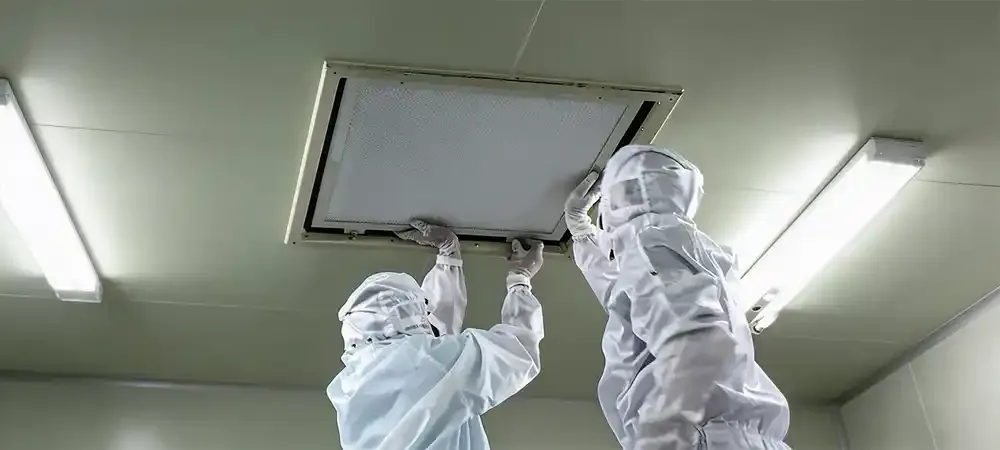
cleanroom HEPA filter leak detection
When does the high-efficiency filter need to be replaced
For high-efficiency filters, when the resistance value of the filter is greater than 450Pa;
Or, when the airflow velocity on the windward side is reduced to the minimum, even if the medium-efficiency filter is replaced, the airflow velocity cannot be increased.
If there is an irreparable leak on the filter surface, a new high-efficiency filter must be replaced, and clean room detection and high-efficiency filter leak detection are required after replacement.
If the above conditions are not available, it can be replaced every 1-2 years according to environmental conditions.
Leak detection method of high efficiency filter
The particle counter sampling head must be inserted into the exhaust static pressure tank (or pipeline) connected to the exhaust high efficiency filter for leak detection of high efficiency filter (this is different from the scanning leak detection of high supply air volume high efficiency filter) because the leak detection side of the supply air high efficiency filter is exposed in the room, and the leak detection side of the exhaust high efficiency filter is located deep in the static pressure box or pipeline, so the above-mentioned leak detection side of the exhaust high efficiency filter can be pressed as mentioned above.
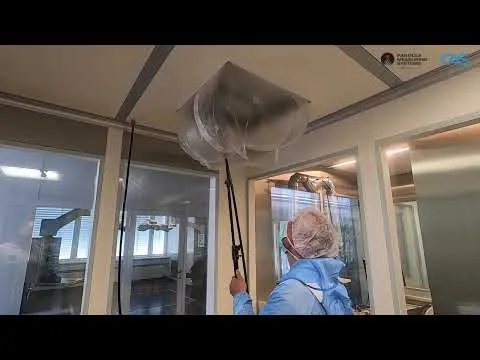
The PAO leak detection of the high efficiency filter installed in the clean room can confirm the integrity of the high efficiency filter and the sealing of the equipment.
Test requirements
Test method: PAO leak detection method
Test scope: For all clean rooms with high efficiency filters installed in the company, the high efficiency filters must be inspected and leaked on site in clean areas such as production workshops and laboratories.
Working principle: PAO aerosol generates dust source on the upwind side of the tested high-efficiency filter, and is sampled and detected by the downwind photometer. The scattered light generated by the dust gas during the photometric time is converted into electricity through the photoelectric effect and linear amplification, and is quickly displayed by the microammeter. The collected air sample passes through the diffusion chamber of the photometer.
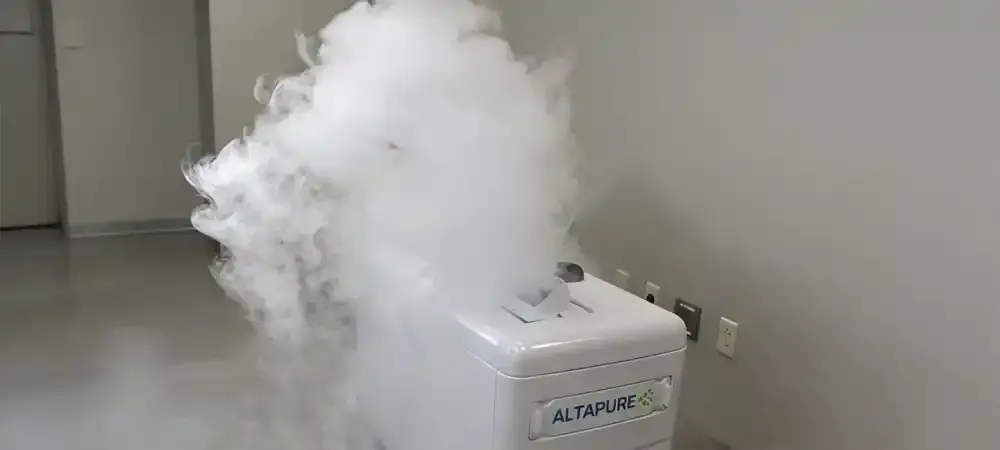
Aerosol
High-efficiency filter leak detection range
Filter material
The filter material of the filter is connected to the inside of the frame
The filter frame between the gasket and the filter group of the support bracket
The filter between the support frame and the wall or ceiling.
High-efficiency filter leak detection status and prerequisites
1. Static
2. The air volume/wind speed test has been completed and the results meet the requirements;
3. Qualification standard: The maximum permeability measured by the inspected high-efficiency filter shall not exceed 2 times the "factory qualified rate". (The "factory pass rate" can be calculated based on the filtration efficiency marked on the HEPA filter nameplate)
1k = (1-α) × 100%
In the formula: k ---- factory qualified permeability.
α----filtration efficiency indicated on the nameplate.
Note: Before testing, you need to fill in the relevant records of the "high efficiency filter leakage record".
4. High efficiency filter leak detection process
High efficiency filter leak detection preparation: remove the diFFUsion plate of the high efficiency filter and clean the cabinet and frame to avoid interference from dust. Prepare nitrogen cylinders and related connecting pipes.
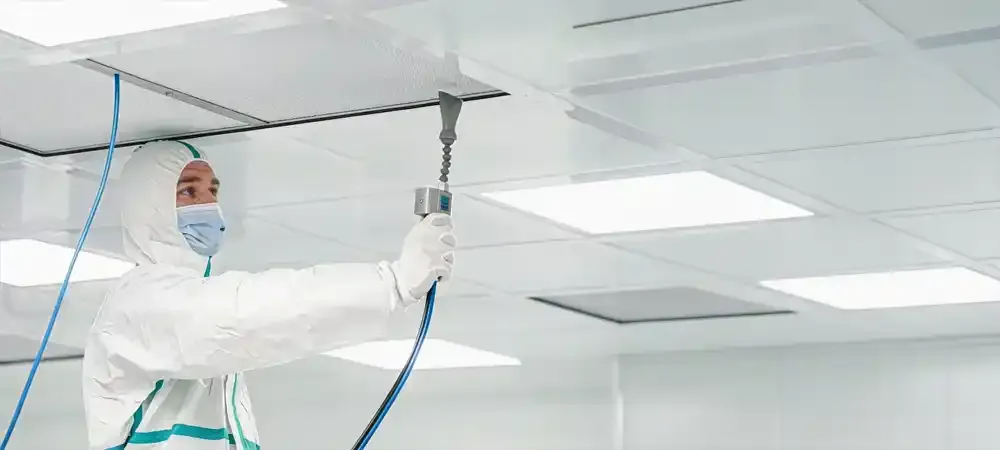
High efficiency filter leak detection
Smoke generation: The inert gas inlet of the smoke generator is connected to the outlet of the nitrogen cylinder equipped with a pressure regulating valve through a plastic tube with an outer diameter of 1/4. The nozzle of the aerosol generator is connected to the intermediate storage nozzle of the gas cabinet of the air purification system through a plastic tube. Press the "TDA-5C aerosol generator" to heat it to 393.3°C-407.4°C. Open the nozzle regulating valve, open the nitrogen source and its regulating valve to adjust the output of the smoke.
Parameter setting: Aerosol photometer initialization, 0% reference standard value setting. Before eACH high efficiency filter scan, check the 100% reference value and connect the DOP detection hole retained on the sampling tube channel, one end is connected to the upstream (high efficiency filter inlet side) sampling port, and the other end is connected to the upstream aerosol photometer. Open and measure the upstream aerosol concentration. Adjust the opening of the aerosol generator output valve until it is confirmed that the upstream concentration reaches 10-20 ug/L, and set this benchmark to 100%.
Adjust the aerosol generator and aerosol photometer according to the "TDA-2H Aerosol Photometer Standard Operating Procedure" and "TDA-5C Aerosol Generator Operating Procedure".
Photometer scanning: Scan the entire working surface of the high efficiency filter (including between the filter and the frame, between the frame and the frame, and between the frame and the static pressure box) with the sampling head of the photometer. When scanning, the sampling head is about 2-4 cm away from the filter, and the speed is about 3-5 cm/second. When scanning, the line will reciprocate back and forth, and the lines should overlap.
Note: During the scanning process, avoid ash interference with the cabinet, especially when the sampling head cannot contact the high-efficiency air outlet or filter frame.
Test result record: Record the measured permeability data of each clean room high-efficiency filter in the "High-efficiency Filter Leakage Detection Record".
FAQs
What is PAO Leak Testing for cleanroom HEPA filters?
Polyalphaolefin (PAO) leak testing is a method for testing the integrity of HEPA filters in cleanrooms. The method utilizes PAO from a mounted filter. The HEPA filter media is set in place using a seal and a mounting assembly. An aerosol photometer measures the concentrations of the aerosol that pass through the filter versus the concentration of the aerosol that is present in the filter. The aerosol that is present in the filter is called a challenge aerosol. The photometer can detect leaks by measuring concentrations as they pass through the filter.
What is the Basic PAO Leak Testing Process?
First, it must be confirmed that the instrument is calibrated, and the HVAC system is set to the operating requirements as per the approved procedure and acceptance criteria. Next, the PAO challenge fluid is introduced to the filter. Once the challenge fluid is introduced to the filter, it is confirmed that the challenge fluid is adequately mixed, stable, and is in the instrument’s operating range. The photometer is then set to reference and zero. Next, the focus is shifted to the filter, where the downstream face, perimeter, the filter’s seals, and the joints of the filter housing are subjected to a scan at the specified distance and at the specified velocity. If any readings exceed the acceptance limit, further action must be taken as per the accepted procedure. The conditions, measurements, and locations of the leaks are to be documented. The corrective action must be taken, and the results of the test must be documented. The test must be conducted by an individual who has the necessary and proper training to perform the action, and it must be done using the correct method for the system that is installed.
What Equipment is Required for PAO Leak Testing?
The equipment that is needed for PAO leak testing is a compatible aerosol generator, a PAO challenge fluid, a calibrated aerosol photometer, and the appropriate sampling probes and tubing. It is necessary to install aerosol injection and sampling access for adequate aerosol challenges to be conducted. It may be necessary to use additional equipment to measure the flow of air.
What is the requirement for a PAO leak test on a HEPA filter?
For many of the HEPA filter photometer tests performed, a local penetration limit of 0.01% of the upstream aerosol concentration is standard. However, this is not applicable to every situation. The filter's specifications, the testing method selected, the regulations, and the approved qualification protocol impact the acceptance limit. Do not mistake the test limit for a leaks in an installed system with the filter’s factory‑rated filtration efficiency.
How often should HEPA filters in a cleanroom be tested for leaks?
HEPA filters should be tested in other situations, at set intervals of requalification, during initial qualification, and after replacement and/or when cleanroom jobs may impact the filter’s integrity. For EU GMP Annex 1 Sterile Manufacturing, requalification includes the final integrity testing of the filter, where the maximum requalification intervals are for six months (Grades A and B) and 12 months (Grades C and D).
Is PAO leak testing similar to cleanroom particle classification testing?
No. The integrity of an installed filtration system is examined during PAO testing. In cleanrooms, particle classification is evaluated through air quality testing for particles. A cleanroom’s air quality testing for particles is not a reliable method for finding active fails in filters. Likewise, an integrity testing of a filter does not mean that the cleanroom's air quality meets the classification standard. The two may be part of the cleanroom's qualification.
What happens when a HEPA filter does not pass a PAO leak test?
When a HEPA filter fails a PAO leak test, the problem needs to be investigated to determine whether failure is due to a media defect, sealing failure, improper installation, a leak in the housing, or a problem with the equipment used to conduct the test. Each will need to be assessed individually with the proper corrective procedures and instructions per the manufacturer, then the filter and the system will need to be retested. For repair of HEPA filter media, the regulatory requirements associated with good manufacture practice (GMP) will determine whether the HEPA filter media can be repaired. If repair is not possible, the HEPA filter media will need to be replaced. If the HEPA filters are used in GMP facilities, the relevant authorities will need to be consulted to determine whether there may be an impact on either operations or product quality prior to the resumption of service in the respective area.
What information is found on a PAO leak test report?
A PAO leak test report includes the determination of the location of the test, identification of the specific filters and the test, the acceptance criteria, the condition of the HVAC system, the scanning instrument used and the calibration status, the aerosol Type And the aerosol scanning results, the locations.