+86 13638632902
 Jason@cleanroomequips.com


 MENU
MENU
GMP certification is no longer just a regulatory formality. It’s a core business standard for pharma, medical device, supplement and cosmetic brands,Global supply chains keep merging. Overseas purchasers and large cross-border drug enterprises won’t cooperate with suppliers lacking legitimate GMP certification.
Most factory owners don’t debate if they need GMP certification. Their main headACHe lies in streamlining the GMP certification process, cutting extra expenses and avoiding long hold-ups from repeated revisions,To meet full GMP certification requirements, a factory must unify every link. This covers GMP certified facility layout, equipment verification, staff skill training and complete GMP compliance management systems.
Deiiang™ has delivered more than 80 Asia-based GMP compliance projects. We embed compliance checks in early design work, cutting clients’ certification cycles and lifting the success rate of first-round GMP certification audits.
7I2tH4z6LOo

What is GMP Certification?
Grasping all boundaries tied to GMP certification lays the groundwork for long-term GMP compliance plans,Lots of firms misunderstand GMP certification as merely one official paper. It actually means full checks across every production and quality control segment within a business.
A GMP certified facility proves stable production following official quality benchmarks via GMP certification. This move lowers hazards for end users and keeps product quality intact,GMP certification requirements stretch well past cleanroom build-out work alone.
Material handling, production workflows, lab testing rules, record keeping, staff credentials and post-launch product monitoring all fall under its scope,Who issues formal GMP certification varies by sales region. Options include local official regulators or independent authorized third-party certification groups.
Basic Concepts of GMP and GMP Certification
GMP stands for standardized manufacturing rules. Its core goal is steady, standardized production, stopping cross-contamination, wrong material mixing and operational mistakes at every production stage.
GMP certification is the official GMP certification process. Authorized regulators or external auditors visit sites to run inspections, then grant credentials only when a GMP certified facility satisfies all GMP certification requirements.
Two ways to get valid GMP certification exist.
Government regulatory certification comes from bodies like China NMPA, mandatory to sell goods in local markets.
Accredited third-party GMP certification works better for supplier screening and cross-border trade.
Applicable Industries and Common Frameworks
GMP compliance rules apply to sectors whose goods directly affect public health,GMP certification requirements grow stricter based on product risks; sterile pharmaceutical lines face the toughest GMP certification standards overall.
Key industries requiring GMP Certification include:
Pharmaceuticals and biological products
Medical devices and in vitro diagnostic (IVD) reagents
Dietary supplements and nutritional products
Cosmetics and high-risk food production segments
Common GMP frameworks recognized globally include:
China GMP (NMPA)
EU GMP (EMA and member state authorities)
US FDA cGMP
WHO GMP
ISO 22716 (cosmetics GMP)
Major Global GMP Certification Systems & Key Differences
Businesses aiming to branch out overseas need to tell apart regional GMP certification systems clearly,Every GMP compliance framework prioritizes consistent quality and product safety at its core. Still, every region holds unique audit styles, official structures and separate GMP certification requirements.
Your chosen GMP certification process shapes both market entry plans and total project spending a great deal,Lots of factory operators fall for a common wrong assumption. They believe a single GMP certification covers all global market rules,Cross-system mutual recognition stays limited in reality. Any GMP certified facility serving multiple overseas markets should build workflows around the strictest local standards right from early design stages.
China GMP vs EU GMP vs US FDA cGMP: Positioning Differences
The three most influential GMP systems serve different regulatory purposes and market scopes. The table below summarizes their core structural differences:
The Subtle Difference Between "Certification" and "Compliance"
Talk to most plant managers, and you’ll hear the same line: get GMP certification once, and you’re set forever,Over in the EU and US, regulators don’t put much stock in the paper itself. What they care about is real, day-to-day GMP compliance — or cGMP compliance, as it’s called stateside.
That certificate only captures what your GMP certified facility looks like on audit day. Staying compliant long-term isn’t automatic. You’ve got to keep monitoring processes, keep paperwork current, and tweak operations little by little on an ongoing basis.
Important Note
A lot of companies treat the whole GMP certification process like a one-off project — wrap it up, check the box, move on.
Regulators don’t care about your pre-audit sprint. What they’re really digging into is whether daily operational data and records hold up when they show up unannounced. DeiiangTM designs facilities built for auditability, not just for show. That makes routine compliance far easier to document, both for initial certification and periodic checks.
For export-focused teams, grasping how your target market actually enforces rules beats collecting certificates alone.Take the FDA. They don’t hand out formal GMP certification at all. They confirm cGMP compliance through pre-approval inspections and routine surveillance visits. Slip on core GMP certification requirements in daily work, and warning letters or import alerts can hit you fast.
General Process to Achieve GMP Certification
GMP certification isn’t something you knock out in a couple months,From early planning to final on-site audit, the full GMP certification process usually runs 12 to 24 months,Rush any single stage to save a few weeks? It almost always backfires.Costly rework. Dragged-out timelines. That’s the standard result. A solid project lines up facility build-out, equipment orders, validation runs and documentation in a steady, logical sequence.
Here’s what Deiiang™ project data bears out,Run a full regulatory gap analysis before locking in facility design, and you cut overall GMP certification timelines by 15–25% on average. Sorting out GMP compliance and core GMP certification requirements up front skips expensive structural overhauls later. Late fixes cost 3 to 5 times more than design-phase tweaks.
Overview of the Typical GMP Certification Process
The end-to-end GMP certification process splits into 10 core stages,Each comes with its own deliverables. Each has clear acceptance criteria,The flowchart below maps the full standard sequence — from the initial go-ahead decision right through to ongoing compliance upkeep for your fully GMP certified facility.
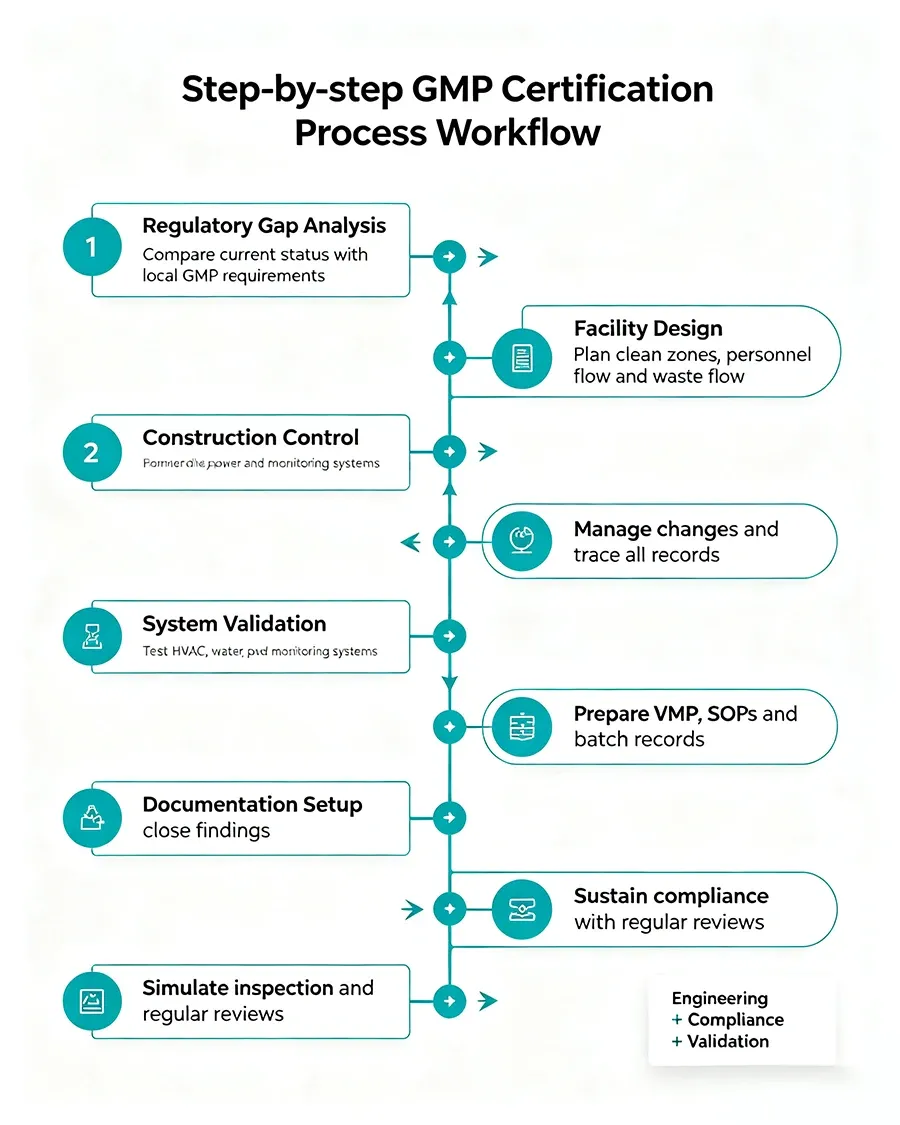
Strategic decision and product positioning
If you’re starting the full GMP certification process, first figure out where you plan to sell goods, your product lineup, plus all GMP certification requirements you must meet.
Walk through your plant space and daily workflows side-by-side with official GMP standards.Jot down every weak spot: room layouts, internal steps, missing paperwork all get logged clearly.
Work up cleanroom layouts, HVAC and auxiliary utilities built to match every GMP certification rule on file.
Source production gear that passes audit checks, then finish every IQ installation task on site.
We run full OQ checks for pure water lines, air handling units and other critical plant kit.
PQ testing needs full completion, so every manufacturing batch holds steady, consistent quality.
Draw up full SOP guides, batch logs and quality files — these keep daily GMP compliance running smoothly.
Carry out test production cycles and self-checks. Copy how official auditors run their full site reviews.
Send over all formal application documents, then host auditors to tour your full GMP certified facility.
Key Milestones and Timeline Estimates
We checked Deiiang™’s old project files,Eighty-plus factory builds, all working toward GMP certification,One obvious trend shows up when we tally their schedules,Start with early design work, finish when you lock in your first GMP certification,That whole process usually runs 12 to 24 months, no fixed timeline for everyone,Plant size matters a ton,Industry technical hurdles also stretch or shorten the overall schedule,We drafted a rough timeline split specifically for mid-size sterile pharma sites,This time estimate works best for factories built across China and nearby Asia-Pacific markets.
Design and construction phase: 8–12 months
Validation, trial production, and certification preparation: 6–12 months
Pro Tip
Deiiang™ internal project statistics show that projects initiating regulatory gap analysis and validation master planning during the design phase shorten overall GMP Certification cycles by an average of 3–6 months. This reduction comes from eliminating late-stage rework and aligning construction activities with validation requirements from day one.
Core Requirements for GMP Certification
Three core parts make up all GMP certification rules: site infrastructure, equipment plus supporting utilities, and full quality management systems.You need all three areas running well together to get and keep valid GMP certification.
If any section falls short, auditors will flag issues. These delays your GMP certification approval, and worst cases lead to full rejection.Auditors check two sides for GMP certification applicants: fixed plant design, plus day-to-day running performance.A space that hits size specs but misses standard operating rules won’t pass GMP certification. Good protocols also cannot fix bad layouts that bring contamination risks.
Facility & cleanroom design
Your building layout forms the physical base for GMP certification.Split staff paths, material transport routes and waste lines fully to stop cross-contamination. cleanroom grades have to match product risks, paired with correct air exchanges, room pressure gaps and filter performance.
Key facility requirements for GMP Certification include:
One-way staff and material paths plus special gown zones meet GMP certification rules
Set cleanroom grades following GMP certification benchmarks; sterile lines use Grade A/B
HVAC holds stable heat, moisture and pressure differences across spaces
Grade A areas need H14 standard HEPA filters installed
Pick smooth, washable building materials for simple daily sanitizing
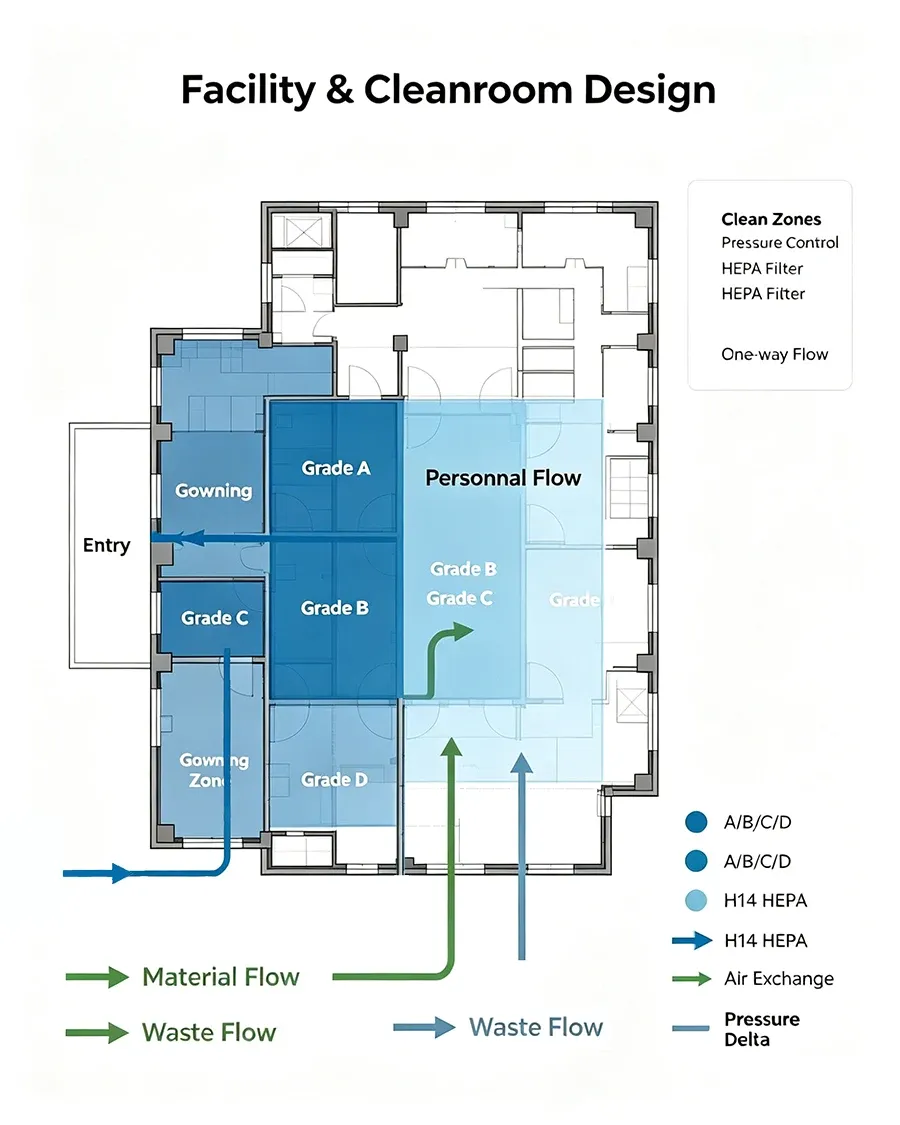
Cleanroom zoning and material/personnel flow diagram
Equipment, Utility Systems and Validation
We run IQ, OQ and PQ checks on all production and lab gear to meet standards for GMP certification.IQ confirms gear is set up matching design rules, OQ tests its working limits across all operating states, and PQ proves stable output during real batch production.These high-risk utilities need full validation before you finish preparations for GMP certification:
Purified water and WFI supply lines
Air purified and filtered by the AHU is supplied to the clean area.
Gas equipment dedicated to GMP operations must ensure freedom from contamination.
Accurately monitor the Cleanroom HVAC units.
Quality Management System & Documentation
To keep your facility eligible for long-term GMP certification, a usable QMS cannot be overlooked.
All paperwork should match daily real-site work, not just empty written rules. Auditors spend lots of time checking data authenticity and full traceability over long operating cycles.
You need these core QMS parts ready ahead of GMP certification audits:
Quality handbooks, SOP guides and blank batch recording forms
Protocols for handling changes, fixing deviations and carrying out CAPA
Vendor screening steps and regular supplier audit arrangements
Employee Training Records
Internal Audit Checklist
Expert Insight
Many companies rush to compile documentation in the final months before GMP Certification, resulting in superficial, disconnected documents. During GMP inspections, regulatory authorities focus on the completeness and consistency of production and operational logs from the past 6 to 12 months, rather than simply checking for the presence of the documents. Deiiang advises clients to begin preparing documentation during the production process itself; this ensures the records accurately reflect actual operations and avoids the awkwardness of reconciling data later when trying to fill in the gaps.
Deiiang Local Project Data: Success Rates & Common Pitfalls
Over the past three years, we have successfully completed GMP certification projects for numerous enterprises in China and Southeast Asia,From these real-site cases, we summed up clear differences between facilities that pass audits on the first try and those stuck with repeated inspections,These region-tailored takeaways let our clients foresee local compliance hurdles and arrange manpower, budgets reasonably,Below are our internal project figures for GMP certification compliant cleanroom builds,All stats come from fully finished jobs spanning 2023 to 2025, usable as practical planning benchmarks.
Deiiang GMP Project Data in Recent Years
We finished more than 80 GMP engineering jobs across varied sectors and regional compliance standards in three years.
Industry split for all finished jobs
Pharma & biological product projects: roughly 60%
Medical device and IVD builds: roughly 25%
Nutritional supplements, food and cosmetic facilities: roughly 15%
Key performance stats pulled from our full project roster
Over 90% of sites pass required GMP certification audits on their initial visit
Cross-territory registration work for EU, US and China accounts for 20 to 25% of total jobs
Integrating GMP compliance planning early shaves 3–6 months off typical project timelines
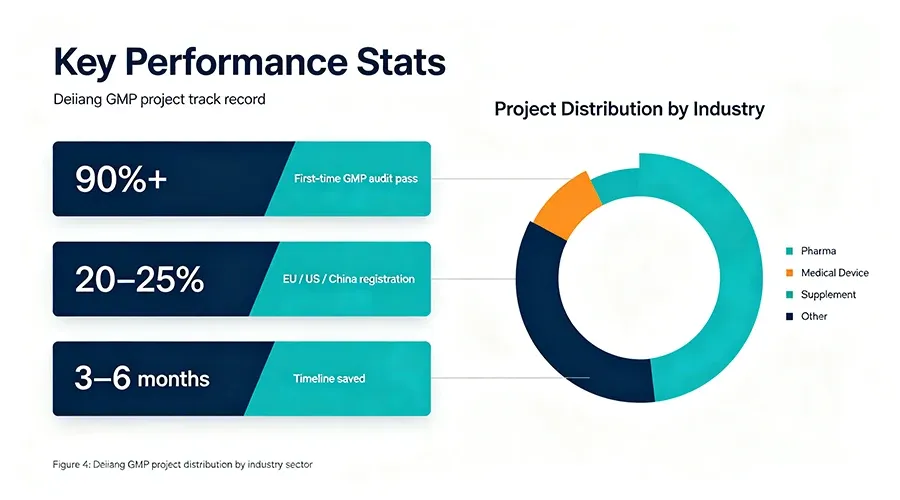
Deiiang GMP project distribution by industry sector
Common Pitfalls in GMP Certification Projects
Reviews from over 80 completed plant projects reveal three main issues that hold up GMP certification and trigger audit nonconformities. These recurring issues are flawed design decisions, incomplete written records, and poorly structured validation plans.
Pre-design phase: Teams skip full regulatory gap checks, so core facility layouts fail regulatory standards right from the start.
Construction phase: Poor recordkeeping for design changes breaks full traceability needed for later validation work.
Validation phase: Too few test samples and incomplete method validation produce untrustworthy statistical test data.
Important Note
Field projects under Deiiang™ highlight a common oversight for firms operating in China and Southeast Asia.Most operators overlook how local hot, humid weather disrupts cleanroom function and microbial containment.The result is constant environmental monitoring readings that fall outside GMP acceptable ranges.Design work must prioritize backup HVAC setups and robust dehumidifying capacity for these areas.Tropical site facilities need dehumidifier output 20–30% above temperate zone standards to sustain steady GMP certification eligibility.
Real-World GMP Certification Case Studies by Deiiang
Every project handled by Deiiang™ leverages hands-on GMP certification know-how to fix actual manufacturing compliance hurdles.
All custom solutions strike a workable balance between regulatory rules, tight spending limits and daily production functionality.
Our portfolio spans brand-new factory builds and old plant upgrades, covering full GMP certification scenarios. Combined engineering and compliance planning delivers clear, quantifiable project gains.
Case 1: New Sterile Injectable Manufacturing Plant
Project Overview
This new sterile injection production base sits in an eastern Chinese province.
The client aimed for local China GMP certification, plus built-in capacity to pursue EU GMP registration later.
The plant spans 28,000 m² total floor space, with 3,200 m² dedicated classified cleanroom zones.
Key Challenges
Need to satisfy China GMP and stricter 2023 EU Annex 1 standards at once
Unreliable city utilities demanded stable backup pure water and power units
Client staff lacked prior GMP certification and validation experience
Deiiang Solutions
We rolled out a one-time high-standard design to hit near-EU GMP specs upfront, cutting later costly renovations without blowing initial budgets.
Separate one-way routes for staff, raw materials and waste cut cross-contamination; Grade A core areas carry 20% extra air change redundancy.
modular cleanroom panels cut site build time by 25%. Early HVAC and water system joint testing caught integration faults early.
A full Validation Master Plan covered all IQ/OQ/PQ work. Mock regulatory audits were run repeatedly to prep for official GMP certification inspections.
Project Site Gallery
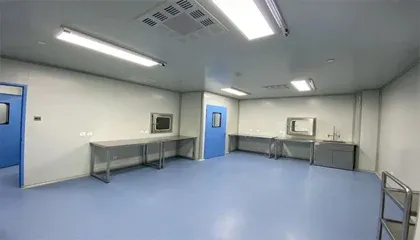
Grade B background with Grade A filling zone
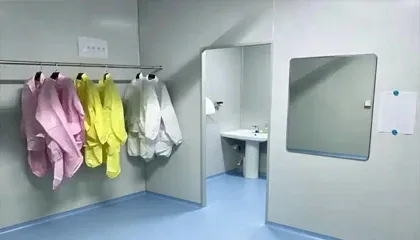
gowning area with unidirectional personnel flow
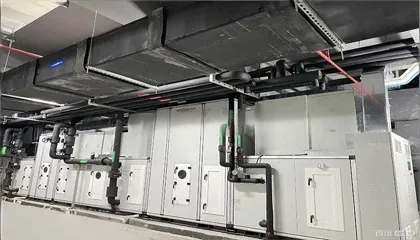
HVAC system with HEPA filter installation
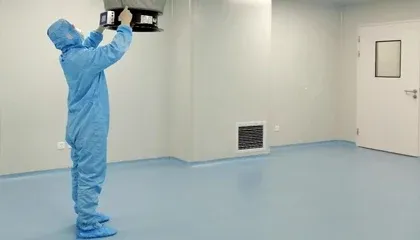
On-site environmental monitoring sampling
Results and Performance Data
Work on the construction site wrapped up fast,We obtained China GMP certification in 18 months, finishing two months ahead of the planned timeline,Half a year after trial production kicked off, the site delivered stable top-tier operating data:
Critical sterile zones held microbial anomaly rates under 0.5%, computed based on sampling locations and testing cycles
No product batches scrapped over serious quality non-conformities
99.7% of all environmental test readings stayed within GMP acceptable ranges
Expert Perspective
Handling cross-region GMP certification projects comes with a hidden core difficulty.
It is never about adding extra cleanroom areas, but balancing limited funds with designs ready for stricter future rules.
Deiiang utilizes an intelligent HVAC system that transmits real-time data from high-precision temperature, humidity, and pressure sensors at various monitoring points within the cleanroom to a central control unit, ensuring full compliance with GMP validation requirements.
This type of intelligent cleanroom system currently leads the industry by a wide margin; it will remain state-of-the-art for the next 5 to 10 years without becoming obsolete, eliminating the need for large-scale retrofitting or upgrades and allowing for a one-time investment.
— Jason.peng, Product Designer at Deiiang™
Additional Case Studies
Case 2: IVD Medical Device Facility Retrofit
A regular factory was renovated to fit IVD reagent GMP and ISO 13485 standards.
Work proceeded in phases so partial production could keep running.
Modular cleanroom frames and streamlined validation got the site GMP certification ready in 8 months.
New clean zones, HEPA-equipped HVAC and full quality documentation let the client clear its first third-party GMP audit with zero major issues.
Case 3: Dietary Supplement Plant GMP Upgrade
We transformed a regular food factory for supplement GMP certification.
The original open floor plan was restructured into isolated production zones with orderly material transit paths.
Modular wall panels, independent air handlers and complete SOP plus batch records wrapped up the project within six months.
Successful GMP certification unlocked premium domestic retail and cross-border sales for the client.
Strategic Planning for GMP Certification
For manufacturers of relevant products, GMP certification and management represent a long-term management strategy rather than a one-time capital investment project.
As business managers, it is essential to recognize that compliance with GMP standards is a long-term requirement throughout the company's operations.
Well-planned GMP layouts lower quality waste, lift operational efficiency and leave room for new products or overseas market expansion.
GMP Path Options for Different Business Stages
Ideal GMP certification strategies change with business size and market targets.
Startups: Lease ready GMP workshops or cooperate with CDMOs to lower initial spending and obtain GMP certification faster
Growing businesses: Design local GMP facilities reserved for future international registration to skip costly reconstruction
Mature enterprises: Pair GMP certification renewal with digital overhauls including electronic batch records and real-time environmental monitoring
Deiiang End-to-End GMP Solutions
Deiiang offers full-lifecycle assistance covering every phase of GMP certification, from initial regulatory evaluation to post-certification compliance guidance,This integrated service eliminates disjointed communication among design, construction and validation teams.
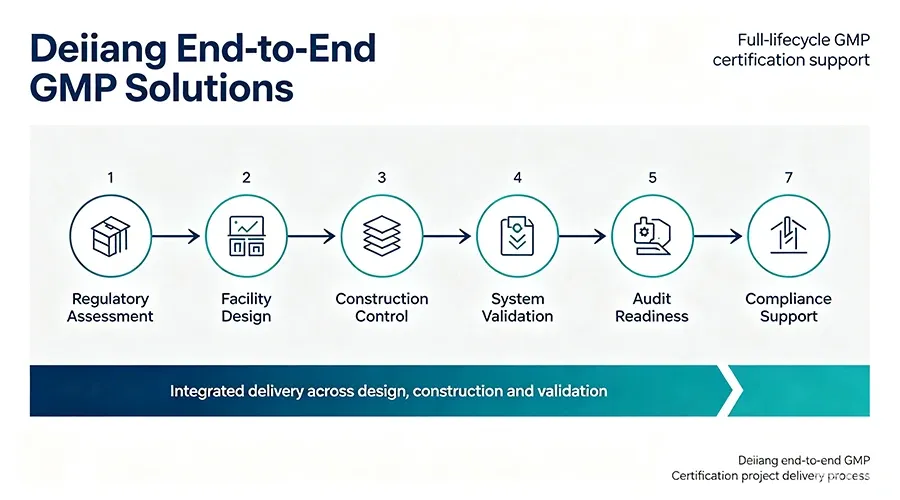
Deiiang end-to-end GMP Certification project delivery process
Pre-project regulatory and gap analysis: Benchmark current status against target GMP Certification standards and define the most efficient upgrade path.
Facility planning and clean engineering design: Custom facility layout and HVAC/utility design optimized for GMP compliance and operational efficiency.
Construction and MEP general contracting: Turnkey execution of cleanroom construction, mechanical, electrical, and plumbing systems.
Validation and certification support: Validation master planning, IQ/OQ/PQ execution, documentation development, and pre-audit preparation.
Summary & Action Recommendations
A GMP certification is never just a simple regulatory credential. It truly embodies an enterprise’s overall quality management level, production standardization and long-term market reputation,Businesses that view GMP certification as a one-off task tend to face ongoing compliance troubles and rising operating expenses. In comparison, firms that embed GMP norms into daily production can turn compliance into solid market competitiveness,Deiiang™ delivers diversified cross-industry, cross-region experience for all GMP certification projects. Boasting 80+ finished projects and a first audit pass rate over 90%, the team helps manufacturers evade common errors, speed up certification progress, and build facilities adaptable to future regulatory updates.
Next Steps
Obtain the professional GMP Certification Practical Whitepaper, which offers targeted checklists, timeline tools and budget guidelines for pharmaceutical, medical device and dietary supplement production sitesShare your specific project demands to acquire a tailored GMP certification feasibility evaluation and initial timeline plan from our professional engineering team
References
National Medical Products Administration (NMPA) — Good Manufacturing Practice for Drugs
European Medicines Agency (EMA) — EU GMP Guidelines and Annexes
U.S. Food and Drug Administration (FDA) — 21 CFR 210/211 Current Good Manufacturing Practice
World Health Organization (WHO) — GMP Guidelines for Pharmaceutical Products
ISO 22716:2007 — Cosmetics — Good Manufacturing Practices (GMP)