+86 13638632902
 Jason@cleanroomequips.com


 MENU

Clean room validation pharmaceutical plants rely on is the established method of validating the level of cleanliness in a controlled environment by means of qualification and verification.
The purpose of validation of clean rooms in the pharmaceutical industry is to comply with regulations, safeguard sterility, and prevent the occurrence of cross-contamination.
This article provides information regarding the steps that quality assurance/quality control and engineering personnel must follow to successfully validate clean rooms, from regulatory guidelines to re-validation.
Regulatory Framework for Pharmaceutical Cleanroom Validation
The validation of clean rooms in pharmaceutical facilities is subject to a layered approach. The Good Manufacturing Practices (GMP) determine what needs to be validated while the ISO guidelines provide a protocol on how the validation should take place.
As a result, gmp cleanroom validation is not one test, but rather involves following the series of steps in the entire life cycle, which includes installation, validation, and continuous monitoring.
Below is a table that depicts all the major regulatory and standardization agencies along with their functions.
Table 1: Regulatory and standards framework for pharmaceutical cleanroom validation
| Instrument | Scope | Key relevance |
|---|---|---|
| EU GMP Annex 1 (2022) [1] | Sterile pharmaceuticals manufacturing | Classification, monitoring, CCS |
| FDA 21 CFR Part 211 [2] | US cgmp clean pharmaceuticals manufacturing | Facility design, validation, record keeping |
| PIC/S GMP Guide [3] | Global standardization | Alignment with Annex 1 |
| iso 14644-1:2015 [4] | Particle classification | ISO classifications and sampling points |
| iso 14644-2:2015 [5] | Testing schedule | Time frame for re-validation |
| iso 14644-3:2019 [6] | Testing protocols | Methods of measurement |
| USP <797> [7] | Sterile compounding | iso class 5, re-validation schedule |
| iso 14698-1:2018 [8] | Microbial contamination | Microbial sampling methods, action levels |
| Instrument | Key relevance |
|---|---|
| EU GMP Annex 1 (2022) [1] | Classification, monitoring, CCS |
| FDA 21 CFR Part 211 [2] | Facility design, validation, record keeping |
| PIC/S GMP Guide [3] | Alignment with Annex 1 |
| iso 14644-1:2015 [4] | ISO classifications and sampling points |
| ISO 14644-2:2015 [5] | Time frame for re-validation |
| iso 14644-3:2019 [6] | Methods of measurement |
| USP <797> [7] | ISO Class 5, re-validation schedule |
| ISO 14698-1:2018 [8] | Microbial sampling methods, action levels |
GMP Cleanroom Validation Regulatory Mandates
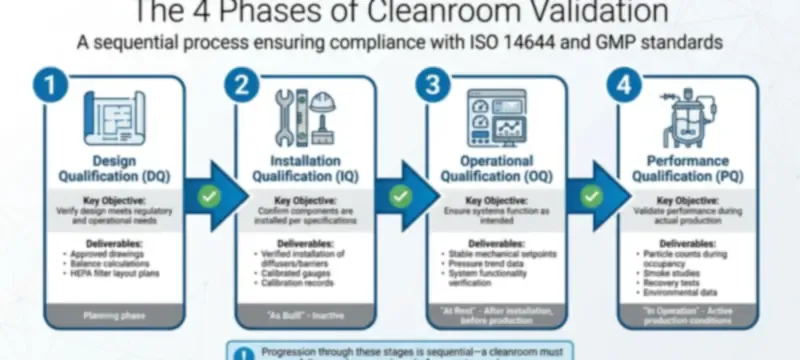
According to EU GMP Annex 1 [1], there is a need to classify clean rooms and clean air equipment for sterile manufacturing. It requires a written contamination control strategy (CCS) that is customized to the process risks of the specific facility.
Clean and buffer areas of different classifications must be maintained at a pressure differential of at least 10 Pa as the recommended measure. Qualification occurs in accordance with Annex 15 standards and entails using specific and documented tests.
FDA 21 CFR Part 211 [2] requires that sterile drugs are manufactured in ISO Class 5 or better ambient air quality in a moving air environment, as required by Section 211.42(c) of the CFR.
Pharmaceutical cleanroom qualification starts by testing the air quality of the cleanroom in an "as built" and static condition. The PIC/S GMP Guide [3] provides for the same procedures as laid out in Annex 1.
ISO 14644 Cleanroom Validation Standards
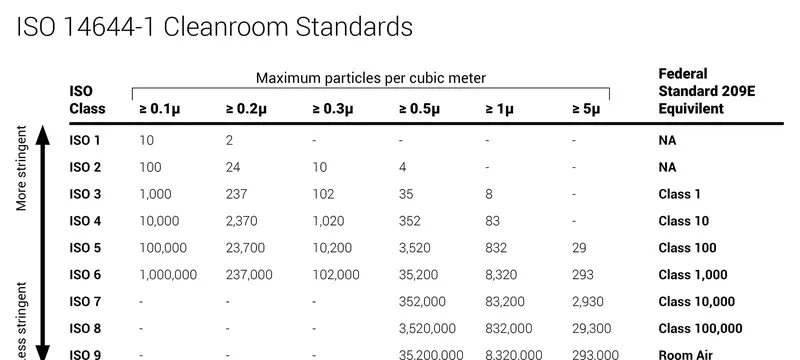
ISO 14644 cleanroom validation provides important measurement standards for the pharmaceutical cleanroom qualification process. ISO 14644 is contained within a series of standards.
- ISO 14644-1 [4]: classification of particle concentration by way of a particle level sample point and an upper 95% confidence limit
- ISO 14644-2 [5]: introduces testing procedures and maximum requalification periods
- ISO 14644-3 [6]: measurement procedures for counting particles, testing filter leaks, measuring air flow and air recovery
ISO 14644-2 [5] recommends testing of airborne particle concentration no longer than at six-month intervals for ISO Class 5 and below, or at twelve-month intervals for ISO Class 6 and above.
Pharmaceutical Cleanroom Qualification Phases
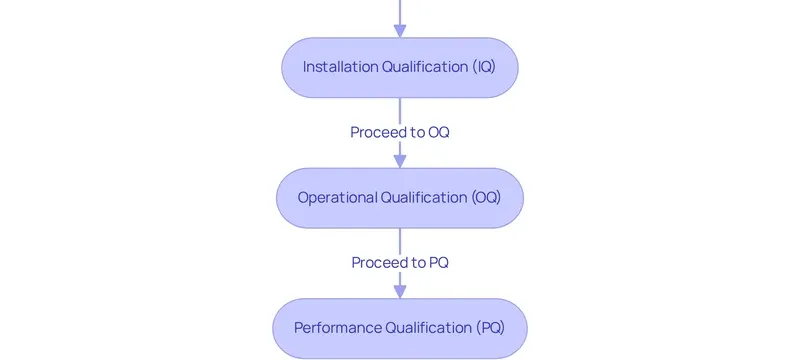
Pharmaceutical cleanroom qualification includes three main steps and is sequential in nature: installation qualification (IQ), operational qualification (OQ), and performance qualification (PQ).
The IQ process serves to verify that the installation has occurred according to specifications, while OQ serves to test that the operation functions in the manner defined. PQ demonstrates the ability to function continuously.
Installation information includes the dimensions of the panels, filters, and airflow according to the specifications. Deiiang modular panel systems and ffu units are designed for direct integration into this sequence.
Installation and Operational Qualification Execution
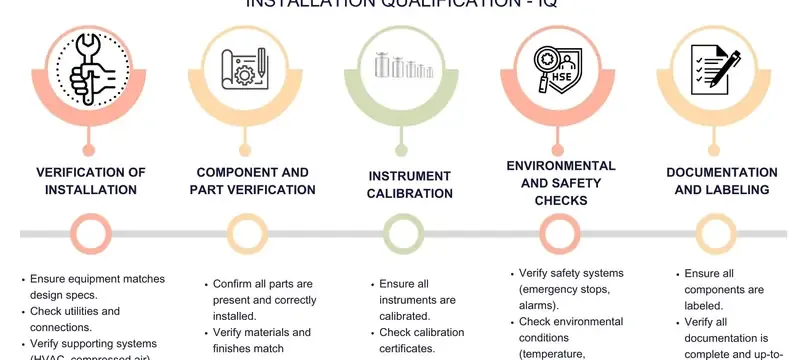
The IQ and OQ execution process is concerned with confirming the physical and functional aspects of the essential systems.
- HVAC system IQ: the site of the air handling unit, installation of the ducts, and other requirements according to the drawings issued for installation
- HEPA unit installation check: inspection of the frame for proper sealing, compression of seals, and filter type
- Airflow velocity OQ: measurement of airflow velocity at the face of the filter, at the level of 15-30 cm across the face, targeting 0.45 m/s ±20%
- Pressure differential OQ: checking the pressures between the classified zones and the areas without classification
- Temperature and humidity OQ: checking for stability of the setpoints
- Instrument calibration check: verification that the test meters have all the necessary calibration certificates before the tests
Deiiang ffu units are designed for an airflow rating of approximately 500 to 2,000 m3/h. Deiiang uses EC brushless motors that operate at above 85% efficiency, saving as much as 30% in energy consumption compared to conventional AC motors.
Jason Peng of Deiiang mentions that about 80% of the HEPA leaks experienced at the facility are traceable to improper compression of the gaskets during installation, and this is easily picked up by the IQ procedure.
Performance Qualification for Sustained Compliance
PQ is about assessing the specified parameters and showing the performance of the machines. Particle count information for two different states, at rest and operating, is collected during this phase.
For test purposes, active air samplers, settle plates, and contact plates are used. Microbial contamination testing covers active air sampling, settle plates, and contact plates.
The required number of samples (N) is obtained using N = √A, where A refers to the area of the room in m². A minimum of one point per zone is required per ISO 14644-1 [4].
The PQ data is what is applied for the baseline in the comparison of future monitoring and revalidation results.
cleanroom validation protocol Pharma Framework
A cleanroom validation protocol pharma must indicate the scope, test procedures including the decision criteria, and proofs necessary for documentation prior to the commencement of the testing process. Cleanroom validation protocol pharma best practices include a risk-based scope as the focus of that structure.
The scope of the protocol needs to identify every piece of equipment included in the boundaries of validation. The criteria for decision must be numerical and sourced from a regulatory authority.
The requirements for documentation provide for raw data sheets, calibration information, forms for deviations, and the structure of the final report. The inspector must first check the protocol, and any protocol that is not complete raises doubts about the results obtained.
Core Protocol Components for Sterile Facilities
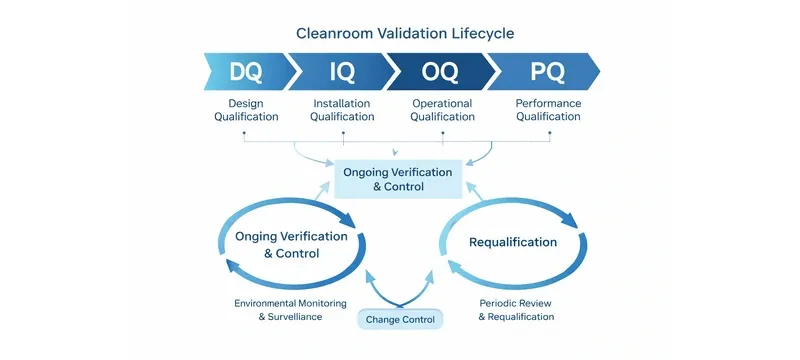
Table 3: Core protocol components for sterile facilities
| Component | Purpose |
|---|---|
| System identification inventory | Map all equipment used within the boundaries of validation |
| Step-by-step test procedures | Standardize recording of outcomes as pass/fail |
| Deviation handling process | Provide specific paths for CAPA escalation |
| Risk-based test scoping | Allocate tests based on their degree of significance to the process |
| Final report structure | Standard format used |
| Component | Purpose |
|---|---|
| System identification inventory | Map all equipment within the validation boundary |
| Step-by-step test procedures | Standardize pass/fail recording |
| Deviation handling process | Provide CAPA escalation paths |
| Risk-based test scoping | Prioritize tests by process significance |
| Final report structure | Standard format used |
Risk-based test scoping uses FMEA-derived protocols to give priority to systems and the frequency of testing, based on the 2022 Annex 1 risk-based validation framework [1].
Deiiang Equipment Integration in Protocols
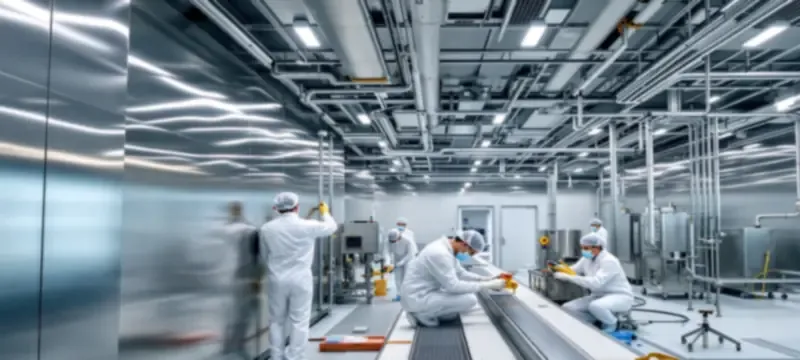
Deiiang provides pre-characterized equipment for protocols. The catalogue values below can be used in the IQ acceptance criteria tables.
- DOP Integrated Filter (H13/H14, EN 1822): built-in DOP test port sealed on the air outlet side, eliminating the need for upstream injection modifications
- Efficiency per catalogue: H13 = 99.97-99.99% at 0.3 µm; H14 = 99.995-99.999% at 0.3 µm
- Model 610×610×150 mm: 2,500 m³/h, 22.14 m² surface area of filtering media, initial pressure drop ≤200-220 Pa
- Every system is tested prior to delivery to ensure traceability through the individual unit's serial number
HEPA Filter Integrity Testing Pharma Procedures
The HEPA filter integrity testing pharma relies on is used in pharmaceutical applications to assure that the filter is not leaking through the fibrous media, frame, or seals. The process uses a known aerosol to challenge the filter.
The downstream filter face is scanned for any penetration greater than the acceptable limit. The DOP/PAO aerosol technique continues to be the standard as recognized through regulations.
The physical requirements of the PAO test are equivalent to those for the DOP method and are accepted through the FDA, EMA, and ISO 14644-3 [6]. The maximum penetration threshold of 0.01% is common to all entities.
Test Methodology for Critical Clean Zones
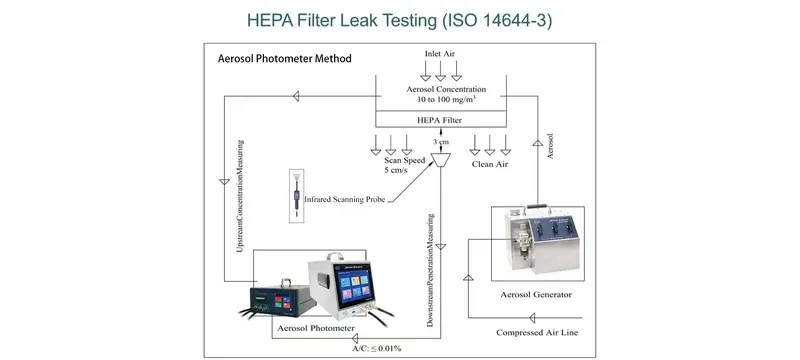
Deiiang H13/H14 filters each receive a scan test prior to delivery, so that documentation can be traced to the serial number of the unit. This reduces the duration of on-site testing since the pre-delivery baseline test has already been performed.
- Injection of known aerosol upstream at 20-100 µg/L concentration, adjusted for the filter type
- Scanning for particles through the filter at a distance of 2-3 cm from the downstream face, at a maximum velocity of 5 cm/sec, so that every part of the downstream face, the frame, and seals is scanned
- Identification of leaks and maintenance of corrective actions, including the requirement to retest any repaired areas
- Verification of upstream concentration, at least 20 µg/L for PAO before each scan
If there is a peak above 0.01% during a PAO scan that cannot be fixed within the allowable limits, the filter must be changed out.
Acceptance Criteria and Documentation
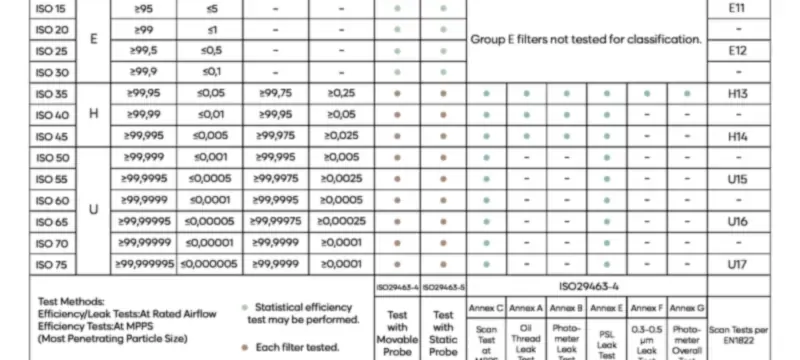
The maximum allowable amount of penetration is 0.01% of upstream challenge concentration at any location [6]. The test report must include the identification of the filter, the type and concentration of aerosol, the calibration status of the instrument, the locations of the scans, and the signature of the individual performing the scan.
When there are failures, the QA department elevates the findings through their CAPA process. If one filter fails, the QA department investigates the installation method, transport handling, and whether a neighbouring filter was compromised.
If a filter is successfully repaired, it must first be tested again, documented, and signed off before being made available for use.
Audits have revealed that the most prevalent finding in a GMP audit is missing records of upstream concentration. It is important to record the upstream concentration at 30-minute intervals, or at least every 30 minutes, during full-filter bank testing.
Grade A Cleanroom Validation Requirements
Grade A cleanroom validation represents the highest classification of a cleanroom. Grade A correlates with iso 5, allowing no more than 3,520 particles ≥0.5 µm in a cubic metre and 20 particles ≥5 µm [1].
These specifications are valid under static and dynamic conditions. Grade A must have unidirectional airflow at 0.45 m/s ±20%, measured 15 cm to 30 cm below the face of the filter.
Validation conditions must include recovery testing, airflow visualisation testing, and continuous particle count monitoring. The table below outlines the comparison of Grade A cleaning standards and microbial action levels.
Table 2: Grade A static and dynamic classification requirements (per EU GMP Annex 1 [1])
| Parameter | Static (at rest) | Dynamic (in operation) | Microbial action level |
|---|---|---|---|
| Particles ≥0.5 µm/m³ | 3,520 | 3,520 | — |
| Particles ≥5.0 µm/m³ | 20 | 20 | — |
| Air sample (CFU/m³) | — | — | <1 |
| Settle plate (90 mm, CFU/4h) | — | — | <1 |
| Contact plate (CFU/plate) | — | — | <1 |
| Glove print (CFU/glove) | — | — | <1 |
| Parameter | Static | Dynamic |
|---|---|---|
| Particles ≥0.5 µm/m³ | 3,520 | 3,520 |
| Particles ≥5.0 µm/m³ | 20 | 20 |
| Air sample (CFU/m³) | — | <1 |
| Settle plate (90 mm, CFU/4h) | — | <1 |
| Contact plate (CFU/plate) | — | <1 |
| Glove print (CFU/glove) | — | <1 |
Static and Dynamic Classification Testing
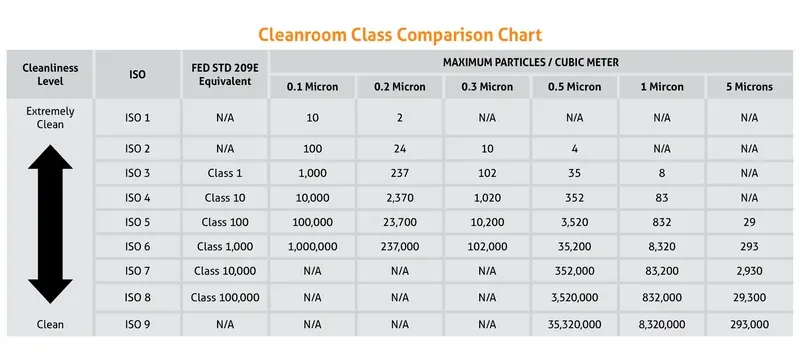
Static characterization verifies whether the cleanroom meets its grade requirements without any human or equipment activity. Dynamic classification verifies continuing operation of cleanrooms during actual aseptic operations.
Both systems must be present because static data alone does not satisfy EU GMP Annex 1 [1]. Dynamic classification must be achieved during operation, simulated aseptic operation, or aseptic process simulation.
As of 2023 statistics, 32% of all EU GMP sterile manufacturing inspections were related to failure to demonstrate dynamic operating conditions.
Aseptic Process Validation Alignment
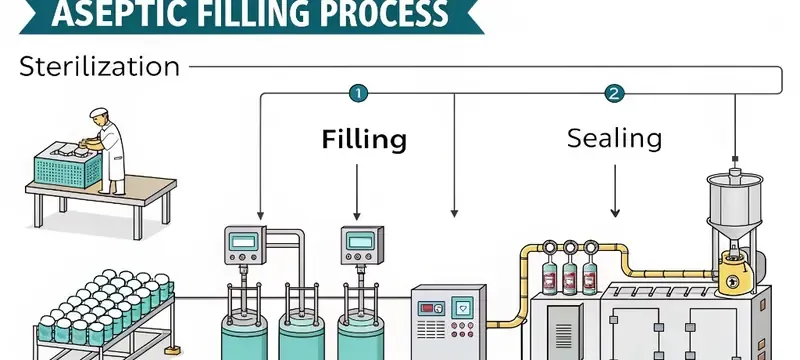
Grade A cleanroom validation is not independent of aseptic process validation, as media fill simulation combines cleanroom operation history with personnel practices, gowning influences, and equipment movement impacts upon airflow.
The minimum number of initial qualifying media fill procedures required by the FDA prior to commercial manufacture is three, with semi-annual revalidation for each aseptic production line [7].
Smoke studies identify the absence of dead zones and acknowledge air moving in only one direction; air moving through critical areas of the final product cannot cause the development of eddies.
Personnel gowning qualification, as well as the air displacement caused by the movement of equipment, is part of the variables documented in a media fill protocol.
Cleanroom Requalification Frequency and Triggers
Cleanroom requalification frequency is defined by both the regulatory schedule and event-driven risk. EU GMP Annex 1 [1] defines the maximum intervals for requalification according to the grade level.
Requalification comprises cleanroom classification (total particle count), integrity testing of the final filters, airflow quantity assessment, confirmation of pressure differentials, and air velocity measurement.
Deiiang advises scheduling the requalification process for the same time that the filtration modification process is scheduled. Recorded pressure drop results of the 400–600 Pa resistance ratings for Deiiang H13/H14 filters aid in estimating when replacements are due.
Standard Requalification Intervals by Grade
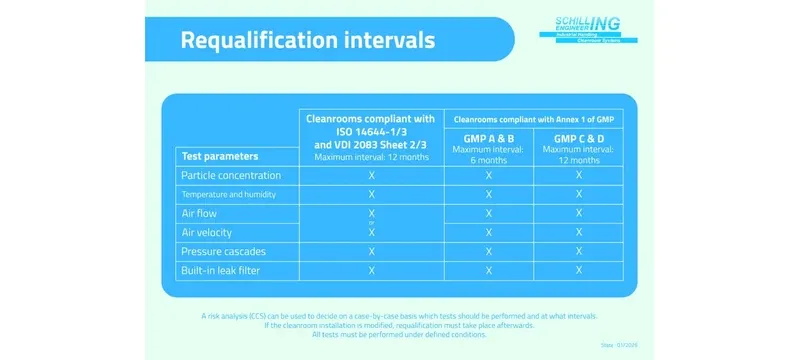
- Grade A: requalification every six months with air particle classification, HEPA testing, airflow measurement, and microbial monitoring
- Grade B: requalification every six months with particle monitoring during critical operations
- grade c: requalification every twelve months with air particle classification and differential pressure verification
- Grade D: requalification every twelve months with classification and airflow measurement
Intervals can be varied according to documented past performance and formal risk assessment outcomes, pursuant to ISO 14644-2 [5].
Event-Based Requalification Scenarios
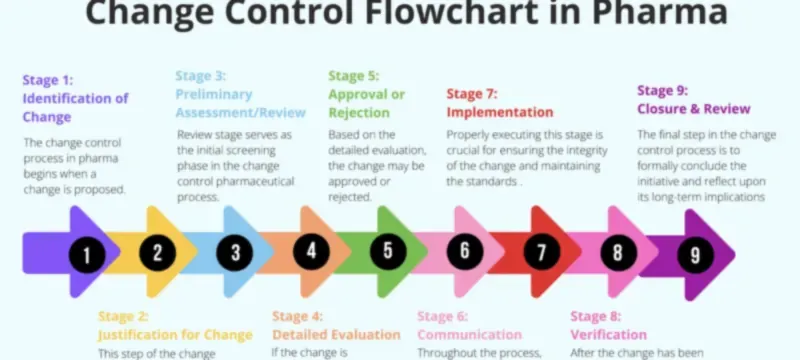
There are events that render previous qualification records invalid and become subject to immediate requalification, without regard to the previous schedule.
- HVAC modification or replacement of air handling units
- HEPA filter replacement and/or repair
- Structural changes affecting room integrity
- Contamination events exceeding action limits
- Installation or relocation of process equipment that disrupts airflow patterns in graded zones
An event of this nature turns the original qualification baseline invalid. Documentation for requalification of the involved parameters must be prepared prior to going back into production.
Sterile Manufacturing Cleanroom Validation Best Practices
Sterile manufacturing cleanroom validation succeeds when it is embedded in an integrated quality management system rather than treated as a periodic standalone event. Continuous monitoring provides real-time data that bridges qualification snapshots and operational reality.
Audit readiness depends equally on traceable records. Every measurement must be tied to a qualified operator, a calibrated tool, and a documented raw data sheet.
Continuous Monitoring for Sustained Compliance
Case Study: Retrofit of Deiiang's ISO 6 Cleanroom for Pharmaceutical Packaging
A pharmaceutical packaging cleanroom with high airborne particle count and low ceiling height aimed for ISO 6. Deiiang provided low-profile H14 combined high-efficiency filters (592×592×292 mm, 2,500 m³/h, ≤220 Pa initial, 20.04 m² media area) with silicone-free gaskets and F7 pre-filters.
Per-filter DOP scan tests were conducted prior to filter installation. Project-reported results showed a fall from the ISO 7 baseline level into steady ISO 6, which remained unchanged.
Particle level post-validation was reduced to 2,100 particles/m³ ≥0.5 µm, much lower than the maximum limit of the ISO 6 standard, which is 35,200. There was a drop of 18% in annual HVAC energy consumption compared to previous filter configurations.
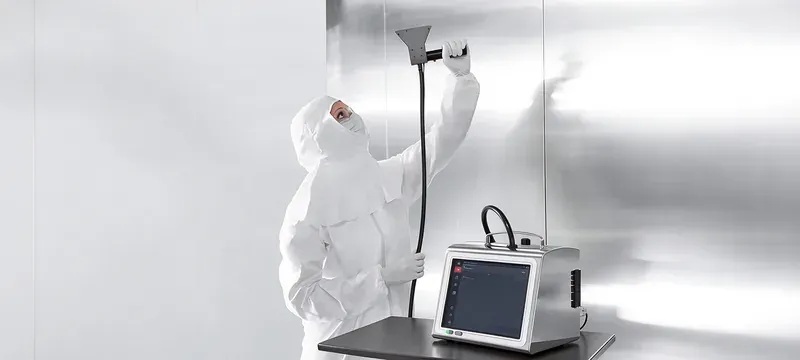
Constant monitoring changes qualification from a moment in time into perpetual confirmation:
- Real-time particle counters process 1-minute interval data of particle counts in Grade A zones
- Active air samplers using 28.3 LPM (1 CFM) velocity for continuous real-time viable monitoring of air
- Differential pressure sensors having alarm values at 10 Pa and 15 Pa
Deiiang FFU control systems reduce monitoring integration time by 40% versus standard units, with plug-and-play BMS connectivity for Grade A/B zones.
Regulatory Audit Preparation and Documentation
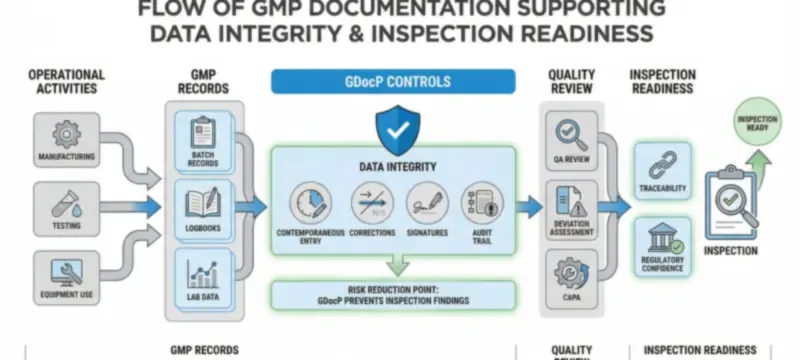
For audit readiness, there should be traceability of testing records. A deviation record must include an investigation report indicating the root cause of the deviation, as well as a corrective action plan (CAPA) showing the effectiveness of corrective actions taken.
Retention of historical data must be done for at least one year after product shelf life. If sterile products are kept on hold for future use, they must have an additional one-year extension beyond their expiration dates.
Pre-audit validation readiness checklist:
Jason Peng advises that periodic trend reviews should be undertaken against the PQ baseline. This helps reduce audit finding resolution time by 60% since deviations are detected early.
Frequently Asked Questions
This section addresses common questions raised by QA/QC and engineering teams in the course of a pharmaceutical cleanroom validation project.
The answers are based on the latest EU GMP Annex 1 and ISO 14644 regulations, and also contain certain tips from experienced field validation professionals.
What is the difference between qualification and validation?
Qualification is the procedure of installation of a system and its documentation, to ensure that equipment or the facility is functioning correctly. Validation is a further confirmation that the qualified system continues to work properly and provides the required output.
Both of these procedures are required under GMP guidelines. Qualification is performed without validation, while validation cannot be done without qualification.
How often must HEPA filter integrity tests be performed?
Integrity testing must be done every 6 months for Grade A areas. For Grade B, C, and D areas, testing must be done once a year, except in cases where risk assessment requires otherwise.
Any replacement or repair of filters, as well as any modifications in HVAC, must be followed by immediate retesting regardless of schedule. The 0.01% penetration limit applies to all tests.
Does ISO 14644 compliance meet GMP requirements?
The answer is simply no. ISO 14644 only provides the framework and confirmation of cleanliness and does not meet GMP requirements due to different microbial requirements, pressure differentials, and monitoring of personnel.
To truly comply requires compliance with both ISO 14644 and GMP standards contained in Annex 1 [1].
What core tests are required for Grade A cleanroom validation?
Grade A cleanroom validation requires tests on particles greater than or equal to both 0.5 microns and 5 microns, alongside tests for the integrity of HEPA filters and tests for the velocity of airflow (approximately 0.45 m/s ±20%).
It also requires visualization of airflow, recovery testing, establishing pressure differentials, and microbial monitoring. Each test must be conducted under both static and dynamic conditions.
When is event-driven cleanroom requalification required?
Events that lead up to revalidation of cleanrooms include modification of HVAC systems, replacement of HEPA filters, alterations in the structure of the cleanroom, and contamination that exceeds established limits.
An event of this nature turns the original qualification baseline invalid. Documentation for requalification of the involved parameters must be prepared prior to going back into production.
What documents make up a complete validation protocol?
The complete protocol includes identification and scope, systems and identification, comprehensive test protocols with numeric acceptance criteria, and recording sheets.
The protocol also includes procedures for handling deviations and a validation report containing qualification verification. Supporting documentation includes certificates of calibration and training records for operators.
References
- [1] EU GMP Annex 1, Manufacture of Sterile Medicinal Products, 2022 revision
- [2] FDA 21 CFR Part 211, Current Good Manufacturing Practice for Finished Pharmaceuticals
- [3] PIC/S GMP Guide, Annex 1, Manufacture of Sterile Medicinal Products
- [4] ISO 14644-1:2015, Classification of air cleanliness by particle concentration
- [5] ISO 14644-2:2015, Monitoring to provide evidence of cleanroom performance related to air cleanliness by particle concentration
- [6] ISO 14644-3:2019, Test methods
- [7] USP <797>, Pharmaceutical Compounding – Sterile Preparations
- [8] iso 14698-1:2018, Cleanrooms and associated controlled environments – Biocontamination control – Part 1: General principles and methods