+86 13638632902
 Jason@cleanroomequips.com


 MENU
MENU
Successful cleanroom projects require meticulous integration of technical expertise, regulatory compliance, and operational foresight. From pharmaceutical manufacturing to critical healthcare facilities, these four pillars determine project outcomes:
1. Precise Requirements Definition
Thorough needs analysis precedes design, mapping user processes against iso 14644 classifications and regulatory frameworks (FDA 21 CFR Part 211, EU GMP Annex 1). This includes contamination risk assessments, material flow simulations, and future expansion allowances. For example, vaccine facilities require Grade B/C zoning with strict pressure cascades, while semiconductor cleanrooms demand ESD protection down to 106 ohms. Documentation encompasses User Requirement Specifications (URS) and Quality Risk Management (QRM) per ICH Q9.
2. Optimized Spatial Architecture
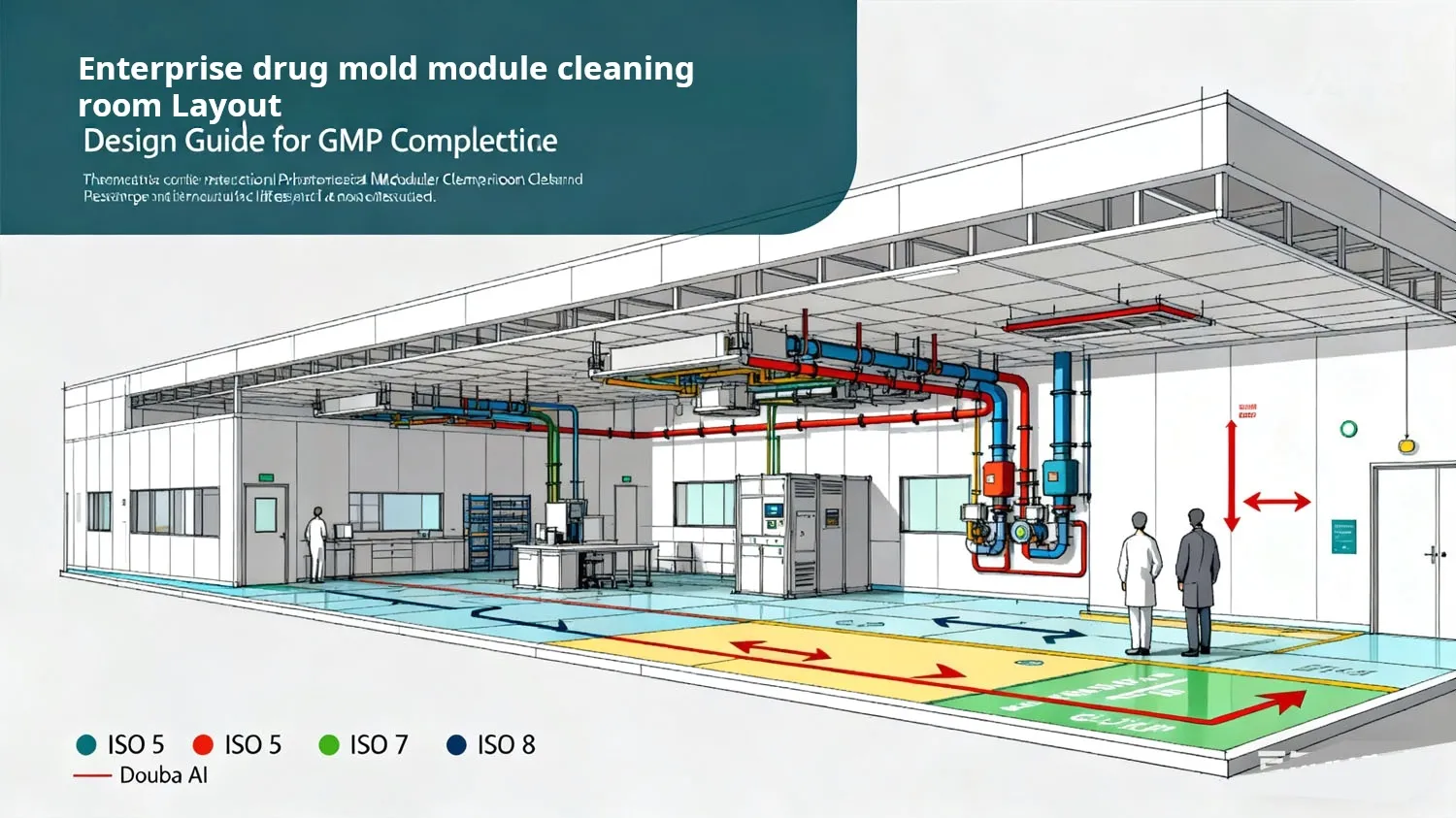
Efficient cleanroom layouts minimize particle traps while maximizing workflow efficiency. Key principles include: single-direction personnel/material flows, minimized transit through higher-class areas, and strategic placement of airlocks. modular cleanrooms increasingly utilize prefabricated wall systems (0.3μm surface roughness) with seamless welded vinyl flooring. Recent projects demonstrate 30% efficiency gains using 3D BIM modeling to coordinate MEP systems before construction, avoiding clashes between HEPA ducts and structural elements.
3. Engineered System Configuration
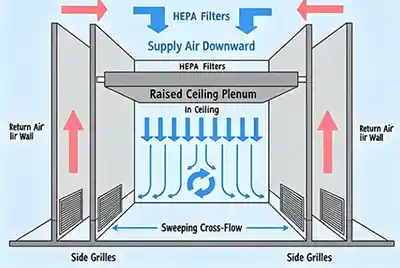
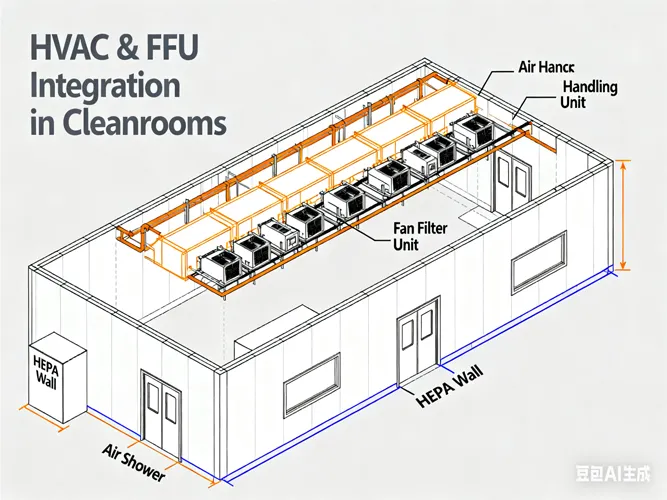
Critical mechanical systems must be precision-matched to cleanroom classification and operational demands. Pharmaceutical iso class 5 environments require H14 HEPA filtration with redundancy, while microelectronics facilities need integrated ESD controls. System integration follows a cascading approACH: primary containment barriers connect to monitoring networks, which interface with utility modules and building automation systems (BAS). Validation testing includes particle challenge tests and airflow visualization studies per iso 14644-3 standards.
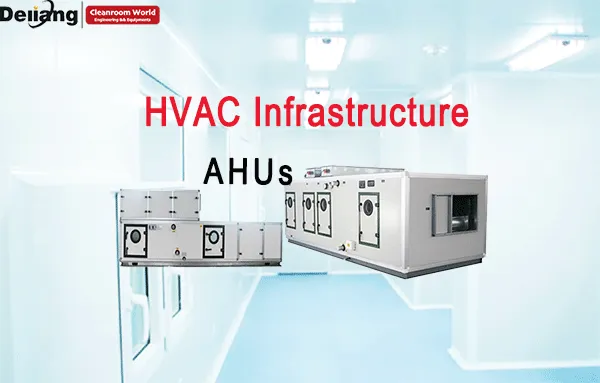
- 1. HVAC Infrastructure: 1. Air Handling Units (AHUs)-2. HEPA/ULPA Filter Banks-3. Ductwork with Antimicrobial Coating-4. fan filter units (ffus)-5. Variable Air Volume (VAV) Controllers-6. Desiccant Dehumidifiers-7. Energy Recovery Wheels-8. Chilled Water Coils-9. Pre-filtration Systems
- 2. Containment Systems: 1. Pass-Through Autoclaves-2. Rapid Transfer Ports (RTPs)-. Biological Safety Cabinets (BSCs)-4. Isolator Gloveboxes-5. Laminar Flow Workstations-6. Double-Door Airlocks-7. Decontamination Showers-8. Material Transfer Hatches-9. Negative Pressure Chambers
- 3. Monitoring Network:1. Laser particle counters-2. Continuous Microbial Air Samplers-3. Differential Pressure Sensors-4. Temperature/Humidity Loggers-5. Viable Particle Detectors-6. Airflow Velocity Monitors-7. EM Software Platforms-8. Alarm Notification Systems- 9. Data Integrity Servers
- 4.Utility Modules: 1. Clean Steam Generators-2. Water-for-Injection (WFI) Systems-3. Purified Water Distribution Loops-4. Process Gas Panels (N2/O2/CO2)-5. Clean Compressed Air Dryers-6. Vacuum System Packages-7. Electrical Power Conditioning Units-8. Emergency Backup Generators-9. Waste Decontamination Systems
4. Specialized Project Execution Team
Cross-functional teams integrate cleanroom-certified architects, validation engineers (CSV specialists), and CQV professionals. Successful projects feature: iso 14644-5 certified project managers, mechanical engineers with ASHRAE 170 expertise, and contractors trained in controlled environment construction protocols. Post-commissioning, teams provide IQ/OQ/PQ documentation packages meeting GAMP 5 standards, with 12-month performance tracking against baseline particle counts.