+86 13638632902
 Jason@cleanroomequips.com


 MENU
MENU
Let's be realistIC: looking at a cleanroom HVAC System Quotation can be overwhelming. It's rarely just a single number; it's a complex assembly of four critical systems: the main AHU, the cooling source, filtration, and the ductwork delivery. EACH component is a variable, and the choices you make for eACH one will drastically change your final investment.
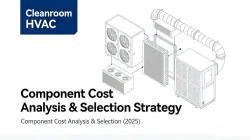
The Logic Behind the Numbers
As engineers, we often see project owners focus strictly on the bottom line of a Cleanroom HVAC System Quotation. While budget is critical, treating this purely as a price comparison is a trap. I've personally seen a Pharmaceutical client cut 15% from their initial budget by opting for generic commercial equipment. The result? They spent nearly 40% more six months later on emergency retrofits when the humidity levels drifted during GMP validation.
The financial landscape changes based on technical paths. For instance, comparing a Direct Expansion (DX) system against a Chilled Water system isn't apples-to-apples. A DX setup might lower your initial Cleanroom HVAC System Quotation, but for facilities exceeding 500m², the operational costs of water systems usually offer a better return on investment (ROI), despite the higher upfront tag.
Quick Insight: Where Does the Money Go?
Typical Cost Breakdown in a Professional Quote:
When you review a comprehensive cleanroom HVAC System Quotation, remember that the "cheapest" bid often hides future operational headaches. A transparent proposal should clearly delineate where costs originate, empowering you to make informed trade-offs.
AHU Selection: Balancing Precision and Price
The Air Handling Unit (AHU) usually eats up the largest chunk of the budget. However, the price isn't driven by size alone—it's driven by precision. Do you need basic comfort cooling for an electronICs packing room? That’s affordable. Do you require strict ±0.5°C temperature and ±5% humidity stability for cell culture? That precision changes the engineering entirely.
Here is a breakdown of how AHU choices impact your Cleanroom HVAC System Quotation, ranked from basic to premium:
Standard DX AHU - The budget-friendly entry point. Ideal if humidity control isn't critical. These units are typically 30-40% cheaper than precision models.
Fresh Air DX AHU - Incorporates 100% outside air processing. Expect a 15-25% cost increase over standard units, but necessary for air quality compliance in populated zones.
Chilled Water AHU - The standard for large-scale facilities (500m²+). Higher CapEx, but significantly lower OpEx over time.
Constant Temp & Humid AHU - Adds precision controls and reheat coils. This adds 40-60% to the base cost but is non-negotiable for stable process environments.
Desiccant Wheel Dehumidifier - The only viable option for low humidity (<45% RH). This can double or triple the equipment cost in your Cleanroom HVAC System Quotation, but for lithium battery or hygroscopic powder production, standard cooling coils simply won't work.
A relevant example involves a biotech startup needing 30%±5% RH. Their initial budget assumed a standard unit at roughly $85,000. We had to clarify that standard cooling coils freeze before reaching that dew point. The necessary desiccant system brought the line item to $142,000. While the Cleanroom HVAC System Quotation increased by 67%, the alternative was a facility that couldn't pass validation.
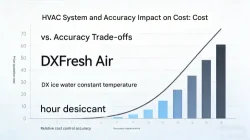
HVAC System and Accuracy lmpact on Cost
When Jason.peng, our lead product designer at Deiiang™, reviews specs, his first question is always: "What is the cost of failure?" If a humidity spike halts production, the premium for a robust system pays for itself instantly.
Chillers & Condensing Units: CapEx vs. OpEx
For larger cleanrooms, choosing a cooling source creates the biggest divide between what you pay now versus what you pay monthly. It represents a major pivot point in any Cleanroom HVAC System Quotation.
Consider the math: A 1,000m² facility running 24/7 might demand 300 tons of cooling. A standard air-cooled modular unit (COP ~3.0) might use 351,000 kWh/year. A high-efficiency centrifugal chiller (COP ~6.0) could drop that to 175,500 kWh. At $0.12/kWh, you are saving over $21,000 annually. This operational reality should weigh heavily on your decision.
Our Product Strategy: Matching Tech to Scale
Air-cooled Modular
Best for facilities under 500m². They offer lower equipment costs and simpler installation (no cooling towers). This option typically lowers the initial Cleanroom HVAC System Quotation by 15-25% compared to water-cooled counterparts.
Screw Chillers
The sweet spot for 500-2,000m² areas. They balance efficiency with reliability. While adding 10-20% to the chiller budget, they offer better stability for medium operations.
Centrifugal Chillers
Designed for huge demands (>2,000m²). These have the highest efficiency and lowest lifetime cost. They may increase the CapEx in your Cleanroom HVAC System Quotation by 30-50%, but the payback period is often just 3-5 years.
Cooling towers also complicate the picture. Open towers save money upfront but introduce contamination risks. For Pharma clients, we almost exclusively recommend closed cooling towers. Yes, they increase the Cleanroom HVAC System Quotation, but avoiding water contamination issues during GMP audits is worth the premium.
Quick Decision Guide for Your Budget
Rule of thumb: Always ask for a line-item breakdown for cooling systems. Bundled quotes often hide inefficient "balance of plant" components.
HEPA/ULPA Filters: Hidden Price Traps
Filtration is where low-quality Cleanroom HVAC System Quotations often cut dangerous corners. A filter might look identical on a spec sheet but perform terribly during field validation. We've seen owners save $8,000 on generic filters only to spend triple that amount on re-testing when penetration tests fail.
At Deiiang™, we specify filter configurations based on validation requirements, not just size. The frame type (knife-edge vs. liquid seal) dictates the leak-proof integrity. Getting this wrong leads to failed certifications.
| Filter Type | Key Feature | Cost Factor | Best Application |
|---|---|---|---|
| HEPA (No Partition) | Standard frame, no test ports | 1.0x (Baseline) | General cleanrooms, Electronics |
| DOP Integrated | Built-in PAO/DOP injection ports | 1.4-1.7x | Pharma/GMP (Crucial for validation) |
| High Temp Separated | Heat resistant to 350°C | 2.5-3.0x | Depyrogenation tunnels, Ovens |
| Tank Type (Liquid Seal) | Gel gasket seal | 2.0-2.5x | Bio-safety, Class 100 environments |
The "DOP Integrated" filter is worth noting. Yes, it raises the line item in your Cleanroom HVAC System Quotation by 40-70%. But for GMP facilities, this upfront cost allows for rapid testing without removing ceiling tiles or installing makeshift adapters. It reduces annual validation downtime from days to hours.
Sealing Mechanism Comparison
Why pay more for tank-type (gel seal) filters?
Knife-edge Seal
Metal-to-metal contact with a neoprene gasket
Standard in most economy Cleanroom HVAC System Quotations
Tank-type Seal
Filters sit in a channel of viscous gel
Adds 25-30% to filter costs but virtually eliminates bypass leakage.
Key insight: Tank-type seals are roughly twice the price of knife-edge filters. However, in a Class 10 semiconductor cleanroom, the assurance against micro-leaks is worth every penny.
Ducting: Material & Thickness Costs
Ductwork is often the "silent budget killer," consuming 50% or more of the material costs in a Cleanroom HVAC System Quotation. material selection correlates directly with longevity.
To illustrate: For a 10,000 ft² project, 0.6mm galvanized steel ducting might cost $45,000. Upgrading that same layout to 304 Stainless Steel jumps the cost to nearly $135,000. That $90,000 difference is huge, but if your process involves corrosive fumes or requires daily washdowns, galvanized steel will fail within years, leading to a production shutdown and a $200,000 replacement bill.
Material Options Simplified
Galvanized Steel
The baseline choice. Suitable for general electronics or packaging. It keeps the Cleanroom HVAC System Quotation low but isn't viable for Sterile or corrosive zones.
201 Stainless Steel
Economy corrosion resistance. Adds ~60-80% to ducting costs. A middle-ground solution, but usually not accepted for high-grade pharma.
304 Stainless Steel
The Pharma Standard. Increases ducting costs by 200-300% over galvanized. If you are building a GMP facility, this is non-negotiable insurance against contamination.
Don't overlook thickness. Moving from 0.6mm to 1.0mm adds weight and fabrication difficulty, increasing costs by 15-25%. However, it prevents the "oil canning" (popping noises) and vibration issues common in high-pressure cleanroom systems.
Ducting Strategy for Your Quote
A Note on Fabrication
Cheap ductwork often means poor seals. Our Deiiang™ fabrication standards ensure <5% leakage. While this might slightly raise the initial Cleanroom HVAC System Quotation, it prevents the massive energy penalty of leaking conditioned air.
Jason's Pro Tip: "Look for 'Pittsburgh Lock' construction in your specs. It costs more than snap-lock seams but reduces leakage significantly. A detailed quote should specify the joining method."
Installation & Commissioning: The Hidden Variable
There is an old saying in our industry: "Three parts equipment, seven parts installation." Even top-tier equipment fails if the install is sloppy. This is often where vendors slash prices to make their Cleanroom HVAC System Quotation look attractive, usually by cutting commissioning time.
Take duct leakage testing. A proper SMACNA test takes days and adds thousands to the budget. Some contractors skip it. The result? A system that leaks 15% of its air, driving up energy bills and messing up pressure cascades. A trustworthy quote lists testing as a specific line item.
What Should Be In Your Commissioning Scope?
Duct Leakage Testing
Verifies airtightness. Essential for energy efficiency. Adds cost to the Cleanroom HVAC System Quotation but saves money long-term.
Airflow Balancing
Ensures pressure cascades are correct. Represents 5-8% of the total quote cost but is critical for containment.
Filter Integrity Testing
PAO testing of HEPA filters. Adds $3k-$5k to the budget, but mandatory for valid certification.
Professional commissioning for a medium facility might cost $40,000-$60,000. It seems high until you realize it includes control calibration and compliance documentation. If this number is suspiciously low in your Cleanroom HVAC System Quotation, you are likely buying a system that won't be tuned correctly.
Often Missed Line Items
Prevents noise and equipment fatigue. Cheap quotes often skip spring isolators.
Connecting everything to a Building Management System allows for automation and remote monitoring.
Vital for future maintenance. Ensure your Cleanroom HVAC System Quotation includes full drawing sets.
Final Thoughts on Your Quotation
Ultimately, a Cleanroom HVAC System Quotation is an educational document as much as it is a price list. It shows you how the vendor intends to solve your specific problems.
From the precision of the AHU to the quality of the ductwork seams, every number represents a technical decision. The goal isn't just to find the lowest number, but to find the configuration that balances immediate budget with long-term reliability and compliance.
The Bottom Line
The most expensive quote isn't always the best, but the cheapest one is almost always the most expensive in the long run. Look for transparency.
Need a Second Pair of Eyes?
Confused by the variance in your bids? Can't decide if the premium for screw chillers is worth it? Let us help you decode your Cleanroom HVAC System Quotation.
Our Engineering Review Includes:
Unbiased component analysis
Line-by-line cost validation
Technical gap analysis against your URS
Total Cost of Ownership (TCO) estimation
Our team usually responds within 24 hours.
Product Lead: Jason.peng
Deiiang™ Cleanroom Solutions
```