+86 13638632902
 Jason@cleanroomequips.com


 MENU
MENU
The Unseen Shield – Why Fire Ratings Matter in cleanrooms
In controlled environments where precision and purity are paramount, safety extends beyond contamination control. The fire safety of cleanroom panels represents a critICal, yet often complex consideration that directly impacts personnel safety, asset protection, and operational continuity. Understanding and complying with various Cleanroom Panel Fire Rating Standards is essential for proper Cleanroom design and construction.
This comprehensive guide from Deiiang™ will demystify the key international and regional Cleanroom Panel Fire Rating Standards, their practical implications, and how to ensure your facility meets all necessary compliance Requirements. Product designer Jason.peng emphasizes that "proper fire rating selection can mean the difference between a minor incident and catastrophic loss."
Understanding Fire Ratings: The Fundamentals
Fire ratings for cleanroom panels primarily measure a material's ability to resist flame spread, limit fire contribution, and maintain structural integrity during fire exposure for specified durations. These Cleanroom Panel Fire Rating Standards provide quantifiable metrICs that engineers and facility managers can rely on when designing safe environments.
Key Aspects of Fire Performance
- • Flame Spread Index (FSI): Measures how quickly flames travel across material surface
- • Smoke Developed Index (SDI): Quantifies smoke generation during combustion
- • Fire Resistance Rating (Duration): Time assembly maintains integrity (30/60/90/120 minutes)
- • Heat Release Rate: Measures energy contribution to fire growth
Major International & Regional Fire Rating Standards for Cleanroom Panels
Navigating the complex landscape of Cleanroom Panel Fire Rating Standards requires understanding the most widely recognized standards that apply to cleanroom panels globally. Different regions and industries may prioritize specific standards, but comprehensive knowledge of all major systems ensures complete compliance.
At Deiiang™, we work with clients to navigate these complex Cleanroom Panel Fire Rating Standards to ensure their facilities meet both local requirements and international best practices for maximum safety and compliance.
A. ASTM E84: Surface Burning Characteristics (North America)
The ASTM E84 cleanroom panel fire rating standard measures flame spread and smoke development on a material's surface using the Steiner Tunnel Test. This test involves exposing a 25-foot sample to controlled fire conditions and measuring how quickly flames travel across the surface.
ASTM E84 Classifications
- Class A (I): FSI 0-25, SDI 0-450 (Most stringent)
- Class B (II): FSI 26-75, SDI 0-450
- Class C (III): FSI 76-200, SDI 0-450
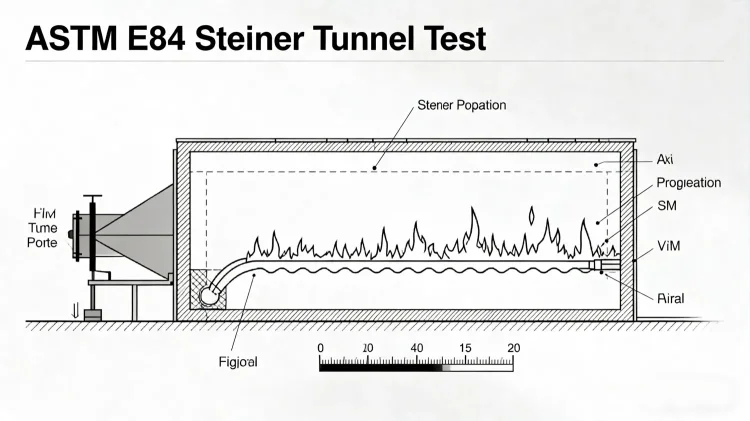
ASTM E84 Steiner Tunnel Test apparatus measuring flame spread
B. EN 13501-1: Fire Classification of Construction Products (Europe)
The EN 13501-1 Cleanroom panel classification provides a comprehensive European standard that classifies products based on reaction to fire, encompassing flame spread, heat release, smoke production, and flaming droplets/particles. This system offers more detailed information than single-number ratings.
EN 13501-1 Classifications (Reaction to Fire)
- A1/A2: Non-combustible materials
- B, C, D, E: Combustible materials with decreasing fire performance
- F: Not classified or failed classification
- Additional classifications: s1-s3 (smoke), d0-d2 (droplets)
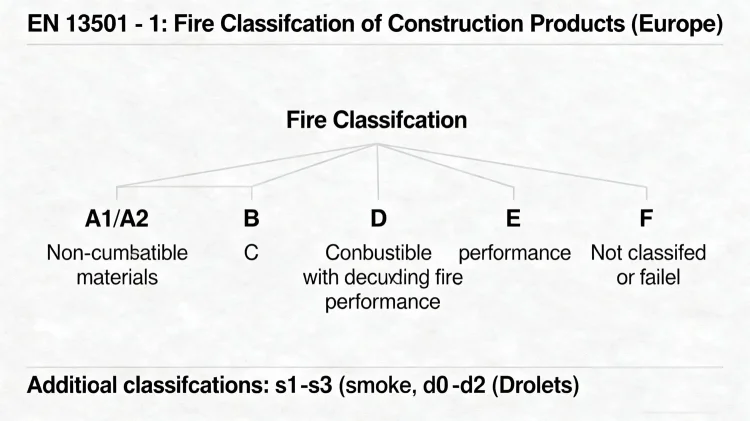
EN 13501-1 classification system including main and supplementary classes
C. Underwriters Laboratories (UL) Standards (North America & Global)
Underwriters Laboratories (UL) serves as a crucial third-party safety Certification organization, with UL 723 Cleanroom wall fire rating being equivalent to ASTM E84 for surface burning characteristics. UL certification provides independent verification that products meet specific safety standards.
Key UL Relevance for Cleanroom Panels
- • UL 723: Surface Burning Characteristics (equivalent to ASTM E84)
- • UL 263: Fire Resistance Ratings for Building Construction
- • UL Listed/Classified: Indicates product compliance with specific standards
D. FM Global (FM Approved) Standards (Global - Property Insurance)
FM Global takes a unique, performance-based approACH focused on property loss prevention, with FM 4880 cleanroom panel approval representing one of the most rigorous certifications available. FM Approved signifies comprehensive testing for fire, wind, and hail resistance, making it particularly important for insurability of high-value facilities.
FM Approval Focus Areas
- FM 4880: Standard for Class 1 Fire Rating of insulated panels
- FM 4881: Standard for Class 1 Exterior Wall Systems
- Primary Focus: Fire propagation, smoke production, fuel contribution, wind uplift resistance
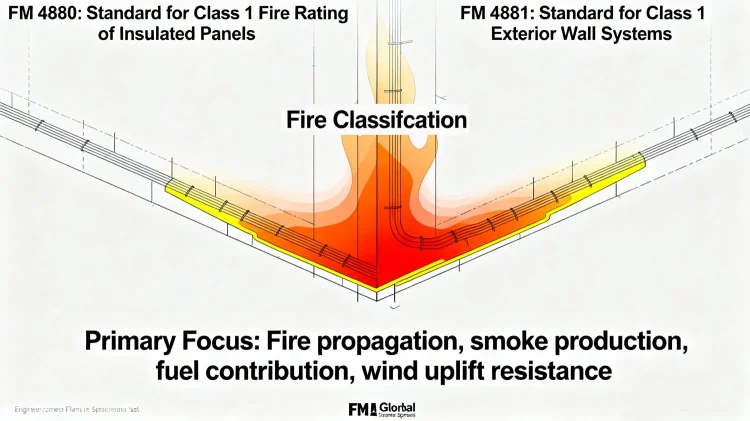
FM Global corner test evaluating large-scale fire propagation
E. Other Relevant Standards (Brief Mention)
Beyond the major standards, various national and industry-specific regulations may apply to your cleanroom project. These can include NFPA codes in the United States, local building codes with specific fire resistance requirements, and industry-specific guidelines for Pharmaceutical, biotechnology, or Electronics manufacturing facilities.
Factors Influencing Cleanroom Panel Fire Ratings
A panel's fire rating represents a complex interaction between its components and construction methods. Understanding these factors is essential when selecting appropriate materials for your specific application and compliance requirements. The cleanroom panel core material fire resistance is particularly critical, as different materials offer varying levels of protection.
Proper consideration of these elements ensures that your selected panels will meet the necessary Cleanroom Panel Fire Rating Standards while providing the required CleanRoom performance characteristics.
Key Influencing Factors
- Core Material: Mineral wool (high ratings) vs. EPS/PU (lower ratings)
- Surface Material: Steel, aluminum, or FRP coatings
- Adhesives & Sealants: Must also meet fire rating requirements
- Panel Thickness: Thicker panels typically offer better resistance
- Joint/Connection System: Impacts overall fire integrity
- Overall Assembly: How panels integrate within the larger system
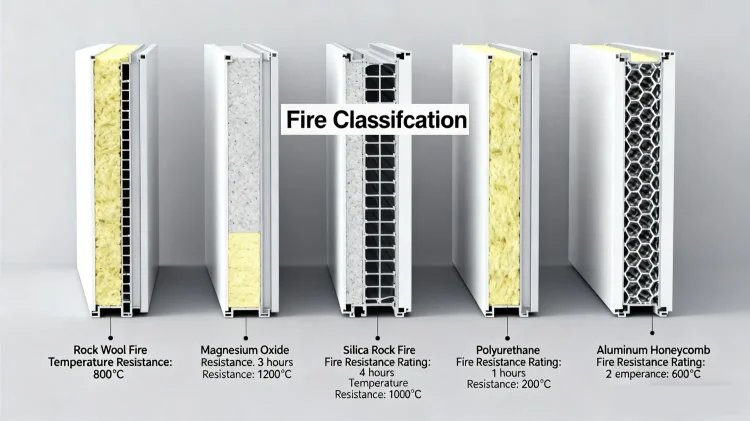
Cleanroom panel cross-section showing core materials and their fire resistance properties
Interpreting & Applying Fire Ratings for cleanroom design
Understanding how to properly apply Cleanroom Panel Fire Rating Standards in practical cleanroom projects requires considering multiple factors beyond just the test ratings. Compliance with local cleanroom fire safety regulations should always be the starting point, followed by project-specific considerations.
At Deiiang™, our approach to implementing proper Cleanroom Panel Fire Rating Standards involves comprehensive assessment of your specific operational requirements, risk factors, and compliance obligations to ensure optimal safety and performance.
Practical Considerations for Application
- • Local Building Codes: Always the primary compliance requirement
- • Occupancy Type: Manufacturing, laboratory, or storage applications
- • cleanroom class: Higher classes often demand stricter material requirements
- • Process Materials: Presence of flammable chemicals or solvents
- • Insurance Requirements: FM Approval often required for coverage
Cleanroom Panel Fire Rating Standards Comparison
| Standard | Region | Primary Focus | Key Classification | Typical Cleanroom Application |
|---|---|---|---|---|
| ASTM E84 | North America | Surface burning characteristics | Class A, B, C (I, II, III) | General cleanroom areas |
| EN 13501-1 | Europe | Reaction to fire performance | A1, A2, B, C, D, E, F | EU compliance projects |
| UL 723 | North America & Global | Surface burning characteristics | Class A, B, C | UL certified projects |
| FM 4880 | Global (Insurance) | Property loss prevention | Class 1 | High-value facilities |
Choosing Fire-Rated Cleanroom Panels: Best Practices
Selecting appropriate fire-rated cleanroom panels requires a systematic approach that considers both current needs and future requirements. Proper implementation of Cleanroom Panel Fire Rating Standards ensures not only compliance but also long-term safety and operational continuity.
Following established best practices for applying Cleanroom Panel Fire Rating Standards helps facility managers and designers create environments that protect both personnel and valuable assets while maintaining regulatory compliance.
Key Decision Points
- • Verify Certifications: Demand official documentation (test reports, listings)
- • Understand Scope: Ensure ratings apply to the entire panel assembly
- • Consult Experts: Engage with fire safety consultants and Manufacturers
- • Consider Lifecycle: Fire safety extends from installation through maintenance
- • Evaluate Total Cost: Consider both initial investment and long-term value
Conclusion: Prioritizing Safety Through Standards
Understanding and properly implementing Cleanroom Panel Fire Rating Standards represents a critical component of comprehensive cleanroom safety planning. These standards provide the framework for creating environments that protect personnel, preserve assets, and ensure operational continuity in the event of a fire emergency.
By working with knowledgeable partners like Deiiang™ who understand the nuances of these complex standards, facility managers can ensure their cleanrooms meet all necessary compliance requirements while providing optimal protection. As product designer Jason.peng notes, "Investing in properly rated cleanroom panels isn't just about compliance—it's about creating a fundamentally safer working environment."
Ready to Ensure Your Cleanroom's Fire Safety?
Contact Deiiang™ today to explore our comprehensive range of fire-rated cleanroom panels and consult with our specialists for compliance guidance tailored to your specific project requirements.
Frequently Asked Questions (FAQ)
Q1: What is the difference between "reaction to fire" and "fire resistance" in cleanroom panels?
A1: "Reaction to fire" (e.g., ASTM E84, EN 13501-1 classes A1-F) measures how a material contributes to a fire (flame spread, smoke). "Fire resistance" (e.g., UL 263, EN 13501-2) measures how long a component/assembly can withstand fire while maintaining its integrity and insulation, preventing fire spread through a barrier.
Q2: Is a Class A rating under ASTM E84 always sufficient for cleanroom panels?
A2: While Class A (I) is the most stringent surface burning classification, it's not the only consideration. Local building codes, the specific CleanRoom application, and the presence of flammable materials may require additional fire resistance ratings for the entire assembly or FM Global approval.
Q3: How do core materials affect A CleanRoom panel's fire rating?
A3: The core material is the primary determinant of a panel's fire resistance. For example, mineral wool cores typically offer superior fire resistance and non-combustibility compared to polyurethane (PU) or expanded polystyrene (EPS) cores, which are more combustible but can be treated to achieve certain ratings.
Q4: Why is FM Approval often required for cleanroom projects?
A4: FM Approval is a performance-based certification from FM Global, primarily concerned with property loss prevention and insurability. It involves rigorous testing for fire propagation and integrity under various conditions, making it a highly respected standard, especially for large industrial or high-value facilities.
Q5: Where can I find the specific fire rating requirements for my cleanroom project?
A5: You should always consult your local building codes, fire safety regulations, and any industry-specific standards (e.g., NFPA codes for the US, specific Pharmaceutical guidelines). Consulting with a qualified fire safety engineer or cleanroom design specialist like those at Deiiang™ is highly recommended.