+86 13638632902
 Jason@cleanroomequips.com


 MENU
MENU
Imagine a single, tiny spark—so small you can't see or feel it—zapping a Microchip worth thousands of dollars. That's the grim reality in Electronics manufacturing without proper ESD control. It's not just about sparks; static charges act like magnets for dust and microbes, ruining product yield. This is where specialized ESd cleanroom panels come in, forming the very shell of your protected environment. This guide will unpack everything you need to know to build a safe, efficient, and reliable cleanroom.
What are ESD Cleanroom Panels?
Let's start with the basics. You know you need clean Walls, but why do they need to be "ESD"? Standard panels are great for being smooth and easy to clean, but they're often insulators. Insulators + friction (from air flow, people moving) = static charge buildup. That's a big no-no. ESD cleanroom panels are the smart upgrade designed to solve this exact problem.
A. Definition & Core Function
In simple terms, ESD cleanroom panels are wall and ceiling panels made from materials that either conduct electricity or allow static charges to dissipate slowly and safely. Their job is twofold: prevent the buildup of static charges on surfaces, and safely drain away any charges that do occur, directly into a grounding system. Unlike their ordinary cousins, they're part of a connected, grounded ecosystem.
B. How Do ESD Cleanroom Panels Work?
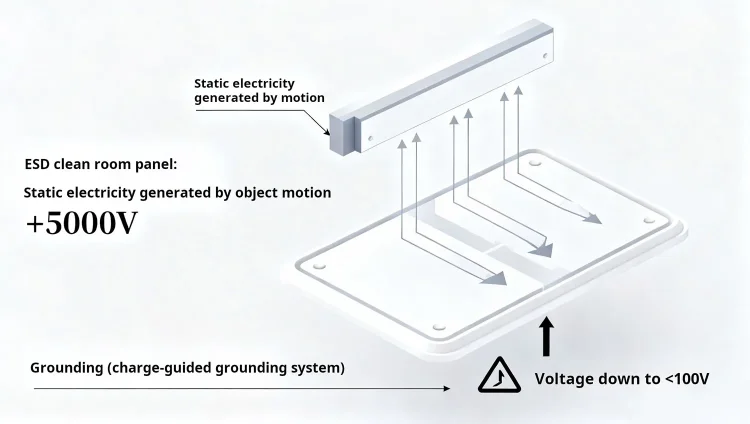
Picture this: A technician walks across the floor, generating 5000 volts of static. They approACH a sensitive circuit board assembly station near the wall. With ordinary panels, that charge stays on them, waiting for a discharge event. With ESD cleanroom panels, the story changes. The panels contain conductive materials (like carbon fibers or metallic layers) that create a continuous, slightly resistive path. When the charged person or object comes near, the panel allows the charge to flow across its surface and down to the ground, harmlessly and continuously, often in less than 1 second. The key here is the complete, bonded grounding path from the panel surface all the way to the earth ground point.
The Path to Safety: ESD Panel Principle
1. Charge Generation: Movement creates static (e.g., +5000V).
2. Contact & Conduction: Charge meets conductive panel surface.
3. Dissipation & Drainage: Charge flows across panel.
4. Grounding: Charge is directed via bonding to the facility ground.Result: Voltage drops to safe levels (<100V) almost instantly.
C. Why is ESD Control in cleanrooms So Critical?
Understanding the "Static electricity hazards in cleanrooms" is step one. ESD isn't just a minor nuisance; it's a major profit killer and safety risk.
- Product Damage: A discharge as low as 10 volts can fry sensitive microchips. In a Semiconductor fab, that's a multi-million dollar mistake.
- Attracts Contaminants: Statically charged surfaces act like a magnet for airborne particles, defeating the purpose of your expensive air filtration system.
- Safety Hazard: In environments with flammable solvents or gases, a spark can be catastrophic.
- Operational Downtime: Tracking down ESD-related failures is time-consuming and costly.
That's the core Function of antistatic CleanRoom panels: to be your first and most widespread line of defense against these invisible threats, as recommended by experts like product designer Jason.peng at Deiiang™.
Types & Materials of ESD Cleanroom Panels
Not all ESD cleanroom panels are created equal. Choosing the right type is like picking the right tool for the job. You need to match the panel's properties to your specific threat level and environmental needs.
A. Classification by Electrostatic Performance
This is the primary way to categorize them, based on their electrical resistance.
- Conductive Panels: These are the "express lane" for electrons. With very low resistance (typically surface resistivity < 10^5 Ω), they move charge quickly. Ideal for high-risk areas where you need to prevent any charge buildup, like around explosive materials or ultra-sensitive assembly.
- Static Dissipative Panels: Think of these as the "controlled flow" option. With moderate resistance (10^5 to 10^9 Ω), they allow charges to drain safely but at a controlled rate. This prevents rapid discharge (which can also cause damage) and is the most common choice for electronics manufacturing cleanrooms.
B. Common Structure & Material Composition
The magic happens in the layers. A typical panel is a sandwich:
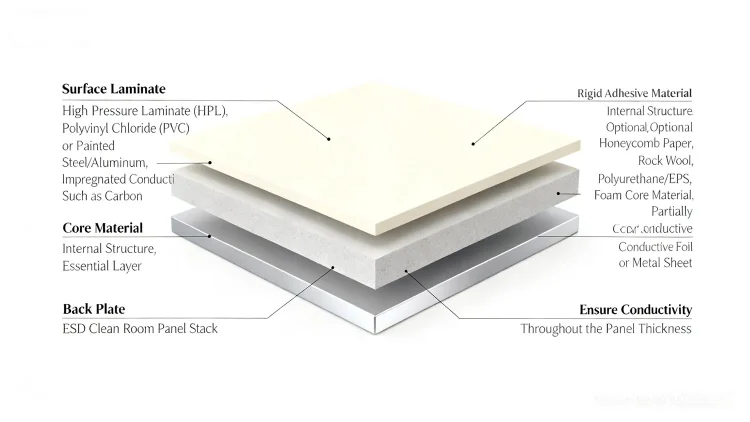
Surface Laminate: This is the wear layer. It can be HPL (High-Pressure Laminate), PVC, or painted steel/aluminum, all impregnated with conductive compounds (like carbon) to give it the necessary ESD properties.
Core Material: The inner structure. Options include honeycomb paper (lightweight), rockwool (great for fire and sound), or foam cores like PU/EPS. Some cores are also treated to be conductive.
Back Sheet: Often a conductive foil or metal sheet to ensure conductivity through the entire panel thickness.
C. Key Performance Specifications ("ESD cleanroom panel specifications")
When you're evaluating ESD cleanroom panels, you'll see these numbers on data sheets. Let's decode them:
| Performance Indicator | Unit | Conductive Range | Dissipative Range | Meaning / Importance |
|---|---|---|---|---|
| Surface Resistivity | Ω (Ohms) | < 105 | 105 - 109 | How easily current flows across the surface. Lower = more conductive. |
| Volume Resistivity | Ω·cm | < 104 | 104 - 109 | How easily current flows through the material bulk. |
| Static Decay Time | Seconds (s) | < 0.1 | < 2.0 | Time to dissipate 1000V to 100V. Faster is better (and often required by standards like ANSI/ESD S20.20). |
| Fire Rating | - | A2 (Euroclass) / Class A (UL) | A2 (Euroclass) / Class A (UL) | Non-combustible or low combustibility is crucial for safety. Always check local codes. |
Application Scenarios & Industries
Where do these specialized panels actually live? Anywhere the stakes are high and the components are tiny or sensitive. The use of ESD cleanroom panels is non-negotiable in environments where a single speck of dust or a milliamp of current can mean disaster.
A. Key Industries
- Semiconductor & Microelectronics Fabrication: The birthplace of chips. Here, ESD panels protect billion-dollar production lines from wafer start to package test.
- Precision Electronics Assembly: Think medical devices, aerospace avionics, high-end servers. Anywhere circuit boards are handled.
- Aerospace & Defense: Reliability is paramount. ESD control ensures guidance systems and communication equipment aren't compromised from the factory floor.
- Medical Device & Pharma (Specific Areas): In areas assembling electronic medical devices (like implants or diagnostics) or handling fine powders susceptible to static cling.
- Optics & Laser Manufacturing: Static attracts particles that can scratch delicate lenses or laser components.
B. Specific Zones Within A CleanRoom
It's not just about the industry, but the zone. ESD cleanroom panels are typically used in:
- Production/Assembly Bay: The heart of the operation, where sensitive devices are exposed.
- Testing & Inspection Areas: Where finished products are verified.
- Packaging Areas: To prevent last-minute contamination or damage.
- Critical Material Storage: For storing wafers, sensitive components, or chemicals.
How to Choose the Right ESD Cleanroom Panels?
Decision time! With so many options, how do you pick? Don't just go for the shiniest sample. Here’s your practical guide for ESD Cleanroom Panel Selection.
A. Key Decision Factors
Think of this as your checklist. For a project like a class 100 (iso 5) Semiconductor cleanroom, you'd need to tick almost every box with high-performance marks.
- cleanroom class & ISO Standard: Your ISO 14644-1 classification dictates surface smoothness, cleanability, and often the panel's seam design. A Class 10 room demands tighter seals than a class 100,000.
- ESD Sensitivity Requirements: What's the most sensitive device you'll handle? If it's a component rated for Human Body Model (HBM) Class 0 (<250V), you need a robust, reliable ESD system with dissipative panels.
- Fire & Safety Ratings: This is non-negotiable. Ensure the panels meet local building codes (e.g., NFPA, EN). A2 or better fire rating is standard for high-tech facilities.
- Chemical & Abrasion Resistance: Will you clean with IPA, hydrogen peroxide, or harsh disinfectants? The surface laminate must withstand them without degrading its ESD properties or appearance.
- Sustainability: Look for panels with low VOC emissions (certified by GREENGUARD or similar) and recyclable materials.
- Budget & TCO: Initial cost is one thing. Factor in lifespan, maintenance needs, and potential cost of failure. Premium panels from suppliers like Deiiang™ often pay off in the long run.
- Installation & Customization: Can they be cut on-site? Are custom sizes, cut-outs, or integrated Windows available? Easy installation saves time and money.
B. Industry Standards & Certifications
Your panels should speak the language of standards. Key ones include:
- iso 14644 Series: The bible for Cleanroom design and testing.
- IEC 61340-5-1: The global standard for ESD control programs. Your panels should help you comply with its requirements for grounding and materials.
- ANSI/ESD S20.20: The North American ESD control program standard.
C. Supplier Selection Tips
Choosing a supplier is as important as choosing the panel. A good partner like Deiiang™ will:
- Provide comprehensive technical data sheets and test certificates.
- Have a proven track record in your industry (ask for case studies!).
- Offer design support and guidance from experts like their product designer, Jason.peng.
- Provide clear warranties and reliable after-sales support.
Installation & Maintenance of ESD Cleanroom Panels
Even the best ESD cleanroom panels can fail if installed or maintained poorly. Think of it like a chain—its strength is determined by the weakest link. Proper installation ensures the entire wall system becomes one continuous conductive entity.
A. Installation Essentials
The golden rule: Maintain electrical continuity. Every panel must be bonded to the next, and the entire assembly must be connected to the facility ground. Special conductive seals and bonding straps are used at joints. Sealing is also critical for airtightness (to maintain cleanroom pressure differentials).
Typical Installation Flow
B. Daily Cleaning & Maintenance
Use only approved, non-ionic cleaners. Avoid alcohol-based cleaners if the manufacturer doesn't recommend them, as they can dry out and degrade some surfaces over time. Use soft, non-abrasive wipes. The goal is to remove contamination without scratching the conductive surface layer, which could break the conductive path.
C. Regular Performance Testing
You can't manage what you don't measure. Periodically (e.g., every 6-12 months), use a surface resistance meter to test random points on the wall. This ensures the ESD properties haven't degraded due to wear, chemical exposure, or physical damage.
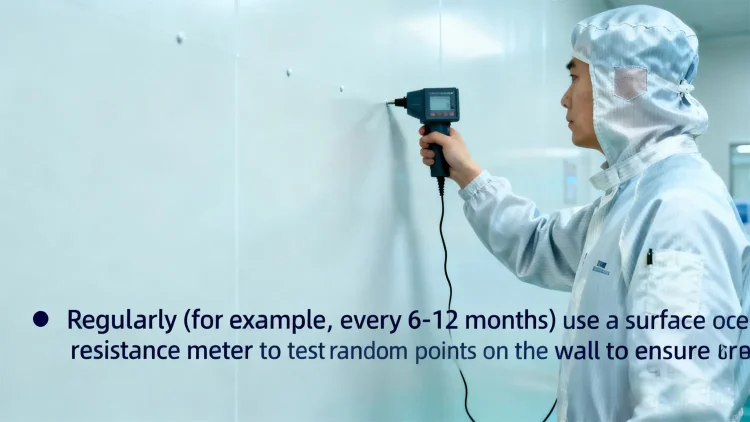
Regular testing is key to long-term "Cleanroom integrity" (cleanroom integrity).
Future Trends & Innovations
The world of ESD cleanroom panels isn't standing still. The future is smart and sustainable. We're seeing the emergence of panels with integrated nano-coatings that are simultaneously anti-microbial and super-durable. Smart panels with embedded sensors could one day provide real-time data on surface resistance and environmental conditions. Furthermore, the drive for circular economy is pushing manufacturers like Deiiang™ to develop fully recyclable panel systems and use bio-based resins, reducing the environmental footprint of these critical components without compromising performance.
Conclusion
ESD cleanroom panels are far more than just wall coverings; they are active, integral components of your contamination and electrostatic control strategy. Choosing the right type, installing it correctly, and maintaining it diligently are investments that pay dividends in product yield, operational safety, and facility longevity.
Ready to Fortify Your Cleanroom?
Don't leave your sensitive processes to chance. Get expert guidance tailored to your specific needs.
Deiiang™ – Engineering Confidence into Every Cleanroom.