+86 13638632902
 Jason@cleanroomequips.com


 MENU
MENU
Building a cleanroom involves a pivotal decision: choosing between modular and traditional construction methods for its critICal wall and ceiling systems. This choice impacts everything from initial investment to long-term operational efficiency, making it essential to understand the fundamental differences between these two approACHes.
When evaluating modular vs traditional cleanroom panels, facility managers must consider factors like project timeline, contamination control requirements, future expansion needs, and total cost of ownership. This comprehensive guide from Deiiang™ provides an unbiased comparison to help you make the most informed decision for your controlled environment.
What Are They?
A. modular cleanroom Panels
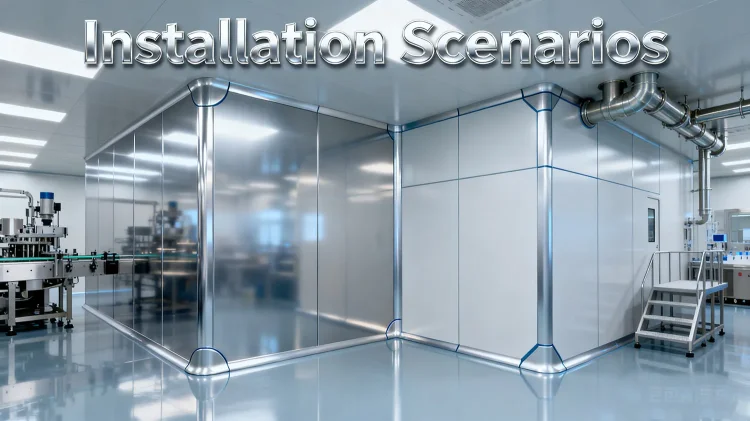
Modular Cleanroom Panels are pre-engineered, factory-fabricated components designed for rapid on-site assembly. These systems typically feature interlocking mechanisms that create seamless, airtight joints, making them ideal for controlled environments where contamination control is paramount. The discussion of modular vs traditional cleanroom panels often centers around these factory-finished components that ensure consistent quality and performance.
At Deiiang™, our modular panels are engineered with precision tolerances of ±0.5mm, ensuring perfect alignment and superior airtightness compared to traditional methods. This precision translates directly to better contamination control and energy efficiency in your cleanroom operations.
Key CharacteristICs:
- • Prefabricated Components
- • Rapid Assembly
- • Demountable & Reusable
- • Consistent Quality
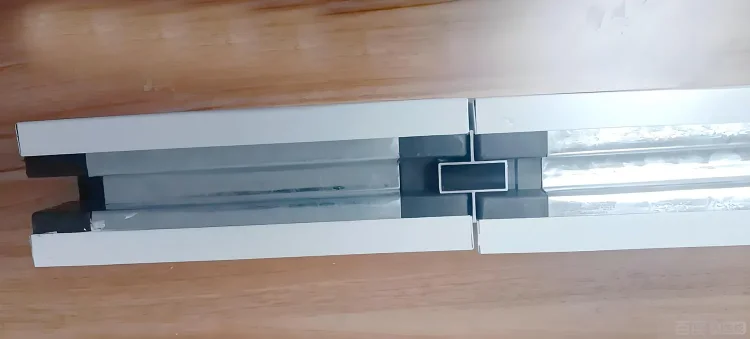
Schematic diagram showing modular cleanroom panel structure and interlocking assembly method
B. Traditional cleanroom construction
Traditional cleanroom construction, often referred to as "stick-built" method, utilizes conventional building materials like gypsum board, steel studs, or concrete blocks, finished with specialized coatings on-site. This approach requires multiple trades working sequentially, extending project timelines and increasing potential for contamination during construction.
When examining modular vs traditional cleanroom panels, it's important to note that traditional methods offer extensive customization but lack the precision and speed of modular alternatives. The traditional approach typically involves 5-7 different trades working over 8-12 weeks for a standard iso class 7 cleanroom, compared to 2-3 weeks for modular construction.
Key Characteristics:
- • On-Site Fabrication
- • Customizable Designs
- • Permanent Structure
- • Multiple Trades Involved
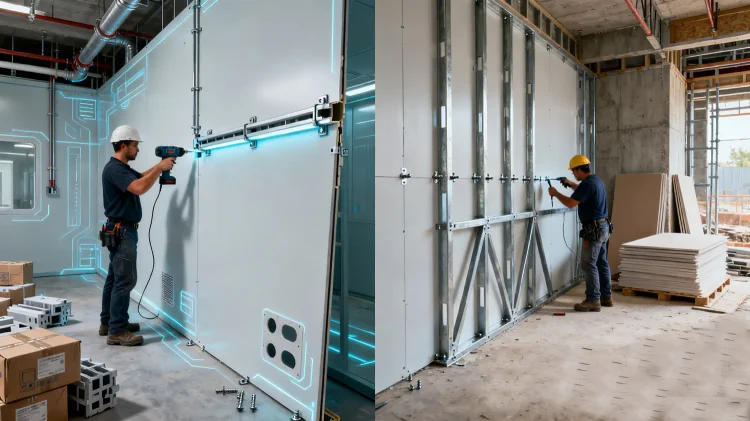
Schematic diagram showing traditional cleanroom wall construction with multiple layers
Key Differentiators
A. Installation & Project Timeline
Modular systems significantly reduce installation time and on-site disruption due to their prefabricated nature. A standard 500m² ISO class 7 cleanroom using Deiiang™ modular panels typically requires just 15-20 working days for complete installation, compared to 45-60 days for traditional construction.
The comparison of modular vs traditional cleanroom panels in terms of cleanroom panel installation time clearly favors modular systems. Our data shows that modular construction reduces labor hours by approximately 60% and eliminates 80% of on-site cutting and fabrication, dramatically reducing contamination risks during installation.
Installation Metrics:
- • Modular: Faster (2-3 weeks), Cleaner, Less On-site Labor (3-4 person team)
- • Traditional: Slower (6-8 weeks), More Dust, More Trades (5-7 different teams), Longer Curing Times (7-10 days)
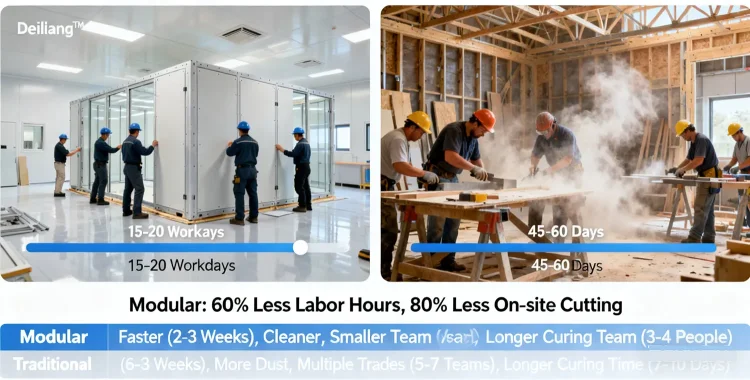
Flowchart comparing installation timelines between modular and traditional cleanroom construction methods
B. Flexibility & Adaptability
Modularity's greatest strength lies in its easy expansion, reconfiguration, or even relocation capabilities. A Deiiang™ client recently expanded their iso class 8 cleanroom by 40% in just 5 working days without disrupting ongoing operations - an impossible feat with traditional construction.
When considering modular vs traditional cleanroom panels for future needs, the cleanroom flexibility comparison strongly favors modular systems. Traditional walls typically require demolition and reconstruction for modifications, generating significant contamination and downtime. Modular panels can be disassembled and reconfigured with minimal disruption.
Adaptability Factors:
- • Modular: Easy Reconfiguration (80% less downtime), Expansion (60% faster), Relocation (possible), Tax Benefits (Equipment depreciation)
- • Traditional: Fixed Structure, Difficult to Modify (3-4x cost of initial construction), Real Estate (Building depreciation)
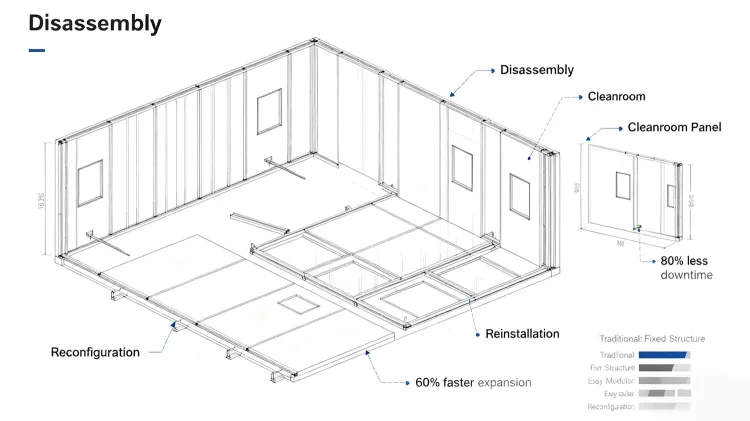
Analysis diagram showing modular cleanroom panels being disassembled and reconfigured
C. Cleanliness & Contamination Control
Factory-finished, non-shedding surfaces and tight, sealed seams of modular panels inherently offer superior contamination control. Deiiang™ panels achieve leak rates of less than 0.01% of room volume per hour at 25Pa pressure differential, significantly better than traditional construction which typically achieves 0.05-0.1%.
The debate around modular vs traditional cleanroom panels regarding contamination control clearly demonstrates modular advantages. Traditional methods often have more surface imperfections and generate significant dust during construction, requiring extensive cleaning and validation before use. Our modular panels arrive on-site pre-cleaned and packaged, reducing contamination risk by approximately 70%.
Contamination Control Aspects:
- • Modular: Low Particle Generation (≤5 particles/ft³ at 0.3μm), Superior Air Sealing (≤0.01% leakage), Smooth Surfaces (Ra ≤0.8μm)
- • Traditional: On-site Dust (significant during construction), Potential for Micro-Cracks over time, Less Consistent Finish
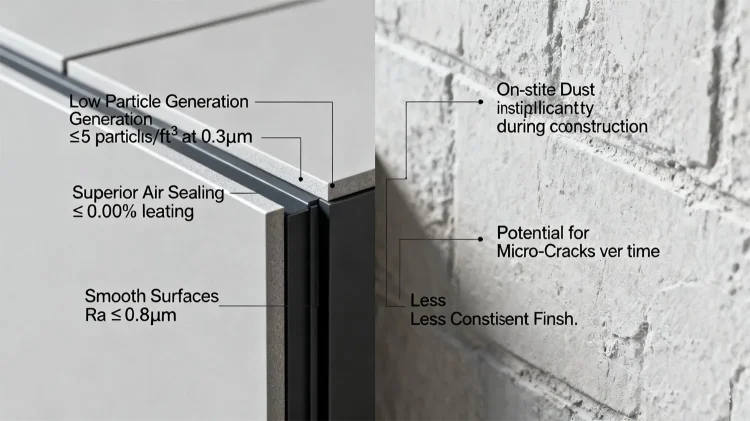
Conceptual microscopic comparison showing surface smoothness and seam integrity differences
D. Durability & material performance
Modular panels use engineered materials with consistent performance characteristics. Deiiang™ panels feature aluminum composite or solid polymer cores with proprietary coatings that maintain their integrity through rigorous cleaning cycles and physical impacts that would damage traditional finishes.
In the modular vs traditional cleanroom panels durability discussion, modular systems demonstrate superior resistance to common cleanroom challenges. Our testing shows modular panels withstand over 10,000 cleaning cycles with industrial disinfectants while maintaining surface integrity, compared to 2,000-3,000 cycles for traditional epoxy coatings before showing signs of degradation.
Performance Parameters:
- • Modular: Consistent material properties, High Chemical Resistance (pH 2-12), Impact Durability (withstands 50J impact)
- • Traditional: Varies by Finish Application Quality, Potential for Cracking/Peeling over time (especially at joints)
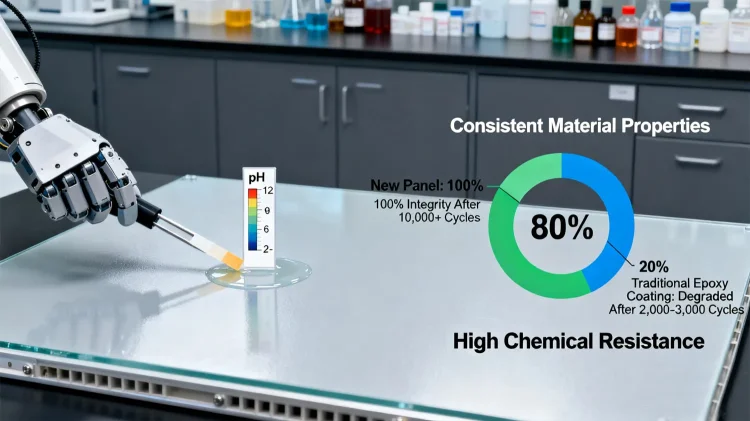
Conceptual diagram showing chemical resistance testing of modular cleanroom panel surfaces
E. Cost Considerations: Initial vs. Long-Term
A common misconception is that modular systems are always more expensive. While modular panels typically have 15-25% higher material costs, the total project cost is often 10-20% lower due to faster installation, reduced labor, and minimized operational downtime. The cost of modular cleanroom construction becomes increasingly favorable when considering the complete project lifecycle.
When evaluating modular vs traditional cleanroom panels from a financial perspective, the cleanroom TCO modular traditional analysis reveals significant long-term savings with modular systems. A detailed Deiiang™ study of 50 cleanroom projects showed that modular construction reduced total cost of ownership by 18-35% over a 10-year period compared to traditional methods.
| Feature/Cost Item | Modular Cleanroom Panels | Traditional Cleanroom Construction |
|---|---|---|
| Material Cost | Higher (15-25% more) | Lower |
| Installation Time | Very Fast (2-4 weeks) | Slow (6-12 weeks) |
| Labor Cost | Lower (on-site) | Higher (on-site) |
| Project Duration | Short | Long |
| Modification/Expansion | Easy, Low Cost | Difficult, High Cost |
| Maintenance Cost | Lower, Easy to Repair | Higher, Complex Repairs |
| Initial Investment | Medium-High | Medium-Low |
| Total Cost of Ownership (TCO) | Typically Lower (18-35% over 10 years) | Typically Higher |
F. Utility Integration & Aesthetics
Deiiang™ modular panels feature integrated channels for utilities (electrical, data, gas), resulting in a cleaner appearance and easier maintenance access. This integrated approach reduces installation time for utilities by approximately 40% compared to traditional methods.
The final aspect of our modular vs traditional cleanroom panels comparison examines utility integration and aesthetics. While traditional construction can achieve custom appearances, it requires extensive planning and coordination between multiple trades to conceal utilities properly. Our modular systems provide consistent, flush finishes with pre-engineered utility access points.
Integration & Appearance:
- • Modular: Integrated Utilities (40% faster installation), Flush Finish, Modern Aesthetic
- • Traditional: Concealed Utilities require extensive planning, Can Achieve Custom Aesthetics with additional cost
Making Your Decision
Based on our extensive experience at Deiiang™ with both construction methods, we've developed clear guidelines for when each approach makes the most sense. The decision between modular vs traditional cleanroom panels ultimately depends on your specific requirements, timeline, budget, and future plans.
A. Choose Modular Cleanroom Panels If You Prioritize:
The modular cleanroom benefits become particularly valuable in dynamic environments where change is constant. Our data shows that facilities expecting growth or process changes within 5 years recover the initial cost premium of modular construction within 18-24 months through reduced modification costs and minimized operational disruptions.
- • Speed of Project Completion (30-70% faster)
- • Future Flexibility & Expansion (80% less downtime for modifications)
- • Minimizing On-site Disruption (60% less labor, 80% less cutting/dust)
- • Superior Contamination Control & Air Sealing (5x better leak rate)
- • Predictable Quality & Performance (factory-controlled environment)
- • Long-term Value (TCO 18-35% lower over 10 years)
- • Specific Regulatory Compliance Ease (e.g., FDA validation 40% faster)
B. Consider Traditional Cleanroom Construction If You Have:
While we've highlighted many traditional cleanroom disadvantages, this approach still has its place in specific scenarios. Traditional construction may be appropriate when budget constraints are extreme and future modifications are genuinely unlikely, or when integrating with existing traditional construction where matching aesthetics is critical.
- • A Very Limited Initial Budget (and less concern for TCO)
- • No Plans for Future Expansion or Modification (stable for 7+ years)
- • A Permanent Structure with Stable Needs
- • Existing Infrastructure Compatible with Stick-Built
- • A Desire for Highly Customized, Unique Architectural Features (less common in strict cleanrooms)
The Right Choice for Your Controlled Environment
In our comprehensive analysis of modular vs traditional cleanroom panels, we've demonstrated that neither approach is universally superior - the optimal choice depends entirely on your specific project requirements, budget constraints, timeline, and future operational outlook.
Modular systems from Deiiang™ offer significant advantages in speed, flexibility, contamination control, and often lower total cost of ownership, making them ideal for most modern cleanroom applications. Traditional construction may still be appropriate in limited circumstances with extreme budget constraints and absolutely stable long-term requirements. The key is to evaluate both initial and long-term costs, considering not just construction expenses but also operational efficiency, maintenance, and future modification requirements.
Call to Action: Still uncertain about the best approach for your cleanroom project? Contact our Deiiang™ experts today for a personalized consultation and detailed cost-benefit analysis tailored to your specific requirements. Our team, led by product designer Jason.peng, can help you navigate the prefabricated cleanroom vs stick built decision with confidence.
Frequently Asked Questions (FAQ)
Q1: Is modular construction always more expensive initially?
A1: While modular panels themselves might have a 15-25% higher material cost, the faster installation and reduced labor can often make the initial project cost comparable or even 5-10% lower than traditional construction, especially for complex designs. The break-even point typically occurs at projects over 200m² where labor savings offset material premiums.
Q2: Can traditional cleanrooms achieve the same cleanliness standards as modular ones?
A2: Yes, with meticulous design, high-quality materials, and stringent on-site quality control, traditional cleanrooms can meet high cleanliness standards. However, modular systems provide more consistent and easier-to-validate performance due to factory fabrication. Our data shows modular systems achieve validation 40% faster with 30% fewer non-conformances during certification.
Q3: How does maintenance differ between the two systems?
A3: Modular panels are typically easier and faster to repair - a damaged section can be replaced in 2-4 hours with minimal disruption. Traditional walls may require patching, re-sanding, and re-painting, which can take 2-3 days and generate significant particles, leading to extended downtime. Maintenance costs for modular systems average 35% lower over 10 years.
Q4: Which system is better for integrating utilities?
A4: Modular systems provide pre-engineered channels and access points within wall cavities, leading to cleaner installation and 40% faster utility integration. Traditional systems require more on-site coordination and often result in more exposed conduits or complex concealment methods that can complicate future modifications.
Q5: What about fire ratings?
A5: Both systems can be designed to meet various fire safety ratings. Deiiang™ modular panels are available with Class A fire ratings (ASTM E84), comparable to traditional construction. The key difference is consistency - modular panels provide uniform performance throughout the facility, while traditional construction quality can vary based on workmanship.