MENU
X

Pharmaceutical Modular Cleanroom Layout: Design Guide for GMP Compliance

  • Author:Jason Peng

  • Cleanroom Engineering Technology Manager of Deiiang Company.

    Product R&D Manager of GDC Inc. Cleanroom Equipment Manufacturing Company.

    Executive Director of Guangdong Cleanroom Industry Association of China.

    Engaged in R&D of related products for 15 years, with rich relevant technical experience

  • 2025-11-11  |  Visits:

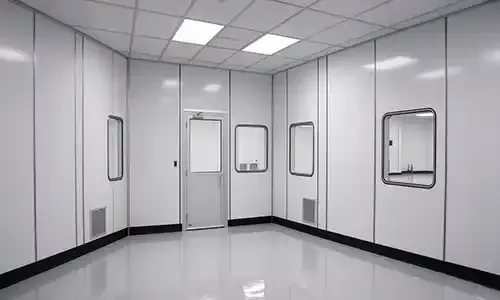
Pharmaceutical Modular Cleanroom Layout.png

Introduction

Cleanrooms are critical environments in pharmaceutical manufacturing, directly impacting product quality, patient safety, and regulatory compliance. A properly designed pharmaceutical modular cleanroom layout ensures controlled environments where airborne particles, temperature, humidity, and pressure are meticulously regulated.

The pharmaceutical modular cleanroom layout approach offers prefabricated, flexible solutions that can be rapidly installed with minimal disruption to existing operations. This comprehensive guide explores the key considerations for designing an effective pharmaceutical modular cleanroom layout that meets stringent regulatory requirements while optimizing operational efficiency.

What is a Modular Cleanroom?

A modular cleanroom is a prefabricated controlled environment constructed from standardized components that can be easily assembled, disassembled, and reconfigured. Unlike traditional built-in-place cleanrooms, modular designs offer greater flexibility and faster deployment.

Why Pharmaceutical industry Prefers Modular Cleanrooms?

The pharmaceutical industry increasingly adopts modular cleanrooms due to their cost-effectiveness, reduced construction timelines (typically 30-50% faster than traditional builds), scalability, and ease of validation. These advantages make them particularly suitable for pharmaceutical applications where regulatory compliance and time-to-market are critical factors.

Unique Advantages of Modular Cleanrooms in Pharmaceutical Applications

When considering a pharmaceutical modular cleanroom layout, several distinct advantages become apparent. The prefabricated nature of these systems offers significant benefits over traditional construction methods, particularly in the highly regulated pharmaceutical sector. A well-planned pharmaceutical modular cleanroom layout can reduce validation time by up to 40% compared to traditional builds.

Rapid Deployment & Shorter Project Timelines

Modular cleanrooms can be deployed 30-50% faster than traditional construction. While conventional cleanrooms might require 6-12 months for completion, a comparable modular facility can often be operational within 3-6 months. This accelerated timeline results from parallel processes: site preparation occurs simultaneously with module fabrication at the manufacturer's facility.

Cost Efficiency & Return on Investment

Modular cleanrooms typically offer 15-30% cost savings over traditional construction. A comprehensive analysis by Deiiang™ shows that for a 500m² ISO 7 facility, the total cost of ownership over 5 years is approximately $1.2M for modular vs. $1.6M for traditional construction. The payback period for the incremental investment in a high-quality pharmaceutical modular cleanroom layout averages 18-24 months.

Flexibility & Scalability

Modular designs allow for easy reconfiguration and expansion. A pharmaceutical company can start with a 200m² facility and expand to 400m² with minimal disruption (typically 2-3 weeks vs. 3-4 months for traditional expansion). This scalability is particularly valuable for pharmaceutical companies with evolving product portfolios or uncertain production volumes.

Quality Control & Consistency

Factory-controlled manufacturing environments ensure higher quality consistency compared to on-site construction. At Deiiang™, each module undergoes 27 quality checkpoints before shipment, resulting in defect rates below 0.5% compared to 3-5% typical in traditional construction.

Easier Regulatory Compliance

The standardized design and documentation of modular cleanrooms streamline the validation process. Our data shows that facilities using Deiiang™ pharmaceutical modular cleanroom layout solutions reduce validation documentation preparation time by approximately 35%.

Modular vs. Traditional Cleanroom Comparison

ParameterModular CleanroomTraditional Cleanroom
Construction Timeline3-6 months6-12 months
Cost (500m² ISO 7)$800K - $1.2M$1.1M - $1.6M
Flexibility for ModificationHigh (weeks)Low (months)
Quality ControlFactory-controlled (0.5% defects)Site-dependent (3-5% defects)
Production DisruptionMinimalSignificant

Core Advantages Infographic

30-50%
Faster Deployment
15-30%
Cost Savings
40%
Faster Validation
0.5%
Defect Rate

Key Considerations for Pharmaceutical Modular Cleanroom Layout Design

Designing an effective pharmaceutical modular cleanroom layout requires careful consideration of multiple factors to ensure regulatory compliance, operational efficiency, and product quality. A successful pharmaceutical modular cleanroom layout balances technical requirements with practical workflow considerations.

2.1 Regulatory Compliance & Cleanliness Classification

Pharmaceutical cleanrooms must comply with Good Manufacturing Practice (GMP) regulations from agencies like FDA, EMA, and other national authorities. These regulations mandate specific environmental controls to ensure product safety and quality.

GMP Requirements

GMP guidelines specify requirements for air quality, surface finishes, monitoring systems, and documentation. For instance, EU GMP Annex 1 requires continuous monitoring of particles ≥0.5μm and ≥5.0μm in Grade A zones, with alerts for excursions beyond established limits.

ISO 14644 Standards

The ISO 14644 standard classifies cleanrooms by the maximum allowable particle concentrations. For pharmaceutical applications:

  • ISO 5 (Grade A): Critical zones for high-risk operations (max 3,520 particles/m³ for ≥0.5μm)
  • ISO 7 (Grade B): Background for Grade A zones (max 352,000 particles/m³ for ≥0.5μm)
  • ISO 8 (Grade C/D): Less critical areas (max 3,520,000 particles/m³ for ≥0.5μm)

Zone Classification Diagram

Grade A (ISO 5)

High-risk operations: Aseptic filling, stopper bowls, open vials/ampoules

Grade B (ISO 7)

Background for Grade A zones: Aseptic preparation and filling

Grade C (ISO 8)

Less critical stages: Preparation of solutions

Key Environmental Parameters

  • Temperature: Typically 20-24°C (±2°C)
  • Relative humidity: 45-55% (±5%) for most applications
  • Pressure Differentials: Minimum 10-15 Pa between adjacent cleanliness grades
  • air changes: ISO 5: 240-600 ACH; ISO 7: 30-70 ACH; ISO 8: 10-25 ACH

2.2 Personnel and Material Flow Design

Proper flow design is critical to prevent cross-contamination in pharmaceutical manufacturing. A well-designed pharmaceutical modular cleanroom layout establishes unidirectional flows that separate personnel, materials, and waste streams.

Personnel Flow Path

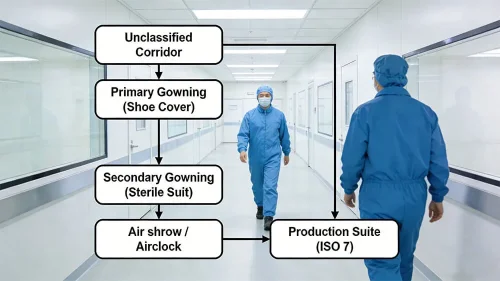
Personnel should follow a sequential gowning procedure through airlocks, moving from lower to higher cleanliness areas. A typical sequence includes: Street clothes → Change area → Gowning area (ISO 8) → Airlock → Cleanroom (ISO 7) → Critical area (ISO 5). Deiiang™ designs incorporate visual indicators and interlocking doors to enforce proper flow.

Personnel Flow Diagram
Non-controlled Area
Change Area
Gowning Area (ISO 8)
Airlock
Cleanroom (ISO 7/5)

Material Flow Path

Materials should follow a unidirectional path from receipt through processing to packaging. Key elements include:

  • Dedicated receiving areas with quarantine zones
  • Material airlocks with interlocking doors
  • Pass-through chambers with UV decontamination
  • Dedicated exit paths for finished products
Material Flow Diagram
Receiving
Quarantine
Material Airlock
Storage
Processing
Packaging

Waste Flow Path

Waste should follow a dedicated exit path that doesn't cross with material or personnel flows. This typically involves dedicated waste airlocks or pass-throughs with appropriate containment measures.

2.3 HVAC System & Air Purification

The HVAC system is the heart of any cleanroom, responsible for maintaining the required environmental conditions. In a pharmaceutical modular cleanroom layout, HVAC design must ensure proper air distribution, filtration, and pressure control.

Air Handling Units (AHUs)

AHUs for pharmaceutical cleanrooms typically include multiple filtration stages: pre-filters (G4/F5), intermediate filters (F7/F9), and terminal HEPA/ULPA filters. For a 500m² ISO 7 facility, the AHU capacity is typically 25,000-35,000 m³/h, depending on room height and air change requirements.

Filtration System

HEPA filters (99.97% efficient for 0.3μm particles) are standard for ISO 5-8 areas. ULPA filters (99.999% efficient for 0.12-0.17μm particles) may be used for critical applications. Filter integrity testing should be performed every 6-12 months.

Pressure Control

Pressure differentials between adjacent areas should be maintained at 10-15 Pa, with higher pressure in cleaner areas. This is typically achieved through airflow balancing and automatic control systems that modulate supply or exhaust airflow based on pressure sensor readings.

Airflow Patterns

  • Unidirectional (Laminar) Flow: Parallel streamlines with minimal cross-contamination (used in Grade A zones)
  • Turbulent (Non-unidirectional) Flow: Mixed air patterns with higher contamination risk (used in Grade B-D areas)
HVAC System Schematic
Outside Air
Pre-filters (G4)
Cooling/Heating Coils
Intermediate Filters (F7-F9)
Fan Section
Ductwork
Terminal HEPA/ULPA Filters

2.4 Space Planning & Equipment Layout

Effective space planning in a pharmaceutical modular cleanroom layout optimizes workflow while ensuring adequate space for equipment, personnel movement, and maintenance access. The design should follow a logical process flow from raw material to finished product.

Process Flow Analysis

Understanding the manufacturing process is essential for optimal layout. For example, a sterile filling line requires sequential areas for: Component preparation → Solution preparation → Filling → Stoppering → Capping → Inspection → Packaging.

Equipment Dimensions & Operational Space

Equipment should be positioned with adequate clearance for operation, maintenance, and cleaning. A general rule is to allow at least 1-1.5 meters around equipment for safe access. Critical equipment like filling machines may require additional space for parts replacement and calibration.

Ergonomics

Workstations should be designed to minimize operator fatigue and contamination risk. This includes appropriate counter heights (typically 900-1100mm), adequate lighting (500-750 lux in critical areas), and comfortable working postures.

Future Expansion Provisions

Modular designs excel at accommodating future expansion. A well-planned pharmaceutical modular cleanroom layout might include:

  • Pre-planned utility connections for additional equipment
  • Structural capacity for future mezzanines or additional modules
  • Flexible partition walls that can be repositioned
Example Cleanroom Layout
ISO 8 Area
  • Changing Rooms
  • Material Airlock
  • Equipment Storage
ISO 7 Area
ISO 5 Area
  • Filling Line
  • Stoppering Station
  • Aseptic Connections

2.5 Building Materials & Surface Finishes

Materials used in pharmaceutical cleanrooms must be smooth, non-shedding, easy to clean, and resistant to cleaning chemicals. The selection of appropriate materials is critical for maintaining cleanliness and complying with GMP requirements.

Material TypeAdvantagesDisadvantagesApplications
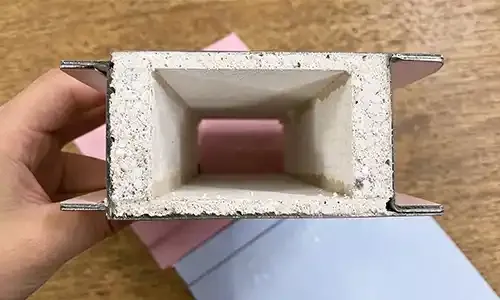
EPS Sandwich PanelLightweight, good insulation, cost-effectiveLower fire rating, limited chemical resistanceISO 7/8 areas, non-critical applications
PU Sandwich PanelExcellent insulation, good fire ratingHigher cost than EPSMost pharmaceutical applications
Rockwool Sandwich PanelExcellent fire resistance, good sound insulationHeavier, higher costAreas with high fire safety requirements
Stainless SteelExcellent durability, chemical resistanceHigh cost, difficult to modifyCritical surfaces, high-wear areas
PVC flooringSeamless, chemical resistant, easy to cleanCan be damaged by heavy equipmentMost Cleanroom flooring applications

Doors & Windows

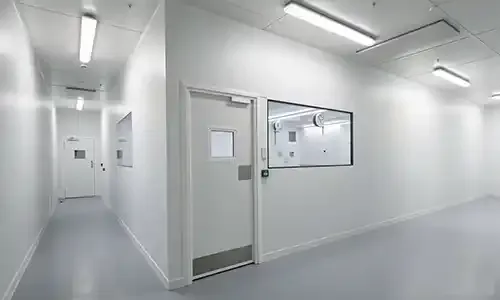
Cleanroom doors should be interlocking to prevent simultaneous opening of adjacent spaces. Windows should be flush-mounted with the wall surface to avoid dust accumulation ledges. Deiiang™ typically uses aluminum frames with tempered glass for cleanroom doors and windows.

2.6 Utility Services & Maintenance Access

Proper planning of utility services and maintenance access is essential for operational efficiency and regulatory compliance. A well-designed pharmaceutical modular cleanroom layout incorporates these elements without compromising cleanliness.

Utility Services

Pharmaceutical cleanrooms require various utilities, including:

  • Purified Water (PW): Conductivity<1.3 μS/cm at 25°C
  • Water for Injection (WFI): Meets pharmacopeial requirements
  • Compressed Air: Oil-free, with dew point ≤-40°C
  • Process Gases: Nitrogen, oxygen, etc., with appropriate purity grades
  • Electrical Power: With backup systems for critical equipment

Maintenance Access

Adequate access must be provided for maintenance of equipment, utilities, and CleanRoom infrastructure. This includes:

  • Service voids above ceilings for HVAC and utilities
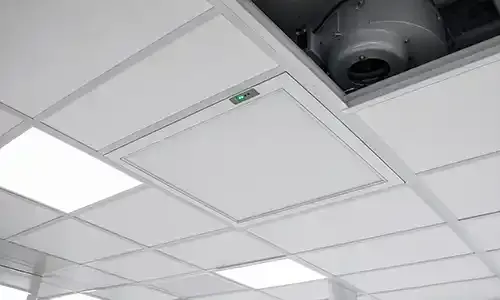
  • Access panels for filter replacement and ductwork inspection
  • Clear pathways for equipment removal and replacement
Utility Distribution Schematic
Utility Source
Distribution Piping
Service Corridor
Vertical Penetrations
Cleanroom Use Points

Case Studies: Typical Pharmaceutical Production Cleanroom Layouts

Examining real-world examples helps illustrate how the principles of pharmaceutical modular cleanroom Layout Design are applied in practice. These case studies demonstrate solutions for different pharmaceutical manufacturing applications.

Sterile Formulation (Injectable) Cleanroom Layout

Sterile injectable production requires the highest level of environmental control to prevent microbial contamination. A typical layout for a vial filling line includes:

Sterile Filling Line Layout
Grade A (ISO 5)
  • Vial filling machine
  • Stoppering station
  • Sealing station
Grade B (ISO 7)
  • Component preparation
  • Solution preparation
  • Filling area background
Grade C (ISO 8)
  • Component washing
  • Equipment storage
  • Personnel changing

Key Features: Unidirectional personnel and material flow, RABS/isolator technology for Grade A operations, integrated Environmental monitoring system.

Solid Dosage (Tablets, Capsules) Cleanroom Layout

Solid dosage manufacturing focuses on preventing cross-contamination and controlling dust generation. A typical layout includes:

Solid Dosage Manufacturing Layout
Weighing & Dispensing
  • Dedicated weighing booths
  • Material airlocks
  • Dust extraction systems
Granulation & Blending
  • High-containment systems
  • Dedicated air handling
  • Material transfer systems
Compression & Encapsulation
  • Tablet presses
  • Capsule fillers
  • Dedicated exhaust
Coating & Packaging
  • Coating pans
  • Blister packaging
  • Bottling lines

Key Features: Containment solutions for potent compounds, dedicated production suites for different products, efficient material flow to minimize cross-contamination risk.

Biologics Production Cleanroom Layout

Biologics manufacturing combines cleanroom requirements with biosafety considerations. A typical layout for monoclonal antibody production includes:

Biologics Production Layout
Cell Culture (BSL-2)
  • Bioreactors
  • Incubators
  • Biosafety cabinets
Purification (ISO 7)
  • Chromatography systems
  • Filtration systems
  • Buffer preparation
Formulation & Fill (ISO 5/7)
  • Formulation tanks
  • Filling lines
  • Lyophilizers

Key Features: Integration of biosafety levels with CleanRoom Classifications, specialized waste handling for biological materials, containment for viral vectors.

From Design to Validation: Modular Cleanroom Project Implementation Process

Successfully implementing a pharmaceutical modular cleanroom layout requires a structured approach from initial concept through final validation. Deiiang™ follows a proven 5-phase methodology to ensure project success.

Project Implementation Flowchart
1
Requirements Analysis & Conceptual Design

Understanding client needs, regulatory requirements, and process flows to develop initial concepts. Duration: 2-4 weeks.

2
Detailed Engineering Design

Developing comprehensive design documents including structural, HVAC, electrical, and control systems. Duration: 4-8 weeks.

3
Modular Fabrication & Site Preparation

Factory fabrication of cleanroom modules while site preparation occurs in parallel. Duration: 6-12 weeks.

4
Installation & Commissioning

Module installation, utility connections, and system commissioning. Duration: 2-4 weeks.

5
Qualification & Validation (IQ/OQ/PQ)

Installation Qualification, Operational Qualification, and Performance Qualification to demonstrate GMP compliance. Duration: 4-8 weeks.

Key Success Factors

  • Early Regulatory Engagement: Consulting with regulatory experts during design phase reduces compliance risks
  • Stakeholder Involvement: Engaging operations, maintenance, and quality teams throughout the project
  • Risk Management: Proactive identification and mitigation of project risks
  • Change Control: Formal processes for managing design changes

Conclusion

A well-designed pharmaceutical modular cleanroom layout offers significant advantages for pharmaceutical manufacturers, including faster deployment, cost savings, flexibility, and easier regulatory compliance. By carefully considering factors such as regulatory requirements, workflow optimization, HVAC design, and material selection, companies can create controlled environments that ensure product quality and patient safety.

The modular approach to cleanroom construction aligns perfectly with the pharmaceutical industry's need for agility, compliance, and efficiency. As regulatory requirements continue to evolve and production demands increase, modular cleanrooms provide a sustainable solution that can adapt to changing needs.

Ready to Optimize Your Pharmaceutical Cleanroom?

Contact our experts at Deiiang™ for a customized solution that meets your specific requirements.

Request a Consultation                    Download White Paper

Product Designer: Jason.peng

Frequently Asked Questions (FAQ)

What is the typical ROI period for a modular cleanroom investment?

The return on investment for modular cleanrooms typically ranges from 18-36 months, depending on the application and scale. Factors influencing ROI include reduced construction time, lower operational costs, and minimized production disruption during implementation.

How do you ensure modular cleanrooms comply with the latest GMP Standards?

Deiiang™ maintains a dedicated regulatory compliance team that continuously monitors updates to GMP Standards worldwide. Our design templates incorporate current requirements, and we perform gap analyses against new regulations before each project. We also engage with regulatory experts during the design phase to address specific compliance concerns.

What are the maintenance costs for modular cleanrooms?

Maintenance costs for modular cleanrooms are typically 15-25% lower than traditional cleanrooms due to standardized components and easier access for maintenance. Annual maintenance costs average $50-100 per square meter, depending on the CleanRoom Classification and operational intensity.

What cleanroom classifications can you design and build?

Deiiang™ designs and builds cleanrooms across all classifications, from ISO 9 to ISO 4 (Class 10), including specialized environments for aseptic processing, potent compound handling, and biological safety requirements. Our expertise covers the full spectrum of pharmaceutical manufacturing applications.

What is the typical project timeline for a modular cleanroom?

Project timelines vary based on size and complexity, but typical durations are: Small projects (≤100m²): 12-16 weeks; Medium projects (100-500m²): 16-24 weeks; Large projects (≥500m²): 24-36 weeks. These timelines are 30-50% faster than traditional construction methods.

Can modular cleanrooms be relocated or expanded?

Yes, one of the key advantages of modular cleanrooms is their relocatability and expandability. Modules can be disassembled, relocated, and reassembled with minimal loss of components. Expansion typically involves adding new modules to existing structures, with minimal disruption to ongoing operations.

Cleanroom Insiders Expert Team

Deiiang's expert team specializes in designing and constructing state-of-the-art cleanrooms tailored to meet diverse industry needs. With a focus on innovation and compliance, we deliver pristine environments that ensure operational excellence and product integrity.