+86 13638632902
 Jason@cleanroomequips.com


 MENU
MENU
The Noise Challenge & Acoustic Needs in cleanrooms
Let's be honest, cleanrooms aren't exactly known for their peace and quiet. It's a constant symphony of whirring ffus, roaring HVAC systems, and humming production equipment. But this isn't just background noise—it's a productivity killer and a quality risk. That's where a strategic solution comes in. Investing in high-performance Soundproof cleanroom panels is the smart move to turn down the volume on your operational challenges.
Why Do Cleanrooms Need Strict Acoustic Control?
Picture this: an operator on a 12-hour shift, constantly bombarded by 70-decibel noise (that's like a loud vacuum cleaner). Fatigue sets in faster, focus drifts, and the chance of human error creeps up. For sensitive processes in biopharma or Microelectronics, even minor vibrations from noise can affect precision equipment. Moreover, regulations (think FDA guidelines for aseptic processing) are starting to put limits on environmental noise for worker safety. Properly specified Soundproof Cleanroom Panels directly address these pain points, creating an environment where both people and processes can perform at their peak.
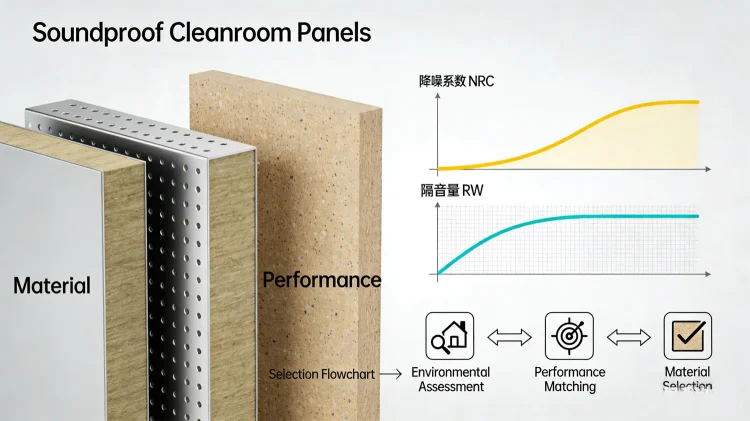
What Are Soundproof Cleanroom Panels?
Think of them as the "Swiss Army knife" of wall systems. They're not just a slab of material; they're an integrated system. At their heart, Soundproof Cleanroom Panels must master a tricky balancing act: providing a perfectly cleanable, non-particulate shedding surface while packing enough mass and clever design to block sound. The core challenge? Cleanliness demands seamless, non-porous surfaces, while acoustics often loves layers, density, and dampening. The best panels, like those engineered by Deiiang™, fuse these needs seamlessly.
Advantages of Soundproof Cleanroom Panels
Here’s the good stuff you get when you choose the right panel system:
- ✅ Noise Reduction: ACHieve measurable silence. For instance, a panel with an STC 45 rating can reduce loud machinery noise (85 dB) to a gentle conversation level (40 dB).
- ✅ Cleanability: Seamless, coved surfaces withstand harsh disinfectants like IPA and hydrogen peroxide vapor.
- ✅ Fire Safety: Core materials like mineral wool offer inherent A-grade (non-combustible) fire resistance.
- ✅ Eco-Friendly: Many use recycled content and are themselves recyclable at end-of-life.
- ✅ Fast Installation: Modular design means faster build times. A skilled crew can install over 500 sqm per day.
- ✅ Durability & Aesthetics: A robust, long-lasting finish that looks professional and modern.
Technical Core: Key Metrics Explained
Navigating acoustic specs can feel like reading another language. Let's decode it. Performance isn't just about thickness; it's about how the material handles sound waves. For Soundproof Cleanroom Panels, two metrics are your best friends. Remember, at Deiiang™, we provide full lab test reports so you know exactly what you're getting.
The Essential Acoustic Metrics
STC (Sound Transmission Class): This is the blocking power. It measures how well a panel prevents sound from traveling through it. A higher STC means better blocking. For most cleanrooms dealing with equipment noise, you'll want panels with an STC of 40 or higher.
NRC (Noise Reduction Coefficient): This is the absorbing power. It rates how much sound a surface soaks up to reduce echo inside the room. An NRC of 0.8 means it absorbs 80% of the sound that hits it.
Deep Dive: How Do They Work?
The magic lies in physics, not magic. Sound is energy traveling through vibrations. The core principle is the Mass Law—basically, the heavier and denser a wall, the harder it is for sound to shake it and pass through. But just adding mass is inefficient. That's where Damping comes in—special viscoelastic materials inside the panel convert that sound vibration energy into tiny amounts of heat, effectively "trapping" the sound.
Anatomy of a High-Performance Panel
A typical Deiiang™ Soundproof Cleanroom Panel is a precision sandwich:
- Outer Skin: Stainless steel, coated steel, or composite. Provides the clean, wipeable surface.
- Core: High-density mineral wool or specialized acoustic foam. The "engine" of sound absorption.
- Inner Skin & Seal: Another metal sheet, with integrated tongue-and-groove joints and acoustic gaskets to ensure an airtight seal.
Structural diagram of a composite soundproof panel
Key Performance Numbers: A standard 75mm thick mineral wool panel might achieve an STC of 42 and an IIC (Impact Insulation Class) of 45 for footfall noise. Its smooth, baked-on epoxy finish ensures compliance with iso class 5 (iso 14644) cleanroom standards by minimizing particle shedding.
Types of Soundproof Cleanroom Panels
One size does not fit all. The right Soundproof Cleanroom Panels for your project depend on your specific cocktail of needs: budget, cleanliness class, fire codes, and of course, decibel targets.
| Classification Basis | Common Types | Best For |
|---|---|---|
| By Core Material | Mineral Wool, Fiberglass, Damped Honeycomb, Composite Foam | Balancing cost, performance, and weight. |
| By Surface | Stainless Steel, Powder-Coated Steel, PVC, HPL | Chemical resistance and cleanability needs. |
| By Application | Pharma/Bio, Electronics (ESD-safe), Food & Beverage, Research Labs | Industry-specific regulatory compliance. |
Where Are They Used? (Applications)
From life-saving drugs to the latest Microchip, quiet precision matters. Here’s where Soundproof Cleanroom Panels make a dramatic difference:
- Pharma/Biotech: Reducing noise in vial filling lines (often >80 dB) to protect operator hearing and focus.
- Microelectronics: Damping vibration and acoustic interference in lithography and metrology suites.
- Medical Device Manufacturing: Ensuring a calm, controlled environment for assembly of delicate implants.
- Research Labs: Creating "quiet zones" for sensitive analytical instruments like electron microscopes.

Material & Structure Showdown
Choosing the right core is crucial. It’s the heart of your Soundproof Cleanroom Panels system. Let’s compare the heavyweights.
High-Density Mineral Wool Core Panels
The industry workhorse for a reason. The dense, interlocked fiber structure is fantastic at trapping sound waves and converting their energy into heat through friction. It's also naturally A-grade fireproof and non-hygroscopic. "In one project," shares Jason.peng of Deiiang™, "we used 100mm thick mineral wool panels to achieve an STC 52, effectively isolating a noisy compressor room next to an iso 7 cleanroom."
Damped Honeycomb composite panels
The lightweight champion. An aluminum honeycomb core offers great structural rigidity with minimal weight. By laminating viscoelastic damping layers to the honeycomb, you get a panel that's excellent at suppressing resonant vibration—a common issue with large, thin wall surfaces. Ideal for retrofit projects where floor loading is a concern.
| Core Material | Typical STC Range | Typical Thickness | Cleanliness | Fire Rating |
|---|---|---|---|---|
| Mineral Wool | 40 - 55 | 50mm - 150mm | Excellent | A (Non-Combustible) |
| Damped Honeycomb | 35 - 48 | 50mm - 100mm | Excellent | B / A (depends on skin) |
| High-Density Fiberglass | 38 - 50 | 75mm - 125mm | Very Good | A |
Note: STC values are system-dependent and include the effect of seals and joints.
Design & Installation: The Devil's in the Details
Here's the secret: a panel with an STC 50 rating can perform like an STC 30 if installed poorly. Why? Sound flanking. Sound is lazy; it finds the easiest path—through gaps, unsealed penetrations, or structural connections. Your brilliant Soundproof Cleanroom Panels are only as good as their weakest seal.
This is why the selection of your Soundproof Cleanroom Panels must go hand-in-hand with a rigorous installation specification. A holistic approach is non-negotiable.
Critical Installation Detail: The Seal
The tongue-and-groove joint is your first defense. But the real hero is the acoustic gasket—a high-density foam or rubber strip that compresses between panels, creating an airtight seal. For penetrations and corners, non-hardening acoustic sealant is a must. Imagine a 1mm gap around a panel: it can reduce the effective STC by up to 5 points! That's a huge performance leak.
Compliance: Cleanliness + Acoustics
The surface must be monolithic, non-porous, and capable of withstanding repeated cleaning with aggressive agents. ISO 14644 is your guide here. PVDF or high-quality epoxy coatings, as used on Deiiang™ panels, offer the perfect blend of cleanability and durability without compromising the acoustic integrity of the underlying core.
Procurement & Long-Term Care
Buying Soundproof Cleanroom Panels isn't like buying office furniture. Look beyond the brochure STC number. Ask for independent lab test reports (ASTM E90, E413) for the complete wall system, including the proposed joint detail. Does the supplier offer installation supervision? This can be worth its weight in gold.
Maintenance for Lifelong Performance
Thankfully, it's simple. The main task is periodic visual inspection of the seals, especially after room washdowns or significant temperature fluctuations. Check for any compression set in gaskets or cracks in sealant. Clean with recommended, non-abrasive cleaners to preserve the surface coating. Properly maintained, a quality Soundproof Cleanroom Panel system from a trusted partner like Deiiang™ should deliver peak performance for 20+ years.
Conclusion: Making the Right Choice
Selecting the ideal Soundproof Cleanroom Panels is a multi-variable equation balancing acoustic performance (STC/IIC), cleanroom compliance (iso class), fire safety, and total cost of ownership. There's no universal answer, but there is a universal process: define your requirements, understand the materials, scrutinize the test data, and plan for flawless installation.
Ready to silence your noise challenges and protect your process purity?
Contact Deiiang™ today. Our team, led by experts like Jason.peng, provides free acoustic consultation and can guide you to the optimal Soundproof Cleanroom Panel solution for your unique project.