I've seen too many cleanroom projects go over budget simply because the modular layout wasn't planned before the concrete was poured. It’s not just about buying panels; it’s about "modular coordination." If you ignore the standard sizing, you'll end up cutting panels on-site, creating dust, and throwing away money. This guide cuts through the noise to give you the practICal data you need on length, width, and thickness for smart engineering.
Field Note: Smart Proper modular planning can realistically reduce your material waste by over 15%. When you are calculating your Cleanroom Panel Dimensions, always account for the effective width versus the total width. A common error I see is failing to subtract the tongue-and-groove or joint overlap, which inevitably leaves the installation team short on coverage at the end of a run.
Why 1150mm is the Industry Standard
While you may encounter various specifications in the market, 1150mm has emerged as the dominant standard for one primary reason: LogistICs efficiency. Standard shipping containers have specific internal width limits; 1150mm panels stack perfectly side-by-side, maximizing payload and eliminating "shipping air." Beyond freight, this width integrates seamlessly with standard door frames and viewing Windows. Unless your facility has rigid, pre-existing constraints, we strongly advise sticking to 1150mm to optimize your budget.
-
The Gold Standard: 1150 mm (approx. 45.3 inches) - Highly Recommended
-
Legacy Sizes: 980 mm or 1180 mm (Often requires custom tooling)
-
Real Coverage: Nominal width minus the 10-15mm tongue-and-groove
A critical note on retrofits: Matching new panels to existing walls requires precision. Older facilities frequently utilized non-standard sizes like 980mm. When calculating cleanroom panel dimensions for an expansion project, establish your modular grid immediately. Forcing standard panels into a legacy grid often results in extensive on-site cutting, which increases labor costs and introduces contamination risks. At Deiiang™, while we standardize on 1150mm for speed and cost-efficiency, we retain the capability to re-tool for custom widths if your specific site conditions require it.
The "Hidden" Joint Loss
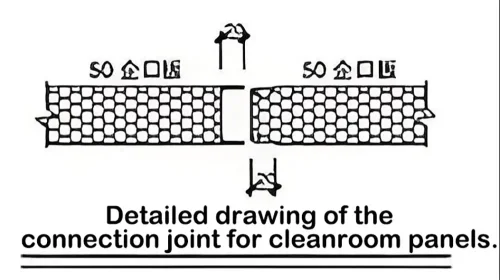
Don't forget: The joint eats up about 15mm of your width!
Real World Math: For a 10m wall (10,000mm), using 1150mm panels:
Don't divide by 1150! Divide by 1135 (effective width).
10,000 ÷ 1135 = 8.81. You need 9 panels.
If you calculated with 1150, you might have ordered 8.6 (rounds to 9), but on longer walls, this error compounds and leaves you short.
Thickness: It's About Stiffness, Not Just Insulation
Here's the mistake people make: They choose 50mm panels for a 6-meter tall warehouse cleanroom to save money. The result? Wobbly walls that flex every time a door opens. For most general Electronics or Pharma jobs (iso 7/8), 50mm is fine. It saves floor space.
However, if your ceiling height goes over 3 meters (10ft), bump it up to 75mm or 100mm. The extra stiffness prevents the wall from bowing under air pressure differentials. Our lead engineer always reminds clients that proper cleanroom panel dimensions selection—specifically thickness—is cheaper than reinforcing a wobbly wall later. We supply up to 200mm, but 50-100mm covers 95% of needs.
Thickness vs. Stability
Max Free-Standing Height
Insulation Value
Thicker panels prevent "wall bowing" in high-ceiling facilities.
-
50 mm (2 inches): The bread and butter. Good for standard iso 7-8 walls.
-
75 mm (3 inches): Use this if you have large temperature deltas (e.g., Cold rooms).
-
100 mm (4 inches): Mandatory for free-standing walls over 3-4m height.
-
125-200 mm: Specialized freezer or fire-containment zones.
Engineer's Insight: Strength isn't linear. A 75mm panel is more than 3x stiffer than a 50mm panel against bending. If your facility has high positive pressure, that extra inch of thickness stops your walls from bulging out like a balloon.
Length Limits: Logistics is the Bottleneck
The continuous production line can theoretically make a panel 100 meters long. But good luck getting that to your job site. In reality, your panel length is dictated by two things: the size of the shipping container and the patience of your installation crew.
For international projects, the 40-foot High Cube (40HQ) container is the hard limit. This caps your length at roughly 5 meters (38.7 feet). Even if you are local, handling panels longer than 6-8 meters increases the risk of them snapping or bowing under their own weight during lifting. For ultra-tall facilities, we almost always advise splicing panels rather than risking a single massive piece.
Go Full Height
Cleaner look
Fewer places for dust to hide
Best for height ≤ 5m
Use Segmented Panels
Mandatory for heights > 5m
Safer to lift and install
Easier to replace later
Decision guide: Don't fight physics or logistics.
Container Math: A 40HQ container is roughly 12m long inside, but you need clearance for packaging and unloading. We cap lengths at 5m to prevent damage. If you need a 15m wall, we design a two-stage install: an 5m base panel topped with a 5mx2 upper panel.
Tolerances: Where Quality Matters
In modular construction, precision is not just about aesthetics; it is about "tolerance stacking." A width variance of just 2mm might seem negligible on a single sheet, but over a long wall run, that error accumulates. This results in misaligned joints and irregular silicone seals, which create "ledges" that harbor dust and microbes, compromising your certification.
We perform rigorous diagonal squareness checks before dispatch because a twisted panel forces installers to fight the material, making a hermetic seal impossible. At Deiiang™, we maintain stricter controls than general market standards, typically holding ±0.8mm on width. When validating cleanroom panel dimensions in your technical submittals, insist on seeing the tolerance capability. A supplier without documented tolerance data lacks process control.
Verification Matters
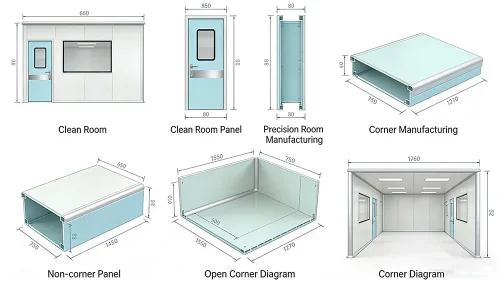
We measure twice so you install once.
Core Material: Weight vs. Dimension
The core material impacts more than just thermal values; it is the deciding factor in your structural limitations. rockwool (Mineral Wool) is a high-density material (typically 100-120kg/m³). While excellent for fire resistance, its sheer weight restricts the manageable size of individual panels. Large-span rockwool panels can be hazardous to maneuver manually and require a denser suspension grid to support the dead load.
In contrast, Aluminum Honeycomb offers an exceptional strength-to-weight ratio. This rigidity allows for wider spans with less deflection, making it the ideal candidate for walkable ceilings. With honeycomb, we can manufacture larger modules that reduce the number of joints overhead. At Deiiang™, whether you specify Rockwool, Magnesium Oxide (MGO), or PU, our engineers strictly cross-check your requested cleanroom panel dimensions against the material’s specific load-bearing limits to ensure both installation safety and long-term structural compliance.
|
Core Type
|
Weight (kg/m²)
|
Max Practical Width
|
Max Practical Length
|
Best Application
|
|
Rockwool
|
18-22 (Heavy!)
|
1200mm
|
8m
|
Fire-rated partitions
|
|
Aluminum Honeycomb
|
6-9 (Lightweight)
|
1500mm
|
12m
|
Walkable Ceilings
|
|
PU (Polyurethane)
|
10-14
|
1300mm
|
10m
|
Cold Storage / Freezers
|
|
MGO (Magnesium Oxide)
|
22-26 (Very Heavy)
|
1150mm
|
7m
|
High humidity / Pharma
|
|
Paper Honeycomb
|
5-8
|
1400mm
|
11m
|
Budget Electronics
|
Rockwool
Weight: 18-22 kg/m²
Max Width: 1200mm
Max Length: 8m
Best For: Walls, Fire-rated areas
Aluminum Honeycomb
Weight: 6-9 kg/m²
Max Width: 1500mm
Max Length: 12m
Best For: Ceilings, Large spans
PU (Polyurethane)
Weight: 10-14 kg/m²
Max Width: 1300mm
Max Length: 10m
Best For: Cold storage, High insulation
MGO (Magnesium Oxide)
Weight: 22-26 kg/m²
Max Width: 1150mm
Max Length: 7m
Best For: Humid environments, Pharma
Paper Honeycomb
Weight: 5-8 kg/m²
Max Width: 1400mm
Max Length: 11m
Best For: Lightweight ceilings, Cost-effective
Compare weight vs. size: Don't overload your structure (or your workers).
Design Tip: For a 15m × 10m room with a suspended ceiling:
• Walls: Stick to Rockwool (50mm, 1150mm wide) for the fire rating.
• Ceiling: Switch to Aluminum Honeycomb.
• Why? You save about 1800kg of dead load on your ceiling grid. That is a massive structural advantage that pays for the slightly higher material cost.
Let's Build it Right the First Time
This guide covers the essential cleanroom panel dimensions considerations, but standard specs only get you so far. Every site has its quirks—columns in the wrong place, tight freight elevators, or unique pressure requirements. Talk to us before you order, not after.
Get the Technical Datasheet
Download our detailed spec sheet containing exact CAD drawings, load-bearing tables, and installation nodes for all Deiiang™ systems.
Download Full Spec Sheet (PDF)
Enter your email to get the PDF and engineering updates from Deiiang™
Talk to an Engineer
Skip the sales pitch and discuss your specific dimension needs.
See the Quality
Request corner samples to check the steel thickness and paint finish.
Waste Calculation
Send us your CAD file, and we'll optimize the panel cuts for you.
Frequently Asked Questions About Cleanroom Panel Dimensions
What is the size of cleanroom panels?
There is no single universal standard size for cleanroom panels. Dimensions vary by manufacturer and panel system. Common wall-panel thicknesses include 50, 75, and 100 mm, while available lengths and widths depend on the selected system. For example, a width of 1150 mm is available in some modular systems, but it is not an ISO requirement. Consult the panel supplier’s technical drawings to confirm available dimensions and effective coverage widths.
Does iso 14644 require cleanroom panels to be a particular thickness?
No. ISO 14644 does not prescribe a panel thickness for a given cleanliness class. iso 14644-1 classifies air cleanliness based on airborne particle concentration. Panel thickness should be selected according to structural loading, support spacing, insulation requirements, fire-performance requirements, and the overall cleanroom design.
What is the difference between nominal width and effective coverage width?
Nominal width is the manufacturer’s stated measurement for a panel. Effective coverage width is the width eACH panel contributes to the completed installation within its joint system. Some suppliers state the effective coverage width as the nominal width, so do not automatically subtract 10–15 mm from the stated dimension. Verify the joint drawings and calculate panel quantities using the approved installation module, accounting for corners, openings, and cut panels.
What is the longest length a cleanroom panel can be?
The maximum panel length depends on manufacturing capabilities, structural performance, packaging, transport, and safe handling on site. A 40-foot high-cube container has an internal length of approximately 12 m, not 5 m, although the usable shipping length depends on packaging and loading arrangements. Long panels require a project-specific assessment of lifting and support needs; 5 m is not a universal cutoff, and segmentation is not automatically required above this length.
Are cleanroom panels adaptable for Doors, windows, and utilities?
Yes. Depending on the panel system, panels can be manufactured with custom dimensions, reinforced openings, and provisions for service penetrations. To reduce on-site cutting, these details should be approved in the shop drawings before production. Openings must preserve the system’s structural integrity, cleanability, sealing performance, and any applicable tested fire-rated assembly details.
What dimensional tolerances should I check for cleanroom panels?
Before ordering, specify tolerances for panel length, effective width, thickness, squareness, flatness, and joint alignment. Acceptance limits should reference the applicable product standard and the agreed supplier specification rather than an assumed universal cleanroom panel tolerance. Account for accumulated dimensional variation across long wall runs and request dimensional inspection records.
Are thicker panels fire-rated or suitable for walkable ceilings?
Not automatically. Panel thickness alone does not establish fire resistance or suitability for a walkable ceiling. Fire-resistance ratings apply to tested or assessed assemblies, including their joints, supports, and penetrations. Walkable ceilings require documented load capacities, support spacing, connection details, and access restrictions. Verify the complete ceiling system against the intended maintenance loads and applicable safety requirements before allowing access.
Specification note: Example dimensions are planning references, not guaranteed performance limits. Verify final panel selections against approved drawings, manufacturer test data, and applicable building and fire codes.
 +86 13638632902
 Jason@cleanroomequips.com


 MENU
MENU