+86 13638632902
 Jason@cleanroomequips.com


 MENU
MENU
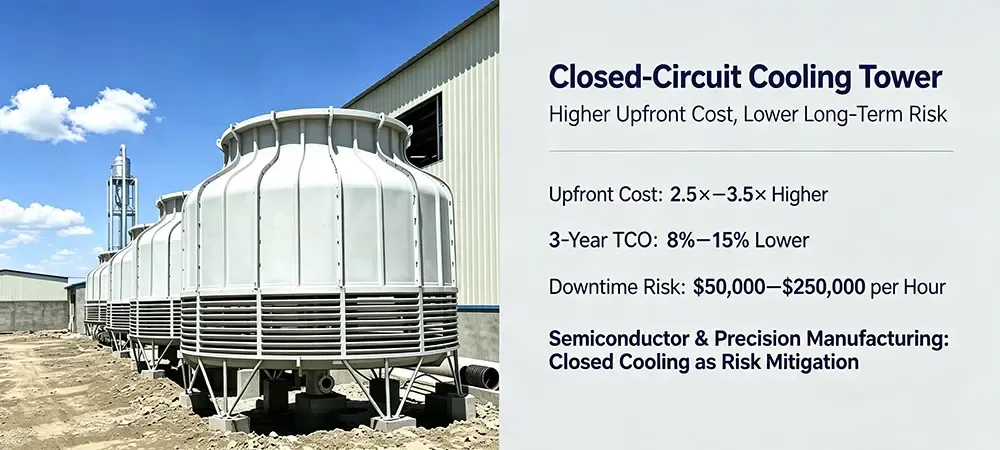
A closed-circuit cooling tower typICally costs 2.5× to 3.5× more upfront than an equivalent open cooling tower.But when you factor in chemical Cleaning, chiller COP degradation, and downtime, the 3-year total cost of ownership can be 8–15% lower for closed systems.
For Semiconductor fabs and precision manufacturing, one hour of downtime may cost $50,000–$250,000. Here, closed cooling tower advantages become a risk-mitigation necessity.
Key takeaway: The closed vs open cooling tower cost debate focuses on the chiller it protects, not just the tower.
This was from last year’s cooling system retrofit at a precision manufacturing plant. The facility owner’s expression changed when he saw the closed-circuit cooling tower quotation: almost three times the open-tower price.
His question cut to the point: "They're both cooling towers — why should I pay this much more?" Answering this means discussing misunderstood trade-offs in industrial HVAC.
In this article, costs of both closed-circuit cooling tower and open-circuit cooling tower are elaborated with actual site data from Deiiang™ applications.
Structure & Heat Exchange Pathways
Even though both cooling tower types sit on the roof and dispose of heat in the atmosphere, there are big differences in the internal architecture, and thus in the quality of the water.
This distinction forms the basis of the closed vs open cooling tower cost comparison.
Open Cooling Tower: Direct Contact Heat Exchange
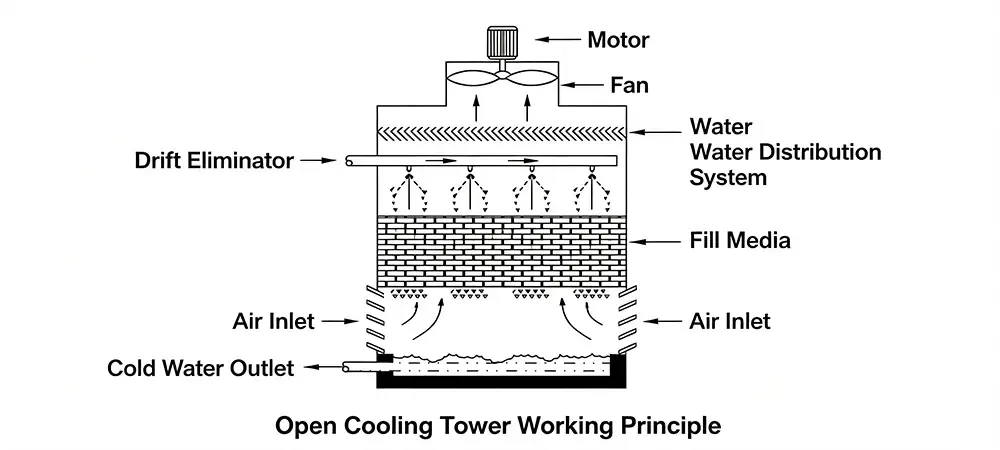
Open cooling towers mix process cooling water with ambient air. The warm condenser water from the chiller is distributed over the fill material.
Air passes through the falling water, evaporating 70-80% of the heat. The remaining heat is removed by sensible convection. Cooled water collects in a basin and returns to the chiller.
Core components: Fill media, drift eliminators, fan/motor assembly, collection basin, distribution nozzles
Material cost drivers: Tower casing and fill packs — relatively inexpensive to manufacture
Water exposure: The entire circulating volume is open to airborne dust, pollen, microbes, and debris 24/7
Closed-Circuit Cooling Tower: Coil + Spray Secondary Exchange
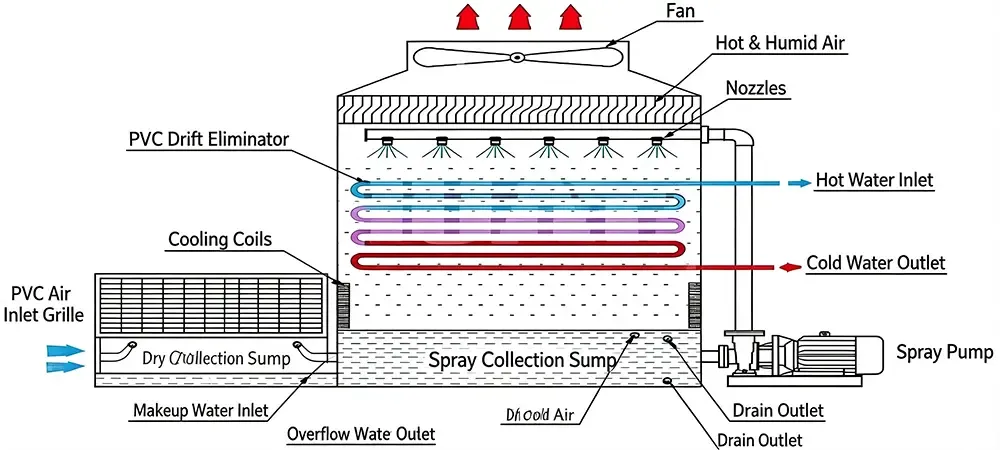
A closed-circuit cooling tower functions like a "tower within a tower." The primary cooling fluid circulates entirely within a sealed serpentine coil bundle.
A secondary spray pump draws water from the basin and distributes it over the outside of the coil. Air flows across the wetted coil surface, evaporating the spray water and rejecting heat.
The primary coolant never touches outside air.
Core components: Serpentine coil bundle, spray pump, drift eliminators, fan/motor, basin
Material cost drivers: The coil bundle alone can represent 35–50% of total tower manufacturing cost
Water isolation: Primary loop is sealed; only the secondary spray water is exposed to ambient conditions
Figure 1 — Principle Cross-Section Comparison: The open tower exposes process water directly to air and contaminants. The closed-circuit cooling tower isolates the primary fluid within a coil bundle.
This architectural difference is the root cause of every cost, efficiency, and maintenance divergence discussed below.
In precision manufacturing, this isolation translates directly to reduced fouling risk. Even a 0.6 mm scale layer can reduce heat transfer efficiency by 15–20%.
Visible CAPEX vs. Hidden OPEX
A basic open cooling tower installation for an 800 kW cooling load would typically be in the region of $32,000–$42,000 for the initial hardware.
Of course, the initial cost for an open cooling tower installation for a typical 800 kW cooling load is within the range of $32,000–$42,000.
Operating costs for closed cooling towers become apparent after 3–5 years of operation. An open cooling tower needs aggressive water treatment in order to function properly.
The cleaning of condensers of open cooling towers has to take place 1-2 times a year. This process causes a lot of time, labor and a lot of money for the chemicals.
In the time between the cleanings the chiller gets more and more inefficient due to fouling.
Rule of Thumb: For every $1.00 saved on tower CAPEX with an open system, expect to spend $0.35–$0.55/year in incremental costs. Over 5 years, the cheaper tower often becomes more expensive.
| Factor | Open Cooling Tower | Closed-Circuit Tower | Impact on TCO |
|---|---|---|---|
| Initial CAPEX (800 kW load) | $35,000 ± $7K | $95,000 ± $15K | ~2.7× multiplier upfront |
| Annual chemical cleaning frequency | 1–2 times/year | 0–0.5 times/year | Labor + downtime: $4K–$18K/yr for open |
| Water treatment chemical cost/yr | $6,000–$11,000 | $1,500–$3,200 | Open: full-volume treatment required |
| Chiller COP degradation (12 months) | 8–18% decline typical | ≤5% decline | Energy penalty: $9K–$22K/yr for open |
| Unplanned downtime risk | Moderate–High | Low | $50K–$250K/hr in Semiconductor fabs |
| Drift/plume contamination risk | Higher (open basin) | Lower (sealed primary) | Critical for cleanroom proximity |
| Factor | Open Tower | Closed-Circuit |
|---|---|---|
| CAPEX (800 kW) | ~$35K | ~$95K |
| Cleaning frequency/yr | 1–2× | 0–0.5× |
| Water treatment/yr | $6K–$11K | $1.5K–$3.2K |
| COP drop (12mo) | 8–18% | ≤5% |
| Downtime risk | Mod–High | Low |
Table 1 — Key cost and risk factor comparison over a 12-month cycle. Source: Deiiang™ field data, 800 kW installation.
Water Quality & Fouling: The Chiller Efficiency Cascade
The most expensive line item isn't the tower itself. It's the chiller compressor energy penalty that accumulates silently as condenser tubes foul.
Fouling Factor & COP Degradation Pathway
In an open cooling tower system, airborne particulates and dissolved minerals continuously enter the water. Even with treatment, fouling can develop.
A fouling factor of 0.0005–0.001 m²·K/W can form within 6–12 months. This thin scale forces the chiller to elevate condensing temperature.
For every 1°C rise in condensing temperature, chiller COP drops by approximately 2.5–4%.
On an 800 kW chiller operating 6,000 hours/year at $0.12/kWh, a 12% COP decline adds roughly $18,500 in annual electricity cost. That's more than half the initial tower price difference.
By keeping the primary loop sealed, the closed cooling tower advantages dramatically reduce condenser fouling rates.
The comparator open-tower installation showed COP degradation to 82–86% of baseline. This was despite rigorous monthly water treatment.
Closed-Circuit Tower — COP Retention @ 12 months
Open Tower — COP Retention @ 12 months
Energy Accounting: Spray Pump & Dual-Exchange Marginal Cost
CritICs point to the spray pump as an additional parasitic load. A typical spray pump for an 800 kW closed-circuit cooling tower draws 1.5–3.0 kW.
The dual-exchange process also introduces a slight thermodynamic penalty. For the same duty, a closed-circuit tower may require more fan power or larger coil area.
Theoretical Incremental Consumption ≤5% — Boundary Conditions
Under properly matched coil and airflow sizing, total incremental energy remains within 3–5% of an equivalent open system.
Spray pump power: 1.5–3.0 kW for 800 kW — approximately 1.2–2.5% of total system power
Fan power delta: 5–10% more airflow may be needed; translates to roughly 1.5–3% incremental fan energy
Net system penalty: Combined incremental draw is ≤5% of total cooling system power
Offsetting gain: This ≤5% penalty is dwarfed by the 8–18% COP erosion from fouling in open systems
Figure 3 — Energy Breakdown: The spray pump adds a visible increment, but it represents less than 2.5% of total system power.
In the Deiiang™ D-2024-017 installation, annualized system COP was 4.72 for the closed-circuit configuration. The open-tower sister site ACHieved only 4.18 — a 12.9% net efficiency advantage.
Pull Quote
"You either pay once for a coil bundle — or you pay permanently for fouling. The closed-circuit cooling tower premium is a one-time capex decision; the open-tower discount becomes a recurring operational liability."
— Jason Peng, Product designer, Deiiang™ Cooling Systems
Persona: Who Really Needs a Closed-Circuit Tower?
Not every facility needs the premium. But for certain profiles, closed cooling tower advantages shift from nice-to-have to mission-critical.
Fab Operations Manager — Semiconductor / Medical Device
👤 Persona: Fab Ops Manager
Pain Points: Chiller downtime can scrap entire batches. Condenser fouling introduces unpredictable thermal drift. Drift from open towers raises airborne contamination concerns.
KPIs: Unplanned downtime <8 hrs/year, chiller COP stability ±5% YoY, condenser approach <2°F.
Decision Metric: 3-year TCO with downtime risk monetized at $75,000–$250,000/hour. One avoided shutdown can justify the entire premium.
Decision Indicators
3-Year TCO: Closed-circuit breakeven at 2.3–3.1 years when downtime and COP penalties are monetized
Unplanned downtime: Any facility with downtime >$15,000/hour should default to closed-circuit
Compliance risk: FDA-regulated or iso class 7+ environments benefit from sealed-loop predictability
Water hardness: When makeup water hardness exceeds 150 mg/L CaCO₃, open-tower fouling accelerates
Regional Water & Energy Profiles
The closed vs open cooling tower cost calculus shifts based on geographic water quality, electricity tariffs, and regulations.
Water Hardness, Electricity Price & Regulatory Drivers
| Region | Hardness (mg/L CaCO₃) | Electricity | Water Cost | Recommendation |
|---|---|---|---|---|
| US Southwest | 250–450 | $0.09–$0.18/kWh | $1.80–$3.20/m³ | Strongly recommended |
| EU Central | 180–350 | €0.14–€0.22/kWh | €2.50–€4.80/m³ | Recommended |
| China East Coast | 120–280 | ¥0.65–¥1.10/kWh | ¥4.50–¥8.00/m³ | Case-by-case |
| Middle East | 200–400 | $0.04–$0.08/kWh | $1.50–$3.00/m³ | Strongly recommended |
| Southeast Asia | 50–120 | $0.10–$0.16/kWh | $1.20–$2.50/m³ | Case-by-case |
| Region | Hardness | Recommendation |
|---|---|---|
| US Southwest | 250–450 | Strongly recommended |
| EU Central | 180–350 | Recommended |
| China East Coast | 120–280 | Case-by-case |
| Middle East | 200–400 | Strongly recommended |
| Southeast Asia | 50–120 | Case-by-case |
Deiiang™ Case Study: Precision Manufacturing Plant Retrofit
Project Background
Industry: Precision CNC machining and optical components. Cleanroom: iso class 7, ±0.5°C stability. Load: 800 kW. Water: Hardness 340 mg/L CaCO₃.
Original System: Two open cooling towers, galvanized steel, installed 2016.
Difficulties Encountered
Rapid scaling: Condenser approach rose from 3.8°F to 8.2°F within 5 months of each cleaning
Drift concern: Tower plume detected within 40 meters of cleanroom air intake
Staffing: Only 1.5 FTE for all HVAC maintenance — insufficient for intensive water treatment
Deiiang™ Solution Configuration
Designed by Jason Peng, Product Designer. Model: CCT-800-SS, 316L stainless steel coil, 18% oversized surface area, VFD spray pump, online conductivity/turbidity/pH sensors.
SOP: Quarterly coil inspection, semi-annual basin cleaning, annual NDT coil check.
Measured Results (12-Month)
| Metric | Pre-Retrofit | Post-Retrofit | Improvement |
|---|---|---|---|
| COP (annual avg) | 4.18 | 4.72 | +12.9% |
| COP retention @12mo | ~82% | 96% | +14 pp |
| Cleaning frequency | 2×/yr | 0× | Eliminated |
| Downtime for cleaning | 96 hrs/yr | 0 hrs | 96 hrs recovered |
| Energy cost/yr | $138,000 | $121,500 | -$16,500 |
| Chemical cost/yr | $9,800 | $2,400 | -$7,400 |
| TCO payback | — | 2.7 years | — |
| Metric | Open | Deiiang™ |
|---|---|---|
| COP avg | 4.18 | 4.72 |
| COP retention | 82% | 96% |
| Cleaning | 2×/yr | 0× |
| Downtime | 96 hrs | 0 hrs |
| Energy/yr | $138K | $121.5K |
| Chemical/yr | $9.8K | $2.4K |
| Payback | — | 2.7 yrs |
Table — Deiiang™ Project D-2024-017: 12-month performance data.
When to Choose Open vs. Closed-Circuit
✅ Choose an Open Cooling Tower when:
Commercial offices with moderate loads
Dedicated water treatment staff available
Makeup water hardness <120 mg/L
First-cost budget constraints dominate
Seasonal operation with annual cleaning feasible
🔴 Choose a Closed-Circuit Cooling Tower when:
Downtime cost >$15,000/hr (semiconductor, Pharma)
Water hardness >150 mg/L CaCO₃
Limited maintenance staffing
Cleanroom proximity with drift concerns
High-dust environments
Maintenance & Water Treatment Closed Loop
A closed-circuit cooling tower relocates and simplifies maintenance. The primary sealed loop needs minimal intervention.
The secondary spray loop and basin need a structured inspection cadence.
Quarterly → Semi-Annual → Annual Flow
Quarterly
Conductivity check
Drift eliminator
Fan belt tension
Conductivity check
Drift eliminator
Fan belt tension
→
Semi-Annual
Basin flush
Spray nozzle
Coil combing
Basin flush
Spray nozzle
Coil combing
→
Annual
NDT coil check
Water chemistry panel
BMS calibration
NDT coil check
Water chemistry panel
BMS calibration
Key Monitoring Points
Spray water conductivity: <1,500 µS/cm target
Turbidity: <5 NTU; >15 NTU triggers flush
Approach temperature: within 2°F of design
System COP: track monthly; >5% deviation triggers review
Primary loop pH: 8.0–9.0 for inhibitor effectiveness
Conclusion: The Premium That Pays for Itself
A closed-circuit cooling tower cost is dominated by the built-in heat exchanger — the coil bundle. That hardware premium is real.
Once you factor in cleaning, COP degradation, and chemicals, the TCO is lower than it initially seemed. For the Deiiang™ D-2024-017 case, the 3-year TCO breakeven point was 2.7 years.
A fab with risk and downtime value above $100,000/hr would find the risk-mitigation alone justifies the upfront cost of the closed-circuit cooling tower.
Product design and technical review: Jason Peng, Product Designer, Deiiang™ Cooling Systems.
Ready to run the numbers for your facility?
Download our free LCCA template, schedule a site assessment, or request the full Deiiang™ D-2024-017 white paper.
📥 Download LCCA Template 📅 Schedule Assessment 📄 Request White Paper
9IRNlNw7e1A
📹 Video: 2–3 minute principle demonstration (placeholder — contact Deiiang™)
References
ASHRAE Standard 90.1-2022. ashrae.org
iso 14644-1:2015. iso.org
CTI STD-201. coolingtechnology.org
ASHRAE Handbook, Chapter 40. ashrae.org
U.S. DOE BMP #10. energy.gov
Deiiang™ Technical Report D-2024-017.
© 2025 Deiiang™ Cooling Systems. All rights reserved. | Product Designer: Jason Peng