+86 13638632902
 Jason@cleanroomequips.com


 MENU
MENU
There is no universal price for a pharmaceutical downflow booth. The cost depends on the process to be contained, booth dimensions, containment target, filtration configuration, construction materials, controls, testing requirements, installation scope, and documentation package. Two booths that look similar externally can differ substantially in quoted price once these variables are defined.
This article does not claim that a downflow booth is universally the “best” containment solution for every pharmaceutical application. For open powder-handling tasks where the required containment can be demonstrated under representative operating conditions, a downflow booth can be an appropriate solution. The goal is to help procurement, engineering, QA, validation, EHS, and project management teams evaluate quotations against actual project needs rather than headline prices.
How Much Does a Pharmaceutical Downflow Booth Cost?
Why There Is No Single Price
A pharmaceutical downflow booth is often configured or customized to project-specific process, containment, installation, and documentation requirements. An accurate price cannot be determined until the material, task, containment requirement, equipment layout, airflow strategy, testing scope, and documentation requirements are defined.
The required containment performance target is derived from the occupational-hygiene risk assessment and, where applicable, the material’s OEL or OEB. A booth specified for manual weighing of a low-hazard excipient will differ substantially in scope from a booth intended for dispensing a potent API with a more stringent containment requirement. These differences can legitimately affect engineering scope and quoted price.
What Should Be Included in a Quotation?
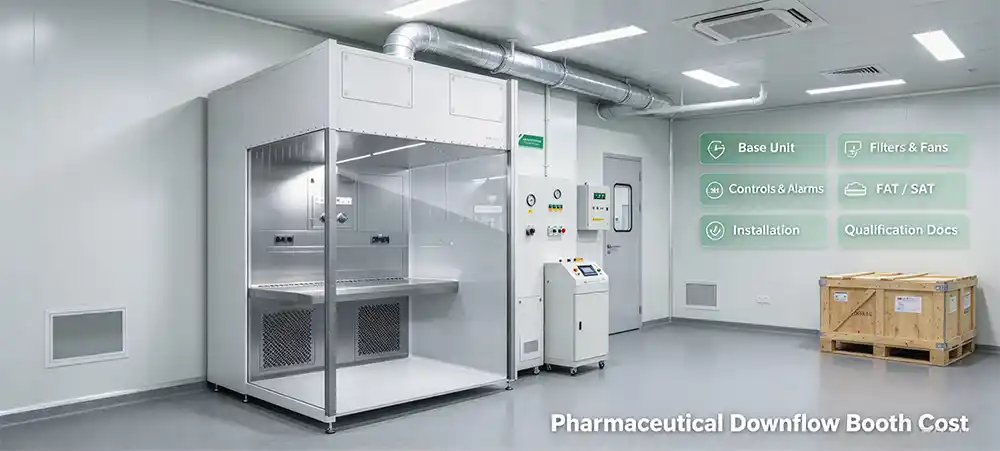
A quotation that lists only the base booth and a freight charge is not comparable to one that includes the full scope of supply and services. Buyers should request an itemised quotation covering the areas below.
| Cost area | Ask | Confirm |
|---|---|---|
| Equipment | What is included in the base unit? Filters, fans, controls, lighting, internal fittings? | Itemised equipment list with make/model where applicable |
| Controls and monitoring | Are differential pressure points, alarm functions, and data outputs specified? | Control philosophy, alarm setpoints, data outputs |
| Testing | Is factory acceptance testing included? What parameters are tested and documented? | FAT protocol, test report format, acceptance criteria |
| Shipping | Packing specification? Who arranges freight? | Incoterms, crating, insurance responsibility |
| Installation | On-site assembly and connection included? Who provides utilities? | Scope split between supplier and buyer |
| SAT and commissioning | Site acceptance testing performed? What measurements taken? | SAT protocol, airflow/particle test methods |
| Qualification support | Documents provided for DQ/IQ/OQ? URS compliance matrix? | Document list, format, traceability to URS |
Equipment — Ask: What is included in the base unit? Filters, fans, controls, lighting, internal fittings? Confirm: Itemised equipment list with make/model where applicable.
Controls and monitoring — Ask: Are differential pressure points, alarm functions, and data outputs specified? Confirm: Control philosophy, alarm setpoints, data outputs.
Testing — Ask: Is factory acceptance testing included? What parameters are tested and documented? Confirm: FAT protocol, test report format, acceptance criteria.
Shipping — Ask: Packing specification? Who arranges freight? Confirm: Incoterms, crating, insurance responsibility.
Installation — Ask: On-site assembly and connection included? Who provides utilities? Confirm: Scope split between supplier and buyer.
SAT and commissioning — Ask: Site acceptance testing performed? What measurements taken? Confirm: SAT protocol, airflow/particle test methods.
Qualification support — Ask: Documents provided for DQ/IQ/OQ? URS compliance matrix? Confirm: Document list, format, traceability to URS.
Where the buyer’s qualification strategy requires formal URS traceability, the expected compliance matrix or equivalent document should be specified in the RFQ and agreed before order placement.
The Seven Main Factors That Determine Downflow Booth Price
1. Booth Size and Process Layout
Increasing booth size generally increases enclosure area and may increase total airflow, filter area, and structural requirements, depending on the design criteria. The internal layout must accommodate the actual task: the scale or balance, material containers, the operator’s working posture, and any tools or interfaces used during the process.
One specification risk is omitting balance dimensions, location, and vibration-sensitivity requirements. If the balance cannot be positioned within the effective downflow zone, the containment rationale for using a booth is undermined. Confirm acceptable balance performance under the proposed airflow conditions with the balance manufacturer and during site testing where required.
2. Containment Requirement and Powder Hazard
The containment objective is one of the most important technical inputs affecting booth selection and configuration. Containment performance is not a property of the booth alone; it depends on the task, the material, and the operating procedure. A booth that ACHieves a certain containment level for one powder handling task may not achieve the same level for a different task with more aggressive material transfer.
The ISPE SMEPAC guideline provides standardized methodologies for evaluating the containment capability of equipment, including a specific test protocol for downflow booths. This framework allows suppliers and buyers to discuss containment in terms of measurable performance under defined conditions, rather than vague “high containment” claims.
3. Airflow and Filtration Configuration
A downflow booth may use filtered air supplied vertically into the working zone, with air extracted or returned through the base or rear. A generic airflow concept can be described as supply plenum → working zone → return → filtration → recirculation or exhaust, though not every configuration uses this exact loop.
Air cleanliness classification under ISO 14644-1:2015 defines particle concentration in a defined cleanroom, clean zone, or separative-device environment. A project may specify classification for a defined booth working environment only where the tested boundary, state, conditions, and sampling locations are defined. Particle classification does not establish powder containment. A booth working environment may meet a defined particle classification and still fail to contain a powder handling operation if the airflow pattern is disturbed by the operator or the task. Buyers should specify both the air cleanliness requirement (if applicable to the process) and the containment performance target (if applicable to operator protection).
4. Construction Materials and Cleanability
Materials of construction should be specified according to product-contact risk, cleaning requirements, chemical compatibility, facility standards, and the project URS. Stainless-steel grades and surface finishes, where required, should be explicitly defined rather than assumed.
Where hygienic design or enhanced cleanability is required by the URS, details such as joints, coving, welds, surface finish and roughness limits should be specified and justified for the application. Material, joint, and finish requirements can affect the quoted scope and should be defined in the project specification.
5. Controls, Monitoring and Automation
The control system scope ranges from basic on/off with manual fan speed to full automation with airflow monitoring, filter loading indication, alarm management, and data logging. Differential-pressure points, alarm functions and data outputs should be treated as buyer-specified requirements; not every booth has three filter stages or per-stage gauges.
Automation and data logging may be required by the site’s control strategy, quality system, monitoring requirements, or integration needs; they should not be assumed to be universal GMP requirements. Buyers should specify what is required for the process and for compliance, not what is available as an option.
6. Testing, FAT, SAT and Containment Verification
Factory acceptance testing verifies performance before shipment. Site acceptance testing verifies installation and performance in the actual facility. Containment performance verification, if required, uses a methodology such as SMEPAC to measure airborne particulate emissions under defined conditions.
Commissioning and site test records can provide important evidence for the project’s qualification or verification package, but the required evidence and acceptance criteria should be defined by the site’s quality system and URS. If containment performance testing is required, the test protocol, surrogate material, acceptance criteria, and reporting format should be agreed before quotation.
7. Shipping, Installation and Lifecycle Costs
Shipping, rigging, on-site assembly, utility connection, and commissioning are often excluded from equipment quotations. Buyers should clarify the scope split: who provides power, compressed air, exhaust ductwork, and final connection? Who performs the installation and who supervises?
Lifecycle costs include filter replacement, maintenance labour, requalification testing, and any production downtime during service. Front- or service-side filter access may simplify maintenance and reduce disruption, depending on the booth design, filter-change method, and site contamination-control procedure. This design detail may affect initial cost but reduce total cost of ownership.
What Does a Pharmaceutical Downflow Booth Actually Do?
Working Principle
A downflow booth provides a controlled working zone with filtered air flowing downward from a supply plenum, across the working area, and into a return or extraction path at the base or rear. The downward airflow is intended to capture airborne particles generated during powder handling and carry them away from the operator’s breathing zone.
In recirculating designs, filtered air is returned to the booth air path. Any exhaust fraction and pressure relationship to the surrounding room are design-specific and should be defined by the process and facility requirements. Where the booth is intentionally operated at a defined negative pressure relative to adjacent space, that pressure strategy can form part of the facility’s contamination-control approach.
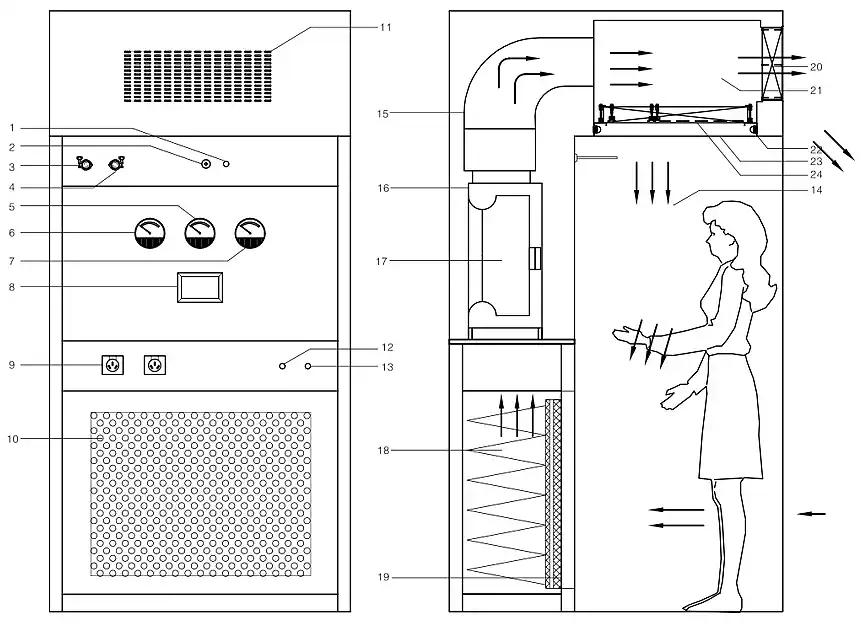
Operator Protection, Product Protection and Cross-Contamination Control Are Different Objectives
These three objectives are often conflated in marketing literature and RFQ discussions. They are distinct and may require different design features.
| Objective | What it protects | Primary design considerations |
|---|---|---|
| Operator protection | Personnel working at or near the booth | Airflow capture of airborne particles, containment performance under task conditions, extraction and filtration |
| Product protection | The material being handled | Supply-air cleanliness, surrounding environment, process exposure, product-contact compatibility |
| Cross-contamination control | Subsequent products and the facility | Cleaning access, surface finish, dedicated versus shared equipment, changeover procedures |
Operator protection: Protects personnel working at or near the booth. Design considerations: airflow capture of airborne particles, containment performance under task conditions, extraction and filtration.
Product protection: Protects the material being handled. Design considerations: supply-air cleanliness, surrounding environment, process exposure, product-contact compatibility.
Cross-contamination control: Protects subsequent products and the facility. Design considerations: cleaning access, surface finish, dedicated versus shared equipment, changeover procedures.
A booth optimised for operator protection may not provide the air cleanliness level required for product protection. A booth designed for product protection may not contain a potent powder effectively during manual handling. The project team should define which objective is primary and which, if any, is secondary.
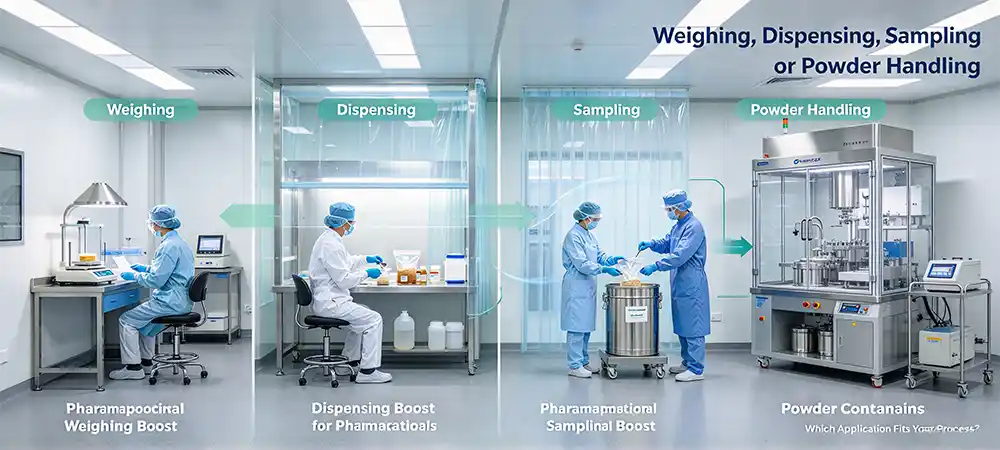
Weighing, Dispensing, Sampling or Powder Handling: Which Application Fits Your Process?
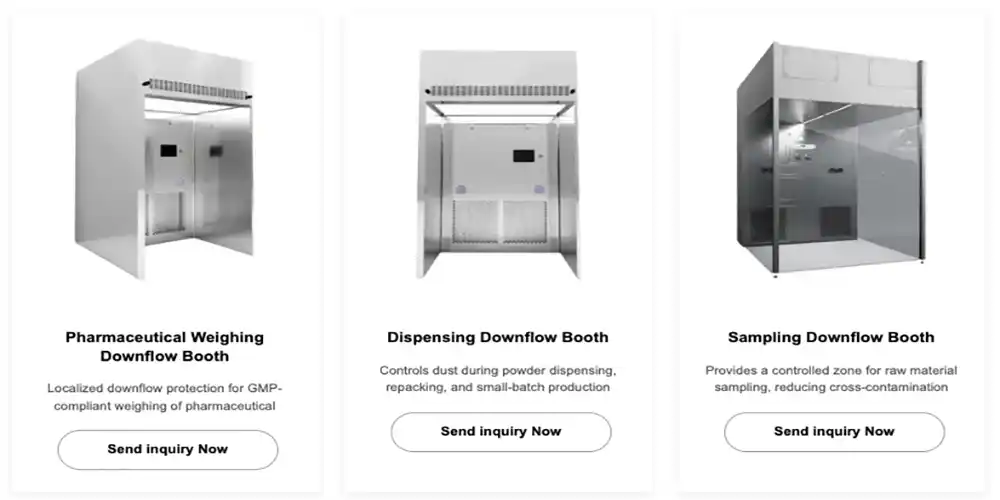
Pharmaceutical Weighing Booth
A pharmaceutical weighing booth is used for weighing powders in a controlled environment. The design must accommodate the scale or balance, including its dimensions, vibration sensitivity, and required positioning within the effective downflow zone. Confirm acceptable balance performance under the proposed airflow conditions with the balance manufacturer and during site testing where required.
dispensing booth for Pharmaceuticals
A dispensing booth is used to divide bulk material into smaller quantities for subsequent processing. Dispensing typically involves more material transfer than weighing, potentially generating more airborne particles. The containment requirement may be more stringent than for a simple weighing operation, depending on the material’s hazard and the quantity handled.
Pharmaceutical Sampling Booth
A pharmaceutical sampling booth is used to take representative samples from starting materials and other materials defined by the site sampling procedure. Sampling may involve opening containers, scooping, or using sampling thieves. The booth must provide containment during these operations and maintain sample integrity.
Powder Containment Downflow Booth
The term “powder containment downflow booth” emphasises the primary function: containing airborne powder during handling operations. The containment performance depends on the airflow design, the operator’s working technique, and the task being performed. SMEPAC testing provides a framework for evaluating this performance under defined conditions.
One Booth for Multiple Operations?
A single booth can be designed to accommodate multiple operations, but this requires careful specification of the worst-case task. The airflow and containment performance must be adequate for the most demanding operation, which may be dispensing rather than weighing, or handling a more potent material. Cleaning and changeover procedures between products must also be considered. A booth optimised for one operation may be a compromise for another.
| Application | Key design question |
|---|---|
| Weighing | Can the balance be positioned in the effective downflow zone without vibration interference? |
| Dispensing | Does the containment performance cover the worst-case material transfer method? |
| Sampling | Is the booth layout compatible with the sampling tool and container access? |
| Powder handling | What is the dust generation potential of the specific task, and has it been tested? |
| Multi-purpose | What is the worst-case task, and does the cleaning procedure support changeover? |
Weighing: Can the balance be positioned in the effective downflow zone without vibration interference?
Dispensing: Does the containment performance cover the worst-case material transfer method?
Sampling: Is the booth layout compatible with the sampling tool and container access?
Powder handling: What is the dust generation potential of the specific task, and has it been tested?
Multi-purpose: What is the worst-case task, and does the cleaning procedure support changeover?
Downflow Booth vs. Alternative Containment Solutions
A downflow booth is one option in a range of containment solutions. Containment performance should not be inferred from equipment category alone; it should be evaluated against the required target under representative operating conditions.
| Solution type | Enclosure | Access | Task fit | Verification approach |
|---|---|---|---|---|
| Open downflow booth | Partial enclosure with downward airflow | Open front for manual operations | Suited to tasks where operator access is required | SMEPAC or equivalent containment testing under defined conditions |
| Partial enclosure / LEV | Local extraction at source | Varies by design | Appropriate for some tasks if exposure control can be demonstrated | Airflow and exposure monitoring |
| Isolator | Greater physical barrier between operator and process | Restricted via gloves, half-suits, or transfer systems | Different engineering, transfer, cleaning, ergonomics and integration requirements | Containment testing and qualification per project requirements |
| Closed transfer | Fully closed material path | No direct operator access during transfer | Appropriate where open handling is not required | System integrity and cleaning validation |
Open downflow booth: Partial enclosure with downward airflow; open front for manual operations; suited to tasks where operator access is required; SMEPAC or equivalent containment testing under defined conditions.
Partial enclosure / LEV: Local extraction at source; access varies by design; appropriate for some tasks if exposure control can be demonstrated; airflow and exposure monitoring.
Isolator: Greater physical barrier between operator and process; restricted access via gloves, half-suits, or transfer systems; different engineering, transfer, cleaning, ergonomics and integration requirements; containment testing and qualification per project requirements.
Closed transfer: Fully closed material path; no direct operator access during transfer; appropriate where open handling is not required; system integrity and cleaning validation.
A downflow booth may not be suitable when the required exposure-control target is more stringent than an open-front booth can demonstrate under representative conditions, when the process is fully enclosed and would be compromised by an open front, or when product protection requirements demand a higher air cleanliness class than the booth can supply. In these cases, an isolator or a more closed containment system should be evaluated.
Pharmaceutical Compliance: What Buyers Should Actually Verify
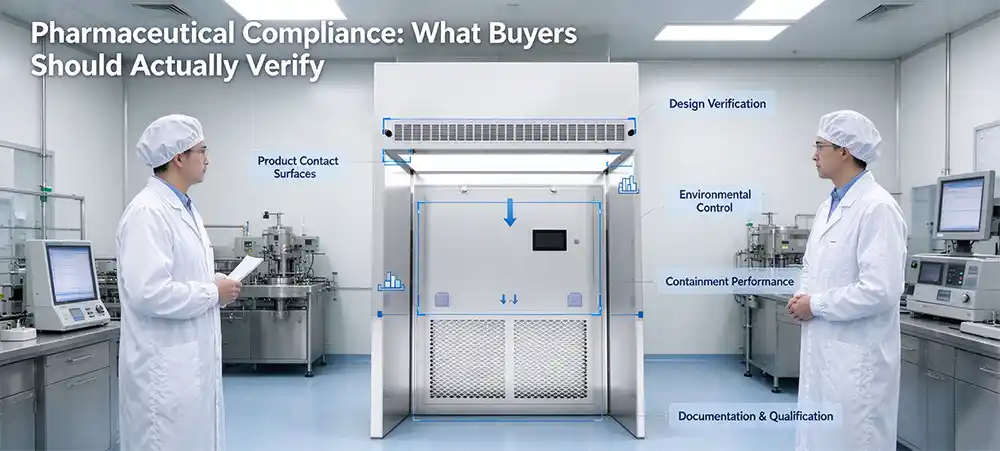
US FDA cGMP Considerations
Under 21 CFR 211.63, manufacturing equipment must be appropriately designed, sized, and located for its intended use, cleaning, and maintenance. 21 CFR 211.65 addresses product-contact surfaces, while 21 CFR 211.46 requires appropriate control of air pressure, microorganisms, dust, humidity, and temperature where relevant. Qualification or verification activities should be defined by the applicable quality system and project requirements.
FDA states that it does not maintain a list of CDER-approved drug-manufacturing equipment; CGMP regulations generally do not approve or prohibit specific equipment. Suitability is the manufacturer’s responsibility for the intended use.
EU GMP Considerations
EU GMP Annex 1 applies to the manufacture of sterile medicinal products. It is not a general standard for all pharmaceutical downflow booths. A downflow booth used in a non-sterile oral solid dosage facility is not within the scope of Annex 1, although selected principles may be applied to non-sterile products only as a documented site-specific decision.
For sterile applications, Annex 1 places emphasis on Contamination Control Strategy, cleanroom classification, and qualification. If a downflow booth is used in a sterile facility, the project team should determine how it fits within the contamination control strategy and what qualification evidence is required.
iso 14644 and cleanroom classification
ISO 14644-1:2015 specifies the classification of air cleanliness in terms of concentration of airborne particles in cleanrooms and clean zones, and separative devices as defined in iso 14644-7. The classification applies to airborne particle concentration in the defined cleanroom or clean zone at specified conditions and sampling locations. It does not demonstrate powder containment. Buyers should confirm precisely what area and state are being classified.
ISPE SMEPAC and Containment Performance
The ISPE SMEPAC guideline is a recognized industry framework for evaluating containment performance under defined test conditions. The third edition, published December 2024, includes a specific Downflow Booth test protocol. This supports defined-condition testing only; it does not provide a universal permanent performance rating.
UK COSHH Perspective
COSHH requires employers to prevent or adequately control exposure using measures appropriate to the assessed risk. HSE recognizes engineering controls such as enclosure, partial enclosure and local exhaust ventilation. An open-front downflow booth should not automatically be classified as COSHH Control Approach 3; its adequacy must be demonstrated for the specific substance and task. The employer remains responsible for ensuring that the chosen control is adequate, including examination, testing, and verification of control measures.
Documentation and Testing vs. Compliance
Equipment documentation and testing support the buyer’s qualification process. They do not, by themselves, make the facility or process compliant. The buyer is responsible for ensuring that the equipment is suitable for the intended use, that it is installed and operated correctly, and that personnel are trained.
How to Specify a Downflow Booth Before Asking for a Price
A specification that allows suppliers to quote on equal terms should include the following.
Material and hazard data. Safety data sheets for all materials to be handled, including occupational exposure limits if established, hazard classification, and any special handling requirements.
Exact task description. The specific operation to be performed, including the worst-case operating steps, the equipment and containers used, and the operator’s interaction with the process.
Dimensions and interfaces. Available floor space, ceiling height, required working zone dimensions, scale or balance specifications, and any connections to adjacent equipment or processes.
Containment objective. The required containment performance target, expressed as an approved CPT or measurable exposure-control criterion, together with relevant OEL/OEB information and its basis.
Airflow and filtration expectations. Supply air cleanliness requirement (if any), exhaust filtration requirement, recirculation versus once-through preference, and any facility exhaust constraints.
Construction and cleaning compatibility. Required materials, surface finish, joint/coving requirements and cleaning-agent compatibility.
Utilities and site constraints. Available power, compressed air, exhaust ductwork, and any structural limitations. Include destination country, electrical supply, hazardous-area classification if applicable, document language, and access/rigging constraints.
Documentation and testing. Required FAT and SAT scope, acceptance criteria, document package (URS compliance matrix if required, material certificates, drawings, test reports), and qualification support requirements.
Installation and service scope. Scope split between supplier and buyer, installation supervision, training, warranty, and service agreement options.
| RFQ checklist item | Information to provide |
|---|---|
| Material(s) | SDS, OEL/OEB where applicable, hazard band, quantity per batch |
| Task | Operation description, worst-case steps, frequency |
| Space | Floor area, ceiling height, access route |
| Containment target | Approved CPT or measurable exposure-control criterion |
| Air | Supply classification, exhaust filtration, recirculation preference |
| Construction | Required materials, surface finish, joint/coving requirements |
| Controls | Monitoring, alarms, data logging, integration requirements |
| Testing | FAT/SAT scope, containment testing requirement |
| Documentation | URS compliance matrix if required, certificates, drawings, reports |
| Installation | Scope split, utilities, training, service |
Material(s): SDS, OEL/OEB where applicable, hazard band, quantity per batch.
Task: Operation description, worst-case steps, frequency.
Space: Floor area, ceiling height, access route.
Containment target: Approved CPT or measurable exposure-control criterion.
Air: Supply classification, exhaust filtration, recirculation preference.
Construction: Required materials, surface finish, joint/coving requirements.
Controls: Monitoring, alarms, data logging, integration requirements.
Testing: FAT/SAT scope, containment testing requirement.
Documentation: URS compliance matrix if required, certificates, drawings, reports.
Installation: Scope split, utilities, training, service.
Comparing Suppliers on Equal Scope
Quotations are only comparable if they cover the same scope. A lower-priced quotation may exclude FAT, installation, or documentation that another supplier includes. Buyers should request itemised quotations and compare line by line.
| Scope item | Supplier A | Supplier B | Supplier C | Evidence supplied |
|---|---|---|---|---|
| Equipment scope | ||||
| Controls/monitoring | ||||
| FAT | ||||
| SAT/commissioning | ||||
| Documentation | ||||
| Installation scope | ||||
| Containment testing |
Equipment scope: Supplier A / Supplier B / Supplier C / Evidence supplied.
Controls/monitoring: Supplier A / Supplier B / Supplier C / Evidence supplied.
FAT: Supplier A / Supplier B / Supplier C / Evidence supplied.
SAT/commissioning: Supplier A / Supplier B / Supplier C / Evidence supplied.
Documentation: Supplier A / Supplier B / Supplier C / Evidence supplied.
Installation scope: Supplier A / Supplier B / Supplier C / Evidence supplied.
Containment testing: Supplier A / Supplier B / Supplier C / Evidence supplied.
First cost versus lifecycle cost. The purchase price is only part of the total cost. Filter replacement intervals and cost, maintenance access, requalification requirements, and expected service life all affect lifecycle cost. Front- or service-side filter access may simplify maintenance and reduce disruption, depending on the booth design, filter-change method, and site contamination-control procedure.
For any supplier, request project-specific drawings, test protocols, material documentation and containment data applicable to the proposed configuration. Where material certificates, traceability records or a URS compliance matrix are required by the project specification, their absence should be recorded as a documentation gap during supplier evaluation. Any specific Deiiang capability requires confirmation.
FAQ
What affects pharmaceutical downflow booth pricing?
Application, size, containment requirement, airflow and filtration configuration, construction materials, control scope, testing and documentation requirements, and installation scope. A quotation without a defined specification cannot be compared.
What is a pharmaceutical downflow booth used for?
Weighing, dispensing, sampling, and powder handling operations where containment of airborne particles is required. The specific application determines the design requirements.
How does it control powder?
Filtered air flows downward across the working zone, carrying airborne particles away from the operator and into a return or extraction path. Actual containment performance depends on the task, the material, and the configuration.
What information should be sent for a quotation?
Material SDS and hazard data, task description, dimensions and site constraints, containment objective, airflow and filtration expectations, construction requirements, documentation and testing scope, and installation scope.
Is the cheapest booth always suitable?
No. A lower price may reflect a narrower scope that excludes required testing, documentation, or design features. The appropriate comparison is fit for the specified application and total cost of ownership.
Conclusion
Pharmaceutical downflow booth pricing reflects a defined scope of equipment, engineering, testing, and documentation. Buyers who specify the material, task, containment target, and facility constraints before requesting quotations will receive comparable offers and can evaluate them against project requirements rather than headline numbers.
The practical next step is to assemble the RFQ inputs listed above and request the traceability and document package required by your project quality system. That approach supports procurement decisions and can support the site’s documented qualification or verification strategy where applicable.
References
1. ISPE Good Practice Guide: SMEPAC – Standardized Methodology for the Evaluation of Pharmaceutical Airborne Particle Emissions from Containment Systems (Third Edition). Published December 2024. https://guidance-docs.ispe.org/doi/book/10.1002/9781946964816. Recognized industry framework for evaluating containment performance under defined test conditions; includes specific Downflow Booth protocol.
2. iso 14644-1:2015 — Cleanrooms and associated controlled environments — Part 1: Classification of air cleanliness by particle concentration. https://www.iso.org/standard/53394.html. Specifies classification of airborne particle concentration in cleanrooms and clean zones; does not address occupational powder containment.
3. 21 CFR 211.46 — Ventilation, air filtration, air heating and cooling. https://www.ecfr.gov/current/title-21/chapter-I/subchapter-C/part-211/section-211.46. Requires appropriate control of air pressure, microorganisms, dust, humidity and temperature where relevant; does not mandate a downflow booth.
4. 21 CFR 211.63 — Equipment design, size, and location. https://www.ecfr.gov/current/title-21/chapter-I/subchapter-C/part-211/section-211.63. Equipment must be appropriately designed, sized, and located for intended use, cleaning, and maintenance.
5. 21 CFR 211.65 — Equipment construction. https://www.ecfr.gov/current/title-21/chapter-I/subchapter-C/part-211/section-211.65. Addresses product-contact surface suitability where applicable.
6. FDA — Questions and Answers on Current Good Manufacturing Practice Requirements: Equipment. https://www.fda.gov/drugs/guidances-drugs/questions-and-answers-current-good-manufacturing-practice-requirements-equipment. FDA does not maintain a CDER-approved manufacturing-equipment list; suitability is the firm’s responsibility for intended use.
7. ASTM E2500-25 — Standard Guide for Specification, Design, and Verification of Pharmaceutical and Biopharmaceutical Manufacturing Systems and Equipment. https://store.astm.org/standards/e2500. Non-regulatory consensus guide for science- and risk-based specification, design and verification; does not establish occupational-health containment requirements.
8. EU GMP Annex 1 — Manufacture of Sterile Medicinal Products (Eudralex Volume 4). https://health.ec.europa.eu/medicinal-products/eudralex/eudralex-volume-4_en. Scope applies to sterile medicinal product manufacture; not a general standard for all booths.
9. UK HSE — COSHH: Control measures to prevent or limit exposure to hazardous substances. https://www.hse.gov.uk/coshh/basics/control.htm. Risk-based exposure prevention and control; engineering controls include enclosure, partial enclosure and LEV.
10. UK HSE — COSHH: How to carry out a COSHH risk assessment. https://www.hse.gov.uk/coshh/basics/assessment.htm. Risk assessment approach including containment and LEV examination and testing requirements.
Supplementary industry reading (not primary authority for regulatory claims):
Pharmaceutical Technology — How to Achieve Pharmaceutical Dust Control. https://www.pharmtech.com/view/how-achieve-pharmaceutical-dust-control
YOUTH Clean Tech — Weighing, sampling and dispensing booth URS for GMP Areas. https://youthfilter.com/ro/stiri/weighing-sampling-and-dispensing-booth-urs-for-gmp-areas/