+86 13638632902
 Jason@cleanroomequips.com


 MENU

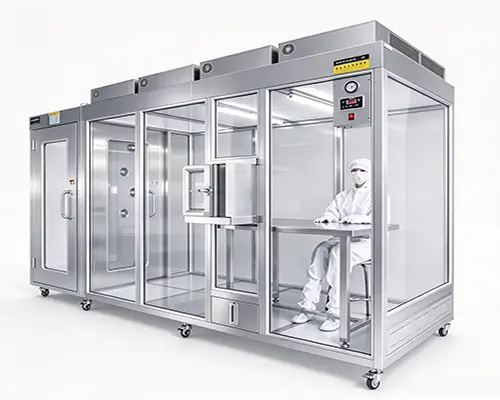
A modular clean booth that meets iso 5 standards is an engineered system, not an off-the-shelf product. Although one may be able to find, at the very low end of the market, standard components that fit the bill of clean booth construction, the reality is that a working clean booth known to work for electronic and pharmaceutical manufacturing will set you back significant bucks, in the ballpark of $15,000-$100,000. The actual cost will depend on the features of your clean booth system including HVAC configuration, choice of wall materials used (i.e. soft vs. hard wall), and environmental monitoring capabilities. Additionally, the costs will be significantly affected by the volume of installation and validation services required. This guide will help explain the basis of the prices.
ISO 5 modular clean booth cost: the short answer
The ISO 5 modular clean booth cost depends materially on the defined configuration, commercial scope, site conditions and required performance evidence, not on a generic price list. iso class 5 is a particle classification, not a price specification. For ISO Class 5, when ≥0.5 µm is the specified particle size, the maximum concentration is 3,520 particles/m³ [1]. A Deiiang company-published page dated 2025-01-20 states US$20,000–US$70,000 and says professional installation may add 10–20%, depending on setup complexity. The page does not define a complete quotation scope and should not be treated as a current market quotation [10]. An older, undated TES budgeting worksheet lists lower per-area figures for a freestanding fixed-in-place cleanroom under its own stated assumptions [9]. Treat any range as a budgeting signal only until the configuration, occupancy state and site scope are fixed.
Key point: ISO Class 5 is a particle classification, not a price specification. Any quoted range must be tied to a defined configuration, occupancy state and scope before it can be compared.
Verify any price range against a defined configuration
Normalize each quotation against the same comparison fields. If a field is missing, clarify it before treating the quotations as directly comparable.
| Verification item | What to require |
|---|---|
| Size | Internal dimensions and floor area |
| Height | Ceiling height and plenum allowance |
| Airflow type | Unidirectional or non-unidirectional; basis of design |
| Occupancy state | As-built, at-rest or operational, as required by the project/application |
| Classification basis | iso 14644-1:2015; specified particle size(s); required occupancy state(s) |
| Enclosure | Hardwall, softwall or rigid panel type |
| ffu/filter scope | Supply, count, filter class, controls |
| HVAC | Included or excluded; cooling, heating, make-up air |
| Controls | Basic switches or monitored/alarmed system |
| Location | Destination country and site conditions |
| Installation | Supplier install or customer install |
| Tests | Applicable standard/method, acceptance criteria, occupancy state, responsible party and required report |
| Item | What to require |
|---|---|
| Size / Height | Internal dimensions, floor area, ceiling height and plenum allowance |
| Airflow type | Unidirectional or non-unidirectional; basis of design |
| Occupancy state | As-built, at-rest or operational, as required |
| Classification basis | iso 14644-1:2015; specified particle size(s); required occupancy state(s) |
| Enclosure | Hardwall, softwall or rigid panel type |
| FFU/filter scope | Supply, count, filter class, controls |
| HVAC | Included or excluded; cooling, heating, make-up air |
| Controls | Basic switches or monitored/alarmed system |
| Location | Destination country and site conditions |
| Installation | Supplier install or customer install |
| Tests | Standard/method, acceptance criteria, occupancy state, responsible party and report |
A public benchmark is not a quotation
| Source | What the source actually shows | Limitation / appropriate use |
|---|---|---|
| Deiiang page, dated 2025-01-20 | Company-published claim of US$20,000–US$70,000 for a Class 5 modular clean booth, with a note that installation may add 10–20% | Historical company claim; no defined scope; requires internal sales and engineering validation; not a current quotation |
| Technical Equipment Sales (TES) cleanroom cost Estimator worksheet, undated older source accessed 2026-09-29 | Budget figures for a freestanding fixed-in-place cleanroom under stated assumptions; the “100NWC/5” category appears in the worksheet; HVAC listed as TBD; excludes assembly, seismic calculations/endorsements and facility modifications | Historical equipment-budget example; not a direct ISO 5 modular clean booth price; not current market data |
| Source | What it shows / limitation |
|---|---|
| Deiiang page, dated 2025-01-20 | Company-published claim of US$20,000–US$70,000, with installation possibly adding 10–20%. Historical claim, no defined scope, requires internal validation, not a current quotation. |
| Technical Equipment Sales (TES) Cleanroom Cost Estimator worksheet, undated, accessed 2026-09-29 | Budget figures for a freestanding fixed-in-place cleanroom under stated assumptions; “100NWC/5” category; HVAC listed as TBD; excludes assembly, seismic calculations/endorsements and facility modifications. Historical example, not a direct ISO 5 booth price. |
Do not combine these figures into a single ISO 5 market-price range or average. They differ in source type, configuration, date, assumptions and included scope.
What “ISO 5” actually requires
ISO 5 particle limit and test state
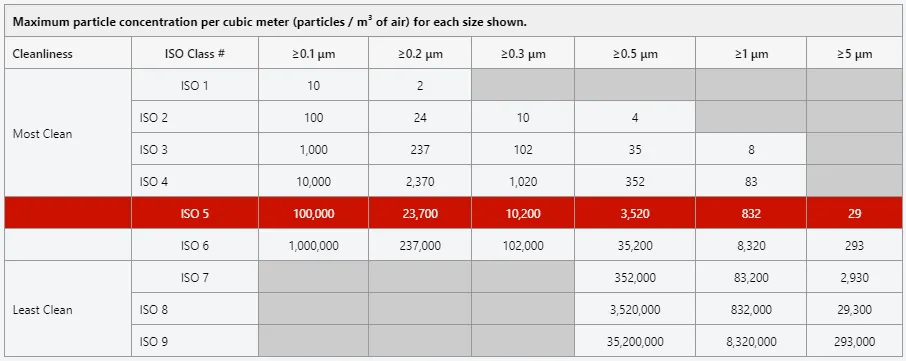
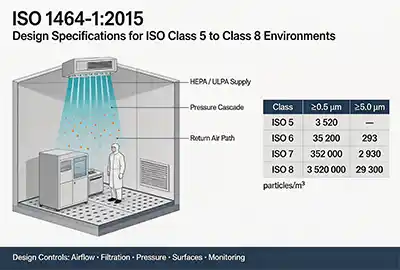
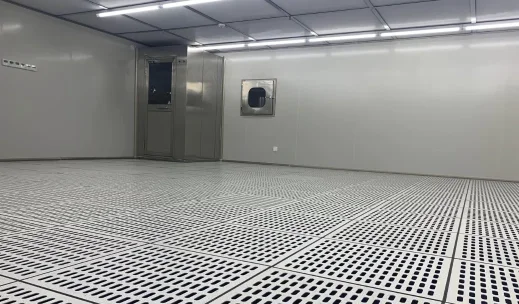
ISO Class 5 sets a maximum concentration for particles at specified sizes under the provisions of ISO 14644-1:2015 [1]. The particle size(s) used for classification should be specified. For ≥0.5 µm, the ISO Class 5 limit is 3,520 particles/m³. For ≥1 µm, the limit is 832 particles/m³. One or more particle sizes may be specified for classification; do not assume every table particle size must be tested for every project.
| Particle size | ISO Class 5 limit (particles/m³) |
|---|---|
| ≥0.5 µm | 3,520 |
| ≥1 µm | 832 |
| Particle size | Limit (particles/m³) |
|---|---|
| ≥0.5 µm | 3,520 |
| ≥1 µm | 832 |
The classification designation must identify the applicable occupancy state. A project may specify one or more states; sector-specific requirements can require particular states. iso 14644-3:2019 provides supporting test methods for cleanroom and clean-zone performance [3].
If a ≥5 µm criterion is required by the process or a sector-specific requirement, define that criterion separately rather than presenting 29/m³ as the current ISO Class 5 limit.
“class 100” is legacy US federal standard 209e terminology commonly cross-referenced to ISO Class 5 at the ≥0.5 µm particle-concentration level. Do not treat the two standards as identical in every requirement.
Classification, monitoring, and ongoing operation are different
These are three distinct activities with different evidence and different costs:
- ISO 14644-1:2015 addresses classification [1].
- iso 14644-2:2015 addresses the monitoring plan and continuing evidence [2]. Monitoring may be continuous, sequential or periodic; not every ISO 5 area requires continuous particle monitoring.
- iso 14644-5:2025 addresses operations control programmes [4].
A classification test documents whether the installation meets the specified ISO Class under the defined test conditions and occupancy state at the time of testing. Classification scope alone does not define the ongoing monitoring programme or operating controls.
Use “ISO 14644-1 classification testing/report” rather than “ISO certification” unless a specific certification service is actually part of the contracted scope.
ISO 5 does not automatically mean sterile, Grade A, or GMP compliant
| Myth | Fact |
|---|---|
| ISO 5 equals sterile | ISO 5 is a particle classification; sterility is a separate microbiological and process outcome |
| ISO 5 equals Grade A | FDA aseptic-processing guidance uses Class 100 (ISO 5) terminology for critical areas; EU GMP Annex 1 uses Grade A. Grade A is not simply another name for ISO Class 5 [7][8] |
| ISO 5 equals GMP compliant | GMP compliance depends on process, facility, monitoring, personnel and documentation; a booth alone does not confer it |
| ISO 5 equals Annex 1 compliant | EU GMP Annex 1 adds contamination control strategy, risk management and process-specific requirements [8] |
| Myth | Fact |
|---|---|
| ISO 5 equals sterile | ISO 5 is a particle classification; sterility is a separate microbiological and process outcome |
| ISO 5 equals Grade A | FDA aseptic guidance uses Class 100 (ISO 5); EU GMP Annex 1 uses Grade A. Grade A is not simply another name for ISO Class 5 [7][8] |
| ISO 5 equals GMP compliant | GMP compliance depends on the full quality system, process, monitoring, personnel and documentation; a booth alone does not confer it |
| ISO 5 equals Annex 1 compliant | EU GMP Annex 1 adds contamination control strategy, risk management and process-specific requirements [8] |
FDA’s aseptic-processing guidance relates Class 100 to ISO 5; EU GMP Annex 1 separately defines Grade A requirements for sterile manufacture [7][8]. Where Grade A is discussed, use Annex 1’s own table and requirements rather than copying ISO Class 5 particle numbers into a Grade A table.
Why an ISO 5 requirement can increase project cost
Airflow distribution and filter coverage
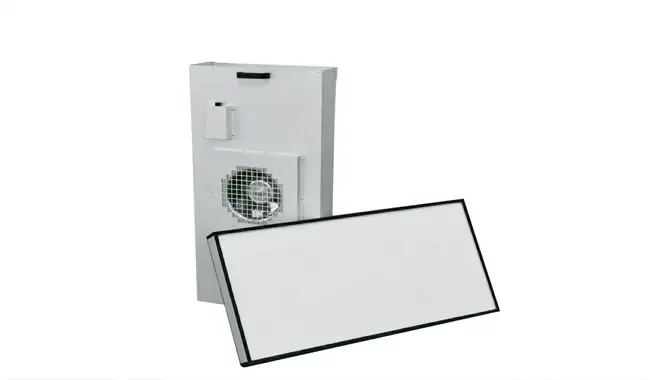
There is no universal FFU coverage or ACH number for ISO 5. The airflow basis should be engineered from the process, contamination sources, geometry, heat load, airflow concept and specified occupancy condition. The required airflow depends on the process, the particle generation rate, the occupancy state and the room geometry.
Airflow visualization and obstruction risk
People, equipment, lights and heat sources disturb airflow. For FDA-regulated aseptic critical areas, FDA guidance recommends in-situ air pattern analysis under dynamic conditions to demonstrate sweeping action away from the product [7]. Airflow visualization should be included where required by the applicable test plan, risk assessment or sector-specific requirement; FDA aseptic critical areas are one such use case.
HEPA/ULPA filters, FFUs, and controls
| Specification item | What to verify where applicable/required |
|---|---|
| Filter component classification | Applicable filter class and test documentation, e.g. ISO 29463-1:2024 where specified [6] |
| Airflow | Rated flow and system operating point |
| Pressure drop | Initial and final; fan curve compatibility |
| Motor/control | Speed control, alarm if required by the URS/process risk, redundancy if required by the URS/process risk |
| Seal | Gasket type and leak-test access |
| Scan access | Ability to scan filter face and frame |
| Spares | Filter and fan availability |
| Item | What to verify where applicable/required |
|---|---|
| Filter component classification | Applicable filter class and test documentation, e.g. ISO 29463-1:2024 where specified [6] |
| Airflow | Rated flow and system operating point |
| Pressure drop | Initial and final; fan curve compatibility |
| Motor/control | Speed control; alarm and redundancy if required by URS/process risk |
| Seal | Gasket type and leak-test access |
| Scan access | Ability to scan filter face and frame |
| Spares | Filter and fan availability |
Why filter efficiency alone does not prove ISO 5
Filter efficiency alone does not demonstrate that the installed booth meets ISO Class 5; installation integrity, airflow distribution and room-level classification evidence also matter.
| Level | What it shows |
|---|---|
| Filter component test (ISO 29463-1:2024) | The filter meets its efficiency class under test conditions [6] |
| Air-cleanliness classification (ISO 14644-1:2015) | The installed booth meets the specified ISO Class under defined conditions [1] |
| Supporting performance tests (iso 14644-3:2019) | Applicable test methods support cleanroom and clean-zone performance evaluation [3] |
| Level | What it shows |
|---|---|
| Filter component test (ISO 29463-1:2024) | Filter meets its efficiency class under test conditions [6] |
| Air-cleanliness classification (ISO 14644-1:2015) | Installed booth meets the specified ISO Class under defined conditions [1] |
| Supporting performance tests (ISO 14644-3:2019) | Applicable methods support cleanroom and clean-zone performance evaluation [3] |
Hardwall vs softwall ISO 5 construction
Both softwall and hardwall systems can be engineered for ISO Class 5 applications. Selection should be based on the required airflow strategy, pressure control, cleanability, access, durability, process risk and project scope.
| Factor | Hardwall | Softwall |
|---|---|---|
| Enclosure type | Rigid panels | Flexible curtains |
| Access method | Doors, windows, pass-throughs | Curtain entry |
| Cleaning approach | Smooth rigid surfaces | Curtain cleaning and replacement |
| Pressure/airflow strategy | To be defined by design | To be defined by design |
| Mobility requirement | To be defined by project | To be defined by project |
| Installation scope | To be defined in quotation | To be defined in quotation |
| Factor | Hardwall / Softwall |
|---|---|
| Enclosure type | Rigid panels / Flexible curtains |
| Access method | Doors, windows, pass-throughs / Curtain entry |
| Cleaning approach | Smooth rigid surfaces / Curtain cleaning and replacement |
| Pressure/airflow strategy | To be defined by design for both |
| Mobility requirement | To be defined by project for both |
| Installation scope | To be defined in quotation for both |
Temperature, humidity, make-up air, and exhaust
Recirculated filtered air can form part of the particle-control design, but recirculation alone does not necessarily control process heat, moisture, make-up air or exhaust requirements. Where the process generates heat, moisture or fumes, the design may require cooling, dehumidification, make-up air, exhaust or other application-specific controls. A booth quote that assumes only recirculation may be incomplete for your process.
Monitoring, alarms, redundancy, and sector requirements
| Tier | Typical scope |
|---|---|
| Basic particle-controlled booth | Particle classification, basic airflow |
| Monitored production booth | Monitoring plan defined by risk/process requirements; frequency may be continuous, sequential or periodic [2] |
| Regulated aseptic application | Application-specific monitoring, qualification/validation documentation, alarm/deviation handling and other controls required by the applicable quality/regulatory framework [8] |
| Tier | Typical scope |
|---|---|
| Basic particle-controlled booth | Particle classification, basic airflow |
| Monitored production booth | Monitoring plan defined by risk/process; frequency may be continuous, sequential or periodic [2] |
| Regulated aseptic application | Application-specific monitoring, qualification/validation documentation, alarm/deviation handling and other controls required by the applicable quality/regulatory framework [8] |
Do not claim GMP compliance for a booth alone. GMP compliance depends on the full quality system and process. Choose the tier that matches your actual regulatory and product risk.
ISO 5 budget model
Capital-cost formula
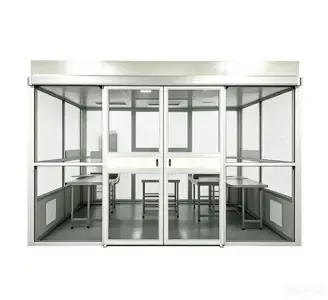
Subtotal = booth package + environmental systems + options/monitoring + logistics + site work + installation + testing/qualification support (if required)
Contingency amount = Subtotal × buyer-defined contingency rate
Capital budget = Subtotal + contingency amount
Count each cost once; do not add items already included.
Price-per-area sanity check
Normalized comparable-scope total ÷ floor area. Scope first. A small booth may have a higher per-area cost because fixed costs spread over fewer square meters. Use per-area only after the scope is identical. Do not scale the historical TES worksheet directly to a current project unless the configuration, assumptions and scope are demonstrably comparable.
Example configuration sheet
| Parameter | Example |
|---|---|
| Dimensions | L × W × H |
| Floor area | L × W |
| Volume | L × W × H |
| Process | [project-specific] |
| Occupancy state | [to be defined] |
| Wall | [to be defined] |
| Airflow basis | [to be defined] |
| FFUs | [after engineering] |
| Temperature/RH | [project-specific] |
| Doors | [project-specific] |
| Monitoring | [to be defined] |
| Destination | [project-specific] |
| Scope | equipment only / installed / commissioned and classification-tested / qualification support if required |
Annual operating-cost formula
Annual electricity cost = average operating kW × annual operating hours × local electricity tariff (currency/kWh)
Annual operating cost = electricity cost + filter cost + scheduled calibration, testing or requalification costs in the year they occur + cleaning + maintenance.
Data needed for a credible energy estimate
FFU model and count, speed and static pressure, HVAC fan/cooling/dehumidification loads, schedule and setback, local tariff and climate. For pre-purchase budgeting, use supplier-verified design power at the intended operating point; replace it with measured average kW when operating data become available. ISO 14644-16:2019 provides guidance on energy efficiency in cleanrooms [5].
Cost-of-change and future expansion
Adding equipment changes heat load, obstruction, particle generation and power demand. It may require re-testing and potentially re-classification. If known future equipment or process changes are likely, include them in the design review. Late changes can increase redesign, site-work and retesting costs.
Three ISO 5 quote scenarios to request from suppliers
Scenario A: equipment-only booth package
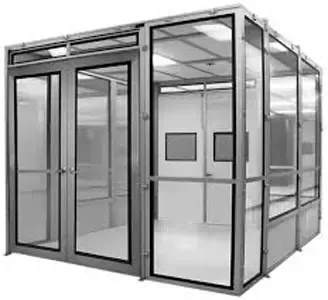
Request a scenario in which the quoted scope includes the booth structure, FFUs, filters and basic controls. You handle site work, HVAC connection, installation and testing.
Scenario B: delivered and installed booth
Request a scenario in which the quoted scope includes delivery to site, installation, connection to your utilities and basic checks. Testing may or may not be included.
Scenario C: commissioned, classification-tested and documented project scope
Request a scenario in which the supplier commissions the installation and provides the agreed ISO 14644-1 classification testing/report; application-specific qualification support is included only if defined in the contract.
Normalize commercial terms before comparing totals
| Term | Why it matters |
|---|---|
| Currency/date | Exchange rate and price validity |
| Incoterm + named place | Defines agreed delivery responsibilities, cost allocation and risk-transfer point |
| Duty/tax | Can be significant |
| Site assumptions | Access, power, ceiling height |
| Travel/hours | Installation labor variability |
| Warranty start | On delivery or on acceptance |
| Test failures/retest | Who pays for retest |
| Change orders | Hourly rate and approval process |
| Term | Why it matters |
|---|---|
| Currency/date | Exchange rate and price validity |
| Incoterm + named place | Delivery responsibilities, cost allocation and risk-transfer point |
| Duty/tax | Can be significant |
| Site assumptions | Access, power, ceiling height |
| Travel/hours | Installation labor variability |
| Warranty start | On delivery or on acceptance |
| Test failures/retest | Who pays for retest |
| Change orders | Hourly rate and approval process |
How to avoid an under-specified ISO 5 purchase
Red flags in a low quote
Classification-test responsibility, acceptance criteria or exclusion is undefined. Generic filter claim without class or test standard. No occupancy state defined. No heat load basis. Supply, return, relief or exhaust airflow path is undefined where applicable to the design. No service access for filter changes. No power requirements listed. Responsibility for applicable local electrical, building, fire or other code requirements is undefined. No freight or installation detail. Exclusions are unclear, internally inconsistent or leave required work without an assigned responsible party.
Questions QA and engineering should sign off
Process risk and required state. Particle limits and sampling plan. Layout and airflow basis. Materials and cleanability. Monitoring and alarm strategy. Cleaning and gowning procedures. Commissioning and test protocol. Deviation handling. Change control. Record retention.
When ISO 5 may be the wrong requirement
If you need local first-air protection for a critical operation, a unidirectional-airflow workstation, RABS or isolator may be more appropriate depending on the process and contamination-control strategy. If you need containment or negative pressure, a different design is required. If you need sterility, ISO 5 alone is not enough. Get sector expert review before committing.
Request an ISO 5 modular clean booth quotation
Copyable RFQ checklist:
- Process description and critical operations
- Required occupancy state for classification
- Specified particle size(s) and limits — for ISO Class 5 at ≥0.5 µm: 3,520 particles/m³; ISO 14644-1:2015, or the applicable contractually agreed edition
- Internal dimensions and height
- Wall type preference
- Airflow basis or engineer calculation request
- Temperature and humidity range
- Door and pass-through requirements
- Monitoring and alarm requirements
- Destination and site conditions
- Installation scope
- Testing and documentation scope
- Currency and Incoterm preference
Send the process, layout, site and qualification requirements for an itemized ISO 5 budget.
FAQs
How much does an ISO 5 modular clean booth cost?
No single price exists. A Deiiang company-published page dated 2025-01-20 states US$20,000–US$70,000 and separately notes that installation may add 10–20%. The page does not define a complete quotation scope and should not be treated as a current market quotation. An older, undated TES worksheet lists US$190–US$215/ft² for its “100NWC/5” softwall and rigid-wall budget categories under the worksheet’s stated assumptions. The worksheet excludes assembly, seismic calculations/endorsements and facility modifications; HVAC is listed as TBD. Your price depends on size, airflow basis, enclosure, environmental systems, monitoring, location and scope.
What is the ISO 5 particle limit?
For ISO Class 5 at ≥0.5 µm, the limit is 3,520 particles per cubic meter. For ≥1 µm, the limit is 832 particles per cubic meter [1]. One or more particle sizes may be specified for classification within the provisions of ISO 14644-1; do not assume every table particle size must be tested for every project. The applicable occupancy state—as-built, at-rest or operational—must be specified.
Is ISO 5 the same as Class 100?
FDA aseptic guidance uses “Class 100 (ISO 5)” terminology at the ≥0.5 µm cleanliness level. “Class 100” remains legacy us federal standard 209e terminology and should not be treated as identical to every requirement in ISO 14644-1 [7][1].
Does an ISO 5 booth satisfy GMP requirements?
No. ISO 5 is a particle classification. GMP compliance depends on the full quality system, process validation, monitoring, personnel, documentation and facility design. FDA aseptic-processing requirements and EU GMP Annex 1 Grade A requirements go beyond ISO Class 5 particle limits [7][8]. Get regulatory review for your specific application.
How many FFUs does an ISO 5 clean booth need?
ISO Class 5 alone does not determine the FFU count. Ask the supplier to provide the airflow and filter-coverage design basis for the proposed configuration, including the process, contamination sources, geometry, heat load, airflow concept and specified occupancy condition.
What tests should be included at handover?
The required handover tests should be defined in the URS, acceptance plan and applicable regulatory framework. ISO 14644-1:2015 addresses particle-concentration classification [1]; ISO 14644-3:2019 provides supporting test methods such as airflow, pressure difference, installed filter-system leakage and airflow visualization where applicable [3]. Sterile medicinal-product applications can require additional qualification tests under the applicable GMP framework [8].
What is usually excluded from an ISO 5 booth price?
Items that may be excluded include HVAC equipment, make-up air, exhaust, facility modifications, freight, duty, site work, electrical connection, installation labor, commissioning, qualification testing, monitoring systems and documentation. Verify every exclusion before comparing quotes.
References
- [1] ISO 14644-1:2015 — Cleanrooms and associated controlled environments — Part 1: Classification of air cleanliness by particle concentration. https://www.iso.org/standard/53394.html
- [2] ISO 14644-2:2015 — Cleanrooms and associated controlled environments — Part 2: Monitoring to provide evidence of cleanroom performance related to air cleanliness by particle concentration. https://www.iso.org/standard/53393.html
- [3] ISO 14644-3:2019 — Cleanrooms and associated controlled environments — Part 3: Test methods. https://www.iso.org/standard/60598.html
- [4] iso 14644-5:2025 — Cleanrooms and associated controlled environments — Part 5: Operations. https://www.iso.org/standard/88599.html
- [5] ISO 14644-16:2019 — Cleanrooms and associated controlled environments — Part 16: Energy efficiency in cleanrooms and clean zones. https://www.iso.org/standard/66331.html
- [6] ISO 29463-1:2024 — High efficiency filters and filter media for removing particles in air — Part 1: Classification, performance, testing and marking. https://www.iso.org/standard/84367.html
- [7] FDA, Guidance for Industry: Sterile Drug Products Produced by Aseptic Processing — Current Good Manufacturing Practice (2004), nonbinding guidance. https://www.fda.gov/media/71026/download
- [8] European Commission, EU GMP Annex 1 — Manufacture of Sterile Medicinal Products, revision dated 22 August 2022; in operation from 25 August 2023, with point 8.123 from 25 August 2024. https://health.ec.europa.eu/document/download/e05af55b-38e9-42bf-8495-194bbf0b9262_en?filename=20220825_gmp-an1_en_0.pdf
- [9] Technical Equipment Sales (TES), “Cleanroom Cost Estimator” worksheet — undated older budgeting source; accessed 2026-09-29. https://products.tesinc.com/Asset/Cleanroom-Cost-Estimator-Worksheet.pdf
- [10] Deiiang, “How much does a class 5 modular clean booth cost?”, company-published 2025-01-20; historical pricing claim, not an independently audited or current quotation. https://www.cleanroomequips.com/Modular-CleanRoom-FAQ/How-much-does-a-class-5-modular-clean-booth-cost-.html