+86 13638632902
 Jason@cleanroomequips.com


 MENU
MENU
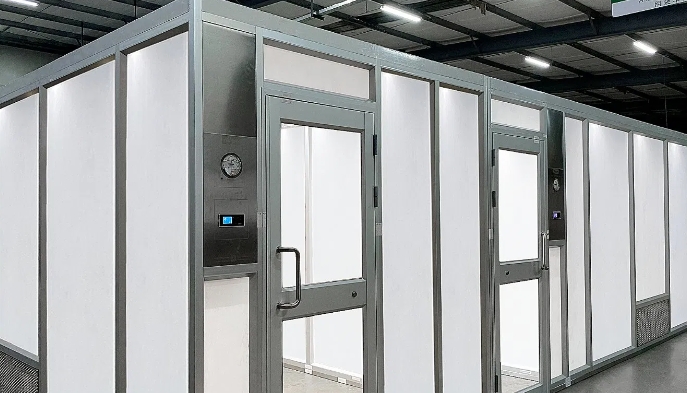
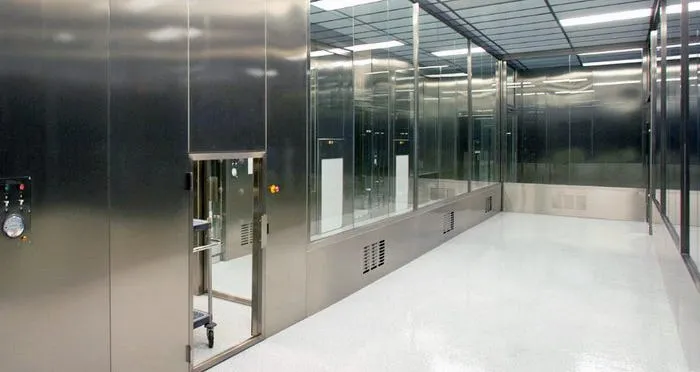
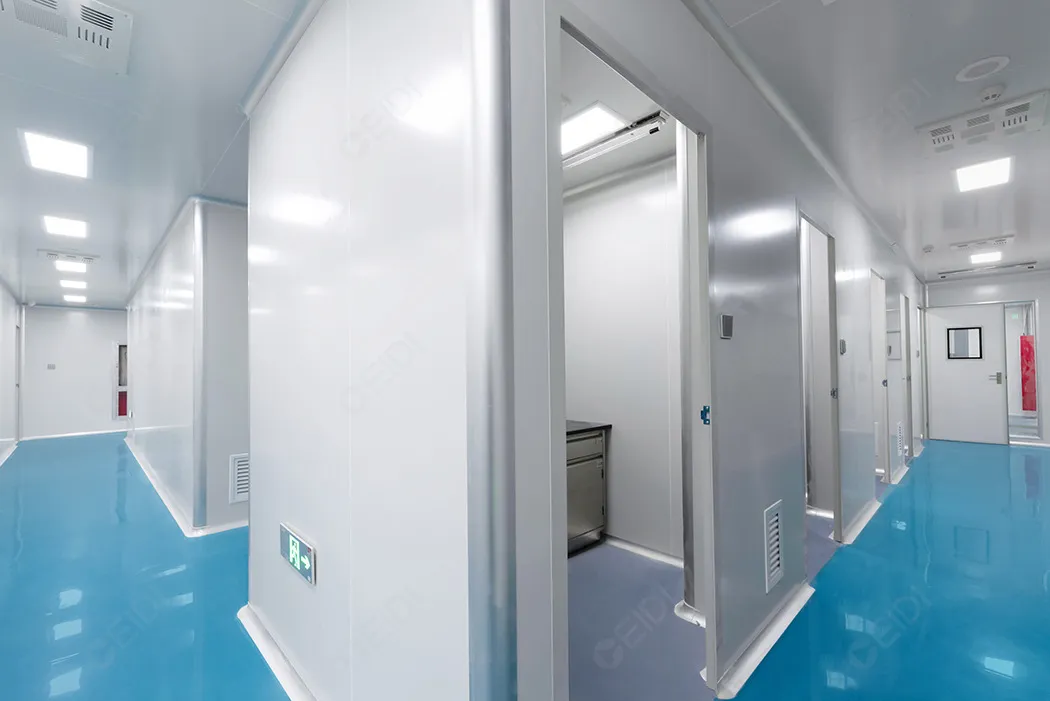
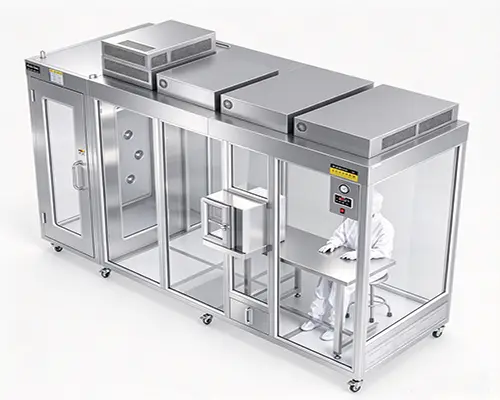
A prefabricated modular cleanroom is a controlled environment assembled from pre-engineered or factory-produced components rather than relying exclusively on predominantly site-built construction. This approACH can shift part of the fabrication and component preparation off-site, depending on the system design.
Prefabrication describes how components are produced and assembled. It does not automatically determine the final cleanliness classification. The required iso class depends on the complete engineered system—filtration, airflow, pressure control, and how the room performs under its specified operating conditions.
Prefabricated Components Versus Conventional Built-In Construction
Conventional construction relies predominantly on site-built methods. Prefabricated modular systems use factory-prepared or pre-engineered components assembled on site. Each approach has project-dependent trade-offs; neither is universally faster, cheaper, or less disruptive.
| Aspect | Predominantly Site-Built | Prefabricated Modular |
|---|---|---|
| Primary fabrication location | Mostly on site | Component preparation can occur off-site |
| Component standardization | Project-specific | Pre-engineered modules where applicable |
| Site fabrication demands | More site fabrication may be required | More component preparation may occur off-site |
| Modification approach | Conventional demolition and rebuild | Component-level changes where designed |
| Aspect | Predominantly Site-Built |
|---|---|
| Primary fabrication location | Mostly on site |
| Component standardization | Project-specific |
| Site fabrication demands | More site fabrication may be required |
| Modification approach | Conventional demolition and rebuild |
| Aspect | Prefabricated Modular |
|---|---|
| Primary fabrication location | Component preparation can occur off-site |
| Component standardization | Pre-engineered modules where applicable |
| Site fabrication demands | More component preparation may occur off-site |
| Modification approach | Component-level changes where designed |
Modular Does Not Automatically Mean Portable
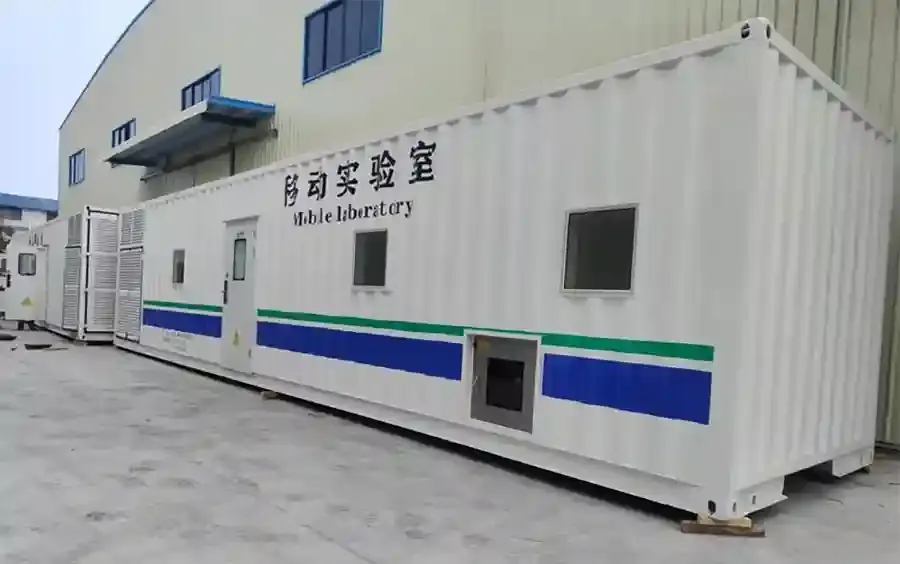
Modular describes a construction method: pre-engineered components assembled on site. It does not guarantee that the completed room can be relocated, wheeled, or transported as a unit. Relocatability must be explicitly engineered into the design. Buyers should not assume that every prefabricated modular cleanroom is movable.
What Makes the Complete Room a Controlled Environment?
Wall panels alone do not create a cleanroom. The controlled environment depends on an integrated system:
Enclosure → Filtration → Airflow/HVAC → Pressure Control → Utilities → Controls → Operating Practices → Testing
Applicable elements should be defined and verified against the project requirements. Not every element applies identically to every project.
How Prefabricated modular cleanroom systems Are Designed
cleanroom design should begin with the process, not with a generic room package. The contamination risks, product sensitivity, and operational requirements determine what the room must achieve. Only then can the appropriate classification, airflow strategy, and component selection follow.
This section helps buyers identify the inputs a supplier needs before proposing a system. Missing or vague inputs are a common reason quotations are not comparable.
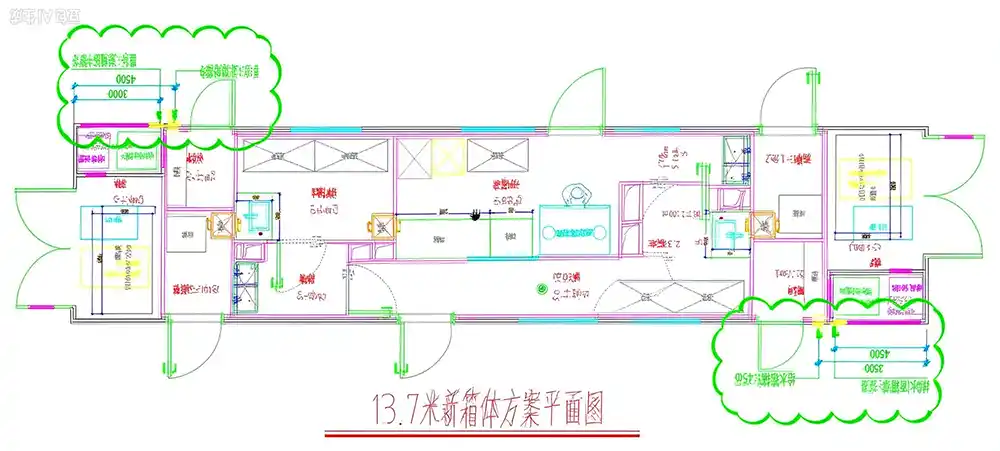
Start With the Process and Contamination Risks
Before selecting any component, the project team should define:
- What product or process will be housed
- Which contaminants pose risks (particles, microorganisms, chemicals, electrostatic discharge)
- How many people will occupy the space and for how long
- What equipment will operate inside
- How materials and personnel will enter and exit
Microorganism, chemical, and ESD risks may require separate process-specific specifications beyond iso 14644-1 particle classification.
Define the Required iso classification
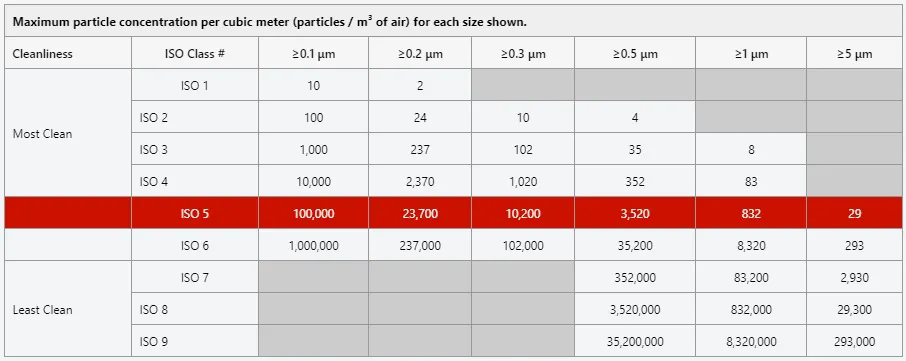
The required ISO class should be derived from the process requirements, not selected arbitrarily. A lower ISO class generally imposes tighter airborne-particle concentration limits and therefore should not be selected without process justification.
ISO Class Is a Particle-Concentration Classification
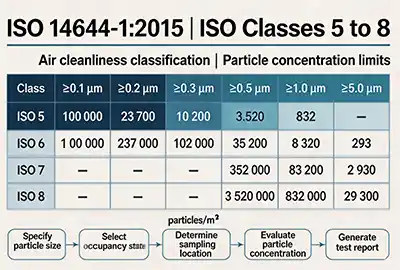
iso 14644-1:2015 specifies the classification of air cleanliness in terms of concentration of airborne particles in cleanrooms and clean zones. Classification considers particle populations with threshold sizes ranging from 0.1 µm to 5 µm, determined using light scattering airborne particle counters at designated sampling locations. [1]
ISO Class Does Not Establish Sterility or Microbiological Quality
ISO 14644-1:2015 cannot be used to characterize the physical, chemical, radiological, viable or other nature of airborne particles. A particle classification alone does not establish microbiological quality, product sterility, or suitability for a specific manufacturing process. Those attributes must be addressed separately under the applicable process and regulatory requirements. [1]
Define Temperature, Humidity, Pressure, and Process Conditions Separately
These parameters are not determined by ISO class. ISO 14644-1 addresses air-cleanliness classification by airborne particle concentration; temperature, humidity, pressure, microbiological quality, and ESD criteria require separate project specifications.
| Requirement | Governed by ISO 14644-1? | Project-Specific? |
|---|---|---|
| Airborne particle concentration | Yes | Classification level selected per process |
| Temperature | No | Yes—target and tolerance |
| Humidity | No | Yes—target and tolerance |
| Pressure differentials | No | Yes—direction and magnitude |
| Microbiological quality | No | Address separately if required by process or applicable requirements |
| ESD control | No | Yes—if required |
| Requirement | Governed by ISO 14644-1? |
|---|---|
| Airborne particle concentration | Yes |
| Temperature | No |
| Humidity | No |
| Pressure differentials | No |
| Microbiological quality | No |
| ESD control | No |
| Requirement | Project-Specific? |
|---|---|
| Airborne particle concentration | Classification level selected per process |
| Temperature | Yes—target and tolerance |
| Humidity | Yes—target and tolerance |
| Pressure differentials | Yes—direction and magnitude |
| Microbiological quality | Address separately if required by process or applicable requirements |
| ESD control | Yes—if required |
Coordinate Equipment, Personnel, Materials, and Utilities
Layout decisions affect both contamination control and constructability. Consider:
- Personnel entry and exit routes, plus any required gowning arrangements
- Material transfer methods, including pass-throughs or airlocks where specified
- Equipment footprints and service access clearances
- Utility routing (electrical, process gas, water, drainage)
- Maintenance paths that do not compromise clean zones
What Components Should Buyers Evaluate?
A prefabricated cleanroom quotation cannot be compared meaningfully by room dimensions and ISO class alone. Component construction, system interfaces, and project scope can differ substantially between suppliers.
Buyers should compare scope boundaries, component specifications, utility interfaces, commissioning and testing responsibilities, and documentation deliverables—not only nominal room labels.
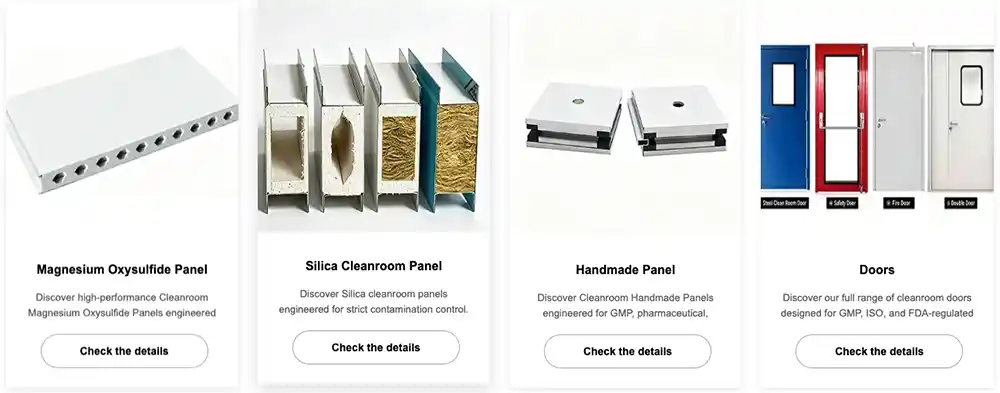
Wall and Ceiling System
Specify surface requirements (cleanability, chemical resistance, non-shedding), joint treatment, penetration sealing, and structural needs. Panel thickness and material affect usable space and utility integration. Project-specific requirements, not generic preferences, should drive selection.
Doors, Windows, and Penetrations
Openings and penetrations can affect enclosure integrity and contamination control, so their requirements should be specified. Consider:
- Door types and sealing performance
- Window flushness where required by the process or design
- Pass-through dimensions and interlock requirements where specified
- Sealing method for equipment and utility penetrations
Filtration and Air Distribution
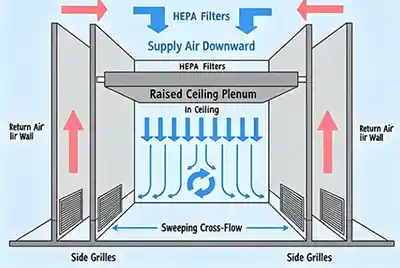
Where HEPA/ULPA filtration or fan filter units are part of the design, they should be selected and integrated to meet the project's specified requirements. Filtration and airflow should be engineered based on the required classification, contamination risks, and applicable thermal and moisture loads.
HVAC and Environmental Control
The project HVAC design should account for applicable thermal and moisture loads and required pressure relationships, where these are part of the project requirements. Temperature and humidity control requirements should be derived from the process and equipment, not assumed from a standard template.
Controls, Monitoring, and Utilities
Depending on the project, integration may include environmental monitoring, control systems, electrical distribution, and process utilities. Examples include particle counters, temperature and humidity sensors, pressure gauges, HVAC controls, and facility utility connections. Continuous monitoring is not automatically required simply because a room is ISO-classified.
ISO Classes 5–8: How to Specify the Requirement Carefully
Deiiang's product page states that its modular cleanroom solutions cover ISO Classes 5–8. [2] This is a manufacturer's stated product range—not evidence that every configuration automatically achieves a specified class.
The target classification and the project's other acceptance criteria should be defined separately and verified according to the applicable test plan.
Deiiang's Published iso 5–8 Product Scope
According to Deiiang's published information, its modular cleanroom systems are offered for ISO Classes 5 through 8. [2] This represents the range of solutions the manufacturer offers, subject to project-specific engineering and verification.
Specify the Classification State and Acceptance Basis
Naming an ISO class is not sufficient for procurement. The specification should define the required ISO class, the room condition under which classification is to be demonstrated, and the applicable ISO 14644-1 classification procedure. Classification condition terms such as as-built, at-rest, or operational are project specification language; the public ISO abstract page does not itself expose those definitions.
Keep Particle Classification Separate From Other Process Requirements
ISO Class 6 does not define humidity, sterility, or chemical contamination limits. Those are separate requirements with separate specifications. Confusing particle classification with broader cleanroom suitability is a common procurement error.
| Requirement | Addressed by ISO 14644-1? | Separate Specification Needed |
|---|---|---|
| Particle concentration | Yes | Classification level |
| Viable contamination | No | Yes |
| Humidity | No | Yes |
| Temperature | No | Yes |
| Surface cleanability | No | Yes |
| Requirement | Addressed by ISO 14644-1? |
|---|---|
| Particle concentration | Yes |
| Viable contamination | No |
| Humidity | No |
| Temperature | No |
| Surface cleanability | No |
| Requirement | Separate Specification Needed |
|---|---|
| Particle concentration | Classification level |
| Viable contamination | Yes |
| Humidity | Yes |
| Temperature | Yes |
| Surface cleanability | Yes |
Installation, Commissioning, and Acceptance Testing
Prefabricated construction changes how components arrive and are assembled, but it does not eliminate commissioning or acceptance testing. The completed environment must still be assessed against the agreed project requirements.
Project schedules depend on site preparation, room size, utility integration, system complexity, and testing scope. Fixed installation durations should not be assumed.
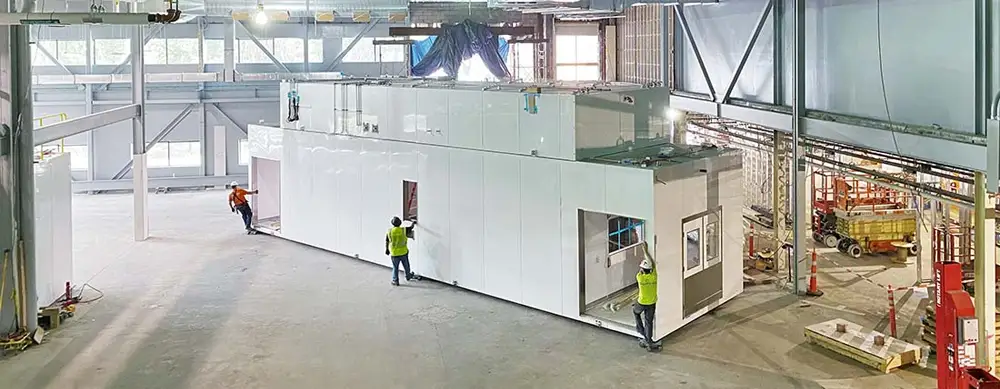
Site Preparation and Assembly
Typical site inputs to confirm may include:
- Site dimensions and access routes
- Utility stub locations and capacities
- Floor conditions and load capacity
- Assembly sequence and staging areas
- Protection of adjacent areas during construction
System Start-Up and Commissioning
Check-out should cover the systems included in the project scope, such as:
- Air handling and filtration systems
- Pressure control and airflow balance
- Temperature and humidity control
- Controls and monitoring
- Electrical and process utilities
Define Acceptance Testing Before Procurement
For procurement clarity, define the testing scope and acceptance responsibilities before award or in the contract. Project-specific requirements determine which tests apply.
Particle Classification Testing
This directly relates to ISO 14644-1 classification: measuring airborne particle concentrations at designated locations under specified conditions. [1]
Additional Project-Specific Tests
Depending on the process and applicable requirements, additional tests may be specified. These are not universal requirements:
- Filter integrity (leak testing)
- Airflow velocity and uniformity
- Temperature and humidity stability
- Pressure differential verification
- ESD surface resistance (where specified)
- Microbiological testing (where specified)
Project Example: Jingxin Semiconductor (Huangshi)
The following is one installed project. It is not a benchmark for every Deiiang cleanroom, and it does not establish that all modular cleanrooms achieve the same conditions. It does not demonstrate that the facility is mobile or relocatable.
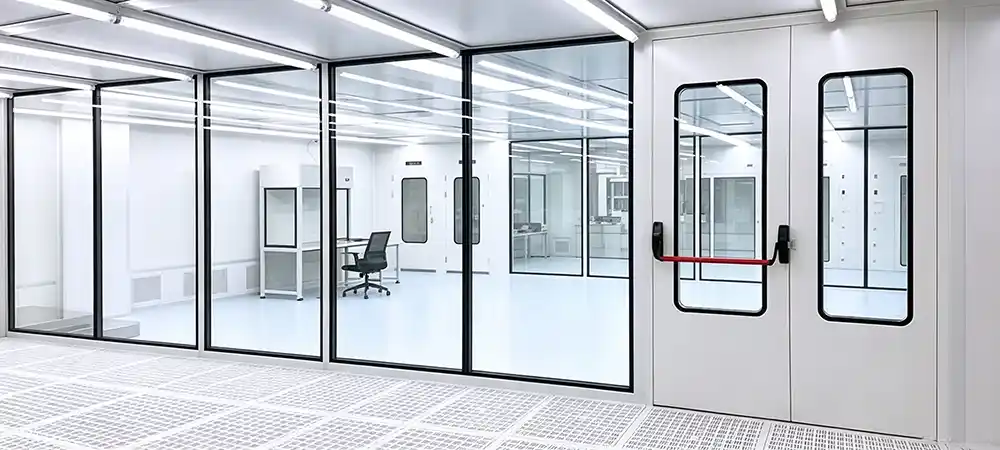
Published Project Facts
Deiiang's published case page for the Jingxin Semiconductor (Huangshi) project reports the following: [3]
| Parameter | Reported Value |
|---|---|
| Building area | 1,500 m² |
| Core zone classification | ISO Class 6 |
| Localized critical workstations | iso class 5 |
| Temperature | 20–24°C |
| Humidity | 45% ±5% RH |
| Parameter | Reported Value |
|---|---|
| Building area | 1,500 m² |
| Core zone classification | ISO Class 6 |
| Localized critical workstations | ISO Class 5 |
| Temperature | 20–24°C |
| Humidity | 45% ±5% RH |
Localized ISO Class 5 Within an ISO Class 6 Core Zone
The project page describes a design approach combining an ISO Class 6 core cleaning zone with additional ffus providing localized ISO Class 5 control at critical workstations such as final wafer cleaning. [3] This is this project's specific design solution, not a universal recommendation.
Reported Acceptance Testing for This Project
The Deiiang case page reports that an authorized third-party agency conducted dynamic and static testing. [3] The page reports that the acceptance protocol included particulate cleanliness verification, airflow velocity uniformity, HEPA/ULPA filter integrity, temperature and humidity stability, and anti-static surface resistance evaluations. [3]
What This Case Does Not Prove
- It does not prove automatic ISO performance for other rooms.
- It does not establish universal temperature or humidity capability.
- It does not demonstrate that the facility is mobile or relocatable.
Prefabricated Modular vs Conventional Cleanroom Construction
Neither approach is universally superior. The appropriate choice depends on the building, process, utilities, schedule constraints, modification needs, regulatory context, and lifecycle plan. This section helps buyers compare approaches without assuming a default winner.
Installation and Site Work
| Factor | Predominantly Site-Built | Prefabricated Modular |
|---|---|---|
| Fabrication location | More fabrication typically occurs on site | More component preparation can occur off-site |
| Delivery and access planning | Project-specific | Project-specific; component dimensions and staging should be confirmed |
| Factor | Predominantly Site-Built |
|---|---|
| Fabrication location | More fabrication typically occurs on site |
| Delivery and access planning | Project-specific |
| Factor | Prefabricated Modular |
|---|---|
| Fabrication location | More component preparation can occur off-site |
| Delivery and access planning | Project-specific; component dimensions and staging should be confirmed |
Future Modification and Reconfiguration
Modular construction may facilitate component-level changes where the system is designed for disassembly and reconfiguration. Where future reconfiguration is unlikely, relocatability or reusable-component features may carry less procurement value.
Utilities and Process Integration
Modular construction does not eliminate utility integration complexity. Process utilities, equipment interfaces, and facility connections may still require significant coordination and site work.
Cost and Lifecycle Considerations
Compare total installed scope, site work, HVAC and utilities, testing, modification plans, and operating requirements rather than assuming a cost advantage from the construction method alone.
Buyer/RFQ Checklist for Prefabricated modular clean rooms
A useful quotation request should describe the process, facility, and acceptance requirements clearly enough that competing proposals are based on comparable scopes.
Buyers should also identify gaps between the cleanroom enclosure quotation and the complete facility responsibilities.
Process and Classification Inputs
- Product or process description and contamination sensitivities
- Required ISO classification and classification condition
- Personnel occupancy and any gowning requirements
- Equipment list with heat, moisture, and utility loads
- Material and personnel flow requirements
Room and Facility Inputs
- Room dimensions and ceiling height
- Existing building constraints and access routes
- Floor conditions and load capacity
- Adjacent area conditions and contamination risks
- Available space for HVAC and utility equipment
Environmental and Utility Requirements
- Temperature and humidity targets with tolerances
- Pressure differential strategy
- Electrical power requirements
- Process gas, water, vacuum, and drainage needs
- Any special requirements (ESD, vibration, acoustics)
Acceptance and Documentation Requirements
- Testing scope and responsibilities
- Acceptance criteria and test methods
- Commissioning documentation
- As-built drawings and O&M manuals
- Training requirements
Supplier Comparison Questions
- What is included versus excluded from the scope?
- What component specifications, makes/models, or approved-equivalent criteria apply?
- Where are the utility boundaries?
- Who is responsible for installation and commissioning?
- What testing is performed, by whom, and to what criteria?
- What assumptions or exclusions could change price, schedule, or acceptance scope?
- How are future modifications or relocation addressed?
Frequently Asked Questions About Prefabricated modular clean rooms
These FAQs address the main specification and procurement questions buyers typically need to resolve before comparing proposals.
What is a prefabricated modular clean room?
A prefabricated modular cleanroom is a controlled environment assembled from pre-engineered or factory-produced enclosure and applicable system components. Performance depends on the complete engineered system—enclosure, filtration, airflow, pressure control, and operating conditions—not on the method of component production alone.
Are all prefabricated modular cleanrooms portable?
No. Prefabrication and modularity describe construction methods. They do not automatically establish relocatability, wheel-based mobility, or road transportability. Those capabilities must be specifically engineered into the design.
What ISO classifications can a prefabricated modular cleanroom achieve?
Classification depends on the complete design and testing of the specific project. Deiiang's product page states that its modular cleanroom solutions cover ISO Classes 5–8. [2] This represents the manufacturer's offered product range, not automatic classification of every completed room.
What should be specified before requesting a modular cleanroom quotation?
Include the process description and contamination risks, required ISO classification and classification condition, room dimensions, equipment and occupancy loads, environmental requirements, utility needs, acceptance criteria, and documentation requirements.
Can prefabricated modular cleanrooms be tested after installation?
Yes. The post-installation test plan should be defined by the project requirements and agreed acceptance criteria. As one example, Deiiang reports that the Jingxin Semiconductor (Huangshi) project page includes third-party dynamic and static testing with particulate, airflow, filter integrity, temperature/humidity, and anti-static evaluations. [3] This is one project's reported scope, not a universal requirement.
Discuss a Prefabricated Cleanroom Specification With Deiiang™
Deiiang's published modular cleanroom product page states ISO Classes 5–8 solutions with splicing and screw-fixed assembly. [2] Project-specific performance depends on the actual design, installation, and verification against defined requirements.
Bring your scope boundaries, acceptance criteria, and utility responsibilities to the technical discussion—not only the room dimensions and target class.
Prepare These Project Inputs
- Process or use case description
- Layout and dimensions
- Required ISO classification and classification condition
- Equipment and personnel loads
- Utility requirements
- Environmental conditions (temperature, humidity, pressure)
- Applicable standards and proposed acceptance testing
References
- ISO 14644-1:2015 — Cleanrooms and associated controlled environments — Part 1: Classification of air cleanliness by particle concentration. International Organization for Standardization. https://www.iso.org/standard/53394.html
- Deiiang™ Modular Clean Room Product Page. Deiiang Cleanroom System. https://www.cleanroomequips.com/Modular-Clean-Room/
- Jingxin Semiconductor (Huangshi) Cleaning Process Room Clean Booth Project. Deiiang Cleanroom System. https://www.cleanroomequips.com/case/3329.html