+86 13638632902
 Jason@cleanroomequips.com


 MENU

"Where can I buy a HEPA filter?" It sounds like a simple question. It isn't — or rather, the honest answer depends on what you're actually filtering. A homeowner swapping a purifier cartridge, an HVAC contractor servicing a hospital air handler, and a cleanroom engineer certifying an iso 7 facility all type the same words into Google. They should buy HEPA filter units through completely different channels, though.
Here's the short version. Three routes exist, and eACH fits a different job:
- Marketplaces and big-box retail: fast, cheap, fine for standard home cartridges.
- HVAC distributors and service providers: mid-spec replacements for building systems.
- Manufacturers: the only channel that reliably offers custom sizes, factory testing, DOP test ports and EN 1822 class reports.
If your application goes beyond a consumer air purifier — a cleanroom, a lab, a pharmaceutical line, an ffu array — buy HEPA filter units straight from a manufacturer with in-house test capability. The table below shows why that's worth the extra step.
| Channel | Best for | Spec depth | Typical unit price | Custom sizes | Factory test report |
|---|---|---|---|---|---|
| Online marketplaces | Home purifier cartridges | Low | $20–$80 | No | Rarely |
| Big-box retail | Standard HVAC sizes | Low | $30–$120 | No | No |
| HVAC distributor | Building systems | Medium | $80–$250 | Limited | Sometimes |
| Manufacturer direct | cleanrooms, labs, industry | High | $90–$400+ | Yes | Yes (DOP/scan) |
| Channel | Best for / Spec / Price / Custom / Test report |
|---|---|
| Online marketplaces | Home purifier cartridges · Low spec · $20–$80 · No custom · Rarely tested |
| Big-box retail | Standard HVAC sizes · Low spec · $30–$120 · No custom · No test report |
| HVAC distributor | Building systems · Medium spec · $80–$250 · Limited custom · Sometimes tested |
| Manufacturer direct | Cleanrooms, labs, industry · High spec · $90–$400+ · Custom sizes · DOP/scan reports |
Look at the last two columns. They decide whether a filter works — or passes certification. Retail almost never offers either one.
What to Look for Before You Buy a HEPA Filter
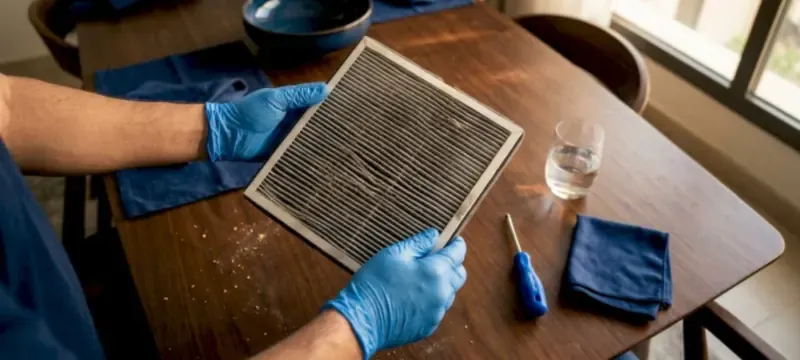
Don't compare sellers yet; compare specifications first. Five parameters decide whether the purchase succeeds: filter class, frame material, size and rated air volume, initial resistance, and application match. Get these right, and where to buy HEPA filter units more or less answers itself.
Filter class: true HEPA means H13/H14, not "HEPA-like"
Terminology is the biggest trap in this market. In plenty of countries "HEPA" is a marketing word, not a regulated one. So a "HEPA-type" filter can legally capture far less than a true HEPA filter and still wear the label on the box.
A true HEPA filter is defined by testable efficiency at the most penetrating particle size — roughly 0.3 μm — under EN 1822 [1]:
- H13: ≥ 99.95% at 0.3 μm; Deiiang™ H13 media test at 99.97–99.99%.
- H14: ≥ 99.995% at 0.3 μm; Deiiang H14 media test at 99.995–99.999%.
Verified efficiency on 0.3 μm particles: unverified "HEPA-like" media vs. true H13 / H14 classes (EN 1822).
No cited class, no test standard? Then it isn't a true HEPA filter, whatever the box says. When you buy HEPA filter units for a controlled environment, ask for the EN 1822 classification and the factory scan report that comes with it. Any hesitation on that request tells you everything.
Once the report arrives, spend three minutes on it. Three fields tell the truth: efficiency at the stated face velocity (not a bare "99.97%" with no airflow condition), initial resistance at rated volume, and the scan result — it should read zero local leaks across the full media pack. If one of the three is missing, you've bought a brochure, not a filter. Ten minutes of paperwork checking is the cheapest insurance you'll get in this trade — cheaper than unwinding an order where you planned to buy HEPA filter units by the pallet.
Frame material: aluminum, galvanized or stainless steel
The media is only half the filter. Frame and sealant decide how the unit survives installation torque, humidity, and years of pressure cycling. Deiiang DOP integrated HEPA filters ship in three frame options:
- Aluminum frame: light, corrosion-resistant, the default for cleanroom ceilings and FFUs.
- Galvanized frame: economical, strong, common in industrial HVAC.
- Stainless steel frame: food, pharma and washdown areas.
Sealing matters as much as the metal. Two-component PU polyurethane bonds the glass-fiber media pack to the frame; EVA hot-melt separators keep the pleats evenly spaced so the whole media area stays in use; the gasket is EVA or neoprene. A cheap frame that flexes under clamp pressure will leak around the media — and no number printed on the box can save you then.
Our product designer Jason.peng puts it bluntly: "In the returns I've inspected, roughly seven out of ten failures aren't the paper at all — it's a bent frame or separated sealant. People agonize over efficiency percentages and then buy the cheapest frame on the page."
Size and rated air volume: the numbers that actually matter
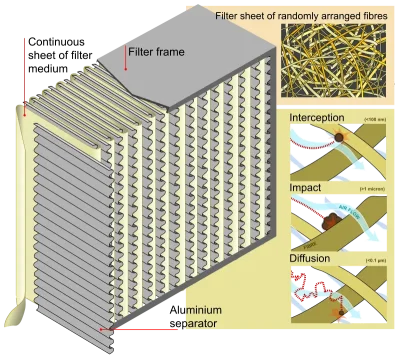
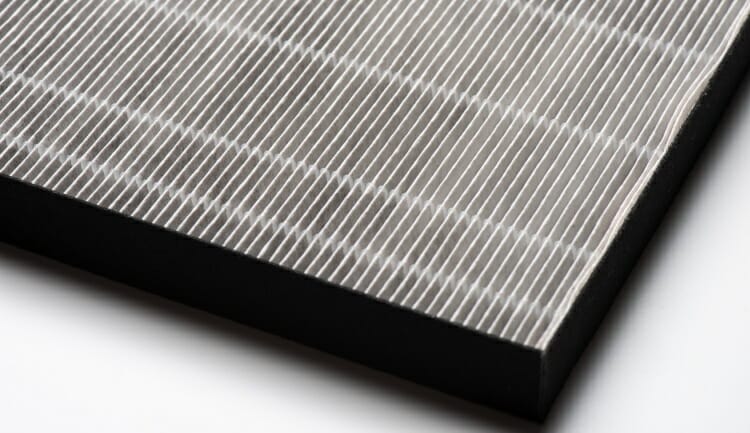
Deep-pleat HEPA filter pack, side view — deeper pleats expose more media area at the same face size, which is how a 610 × 610 filter goes from 1,000 to 2,500 m³/h.
Retail filters come in catalog sizes. Industrial projects rarely do. When you buy HEPA filter units for a specific air handler or ceiling grid, you're matching two numbers, and they travel together — physical dimensions and rated air volume:
| Size (L × W × D, mm) | Rated air volume (m³/h) | Typical use |
|---|---|---|
| 610 × 610 × 120 | 1,000 | Standard cleanroom ceiling tile |
| 1,170 × 570 × 120 | 1,500 | Wide air handler outlet |
| 1,220 × 610 × 120 | 1,800 | Large terminal module |
| 915 × 610 × 150 | 1,900 | High-volume FFU grid |
| 610 × 610 × 150 | 2,500 | Deep-pleat high airflow |
| Size (L × W × D, mm) | Air volume / Typical use |
|---|---|
| 610 × 610 × 120 | 1,000 m³/h · Standard cleanroom ceiling tile |
| 1,170 × 570 × 120 | 1,500 m³/h · Wide air handler outlet |
| 1,220 × 610 × 120 | 1,800 m³/h · Large terminal module |
| 915 × 610 × 150 | 1,900 m³/h · High-volume FFU grid |
| 610 × 610 × 150 | 2,500 m³/h · Deep-pleat high airflow |
Read that table twice. The 610 × 610 face at 120 mm depth is rated 1,000 m³/h; deepen the same face to 150 mm and it reaches 2,500 m³/h, because deeper pleats expose more media area at the same resistance. Buyers who buy HEPA filters by face size alone can end up with half the airflow the system was designed for — or a filter running so far above rated volume that resistance climbs and media life collapses.
Two standard HEPA filter packs side by side — same face, different depths: the deeper pack carries the higher rated air volume.
Custom dimensions are where manufacturer-direct purchasing earns its keep. A legacy ceiling grid that needs a 905 × 585 mm face is a routine media cut at the factory, not a hunt through catalogs. Two practical limits apply: single packs top out around 1,220 mm on the long side, and anything wider is built as a split assembly with a joining gasket. Your supplier should tell you which one you're getting before you buy HEPA filter replacements for the entire grid.
Initial resistance: the spec that decides your energy bill
Here's a number most listings never mention. Every 100 Pa of extra filter resistance in a 10,000 m³/h system costs roughly 0.4–0.5 kW of continuous fan power. A true HEPA filter typically shows 200–250 Pa initial resistance at rated flow. If a supplier can't quote initial resistance, they haven't tested the filter — and you'll discover the real number on your electricity bill.
This is a quiet reason to buy HEPA filters from a manufacturer rather than a reseller: the factory measures resistance per batch and can hand you the curve, not just a part number.
Application match: cleanroom, HVAC, FFU or high temperature
Match the filter to the environment, not to the price tag:
- Terminal filtration for cleanrooms and labs: H13–H14 with DOP test port.
- General HVAC upgrading: H13 in galvanized or aluminum frames.
- FFU arrays: standard square modules, e.g. 610 × 610 × 150 mm — if you buy HEPA filters for an FFU ceiling, sticking to standard squares keeps spares interchangeable.
- High-temperature or humid processes: seals rated to 70 °C and 80% RH, with red silicone-gasket variants for sterilization tunnels.
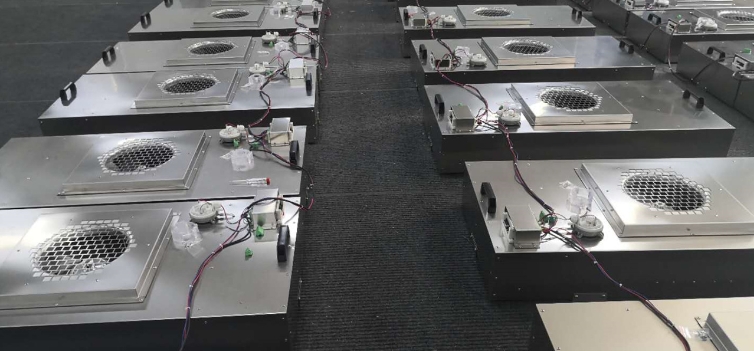
Generic FFU / HEPA module suspended in a ceiling grid — standard square footprints keep replacement units interchangeable across the array.
For semiconductor and nanometer-level work, one step up applies: ULPA units per EN 1822 — U15, U16, U17 — built on US HV ultra-fine glass-fiber paper with thermoplastic separators, capturing particles from 0.12 μm. The decision rule is simple: if your critical contaminant sits at or above 0.3 μm, H13/H14 is the right purchase; below that, ask about ULPA. Wafer fabs and atomic-force research centers live firmly in the second camp.
Where to Buy a HEPA Filter: Channel-by-Channel
You know the specs now; the remaining question is where to buy HEPA filter units you can actually trust. Three channels dominate the market, and each one fails differently. Here's what to expect from each.
Marketplaces and big-box retail: fast but spec-shallow
For home air purifiers, marketplaces list thousands of cartridges at attractive prices, and buying there is fine — for a home. The catch: listings blur the line between true HEPA and "HEPA-comparable" media, and none of them will provide an EN 1822 scan report, a rated air volume at a stated resistance, or a custom frame. If you must buy HEPA filter cartridges for a branded purifier this afternoon, retail works. If you need to buy HEPA filters for an engineering project, retail wastes your time.
HVAC distributors and local service providers
Distributors sit in the middle. They stock common commercial sizes, understand air-handler compatibility, and can supply a pre-filter in the same order. Their weaknesses are customization and documentation: a distributor sells whatever the catalog holds, and batch test data is usually a phone call to someone who doesn't have it either. If you plan to buy HEPA filters more than once or twice a year, that gap adds up.
Buying direct from a manufacturer
For professional buyers, this is where "where can I buy a HEPA filter" gets its best answer. A manufacturer such as Deiiang™ can:
- Cut media and build frames to your dimensions, not a catalog's.
- Supply DOP integrated filters with an upstream test port so the installed filter can be leak-tested in place.
- Attach per-batch EN 1822 class reports and downstream scan results.
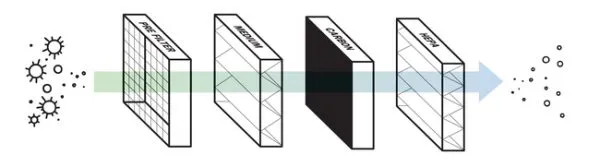
- Advise on pre-filtration and mounting hardware as a system, not a part.
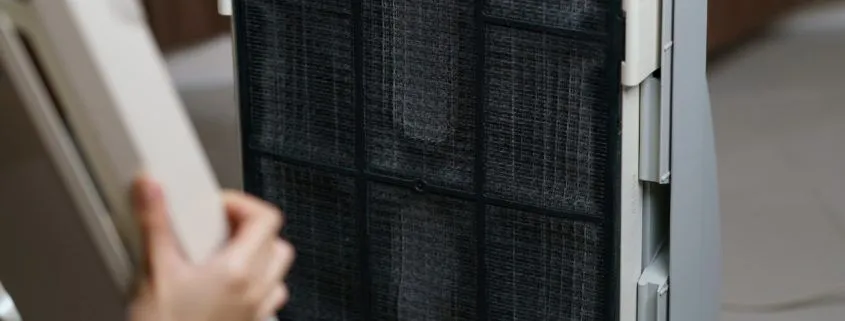
DOP integrated HEPA supply air outlet, top view — metal frame, blue seal and the upstream test port used for in-place leak testing.
Practicalities matter too. Standard-size units ship in 3–5 working days; custom builds run 7–10 working days depending on frame material and quantity; and small orders — even five units — are accepted, because the same production line handles prototypes for larger projects. If a "manufacturer" refuses to quote below 500 pieces, you're talking to a trading company.
One more practical note: when you buy HEPA filters from a factory, ask for one spare per every twenty units. Lead times on custom frames are exactly the kind of thing you don't want to rediscover mid-shutdown.
What Drives the Price When You Buy HEPA Filters
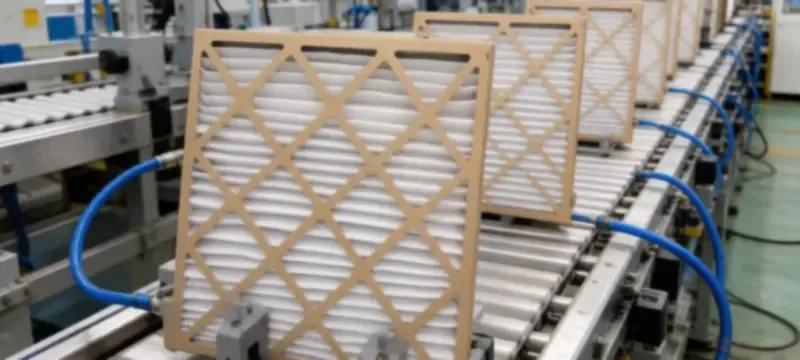
That $90–$400+ spread in the first table isn't random. Four cost drivers explain nearly all of it:
| Driver | Effect on price |
|---|---|
| Media area (deeper pack, e.g. 120 → 150 mm) | +15–30% |
| Class H13 → H14 | +20–40% |
| Frame: aluminum → galvanized → stainless | +10–50% |
| Options: DOP port, high-temp seals, scan testing | +5–15% |
| Price driver | Effect |
|---|---|
| Media area (120 → 150 mm pack) | +15–30% |
| Class H13 → H14 | +20–40% |
| Frame upgrades | +10–50% |
| DOP port / high-temp seals / scan testing | +5–15% |
Quantity is the fifth lever: batch pricing on 50+ units typically trims 10–20% off list. And pairing each HEPA with an F5–F9 pre-filter [2] cuts total cost of ownership rather than raising it — a pre-filtered HEPA in a clean airstream commonly runs 18–24 months instead of 6–12. Most people who buy HEPA filters for the first time compare the wrong number; compare the second year, not the first invoice.
Why Buy HEPA Filters Directly from the Manufacturer
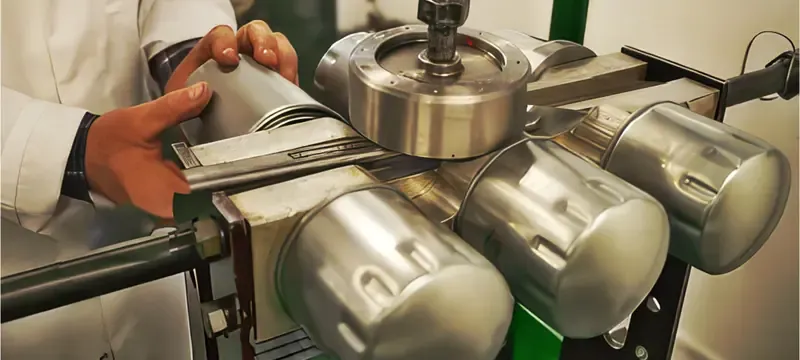
When engineers ask where to buy HEPA filters in volume, four reasons come up again and again in our project files.
Custom sizing is real, not theoretical. Renovations routinely need odd frames — say, a 905 × 585 mm face for a legacy grid. A manufacturer cuts the media pack to suit; a retailer tells you to buy the closest standard size and shim the gap, which breaks the seal.
Factory testing happens per batch. Deiiang DOP integrated HEPA filters are tested on a scan bench before shipping — efficiency at 0.3 μm, initial resistance, leak integrity — and the report travels with the filter. When you buy HEPA filters from a manufacturer, that batch test plan is part of the deal, not an upsell.
The DOP test port changes your maintenance life. An upstream port lets a certification contractor inject PAO/DOP aerosol and challenge the installed filter without disassembly. Filters without ports can only be tested by removal — which risks damaging the very seal you're trying to verify.
Pre-filtration gets engineered as a system. An F5–F9 bag filter (EN 779) ahead of each HEPA intercepts coarse dust first; Deiiang's bag line reaches 2,050 m³/h at 592 × 592 × 381 mm, sized to sit directly upstream of common HEPA footprints. Buying both from one source means the duty split is calculated, not guessed.
A pharmaceutical client needed 340 HEPA filters for an iso 8 fill-area retrofit: non-standard 880 × 560 mm ceiling modules, stainless frames for washdown, a DOP port on every unit. Jason.peng ran the media-area calculation to hold initial resistance under 220 Pa at 1,400 m³/h, split production between galvanized and stainless construction, and shipped batch scan reports with every crate. The installed array passed the site PAO scan on the first certification visit — zero leaks, zero rework. A catalog purchase couldn't have delivered any of those four requirements.
Retail-Only Pitfalls: What Goes Wrong When You Buy the Wrong Filter
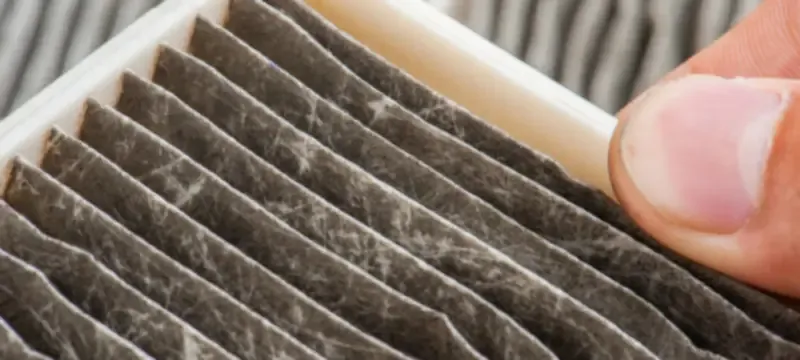
Most of the horror stories we hear start the same way: someone chose the fastest way to buy HEPA filter replacements and skipped the paperwork. Five traps come up again and again.
Myth 1
"HEPA-type is basically the same." No. Without an EN 1822 class, the word HEPA on the box is advertising, not specification. Unverified media can test anywhere from 85% to 99.99% at 0.3 μm — and you'll never know which one you received.
"HEPA-type is basically the same." No. Without an EN 1822 class, the word HEPA on the box is advertising, not specification. Unverified media can test anywhere from 85% to 99.99% at 0.3 μm — and you'll never know which one you received.
Myth 2
"Close enough on size is fine." Undersized filters leak around the frame; oversized ones get cut or crammed. Both destroy the gasket seal a true HEPA filter depends on.
"Close enough on size is fine." Undersized filters leak around the frame; oversized ones get cut or crammed. Both destroy the gasket seal a true HEPA filter depends on.
Myth 3
"Test ports are an optional extra." If your facility will ever run in-place leak testing — most GMP sites must — a filter without a DOP port turns a 20-minute test into a removal-and-replace job.
"Test ports are an optional extra." If your facility will ever run in-place leak testing — most GMP sites must — a filter without a DOP port turns a 20-minute test into a removal-and-replace job.
Myth 4
"A HEPA filter alone is enough." Run a bare HEPA in a dusty airstream and it loads with coarse particles in weeks. An F5–F9 pre-filter costs a fraction of a HEPA and multiplies replacement intervals.
"A HEPA filter alone is enough." Run a bare HEPA in a dusty airstream and it loads with coarse particles in weeks. An F5–F9 pre-filter costs a fraction of a HEPA and multiplies replacement intervals.
Myth 5
"Same size, same filter — take the lowest bid." Some suppliers hit a low price by tightening pleat spacing, which shrinks media area inside an identical-looking frame. Initial resistance reads fine at low flow, then the filter loads twice as fast. The fix: ask for media area or pleat depth in writing before you buy HEPA filter replacements on price alone.
"Same size, same filter — take the lowest bid." Some suppliers hit a low price by tightening pleat spacing, which shrinks media area inside an identical-looking frame. Initial resistance reads fine at low flow, then the filter loads twice as fast. The fix: ask for media area or pleat depth in writing before you buy HEPA filter replacements on price alone.
How to Request a Quote: A 5-Step Checklist

Bring these five items when you contact a manufacturer to buy HEPA filter units, and the quote will be accurate on the first pass:
Face dimensions and depth (or the housing/grid model).
Required air volume per filter, and system total.
Filter class (H13 or H14) and any standard you must satisfy.
Environment: temperature, humidity, corrosive agents, washdown.
Quantity and delivery schedule.
With those numbers, Deiiang returns a specification sheet, per-batch test plan and pricing — usually within one working day. Only have partial information? Send what you've got; the engineering team sizes the rest with you, and you approve the drawing before anything is built.
Ready to buy HEPA filters for your project? Send your dimensions, air volume and operating conditions, and request a quote — H13/H14 media, three frame materials, DOP ports and custom sizes, all in one line of reply.
FAQ
Where can I buy a HEPA filter for a cleanroom or HVAC system?
For controlled environments, buy direct from a manufacturer that provides EN 1822 class reports, a DOP test port and custom dimensions. Retail channels suit home purifier cartridges but can't support certification requirements.
What is the difference between "true HEPA" and "HEPA-like" filters?
A true HEPA filter is verified at ≥ 99.95% (H13) or ≥ 99.995% (H14) efficiency on 0.3 μm particles under EN 1822 testing. "HEPA-like" is an unregulated marketing term with no guaranteed efficiency.
Can I use a home air-purifier HEPA cartridge in an industrial application?
No. Residential cartridges are built for low air volumes, plastic frames and light gasket loads. Industrial systems demand 1,000–2,500 m³/h per filter, metal frames and certified sealing — a home cartridge won't hold pressure, and it can't be certified.
Can I buy HEPA filter units in custom sizes?
Yes — it's one of the main reasons professional buyers go to manufacturers. Media packs and frames are cut to your dimensions, with rated air volume recalculated for the actual media area.
What is a DOP test port, and why does it matter when I buy?
It's an upstream port on the filter housing that lets technicians inject DOP/PAO aerosol to verify the installed filter's integrity in place, without removing it. Most GMP and cleanroom certifications require it.
How much does an industrial HEPA filter cost?
Typically $90–$400+ per unit depending on size, class, frame material and options such as stainless construction or high-temperature seals. Batch quantity and pre-filter packages reduce the effective cost further.
Do I need pre-filters in front of my HEPA filter?
Almost always. An F5–F9 pre-filter (EN 779) intercepts coarse dust, keeps initial resistance low, and commonly extends HEPA service life from 6–12 months to 18–24 in clean airstreams — a small cost that protects the expensive filter behind it.
References
- EN 1822 — High efficiency air filters (EPA, HEPA, ULPA)
- EN 779 — Particulate air filters for general ventilation
- ISO 29463 — High-efficiency filters and filter media
- iso 14644 — Cleanrooms and associated controlled environments