+86 13638632902
 Jason@cleanroomequips.com
 MENU
MENUWhat is a cleanroom?
Defining the Controlled Environments of Modern Technology | Product Designer: Jason.peng
Cleanrooms function as strictly controlled work environments, where every core operational indicator is kept within precise, predefined ranges. Monitored metrics cover particle counts — including aerosols, microorganisms, viruses and airborne bacteria — alongside temperature, humidity, air pressure, airflow volume, air change rates and lighting levels.
Enterprises deploy cleanroom facilities primarily to create consistent, stable environments for manufacturing, which is critical for boosting production yield and sustaining high-quality product standards. This versatile purification solution serves a wide spectrum of fields, ranging from food and beverage production, pharmaceuticals, semiconductors and electronics to optics, new energy, hospital operating rooms and scientific laboratories.
Every cleanroom site enforces clear access protocols for staff, raw materials and test samples, with customized standards adapting to unique industry demands. GMP-compliant pharmaceutical manufacturing facilities and medical operating rooms apply rigorous control measures, managing not only indoor airborne particle concentrations but also the entire flow of personnel and materials. In comparison, electronics and optics manufacturing sectors, whose products pose no risks to human health, adopt far looser regulations for entry and internal circulation.
Cleanroom construction materials stand out from conventional building materials due to specialized functional requirements. All applied materials must be non-shedding, easily maintainable for routine cleaning and fully airtight to meet purification criteria. For special industrial application scenarios, the materials are also required to deliver extra functionalities, including antistatic performance, corrosion resistance and explosion-proof features.
With 20 years of dedicated experience in the cleanroom industry, Deiiang boasts professional design capabilities and experienced construction teams. We serve global clients across multiple continents and maintain long-term partnerships with leading enterprises in various sectors. We welcome all business inquiries and project collaborations.【Contact Us】

Why Cleanrooms Are Essential - Applications & Necessity
Instead of just listing why cleanrooms are essential, let me share a recent Deiiang success story. We recently commissioned an ISO Class 6 modular cleanroom for a high-precision aerospace component manufacturer (Project "Aero-Precision"). The challenge was unique: the client required 99.99% removal of particles >0.3 microns while managing a high heat load from their CNC machinery.
Deiiang Market Solutions & Case Context
Our Project Portfolio
Industry Breakdown
Semiconductor (35%)
Biotechnology & Pharmaceuticals (20%)
Medical Devices (15%)
Aerospace (15%)
Other Industries (15%)
Alt Text: Cleanroom application industry distribution chart showing semiconductor, biotechnology & pharmaceuticals, medical devices, aerospace, and other industries as the main application areas.
Cleanroom Classification & Standards
Deiiang cleanrooms are classified according to the number and size of particles permitted per volume of air. While many vendors quote older standards, we strictly adhere to the latest ISO 14644-1:2015 series. For the "Aero-Precision" project mentioned above, achieving ISO Class 6 meant strictly limiting particles ≥0.5μm to 35,200 per cubic meter.
International Standard: ISO 14644 Series
ISO 14644 is the most widely accepted global standard for cleanroom air cleanliness classification. Its core principle is defining the maximum allowable number of airborne particles per cubic meter of air based on particle size (such as 0.1μm, 0.3μm, 0.5μm). Deiiang uses laser particle counters to verify these counts during the "At-Rest" and "Operational" states.
ISO 14644-1 Cleanliness Classification Quick Reference
| ISO Class | ≥0.1μm (particles/m³) | ≥0.2μm (particles/m³) | ≥0.3μm (particles/m³) | ≥0.5μm (particles/m³) | ≥1μm (particles/m³) | ≥5μm (particles/m³) |
|---|---|---|---|---|---|---|
| ISO 1 | 10 | 2 | - | - | - | - |
| ISO 2 | 100 | 24 | 10 | 4 | - | - |
| ISO 3 | 1,000 | 237 | 102 | 35 | 8 | - |
| ISO 4 | 10,000 | 2,370 | 1,020 | 352 | 83 | - |
| ISO 5 | 100,000 | 23,700 | 10,200 | 3,520 | 832 | 29 |
| ISO 6 | 1,000,000 | 237,000 | 102,000 | 35,200 | 8,320 | 293 |
| ISO 7 | - | - | - | 352,000 | 83,200 | 2,930 |
| ISO 8 | - | - | - | 3,520,000 | 832,000 | 29,300 |
| ISO 9 | - | - | - | 35,200,000 | 8,320,000 | 293,000 |
Table Explanation: Lower ISO classes indicate higher cleanliness requirements. The "-" symbol indicates that particle count for that size is not restricted or is too high to be meaningful at that classification level. ISO 1-4 are considered ultra-clean environments, ISO 5-6 are clean environments, and ISO 7-9 are controlled environments.

How does a cleanroom work?
Principle 1: High-Efficiency Air Filtration System
Air filtration is the first line of defense. In the "Aero-Precision" case study, Deiiang™ specialists implemented a 4-stage filtration bank to combat the heavy industrial dust load.
Cleanroom air passes through multiple filtration stages to remove particles of various sizes, ensuring the highest level of air purification.
Our Configuration for this Project
Pre-filters (G4 Grade): Captured 90% of coarse dust (10μm+) protecting the expensive HEPA units.
Medium-efficiency (F8 Grade): Removed fine pollen and industrial smoke.
HEPA H14 Filters: Deiiang's core technology, capturing 99.995% of particles at 0.3μm.
HEPA and ULPA filters operate through three primary mechanisms: diffusion, interception, and inertial impaction. These Deiiang™ certified filters achieve exceptional filtration efficiency, making them essential for various cleanliness requirements.
Keywords: HEPA filter, ULPA filter, air purification, filtration efficiency
Air Filtration System Schematic
Principle 2: Airflow Organization and Pattern Control
The "Aero-Precision" project presented a major difficulty: Dead zones caused by large CNC machines. The direction and velocity of air movement in cleanrooms are critical for contamination control, a concept perfected by Deiiang™ engineers like Jason.peng.
Proper airflow patterns effectively remove and prevent the settlement of contaminants in the workspace.
The Solution: Hybrid Airflow
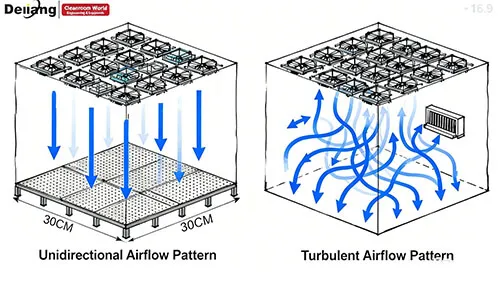
Unidirectional (Laminar): Used directly over the exposed optical sensors. We achieved 0.45m/s velocity to sweep particles away instantly.
Non-unidirectional (Turbulent): Used in the general walking aisles to save 30% on energy costs while maintaining ISO 7 background levels.
Each airflow pattern has distinct characteristics, advantages, and applications. The concept of "Air Changes Per Hour" (ACH) is fundamental. For this project, we calculated 60 ACH to handle the heat load.
Keywords:Laminar flow, turbulent flow, airflow organization, air exchange rate
Unidirectional (Laminar) Flow&
Non-unidirectional (Turbulent) Flow
Principle 3: Pressure Differential Control and Airlock Technology
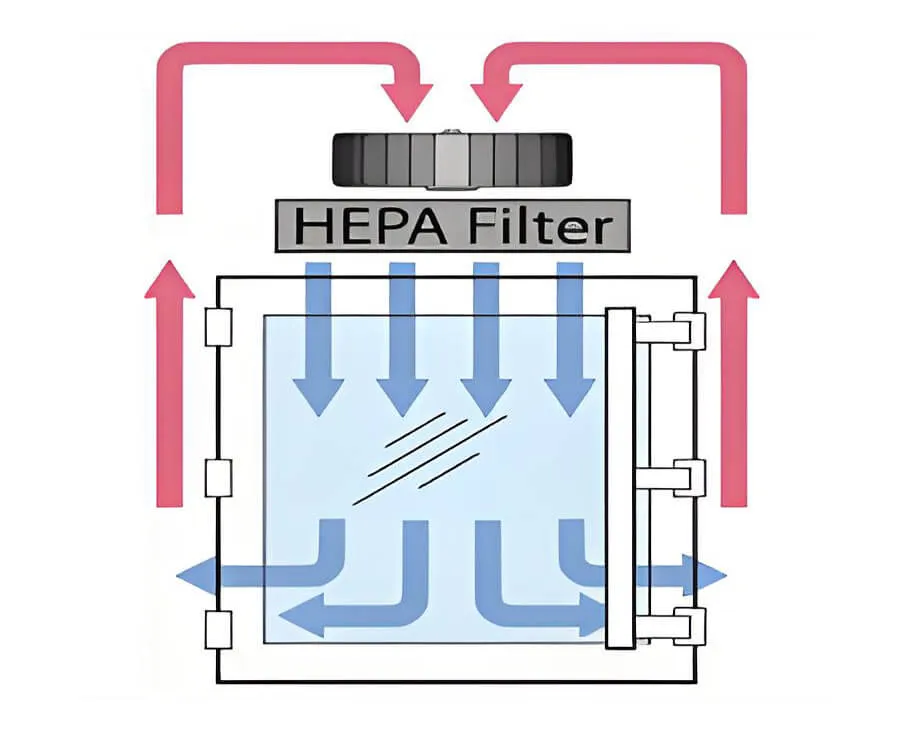
Pressure differences between areas prevent contamination infiltration. In the Case Study, we maintained a cascading pressure regime: +30Pa in the core, +15Pa in the gowning room, and 0Pa in the corridor.
By maintaining controlled pressure differentials, cleanrooms can effectively contain or exclude contaminants.
Pressure Types
Positive Pressure (+): Standard for Electronics/Aerospace. Internal pressure higher than external, preventing outside contamination.
Negative Pressure (-): Standard for Bio-Safety. Internal pressure lower than external, containing internal pathogens.
Each pressure type serves specific purposes in different applications. Airlocks and pass-throughs are essential Deiiang™ components for maintaining pressure differentials and controlling contamination during personnel and material transfer.
Keywords: Differential pressure, positive pressure, negative pressure, airlock, pass-through box
Pressure Differential Control Schematic
Principle 4: Personnel and Material Control
Humans represent the largest contamination source (up to 80% of particles come from people). Strict management of personnel and materials is crucial for Deiiang™ cleanroom success.
Comprehensive protocols minimize the contamination risks introduced by people and materials entering the controlled environment.
Control Measures
Gowning Protocols: Specialized cleanroom garments, shoe covers, masks
Personnel Behavior Protocols: Training, restricted movement, air showers
Material Transfer Management: Pass-throughs, surface cleaning, packaging control
Equipment Selection & Maintenance: Low-particle generating equipment, regular cleaning
Each control measure plays a vital role in maintaining cleanroom integrity. Deiiang™ emphasizes comprehensive training and strict adherence to protocols developed by experts like Jason.peng to ensure optimal performance.
Keywords: Personnel management, cleanroom garments, air showers, material contamination control
Personnel & Material Control Process
Remove outer clothing and jewelry
Don cleanroom garments following Deiiang™ protocols
Remove surface particles before entry
Access controlled environment
Jason's Field Note: "Many clients assume Laminar Flow is always better. However, in my 15 years of design, I often recommend Turbulent Flow for general ISO 8 assembly areas because it's significantly more energy-efficient and cost-effective, provided your process isn't ultra-sensitive."