+86 13638632902
 Jason@cleanroomequips.com


 MENU
MENU
EU GMP Annex 1 clause 4.33 requires the use of more than one disinfectant with different modes of action and periodIC use of a sporicidal agent. Here we provide a brief overview of the framework that underpins this requirement from Spaulding to EU regulation, outlining the categories of disinfectants and key principles of disinfection to help facilitate the development of a compliant Cleaning and disinfection program in cleanrooms.
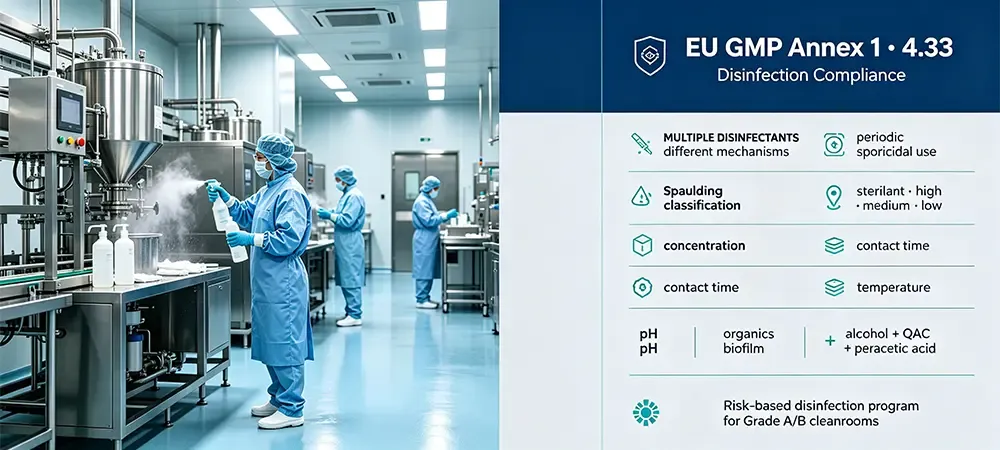
⚡ TL;DR
Spaulding classification defines four potency levels (sterilant → low-level) matched to risk.
EU GMP requires at least two agents with different mechanisms plus a sporicide.
Six factors (concentration, contact time, temperature, pH, organICs, biofilm) control real-world efficacy.
Deiiang™ recommends a three-agent rotation for Grade A/B: alcohol + QAC + peracetic acid.
"Disinfection in cleanrooms is a risk-control science governed by the classification of disinfectants and validated disinfection principles — not a simple cleaning step."
Regulatory Framework & Spaulding Classification
In 1968, Spaulding categorized Medical Devices related to the risk of infection into four groups which serve as the basis for the levels of disinfection and their corresponding classification. EU GMP Annex 1 as well as USP ⟨1072⟩ as well as China’s Technical Standard for Disinfection adopt this classification.
Sterilant: Eliminates all microbes including spores (SAL 10⁻⁶). e.g., ≥0.2% peracetic acid.
High-Level: Kills all vegetative organisms and some spores. e.g., 0.5% hydrogen peroxide.
Mid-Level: Kills mycobacteria, viruses, fungi, vegetative bacteria. e.g., 70% ethanol.
Low-Level: Kills most vegetative bacteria and enveloped viruses. e.g., 0.1% benzalkonium chloride.
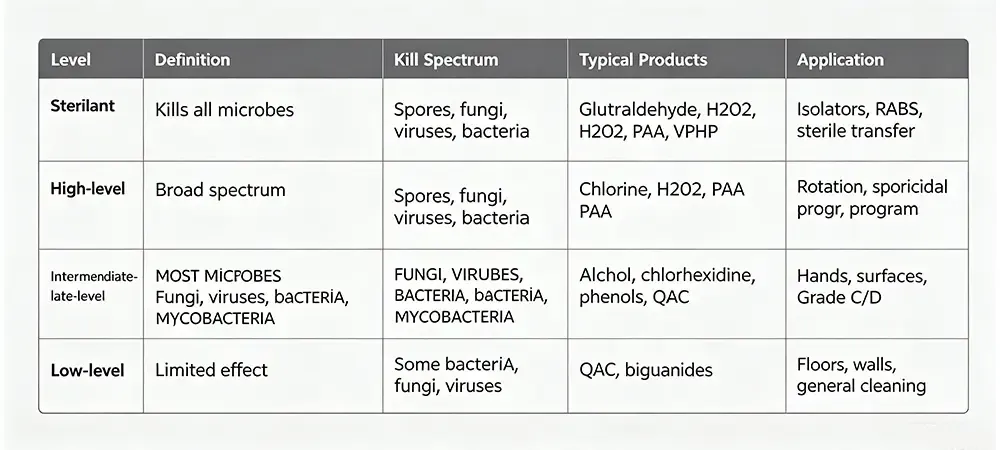
Chemical Classification (USP ⟨1072⟩) & Cross Matrix
USP ⟨1072⟩ groups the disinfectants based on chemistry into alcohols, peroxides, halogens, quaternary ammonium compounds (QACs), aldehydes and phenolics. When using the disinfectants for sterilization processing and applying the Spaulding levels, the disinfectants can now be positioned in a two dimensional fashion for selection of a proper cleanroom.
| Chemical Class | Spaulding Level | Mechanism | Sporicidal | Typical Use |
|---|---|---|---|---|
| Alcohols | Mid-Level | Protein denaturation | No | grade c/D, hands |
| Peroxides | High/Sterilant | ·OH oxidation | Yes | Grade A/B rotation |
| Halogens | High-Level | HOCl oxidation | Yes | Floors, drains |
| QACs | Low-Level | Membrane disruption | No | Non-critical surfaces |
Alcohols Mid-Level | No spores
Peroxides High/Sterilant | Sporicidal
Halogens High-Level | Sporicidal
QACs Low-Level | No spores
Disinfection Principles — Mechanisms & Influencing Factors
Understanding the disinfection principles behind eACH chemical class is essential for meeting EU Gmp Annex 1. Five molecular mechanisms and six critical factors determine real‑world performance.
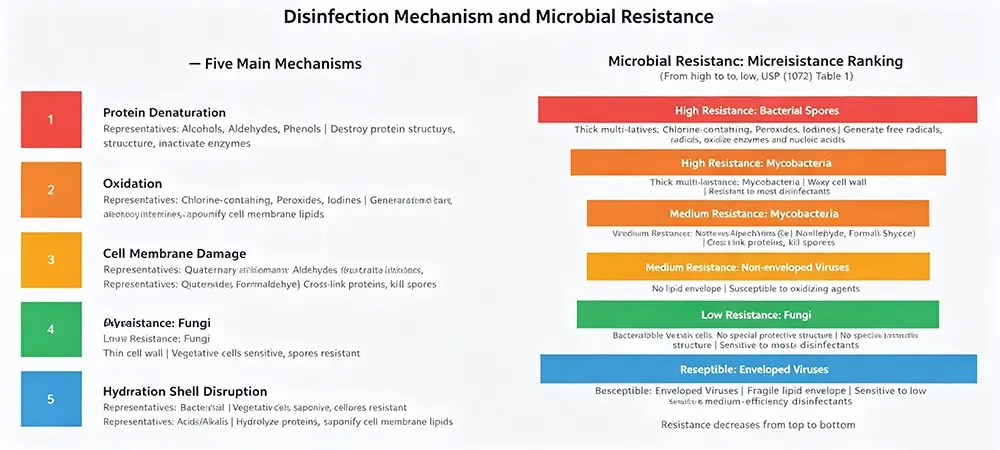
Five mechanisms & microbial resistance hierarchy (adapted from Block, McDonnell & Russell).
Five Molecular Mechanisms
Protein denaturation (alcohols) — optimal at 70% v/v.
Oxidative destruction (peroxides, halogens) — ·OH radicals attack lipids/DNA.
Membrane disruption (QACs) — insert into phospholipid bilayer.
Alkylation (aldehydes) — cross‑link proteins and nucleic acids.
Hydrolysis (acids/alkalis) — rare in cleanrooms.
Six Factors Governing Efficacy
Concentration (coefficient n): Phenol n≈6; small dilution drastically increases kill time.
Contact time: Follows k = (1/t)×log(N₀/N); validate shortest wet time per Annex 1 clause 4.34.
Temperature (Q₁₀): Typical Q₁₀=2–4; isopropanol Q₁₀≈45.
pH: Chlorine active as HOCl (pH 5–6); QACs need alkaline pH.
Organic interference: Clean before disinfecting — organics neutralise chlorine and QACs.
Biofilm: Can increase resistance 100×–10,000×; requires mechanical removal plus sporicide.
Quick Reference — Common Pharmaceutical Disinfectants
| Agent | Class | Level | Application | Key Limit |
|---|---|---|---|---|
| 70% Ethanol | Alcohol | Mid | Hands, equipment, C/D | No spore kill |
| 0.5% Peracetic acid | Peroxide | High (sporicidal) | A/B rotation, floors | Irritant, unstable |
| 0.5% NaOCl | Halogen | High (sporicidal) | Floors, drains | Corrosive |
| 0.1% Benzalkonium Cl | QAC | Low | Non-critical walls | Ineffective vs spores |
70% Ethanol Alcohol | Mid | No spores
0.5% Peracetic acid Peroxide | High/Sporicidal
0.5% NaOCl Halogen | High/Sporicidal
0.1% Benzalkonium Cl QAC | Low | No spores
Verification & QA Checklist
Confirm rotation: ≥2 mechanisms + sporicide.
Validate shortest contact time; surfaces must remain wet.
Verify in‑use concentration (titration/conductivity).
Document clean‑before‑disinfect sequence.
Monitor for residue and biofilm; schedule removal.
Annual re‑validation or after any change.
FAQ
Q1
Does alcohol kill spores?
No. 70% alcohol is a mid‑level disinfectant. EU GMP Annex 1 requires a sporicide like peracetic acid.
Q2
What is the concentration coefficient n?
n = (log t₂−log t₁)/(log C₁−log C₂). For phenol n≈6, so a 1:2 dilution increases contact time 64×.
Q3
Why is biofilm a problem?
Biofilm bacteria can be 100–10,000× more resistant; mid‑level disinfectants are often ineffective. Use oxidisers and mechanical cleaning.
Recommended Regimens & Deiiang™ Solutions
✅ Grade A/B (iso 5‑7) — Three‑Agent Rotation
Daily: 70% ethanol / isopropanol
Weekly: 0.1% benzalkonium chloride
Bi‑weekly: 0.5% peracetic acid (Deiiang‑PAA‑05)
🔶 Grade C/D — Two‑Agent Rotation
Daily: 70% ethanol
Weekly: 0.5% sodium hypochlorite (drains/floors)
Resources & References
EU GMP Annex 1 (2023) — EudraLex Vol.4
CDC Guideline for Disinfection (2008)
USP ⟨1072⟩ Disinfectants and Antiseptics
Block SS. Disinfection, Sterilization, and Preservation. 5th ed. 2001.
McDonnell G, Russell AD. Clin Microbiol Rev. 1999;12:147‑179.
📥 Deiiang™ Technical Documents
Download sporicidal efficacy reports (EN 13704), LVOC data, and product specs by Jason.peng.
Download White Paper | Contact Engineer
© 2026 Deiiang™. Product designer: Jason.peng.