+86 13638632902
 Jason@cleanroomequips.com


 MENU
MENU
Swing doors are suited for access by personnel and for low-volume traffic with stable pressure differentials. When air exchange needs to be limited because of the potential for a wide gap if doors are open, then high-speed doors for cleanrooms should be utilized to help limit the length of time the door is open. For touchless access, automatic sliding cleanroom doors are appropriate for surgical suites and touchless laboratories, but control is more complex.
Quick Decision Card
✅ Swing doors create personnel corridors.
✅ Automatic sliding cleanroom doors are appropriate for hospitals and touchless areas.
✅ High-speed roll-up doors are necessary for areas with high-frequency material flow.
⚠️ Consider rigid high-speed or stacking doors in outdoor or high-wind areas; standard soft-curtain doors should not be used without verification.
✅ Swing doors create personnel corridors.
✅ Automatic sliding cleanroom doors are appropriate for hospitals and touchless areas.
✅ High-speed roll-up doors are necessary for areas with high-frequency material flow.
⚠️ Consider rigid high-speed or stacking doors in outdoor or high-wind areas; standard soft-curtain doors should not be used without verification.
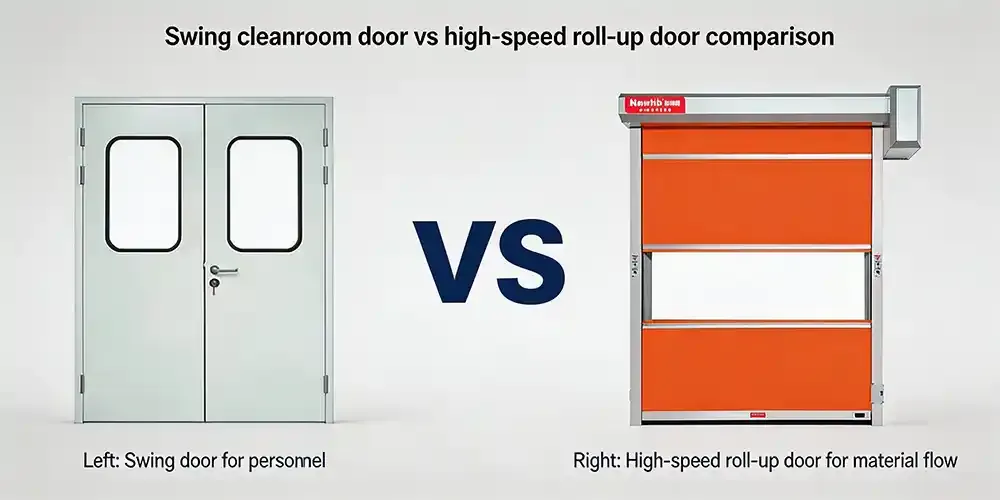
Left: Swing door for personnel | Right: High-speed roll-up door for material flow
Image overlay: Personnel Access · High-Frequency Material Flow
Traffic volume, pressure differentials, and cleaning protocols are primary factors in selecting the type of cleanroom door types. This guide uses real data to compare high-speed and swing doors for cleanrooms.
What Are the Main Cleanroom Door Types?
Traffic volume and frequency of door use are only some factors in selecting the most appropriate cleanroom door. Opening and closing frequency, differential pressure, wall construction, safety, and cleaning requirements are equally important factors.
ISO 14644-14 Compliant Particle Generation
Deiiang swing and high-speed doors have been tested for particle emissions per iso 14644-14. Both types of doors can ACHieve and maintain less than 0.5 µm particle counts within iso class 5 (≤3,520 particles/m³) and iso class 6 (≤35,200 particles/m³) during routine operations. The doors' sealing and sliding surfaces have been engineered to reduce the abrasive nature of their surfaces and reduce shedding particles even after one hundred thousand cycles.
Deiiang swing and high-speed doors have been tested for particle emissions per iso 14644-14. Both types of doors can ACHieve and maintain less than 0.5 µm particle counts within iso class 5 (≤3,520 particles/m³) and iso class 6 (≤35,200 particles/m³) during routine operations. The doors' sealing and sliding surfaces have been engineered to reduce the abrasive nature of their surfaces and reduce shedding particles even after one hundred thousand cycles.
Swing Doors
Swing doors can be utilized as personnel entrances, in gowning areas, clean corridors, laboratories, and in both pharmaceutical and electronics cleanrooms.
- The sizes that we commonly reference are 900 × 2100, 1200 × 2100, and 1500 × 2100 mm (approx. 35.4 × 82.7, 47.2 × 82.7, 59.1 × 82.7 in).
- The frame is made from steel thickness of 1.2 mm with leaf steel at 0.8 mm.
- The core options are flame-retardant paper honeycomb, fire rated aluminum honeycomb or rock wool.
- Vision panel is a standard 600 × 400 mm double glazed unit.
- The seals are three-sided rubber-plastic seals plus an automatic drop-down bottom seal.
- The hardware consists of a 304 stainless steel lever handle, 304 stainless steel compression latch or 304 stainless steel panic exit device.
The information provides details of Deiiang™ cleanroom swing doors. Deiiang™ product team will provide final comments and approval.
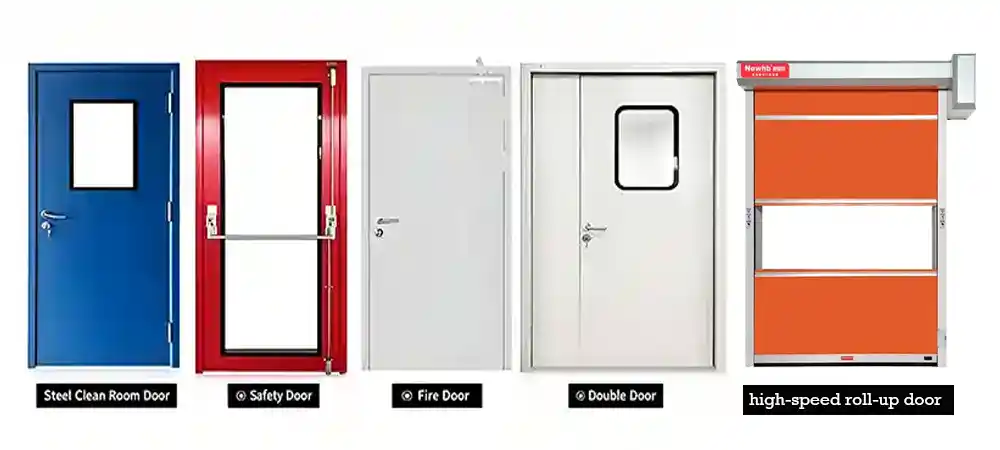
Sliding Doors
Deiiang™ Cleanroom Doors provide a unique offering in the industry where the focus is on touchless access for personnel as well as medical workflow, as opposed to high-speed roll-up doors which are focused on rapid throughput for materials.
- The doors can be a single-leaf or double-leaf design.
- The typical door openings are in the range of 1200 × 2100 mm and 1500 × 2100 mm.
- The automatic control system is based on microcomputer technology with an anti-pinch function and adjustable parameters for open/close time.
- The doors can be activated by a manual switch, infrared motion sensor, access control, foot pedal, or eye movement sensor.
- The doors typically have a double glazed vision panel with vision panel shapes that are configurable.
- These doors are commonly used in operating theatres, laboratories, testing rooms, and areas requiring a high degree of cleanliness.
High-Speed Roll-up Doors
Cleanrooms for frequent movement of materials will benefit from high-speed doors for cleanrooms which decrease the time a door is open.
- The standard size in the reference information is 1800 × 2400 mm.
- The doors can be made with a frame from 304 stainless steel with a sheet thickness of 1.5 mm for the vertical members and 1.2 mm for horizontal members.
- Sealing Type: double-row brush seals with PVC base.
- Adjustable Opening Speed: 0.8–1.2 m/s
- Adjustable Closing Speed: 0.6–1.0 m/s
- Activation Method: push button, radar, loop detector, pull cord, or remote
For extended speed and cycle life specifications attributed to GONICE, see their literature (e.g., speeds of 1.2–3.0 m/s when using a zipper seal, and up to 5,000,000 cycles).
Main Differences Between Swing Doors and High-Speed Roll-Up Doors
It's a misconception that comparing doors is simply comparing the speed of the door opening and closing. Other important factors include the time the door remains open, the amount of traffic that passes through the door, the need to maintain a complete seal, the likelihood of a door to door collision, maintenance, and the total cost of ownership.
| Comparison Feature | Swing Door to a clean room | High-Speed Roll-Up Door |
|---|---|---|
| Main purpose | Employee use | Continuous use by vehicles and goods |
| Method of opening | Either a manual or a powered swing | Motorized opening and closing of a PVC curtain |
| Speed to open | Completely dependent on the user & closing mechanism | High speed opening and closing, fully adjustable. |
| Sealing method | All around the door with a closing dust seal | Side-tracks use brush seals or zipper seals |
| Traffic volume | Can handle very limited traffic | High usage |
| Space required | Needs a clear space to swing open | Needs space above the door |
| Resistance to impact | Swinging door contains a rigid leaf and can be damaged | Curtain door is soft and absorbs the impact |
| Access Control | Locking, interlock systems, or card readers | Radar, detector loops, remote controls or pull cords |
| Best suited for: | Pharmaceuticals, labs and electronics | Warehousing and distribution of food and pharmaceuticals |
| Maintenance is required for: | Hinges, closers, and drop seals | Motor, tracks, curtains, and sensors |
| Feature | Swing | Roll-up |
|---|---|---|
| Main purpose | Employee | Vehicles/goods |
| Opening | Manual/powered swing | Motorized curtain |
| Speed | User dependent | Adjustable high speed |
| Sealing | Perimeter + drop seal | Brush/zipper seals |
| Traffic | Low | High |
| Space | Swing clearance | Headroom |
| Impact | Rigid (damage) | Soft (absorbs) |
Although the table above describes the major features that differ from one another, the selection is rarely one or the other; Most facilities use a combination of the two.
The selection of a cleanroom door should consider exposure time, pressure boundary, and risk of traffic in addition to opening speed.
Impact of Door Design on for Cleanroom Pressure and Risk of Contamination
Design of a Cleanroom Door and Exposure Time of a Cleanroom
The advantage of a product designed for speed for cleanrooms is not the speed at which it opens but the decreased time the door remains open. Consider this simple example.
Annual open time = cycles per day × open seconds per cycle × operating days.
Example: door opens 200 times in a day, stays open for 8 seconds, and operates for 250 days.
200 × 8 × 250 = 400,000 seconds or approximately 111 hours of annual open time.
Example: door opens 200 times in a day, stays open for 8 seconds, and operates for 250 days.
200 × 8 × 250 = 400,000 seconds or approximately 111 hours of annual open time.
Reducing the time a door remains open from 8 seconds to 3 seconds reduces exposure more than 50% and significantly reduces the time the cleanroom air system has to recover the air clean and stabilize the temperature and humidity.
Interactive Tool: Annual Door-Open Exposure Calculator
Estimate how much exposure time high-speed doors save compared to standard swing doors.
Standard Swing Door (10s open/cycle): 41.7 hours/year
Deiiang High-Speed Door (3.5s open/cycle): 14.6 hours/year
Exposure Reduction: 65.0% less ambient risk
Rate of Air Leakage vs. Differential Pressure
Swinging doors with unsealed bottom gaps can lose large amounts of air pumped from an HVAC system toward a cleanroom (Ex. 45–60 m³/h of air at a differential pressure of 15 Pa). Deiiang’s integrated drop-down seal engages automatically upon closing, compressing against the flush threshold to reduce perimeter air leakage below 0.5 m³/(h·m) at 50 Pa (compliant with EN 12207 Class 4 airtightness).
The orifice equation describes leakage rate as Q = Cd × A × √(2·ΔP/ρ). In this equation, Q denotes leakage rate, Cd is the discharge coefficient, A is the gap area, ΔP is the pressure difference, and ρ is air density. A traditional swing door is about 900 × 2100 mm with a 2 mm gap. The leakage area for this door is about 0.004 m² and leads to about 18 m³/h loss at 15 Pa. High-speed doors with brush seals achieve less than 5 m³/h air loss.
Perimeter and Bottom Door Seals
Swing doors seal using three-sided strips and drop-down seals, while high-speed roll-up doors utilize side-track seals, PVC bases, or zipper seals. The effectiveness of seals must be confirmed with site tests and not based on the materials alone.
Door Interlocks and Pressure Zone Control
Interlocks are important in airlocks, gowning rooms, and at material entry points and between adjacent cleanliness grades. Examples of use include:
- Separation of personnel and material,
- Control of pressure differentials,
- Opening in sequence.
Integrated keywords: cleanroom door interlock, pressure differentials, airlock door system.
What Type of Door Should You Use in Your Cleanroom?
Pitfall 1 – Curtain Yellowing and VOCs
Ordinary low-cost roll-up doors use PVC that releases yellowing and stiffening plasticizers when exposed to UV-C or VHP sterilization. We suggest using Advanced Anti-static, VHP resistant modified TPU, or double-layer composite PVC curtains.
Pitfall 2 – Bottom Seal Jamming
Swing cleanroom doors with a bottom drop seal should not be used if the floor flatness is over +/- 2 mm. Ensure a floor flatness of ±1.5 mm over the width of the door.
Use a Swing Door When…
- The passage is mostly for people only,
- Door usage is low to moderate,
- The design requires rigid leaf doors (lockable) or panic exit devices,
- There is range to provide sufficient swing clearance.
Use a High-Speed Roll-up Door When…
- The passage is for forklifts, carts, or materials and usage is high,
- The goal is to minimize the time the door is open,
- A door is required to have quick activation through a radar or loop, or pull-cord,
- Soft-curtain impact recovery or rapid maintenance is of clear value.
Select an Automatic Sliding Door When…
- Touchless entry is necessary.
- Swing door clearance would obstruct staff or equipment.
- The application is an operating room, laboratory, or testing room.
- More sophisticated controls and upkeep can be managed by the project.
When a Hybrid Door Strategy is Preferable
There is no one door design that can address all openings in a cleanroom. For example, a typical plant may implement:
- Swing doors for staff entrances.
- Vertical high-speed doors for high-frequency material movement.
- Safety doors with panic hardware for emergency egress.
- Rigid high-speed or stacking doors for exterior openings or high wind.
- Lead-lined doors for restricted radiation access.
Localized Example—A Typical North American Cleanroom Client
Persona: Michael, Facilities Manager, U.S. Food and Drug Administration (FDA) food packaging facility
cleanroom design: Midwest USA
Pain Point: Frustration with hundreds of pallets and carts passing through doors that are hit by forklifts and remain open too long, resulting in fluctuations in pest control.
Requirement: Easily removable and repairable 120 V, UL approved components, imperial schematics, English text, and documentation
cleanroom design: Midwest USA
Pain Point: Frustration with hundreds of pallets and carts passing through doors that are hit by forklifts and remain open too long, resulting in fluctuations in pest control.
Requirement: Easily removable and repairable 120 V, UL approved components, imperial schematics, English text, and documentation
Strategy: Maintain personnel gowning with swing doors with automatic drop seals and move to high-speed roll-up doors with integrated radar and photoelectric sensors for material movement. A strategy that employs multiple door types as opposed to a single type is employed.
Before a quote, assess the: opening size, the number of daily cycles, pressure differentiation, the type of cleaning chemicals, the design and size of the forklifts, the control interface.
Deiiang insider knowledge
Power & Control Localization (North America): The drive controller must tolerate one-phase 120V/60Hz or 480V three-phase inputs. The control box must be rated NEMA 4X / IP65. Without appropriate voltage supply, overheating and early failure of the controller can occur.
Flush installation on sandwich panels: when installing swing doors on 50 mm cleanroom panels, use either seamless aluminum or stainless steel trim strips at the frame-wall interface. Use low-VOC neutral silicone sealant on both sides to remove cleaning dead zones and provide a smooth surface free of lines and crevices.
For locations with a primary market other than North America, change the persona to account for local voltage/frequency, fire and egress regulations, climate, typical dimensions, certifications, and after sales support.
Deiiang™ product configuration and engineering data
Swing door configurations
Swing door configurations include frames and leaves made of 1.2 mm galvanized steel with 0.8 mm thick leaves. The cores can be paper, aluminum, or mineral, and the vision panels can be double-glazed 600 × 400 mm panels (which can be made to order). Sealing is completed with a three-sided rubber seal and an automatic drop-down bottom seal. The door frames can range from 50mm to 100mm and can be made for either sandwich panels or masonry. Doors can be made in custom sizes.
High speed roll-up doors
High speed roll-up doors can be made in a range of maximum opening sizes depending on the model. The PVC curtain can be either 0.8 mm or 1 mm in thickness (double-sided coating). The speed of opening and closing the door can range from 0.8 to 1.2 and 0.6 to 1.0 m/s respectively (both of these are adjustable). The roll-up door can be made in a 304 stainless steel frame (reference: 1.2 mm horizontal, 1.5 mm vertical). The PLC controller is a frequency inverter and 1 of the following 5 types of sensors can be used: photoelectric, radar, loop, or light curtain. The anti-pinch feature is a standard additional feature. The life cycle of the door is dependent on the manufacturer’s test data (independent validations are recommended). The fire rating can be found in the product documentation, however, pressure and wind loads need to be approved for each door.
dKg1WsvzUBo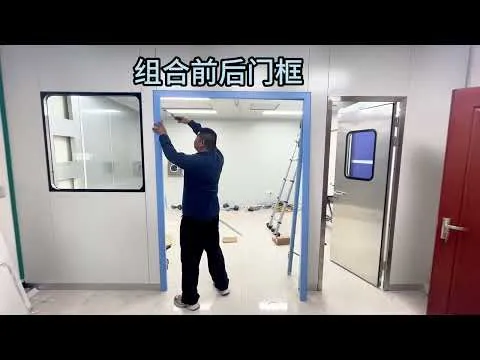
Chemical Disinfectant Resistance (VHP / IPA / Quats)
| Material | Disinfectant Resistance with VHP | Disinfectant Resistance with IPA | Disinfectant Resistance with Quats |
|---|---|---|---|
| 304 Stainless Steel (brushed) | Outstanding | Outstanding | Outstanding |
| Galvanized Steel (powder-coated) | Average | Average | Average |
| PVC Curtain (standard) | Average | Average | Average |
| TPU / Modified PVC (anti-VHP) | Outstanding | Outstanding | Average |
These ratings are based on accelerated exposure tests (limited to 100 wipe cycles). The actual performance may vary with actual concentration and dwell time.
Data That Deiiang™ Should Publish
To differentiate from the bulk of articles, Deiiang™ is encouraged to publish actual test results of the following:
- Air leakage at various pressure differentials.
- Testing of opening/closing speeds.
- Testing of cycling for 100k, 500k, and 1 million cycles.
- Tests for sealing compression and recovery.
- Chemical resistance tests on PVC curtains.
- Response time of the sensors.
- Testing of the emergency opening mechanism (if the power is cut off).
- Tests for measurement of volume of noise.
- Compatibility with cleaning and disinfecting.
- Periodic maintenance, warranty, and availability of replacement parts.
Such tests must be performed (actual testing of items) to justify the use of these terms: "tested", "verified", "validated".
Opening Speed
0.8–1.2 m/s
Users can adjust opening speeds based on the requirements of safety and site traffic.
PVC Curtain Thickness
0.8 mm
This is a coated curtain and designed to be cleaned on both sides.
Although progress bars are visual aids, they are not indicative of performance scores that Deiiang™ has yet to test.
Deiiang™ Cleanroom Door Project Case Study
Project Overview
Deiiang™ was contacted by a pharmaceutical company in Illinois, USA for separate access solutions to control the entrance of personnel and the flow of materials in a respective corridor. Based on assessment of traffic patterns, pressure zoning, and available installation space, Deiiang™ provided an 8 set shipment of swing clean room doors and 6 sets of high speed roll up doors.
- Industry: Pharmaceutical (tablet manufacturing)
- Cleanliness grade: iso 7 / grade c
- Door count: 8 swing doors + 6 high-speed roll-up doors
- Pressure differential: 15–20 Pa
- Daily cycles: ~180 personnel passages, ~250 forklift passages
Four Required Site Photos
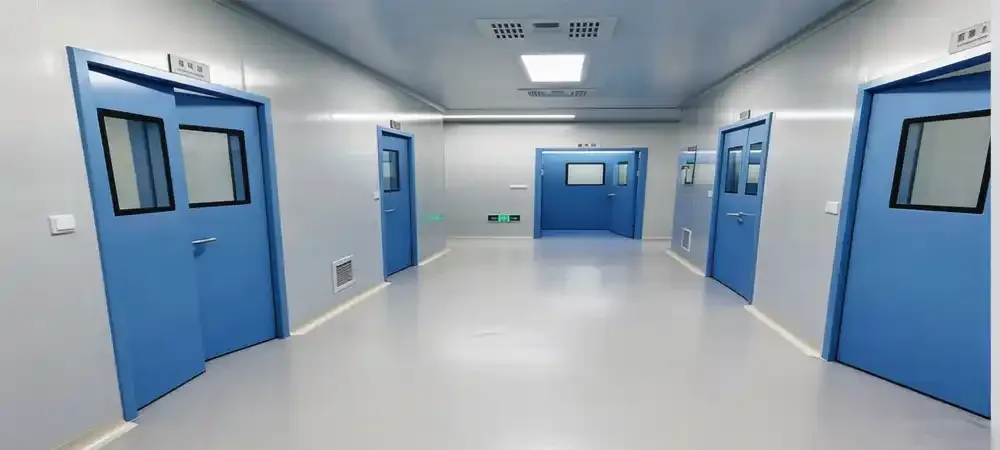
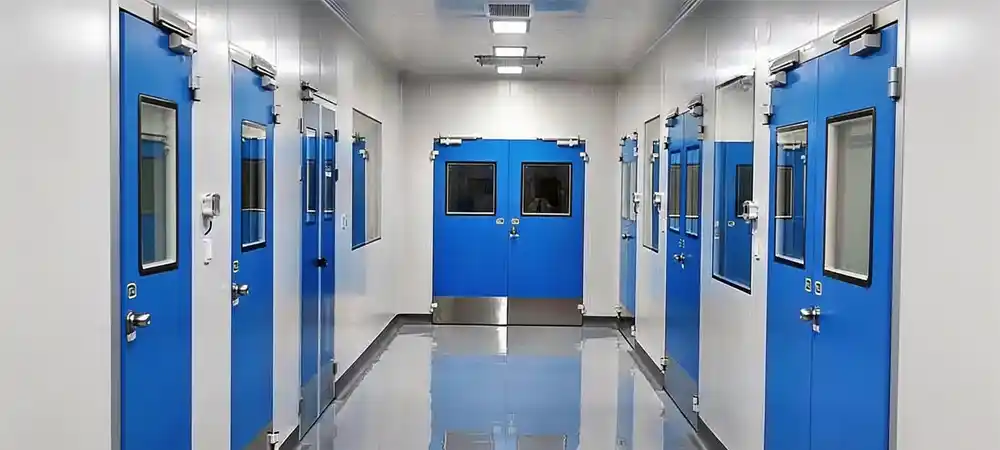
pasillo de sala limpia
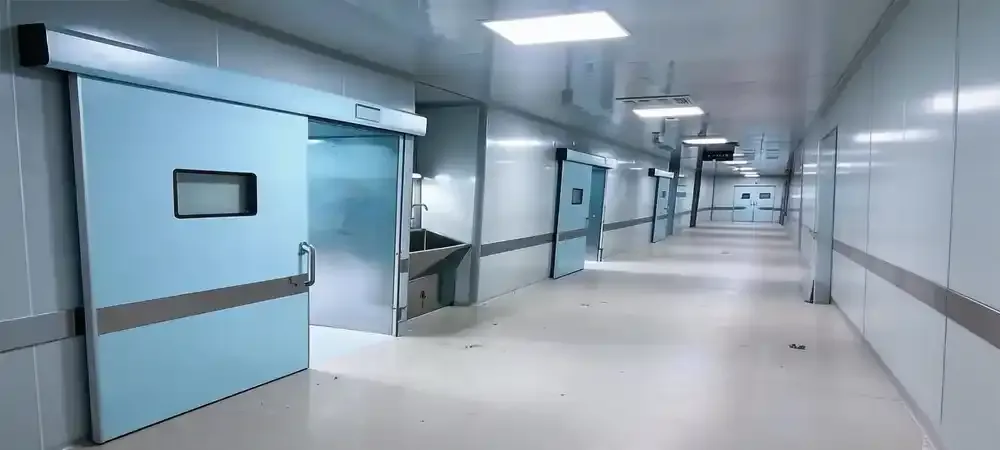
Swing door with flush vision panel
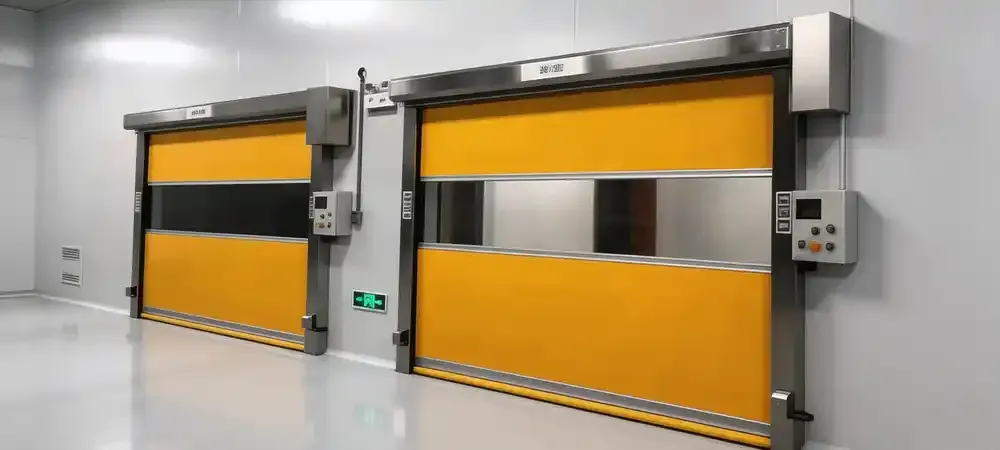
High-speed roll-up door in operation
All photos are taken from the actual project. Stock images are avoided.
Project Challenges
- High-frequency material flow caused existing doors to be open for long periods (avg. 12s).
- Limited headroom (only 2.4 m) and wall thickness (50 mm panels).
- Difficulty balancing pressure control (15 Pa) with speed, safety, and secure personnel passage.
Deiiang’s Solution
- Swing doors for personnel corridors with automatic drop seals and 304 stainless steel fittings.
- High-speed roll-up doors for material flow with radar control and photoelectric safety edges.
- Frames to fit 50 mm panels with flush-mounted trims.
- Integrated with access control and interlock logic for sequential opening.
- Manual pull-cord override for the doors in case of emergency and power failure.
Installation and Commissioning
Flow: Site Survey → Door Selection → Shop Drawing Approval → Factory Test → Installation → Sensor Setup → Seal Inspection → Handover
Measured Results
- Average door open time reduced from 12 seconds to 3.8 seconds (68% reduction).
- Forklift passage time improved by 45% (18 seconds to 10 seconds).
- Recovery time for the temperature chamber reduced by 60% (from 90 seconds to 36 seconds) after the sealing door was closed.
- The number of repairs for door collision was reduced from one per month to one per quarter.
- The pressure differential sealed in four seconds after the door was closed.
- The client accepted the test with no comments on the punch list.
The ideal cleanroom door strategy typically includes a combination of airtight swing doors for personnel access and high speed doors to manage the flow of materials in and out of the cleanroom.
Factors from the installation of the cleanroom panels that affect the performance of the doors
- Swing doors may be mounted on 50 to 100 mm manually assembled sandwich panels, factory-made panels, or masonry walls.
- The frame should be flat on both sides to eliminate dust traps.
- Coved profiles should be used at the floor-to-wall transitions to eliminate sharp corners.
- Verify vertical and horizontal alignment as well as diagonal alignment prior to performing the final fastening.
- Continuous compatible non-particulating sealants should be used.
- For high speed doors, verify overhead clearance, side-column clearance, power supply, and sensor placement.
Safety & Emergency Compliance Checklist
- Panic Pull Cord and Hand Crank (for emergency release). (ANSI/DASMA 102)
- Active Anti-Pinch Safety Photoelectric Safety Edge (response time ≤ 0.1 s) (CE EN 13241-1)
- When a fire alarm is triggered, UL 325 compliant fire release mechanisms allow for an automatic opening of the door.
- During an emergency, doors may be released for egress by breaking the glass or pushing the button.
Testing and Acceptance Checklist
Check door opening and wall thickness
Check frame vertical, horizontal, and diagonal alignment
Check all seals
Test each activation device
Test Anti-Pinch and photocell protection
Test for emergency operation during power failure.
Open and close with the speed measurement.
Please confirm that the access-control or interlock signals have been appropriately set.
Inspect curtain tracking and check for abnormal noise.
Finalize the results of the last test.
For high-grade cleanrooms, and for pharmaceutical and medical projects, the scope of testing should be determined by the design, by the identified risk and by the applicable local regulations.
Cost and Total Ownership Considerations
The lifecycle cost of a system includes more than its original purchase price:
- The initial cost of the door
- Costs associated with the control system and the sensors
- The cost of installation and modification of a wall
- The cost of seals, PVC curtains, and other wearing parts
- The cost of preventive maintenance
- The cost of repairing collisions
- The cost of unplanned downtime of the system
- The cost of recovering the environment after the system has been opened
Swing doors are generally cheaper and easier to build. Automatic sliding doors add the cost of drives, sensors and controls. While high-speed roll-up doors have a greater initial cost, they may shorten wait and open times in high-volume systems. The total cost of ownership may only be established with appropriate cycle time data.
Frequently Asked Questions
What are the common types of doors used in cleanrooms?
Swing doors, automated sliding doors, high-speed roll-up doors, Safety doors, interlock doors, and specialized shielded doors.
Do pharmaceutical cleanrooms use high-speed doors?
Yes, provided that the materials used are compatible, that the cleanability of the closure is provisioned, that the spatial pressure differential and the sealing, as well as the validation and control requirements, are provisioned.
Are automated sliding doors airtight?
Whether they are airtight depends on the compression mechanism of the leaves, the seal design, the quality of the installation, and the results of the test. Airtightness cannot be assumed from the labeling of the door as ‘automated sliding’.
Which door is better for personnel access?
It would depend on whether or not the door is required to be touchless, as well as the space constraints. This could make either automated sliding doors or swing doors a good choice.
Which door is better for Forklifts?
High-speed roll-up doors or rigid high-speed industrial doors that meet passage-controlled wind-pressure and other sealing requirements are the better choice.
How fast does a cleanroom roll-up door open?
Reference range: 0.8-1.2 m/s for Deiiang™ cleanroom high-speed doors. Confirm with product data sheet.
What materials used to construct cleanroom doors?
Galvanized coated steel, 304 stainless steel, aluminum honeycomb, rock wool, paper honeycomb, and PVC curtain fabrics.
Can cleanroom doors be installed in sandwich-panel walls?
Yes, with 50, 75, 100 mm panels, provided that the frame and opening reinforcements are made to match the wall.
How do I request a cleanroom door quotation?
You need to provide the following for the quote: opening dimensions, wall type, and thickness, door swing direction, door use (traffic), how often door is used (daily cycles), pressure differential, required cleanliness, how door is powered, how door is controlled, and the country where the project is.
References
- ISO 14644-1 Cleanrooms and associated controlled environments
- ISO 14644-14 Assessment of suitability for use of equipment by particle concentration
- GB 50243-2016 Code for acceptance of ventilation and air conditioning construction quality
- EN 1886 Ventilation for buildings — Air handling units — Mechanical performance
- EN 13241-1 Industrial, commercial and garage doors — Product standard
- Deiiang™ internal product documentation (2025)
Deiiang™ · Product design by Jason Peng · Data version 2025.03 · All specifications subject to change without notice. Verify with Deiiang™ sales engineering.