+86 13638632902
 Jason@cleanroomequips.com


 MENU
MENU
Your safety relies on physICs, not magic. We explain the engineering controls that stand between you and toxic inhalation, and why understanding the fume hood working principle is non-negotiable for lab personnel.
Quick Summary: The Core Mechanism
Featured Answer: How Does a fume hood Work?
A Chemical Fume Hood isn't just a fan in a box; it is a precision engineering control. It protects you by establishing a dynamic air barrier based on a strict aerodynamic rule: containment through captured airflow.
When the sash is raised, the exhaust system draws room air inward at a specific face velocity (ideally 80–100 fpm) to create negative pressure relative to the laboratory. Inside, the baffles eliminate turbulence and dead spots, forcing heavy fumes to the back. Finally, hazardous vapors are either expelled safely outside or scrubbed by filters. This constant inward pull ensures that no matter what reaction is happening inside, the toxic byproducts move away from your breathing zone, never towards it.
Below, we will strip away the jargon and explain exactly how this fume hood working principle protects you during daily operations. Whether you are using our Deiiang™ units or another system, the physICs of safety remain constant.
The Basic Concept: Your Lab's "Lungs"
If the lab HVAC system is the circulation system, the fume hood is the critical respiratory filter. It constantly inhales potential hazards so you don't have to. This isn't just a metaphor; it describes the continuous negative pressure required for the fume hood working principle to function.
We classify the fume hood as a "primary containment device." Its job is to isolate you from the chemistry. In a Deiiang™ Chemistry Fume Hood, this containment is ACHieved not by sealing the box (which is impossible when you need to work), but by using air itself as a wall.
Macro Airflow Path in a Laboratory Setting
Visualizing the airflow path is crucial for safety. The diagram below illustrates the foundational fume hood working principle
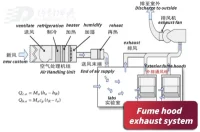
Visual representation of the basic fume hood working principle showing air intake, containment, and exhaust paths.
As shown above, safety depends on the unidirectional flow of air. The fume hood working principle fails if cross-drafts (from open Windows or walking too fast) overpower the hood's capture velocity. Deiiang™ hoods utilize optimized aerodynamics to resist these external disturbances.
Step-by-Step: How air flows Through the Hood
The mechanism relies on **negative pressure**. Essentially, the pressure inside the hood is lower than the pressure in your lab room. Physics dictates that air will always flow from high pressure (your room) to low pressure (the hood interior), carrying contaminants with it.
However, effective containment isn't about maximum suction; it is about controlled velocity. Too little airflow invites leaks; too much creates turbulence that can spill fumes back out. The fume hood working principle requires hitting the "sweet spot" of airflow engineering.
Capture
Room air is pulled through the sash face. This inward stream captures vapors at the generation source.
Contain
The cabinet structure isolates the hazard. Airfoils and baffles prevent the air from rolling back out.
Dilute
Incoming room air mixes with chemical vapors, immediately lowering the concentration of flammable or toxic gases.
Exhaust
The diluted mixture is physically removed from the facility via ductwork or cleaned and recirculated.
Airflow Process Flowchart
The step-by-step journey of air through a fume hood, illustrating the complete fume hood working principle.
Following each step of this journey helps you spot potential failures. If the baffles are blocked (Step 3) or the sash is too high (Step 1), the entire fume hood working principle collapses. Deiiang™ hoods are engineered to maintain this consistency, but proper usage is the final variable.
Anatomy of a Fume Hood: Key Components & Their Functions
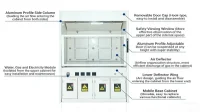
To operate a vehicle safely, you need to know the brake from the gas pedal. The same logic applies here. Each part of the hood plays a distinct role in containment.
Effective containment requires teamwork between physical components. Deiiang™ product designers, like Jason.peng, integrate these parts so they function as a cohesive safety unit. Below is the breakdown of the essential components that enable the fume hood working principle.
Fume Hood Cross-Section Diagram
The Sash: The Adjustable Shield
The sash is your primary shield. It isn't just a viewing window; it acts as a throttle for airflow. The size of the sash opening directly dictates the face velocity—the speed at which air hits the front of the hood.
In practical terms: lowering the sash increases protection. If you cut the opening size in half (e.g., from 50cm to 25cm) while the fan runs at constant speed (CAV), the air speed through the opening effectively doubles. This is why VAV (Variable Air volume) systems are superior—they automatically reduce fan speed to save energy while maintaining safe velocity.
Sash Height vs. Airflow Velocity Relationship
In older or simpler CAV hoods, sash height inversely affects air speed:
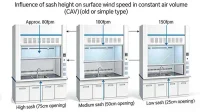
Visual representation of how sash height affects face velocity in a Constant Air volume (CAV) system.
Deiiang™ Fume Hoods use 5mm tempered glass for the sash. This ensures that even if an explosion occurs inside, the blast is contained, protecting the operator's face and body.
The Baffles: Controlling the Air Path
Located at the rear of the cabinet, baffles are slotted panels that suction air from multiple points. Without them, air would only be pulled from a single hole, leaving dangerous "dead zones" in the corners where fumes could accumulate and roll back out toward you.
Effective baffles account for gas density. Heavy vapors (like organic solvents) sink and are pulled through bottom slots. Hot gases or lighter vapors rise and are captured at the top. This comprehensive scavenging is a non-negotiable part of the fume hood working principle.
Baffle System Cross-Section
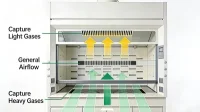
Durability matters here. Deiiang™ baffles are constructed from corrosion-resistant steel to withstand years of chemical exposure without degrading the airflow path.
The Airfoil: Reducing Turbulence
The airfoil is the curved lip at the bottom front edge of the hood. Though it looks minor, it prevents a dangerous phenomenon: the "rolling effect."
If the front edge were flat, air entering the hood would trip over the ledge, creating swirling eddy currents right where your hands are working. These currents can trap fumes and push them back into the room. The aerodynamic shape of the airfoil smooths this transition, keeping the airflow laminar (layered and smooth) along the floor of the hood.
Industry tests indicate that a proper airfoil can reduce turbulence intensity by up to 40%. It is a standard safety feature on all Deiiang™ hoods to ensure the fume hood working principle holds up under real-world conditions.
Mechanism Types: Ducted vs. Ductless
While the aerodynamic concept remains the same, the method of disposal divides hoods into two categories: Ducted (Standard) and Ductless (Filtered).
Your choice depends on your building's infrastructure and the chemicals you use. Ducted systems are the heavy lifters for unknown or high-volume chemicals, while ductless systems offer flexibility for specific tasks.
Ducted vs. Ductless Fume Hoods - Visual Comparison
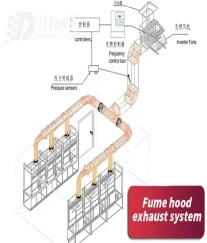
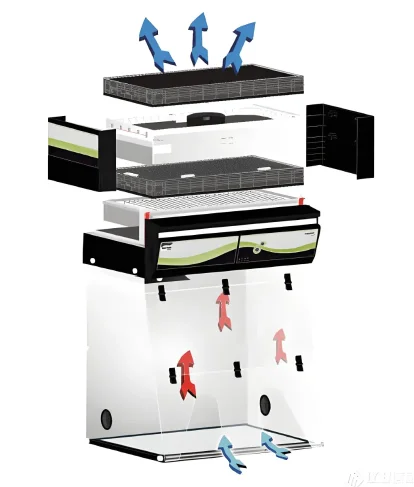
Detailed Comparison: Ducted vs. Ductless Fume Hoods
When selecting hardware, the decision should drive your lab design, not the other way around. Deiiang™ manufactures both types (from 1200mm to 1800mm) to ensure your equipment matches your safety protocols, not just your floor plan.
Airflow Volume Control: CAV vs. VAV
This is a critical distinction for energy management and safety. The difference lies in how the hood responds to sash movement.
CAV (Constant Air Volume) is like a gas pedal stuck in one position. VAV (Variable Air Volume) is like cruise control. The fume hood working principle requires stable face velocity, and VAV achieves this much more efficiently.
VAV System Control Logic
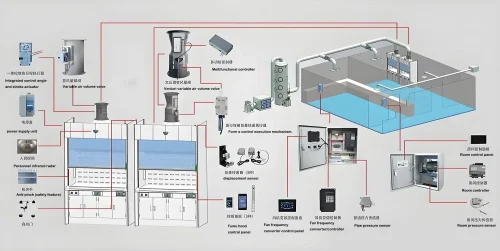
In a CAV system pushing 1000 CFM, closing the sash halfway forces all that air through half the space, doubling the velocity. This can create a wind tunnel effect that might disturb sensitive scales or samples.
A VAV system senses the sash closing and ramps down the fan. If you need 100 fpm at full open (1000 CFM), you only need 500 CFM at half open to maintain that same 100 fpm. Deiiang™ supports both configurations, but for modern energy-efficient labs, VAV is the definitive choice.
Advanced sensors in our VAV options monitor this 24/7, alerting you immediately if the fume hood working principle is compromised by low airflow.
Critical Factors Affecting Performance
The hood can be mechanically perfect and still fail if the environment works against it. External factors are often the hidden cause of containment breaches.
Whether you use a Deiiang™ hood or a generic brand, physics does not discriminate. You must control these environmental variables to maintain safety.
Understanding Face Velocity
Face velocity is measured in feet per minute (fpm). It is the single most cited metric for hood safety, but it is often misunderstood.
More airflow is not safer. This is counterintuitive, but vital. If velocity exceeds 150 fpm, the air moves faster than the aerodynamics can handle. This creates turbulence around the operator's body—specifically a low-pressure zone behind your head—that can actually pull contaminants out of the hood and into your face.
Low Velocity (<60 fpm)
Weak capture. A person walking by can generate cross-drafts stronger than the hood's suction, pulling fumes out.
Ideal Zone (80-100 fpm)
The balance point. Strong enough to resist room drafts, gentle enough to prevent turbulence.
High Velocity (>120 fpm)
Excessive turbulence. Can cause spillage, dry out samples, and drastically increase energy costs.
We calibrate Deiiang™ hoods to target that 100 fpm sweet spot. For a standard 120cm unit, this means calculating airflow precisely (approx. 656 CFM for a 50cm opening) to ensure the fume hood working principle holds true.
Turbulence & Human Behavior
The operator is often the biggest variable in the equation. Your body acts as a barrier to airflow, creating a "wake" similar to a boat moving through water.
Rapid movements cause what engineers call "boundary layer separation." If you walk quickly past an open hood (approx. 3 mph), you generate a cross-draft of nearly 260 fpm—almost three times stronger than the hood's intake! This can rip the contaminant envelope right out of the chamber.
Clutter is the second enemy. Storing bottles right at the baffle slots is like putting a hand over a vacuum hose. We advise strictly following the "6-inch rule" to keep the Deiiang™ airflow path clear and the fume hood working principle effective.
Safety & Operation: Maintaining the Mechanism
Understanding the physics is useless without discipline. A fume hood degrades over time—belts slip, fans get dirty, and sensors drift.
Operating a hood without checking the airflow monitor is like driving with your eyes closed. Deiiang™ hoods include monitoring options specifically to turn the invisible fume hood working principle into visible data.
Keep Sash Low
Use the sash as a shield. Lowering it improves containment by up to 20% and provides physical protection from splashes.
The 6-Inch Rule
Work 6 inches (15 cm) inside the hood. This zone ensures the air has stabilized into a laminar flow before it hits your chemicals.
Minimize Clutter
A fume hood is not a storage cabinet. Excess equipment creates turbulence and blocks the rear baffles, killing efficiency.
Slow Movements
Move deliberately. Quick arm removal can drag a "wake" of contaminated air out of the hood and into your breathing zone.
Maintenance is non-negotiable. Annual ASHRAE-110 testing confirms the containment ability. For Deiiang™ users, we recommend regular checks of the sash mechanism and baffle positioning to ensure the system performs as specified on day one.
Conclusion
Safety in the laboratory is not about fear; it is about understanding physics. A chemical fume hood is a tool that manipulates air to create a life-saving barrier. It relies on negative pressure, specific velocities, and aerodynamic flow management.
When you understand the fume hood working principle, your behavior changes. You stop lifting the sash too high because you know it weakens the airflow. You stop storing boxes in the back because you know it blocks the baffles. You move slower because you understand turbulence.
Deiiang™ fume hoods are built to facilitate this safety, providing the robust engineering needed to contain hazards. But ultimately, the safety of the lab relies on the partnership between good equipment and a knowledgeable operator.
Take Action: Implement What You've Learned
Apply the fume hood working principle to your daily routine:
Schedule regular face velocity testing (at least annually)
Consider upgrading to a VAV system for improved safety and energy efficiency
Train all lab personnel on proper fume hood use based on these principles
Consult with experts like Deiiang™ about the right fume hood configuration for your specific needs
Remember: The best engineering in the world cannot overcome poor usage. Combine quality Deiiang™ equipment with disciplined technique, and you ensure that hazardous vapors stay exactly where they belong—away from you.
About Deiiang™ Fume Hoods
Deiiang™ Chemistry Fume Hoods provide safe containment and exhausting of hazardous chemical vapors and gases to protect laboratory personnel and maintain indoor air quality. Designed with adjustable sashes, chemical-resistant interiors, optimized airflow baffles, and reliable exhaust blowers for consistent capture efficiency.
Available in multiple sizes and configurations with optional sensors, alarms, and utility fittings to support regulatory compliance and varied lab workflows. Product design oversight by Jason.peng ensures every hood meets rigorous safety and performance standards.