+86 13638632902
 Jason@cleanroomequips.com


 MENU
MENU
Cost for iso 5 construction is much higher than for ISO 7 construction. The “3x” multiplier is not an absolute number, but rather an estimate for a variety of factors including air changes, temperature control, differences in density for equipment, materials, and operational redundancies. For a 100 m² cleanroom for semiconductors vs. a pharmaceutical filling line vs. a laboratory, all of these can be expected to have greatly varying costs.
The cleanroom build that requires particle counts below a certain threshold, along with air controls, more HEPA filters, and additional qualification testing, is inherently more expensive than an ISO 7 classified cleanroom. Ultimately the cost is driven by how large the cleanroom is, the purpose for the cleanroom, where the cleanroom is located, how much equipment is to be placed in the cleanroom, and how much validation is required.
Quick answer: iso 5 cleanrooms cost more than ISO 7 because they require tighter particle control, higher airflow volumes, more filtration, stricter environmental control, and more extensive qualification testing. The final cost depends on room size, application, location, equipment density, and validation requirements.
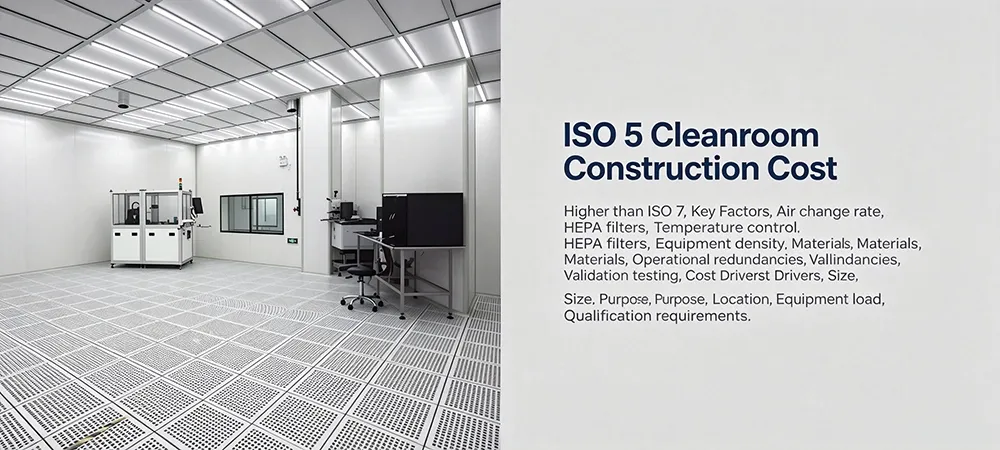
How Much Do ISO 5 Cleanrooms Cost for Each Square Meter?
Modular vs. Stick-Built Construction: Compared to traditional stick-built construction, prefabricated modular cleanrooms (panel systems) cost 20-30% more, but result in 40% less on-site labor and 5-8 weeks shorter project time. While stick-built costs less due to cheaper raw materials, it runs the risk of higher cleanroom contamination due to on-site cutting and welding, hence more expensive time rework. Modular systems for ISO 5, in addition to being very airtight, help to reduce 15% of the annual utility costs.
A complete cleanroom build (from design to certification) is more than renovation of one cleanroom. The price of an iso 5 classified cleanroom includes all of the components for the building shell, all of cleanroom’s HVAC systems, the front end for the HEPA and ULPA filters, the systems for temperature and control of humidity and differential pressure, all of the cleanroom’s electrical and automation systems, and all of the systems for the cleanroom’s commissioning and certification.
The price of build will vary for unidirectional flow systems, low humidity or vibration control systems, GMP/FDA or client-specific systems, or local/entire facility systems.
Budget range with Deiiang project data & market insights
| Project type | Typical application | Deiiang budget range | Deiiang 12‑month avg (S.E. Asia) | Includes validation? |
|---|---|---|---|---|
| Local ISO 5 work zone | Precision assembly, optics | $2,800 – $5,200 / m² | $3,100 – $4,800 / m² | Partial |
| ISO 5 cleanroom | Chip packaging, pharma | $4,500 – $8,000 / m² | $4,900 – $7,600 / m² | Full |
| ISO 5 high-end production | Semiconductor, sterile fill | $7,500 – $12,000 / m² | $8,100 – $11,300 / m² | Full + redundancy |
Regional Cost Multipliers (relative to S.E. Asia baseline):
North America: 1.8x – 2.5x | Western Europe: 1.6x – 2.2x | Middle East: 1.9x – 2.8x | Australia: 1.7x – 2.3x Deiiang Field Data: On-site labor accounts for 12% of CAPEX in Vietnam/Malaysia, vs 25‑30% in Singapore/Europe. Material freight for anti‑static glass walls adds 4‑6% to overseas projects.
North America: 1.8x – 2.5x | Western Europe: 1.6x – 2.2x | Middle East: 1.9x – 2.8x | Australia: 1.7x – 2.3x Deiiang Field Data: On-site labor accounts for 12% of CAPEX in Vietnam/Malaysia, vs 25‑30% in Singapore/Europe. Material freight for anti‑static glass walls adds 4‑6% to overseas projects.
All prices indicative, exclude tax/freight. Deiiang market data based on actual projects in Malaysia, Vietnam & China (2025-2026).
Why "per square meter" can be misleading
- Smaller projects have higher unit-area costs due to fixed engineering and control systems.
- Large projects spread AHU, automation, and design costs over more square meters.
- High ceilings, old buildings, or confined spaces increase installation difficulty.
- A local ISO 5 work zone cannot be compared to a full-room class 100 cleanroom on a per-m² basis.
What are the key technical differences on ISO 5 vs ISO 7?
ISO 5 falls under the older Class 100 cleanroom standard, while ISO 7 falls under Class 10,000. There is a significant difference in 0.5 micron particle concentration. For ISO 5, the concentration must be limited to 3,520 particles per cubic meter as opposed to 352,000 particles per cubic meter for ISO 7.
Particle control standards compared
| Parameter | ISO 5 | ISO 7 | Cost impact |
|---|---|---|---|
| Traditional class | Class 100 | Class 10,000 | ISO 5 stricter |
| 0.5 µm limit | 3,520 / m³ | 352,000 / m³ | More filtration needed |
| Airflow pattern | Often unidirectional | Non-unidirectional | Affects ffu count |
| Testing rigour | High | Moderate | Adds certification work |
Air changes and airflow pattern
ISO 7 allows implementation of non-unidirectional flow with 15 to 30 air changes per hour, whereas ISO 5 makes non-unidirectional flow with 300 to 600 air changes per hour mandatory, significantly increasing the cost of fans, ducts and filters.
One must also account the personnel, equipment heating, spatial dead zones, and expected output when designing the configuration of the return air flow paths. Cost of cleanrooms can rise dramatically when every unit of volume is passed through filtered air.
Expert Tip: Common Pitfall — In a Penang project, the client neglected to factor in return-air plenum resistance. This led to high particle counts in the corners of the cleanroom, and it took us five days to redesign the ceiling. CFD airflow is a non-negotiable requirement to meet the requirements for ISO 5. Deiiang always runs full 3D modelling before any steel goes up.
Typical air change comparison: ISO 7 ≅ 15–30 ACH, ISO 5 ≅ 300–600 ACH (unidirectional). This results in ~10 to 20 times more fan power, larger filters, and more cooling.
HEPA, ULPA and filtration efficiency
HEPA filters (H13/H14) are typical for ISO 7, whereas ISO 5 may be more ULPA (U15–U17) at 0.12–0.3 µm. This higher filtration can lead to higher costs, larger pressure drops, and increased fan power.
- Filters should be correlated to the Class 100 cleanroom objective, and not provide unnecessary ULPA filtration.
- ULPA filters increase costs by 20–40% and lead to 10–15% more resistance.
- The installation and field scanning of the filter are equally as important.
Insights: AC vs. EC FFU motors — Many of the cheaper builders will cost all-in, AC motor FFUs to keep their costs down. However, for an ISO 5 room with 100+ FFUs, EC (Electronically Commutated) motors reduce thermal output to the room by 30% and also reduce the power by 40%. In the Vietnam project, switching to EC FFUs reduced the cooling electricity cost by $22,000 per year, and recovered the cost of the motors in 14 months.
Deiiang™ usually specifies EC plug fans with dynamic balancing, filter scan testing, and pressure differential monitoring to ensure long-term reliability.
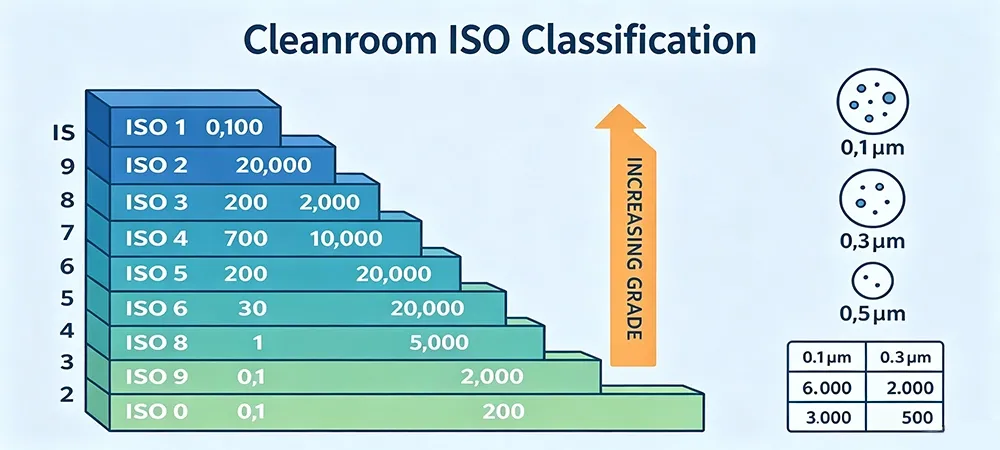
Why Can ISO 5 Cost 3x More than ISO 7?
The cost increase is driven by several factors rather than any one. We'll lay out some of the major cost contributing factors for cleanrooms.
HVAC: The Major Cost Component
An ISO 5 cleanroom room requires 3-5 times the airflow of an iso 7 cleanroom of the same size, leading to larger AHUs, larger ducts, more FFUs, larger cooling coils, and increased reheat capacity.
In addition to the already high costs of HVAC components, ISO 5 cleanrooms also require tighter environmental control, resulting in ±0.5°C and ±3% RH. This can mean the purchase of a humidifier, dehumidifier, and redundant chillers. This is in addition to the already extensive system costs.
- An ISO 7 room of this size may use a single, large AHU with a total capacity of 30,000 CFM.
- An ISO 5 room could require multiple large AHUs with a total capacity in excess of 120,000 CFM, multiple FFU arrays, and more.
The energy cost associated with reheat of the air in a cleanroom can result in 15-25% of total operating costs.
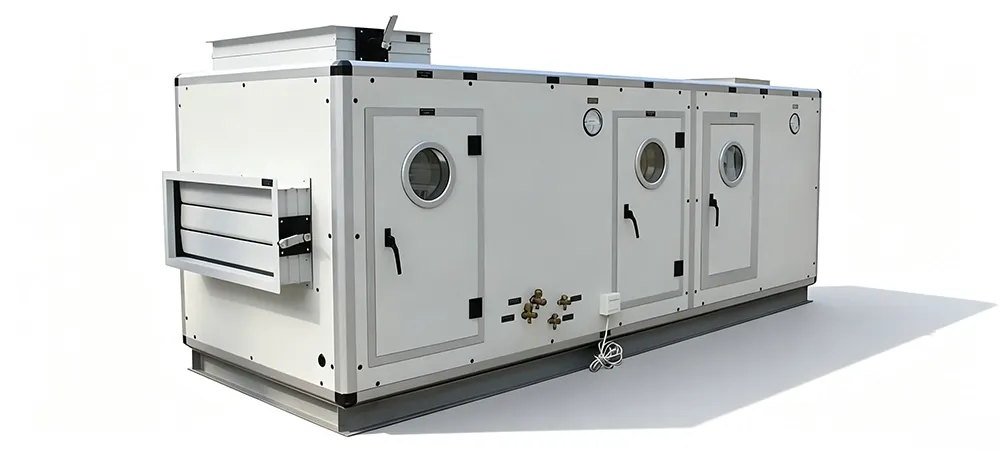
FFU and filter density
A higher FFU (fan filter unit) density is seen in ISO 5 cleanrooms. An ISO 7 cleanroom may have 15-25% FFU ceiling coverage, while an ISO 5 cleanroom ceiling FFU coverage may range from 50-80% (or unidirectional flow).
The FFU coverage ratio is relatively simple to quantify: FFUs ≈ required airflow / airflow of a single FFU. As the number of FFUs increases, so does the cost of the system, installation, and system operation.
FFU coverage example: ISO 7 cleanroom ≅ 20% ceiling coverage; ISO 5 cleanroom ≅ 70% ceiling coverage. This could result in a 3.5x increase in the number of FFUs, from 40 to 140, in a 200 m² cleanroom.
Additional Costs Associated with HVAC
ISO 5 cleanrooms have a higher level of construction and finish than an ISO 7 cleanroom. This includes higher grade wall panels, seamless ceilings, continuous sealing, anti-static flooring, and chemical-resistant coatings, as well as higher grade door and window assembly systems.
- An ISO 7 cleanroom may have standard wall panels, while an ISO 5 room may need a high-seal, anti-static, and corrosion-resistant system.
- Flooring: ISO 5 cleanrooms almost always have a higher grade.
- Sealing: Continuous sealant and cove corners are required for ISO 5 to minimize leak paths.
Expert Tip: Common Pitfall – One of your Shenzhen electronics customers selected regular PVC flooring to save $8,000. In 9 months, ESD failures cost them $47,000 in board destruction. Deiiang specifies conductive flooring with assured surface resistance because it cost them 3% within months of financial success.
Controls, monitoring and alarms
Typically, real-time temperature, humidity, pressure, velocity, and particle count monitoring are included in ISO 5 cleanrooms. Many also need BMS/EMS, alarm logging, and data-traceability.
The budget for high-end cleanrooms includes equipment to monitor the cleanroom status to ensure compliance 24/7/365.
ISO 5 Cleanroom Cost Structure
Assuming a Deiiang™ Project in Southeast Asia (100m², semiconductor assembly), here is what a typical ISO 5 Cleanroom looks like today.
| Cost component | % Range per project | Typical Amount ($) |
|---|---|---|
| HVAC & Filtration | 38–45% | $120,000 – $180,000 |
| Structure & Finishes | 18–22% | $55,000 – $85,000 |
| Electrical & Lighting | 10–14% | $30,000 – $55,000 |
| Controls & Monitoring | 8–12% | $25,000 – $48,000 |
| Installation & Balancing | 10–15% | $30,000 – $60,000 |
| Testing & Validation | 5–8% | $15,000 – $32,000 |
Percentages can be project specific. Pharma fill lines have higher validation. Also, semiconductor tool relaxing shifts budget to the process utilities.
Elements that rapidly amplify the quote
- Compact footprint with high demand
- Height restrictions or other physical constraints
- Low humidity (less than 30% relative humidity (RH)) or tight temperature control (±0.3°C)
- High process heat load (>200 Watts per square meter)
- Needs for special materials or explosion protected
- External Validation and Documentation
- Redundant systems and dual circuits for power supply
- Process Utilities: Tool hook-ups for client-supplied compressed dry air (CDA), nitrogen (N₂), deionized (DI) water, and scrubber exhaust can be 25–35% of the base cleanroom cost. Always obtain a separate utility package quote.
- Vibration Control: Passive or active vibration isolation systems can cost $15,000 to $50,000 per tool.
Cleanroom Budgeting for an ISO Class 5
Three budget scenarios
Deiiang™ provides for three categories, based on the value of the process and the risk of the operation:
- Basic compliance: Targeting Research & Development (R&D) laboratories and assembly. Achieves ISO Class 5 with minimum cost and fewest redundancies.
- Production stability: Medical device and integrated circuit packaging. Equally balanced and flexible heating, ventilation, air-conditioning (HVAC) and maintenance with moderate redundancy.
- High reliability: Semiconductor and sterile pharmaceutical products. Fully redundant systems, advanced monitoring, backup systems, and support 24/7.
Initial investment vs. life cycle costs
Long-term operating costs (OPEX) of high-end cleanrooms must include predicted costs for electricity, filters, maintenance, certification, downtime, and loss of production due to quality issues. A $50,000 reduction in capital costs can lead to $200,000 of additional OPEX in higher costs for energy and maintenance in the following 10 years.
OPEX comparison: ISO 5 vs ISO 7 (per m² per year)
| OPEX Parameter | ISO 5 | ISO 7 | Cost Implications |
|---|---|---|---|
| Annual electricity consumption (kWh) | 1,800-2,800 | 400-700 | 4-5x cost of ISO 7 |
| Frequency of filter change | 2-3 years ULPA | 3-5 years HEPA | Higher cost in shorter cycles |
| Annual maintenance cost (as CAPEX) | 8-12% | 4-6% | 2x cost of ISO 5 |
| Estimated 5-year OPEX (per m²) | $12,000-$18,000 | $3,500-$6,000 | 3x cost of ISO 7 |
Assumptions are based on the 2025 electricity costs ($0.12/kWh) and Deiiang's maintenance records. Actual OPEX will differ based on climate, load factor, and utility costs.
ROI calculation: The cleanroom's annual benefit is the sum of yield improvement times the output value plus savings on scrap and downtimes minus the yearly energy cost plus maintenance costs. A cleanroom can be justified with a
Interactive ROI Calculator
Estimate your payback period for an ISO 5 cleanroom upgrade.
$500k $5,000,000 $50M
0.5% 2.0% 5.0%
$100k $450,000 $2M
Annual yield benefit: $100,000
Estimated payback period: 4.5 years
* Simplified model. Actual ROI depends on energy, maintenance, and process specifics.
Failure Cases & Pitfall Guide: Lessons Learned
In his 12 years of experience managing ISO 5 projects, Deiiang has recuperated over 20 lost projects. Here are 4 predominant examples of challenges, and the best practices to avoid them.
Pitfall 1: The Resistance of Airflow. At a Vietnam electronics facility, 80 fan filter units were installed without paying attention to ceiling plenum static pressure. Only 52% of the fan filter units operated as designed. The airflow issue was addressed by engineering the plenum and installing baffles. This cost $34,000 and required nine days of lost productivity.
Pitfall 2: Omitting a Full-Scale Mock-up. A medical device client permitted a design without a test fit. The air handling unit (AHU) did not fit into the service corridor. A crane was used to lift the unit through a temporary opening in the roof of the facility. This cost the client $22,000 and required an additional three weeks of work. A complete test fit should be required before any major equipment is ordered.
Pitfall 3: Cheap Filter Sealants. A low-bid contractor used a lower standard acrylic sealant to seal ULPA filters. Within eight months, micro cracks developed and increased the facility’s particle counts. Deiiang was called in to re-seal the 120 filter frames and this cost the client $18,000 and required a complete overnight shift to seal the frames. Our standard sign-off is medical grade silicone.
Pitfall 4: Ignoring Pressure Drops in Airlocks. An example in Penang showed high speed, motorized dampers and dual pressure dampers were able to regulate pressure in the airlock space and stabilize positive pressure at 15 Pa. Upon shift changes, the rapid drops in pressure were able to be eliminated along with contraction caused by the airlock doors rapidly opening.
The main reason for failure: engineering validation was bypassed. CFD simulations, mockup installs, material traceability, etc., are all necessary for ISO 5. They are the least expensive way to perform engineering validation.
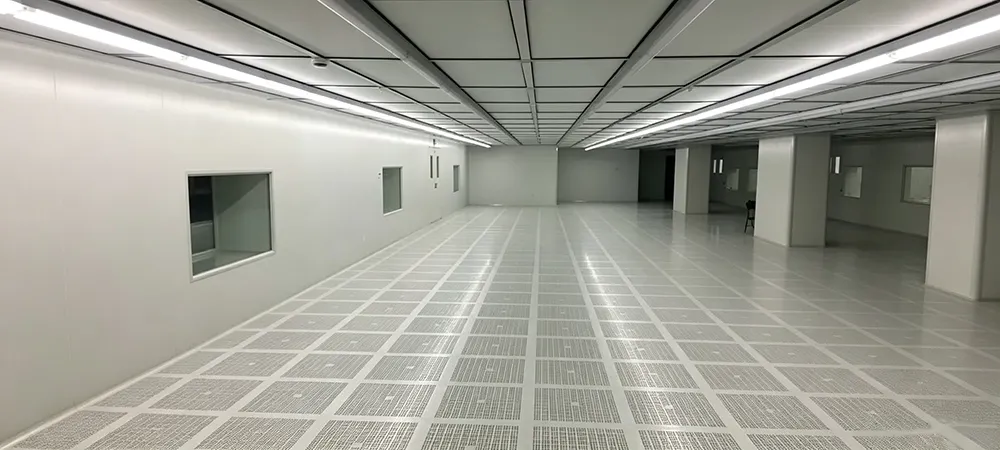
Scenario-Based Analysis: Should You Build ISO 5 or ISO 7?
Meet Mr. Chen. He is the lead engineer for a start-up company that does chip packaging. His team is working on a new production line. The investors are looking to control CAPEX. The new product will be affected by the presence of particles, peripheral ESD, and humidity.
He can choose between three scenarios: (A) construct an entire facility that meets ISO 5, (B) construct an entire facility that meets ISO 7 and provide local ISO 5 protection to local critical tools, or (C) construct an entire facility that meets ISO 7 and control processes to meet local critical requirements.
What’s been observed: "The cheapest option chosen (ISO 7) led many clients to spend 3 times that amount 18 months later, removing ceilings to install ULPA systems. My suggestion is, if the product roadmap has any planned enhancements to be made within 2 years, construct an ISO 5 facility to start with. It is the only option that makes economic sense." — Jason Peng, Lead Design Engineer, Deiiang.
Decision Matrix
| Factor | Full ISO 5 | ISO 7 + local ISO 5 | Full ISO 7 |
|---|---|---|---|
| Initial CAPEX | High | Medium | Low |
| Process Protection | Excellent | Good (layout dependent) | Limited |
| Expandable | Flexible | Medium | Limited |
| Energy Consumption | High | Medium | Low |
For Mr. Chen, the optimal Scenario was (ISO 7 + local ISO 5) since it offered the best balance with a 35% ISO 7 cost reduction while fully protecting the critical wafer handling stations.
Deiiang Case Study: Building a High-Performance ISO 5 Cleanroom
Deiiang™ was contracted to design an ISO 5 cleanroom compliant with full validation for a semiconductor sensor manufacturer in Malaysia. This case study describes the works that will be completed in 2024.
Project Summary
- Industry: Semiconductor / MEMS sensor
- Location: Penang, Malaysia
- Clean class: ISO 5 (Class 100)
- Area: 180 m² (including gowning and airlock)
- Ceiling height: 3.8 m
- Project duration: 16 weeks (design to handover)
- Deiiang scope: Full turnkey - design, supply, install, test, validate
Key challenge: The existing building had a 4.2 m slab-to-slab height, limiting the FFU plenum depth. This was solved using custom low-profile FFUs with a side return airflow strategy.
Deiiang Solutions
CFD Airflow Simulation: Our engineers, under the guidance of product designer Jason Peng, modelled the entire room to optimise spatial arrangement of the FFUs and return air path to remove any dead zones.
CFD Airflow Comparison: Before & After Deiiang Optimisation
Modular Wall System: Prefabricated wall panels with cam-lock joints reduced installation time by 30% and enhanced sealing integrity.
Smart monitoring: Real-time monitoring for particles, temperature, humidity and pressure with alarm system escalation to facility management.
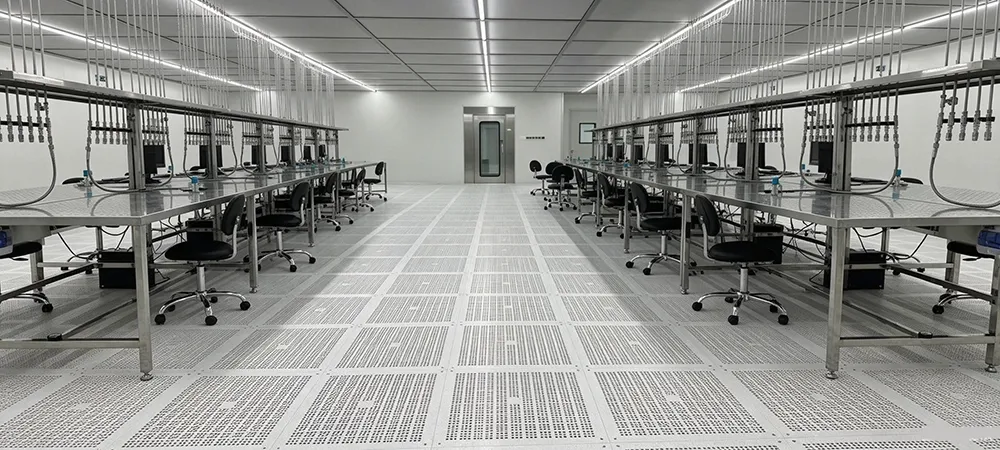
Project Results
- Third-party testing confirmed the following:
- ISO Classification at Rest and Operational
- Stability of Temperature: 21 °C ± 0.4 °C
- Stability of Relative Humidity: 45% ± 2%
- Pressure Cascade: 25Pa differential from Cleanroom to Corridor
- All HEPA/ULPA Filters passed the Scan Integrity Test
- All documentation delivered on time
The client started production within 2 weeks of the handover and reported zero contamination-related defects during the 1st 3 months.
Four Strategies for Reducing the Cost of ISO 5 Cleanroom Construction
1. Design an “ISO 5 critical zone”
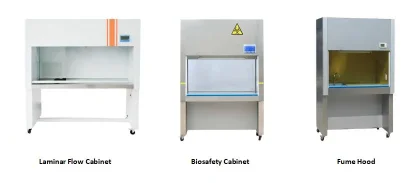
Only protect the areas that contact product. Use localized microenvironments, clean benches, or isolators.
2. Reduce rework during the design
Finalize tool dimensions, heat loads, and maintenance access before construction. Design changes add 5 to 15 percent to project costs and 1 to 3 weeks to project duration.
3. Use the appropriate filter and fan technology
Assess the process needs, and don’t use ULPA for every space.
4. Plan ahead for growth
Air handling, electrical, and control capacities must be planned at the outset. Use moveable walls to avoid expensive changes later.
Testing, Certification and Handover for ISO 5 Cleanrooms
Testing is conducted in a structured manner, starting from a validation of the design to an acceptance of the system as operational.
- Design phase: CFD simulation, heat load calculation, pressure cascade modeling
- Post installation: Air balancing, assessment of velocity uniformity, integrity of filters (tested by scans)
- Performance testing includes: Measurement of particle count, temperature and humidity assessment, assessment of background noise, measurement and assessment of light
- Handover includes: Documentation, training, transfer of monitoring responsibility
Certification risk(s): The hidden cost trap
Hidden cost alert: Many startups budget for hardware but omit the costs for third party certification (NEBB or ISO on-site testing). If the first test fails (which it often does), costs of delay, labor and rework generally add 20% to the quote for the first certification. Deiiang includes a "test-fail remediation" buffer to all fixed price contracts, so you’re never caught off guard.
Deiiang™ offers a 12 month warranty and post-handover support at no extra costs. All test reports are traceable and signed by the lead engineer. During the design phase, we carry out a certification risk study to find and highlight possible failure points before the construction begins. This service alone has saved our clients, on average, $18,000 from the cost of re-testing for that project.
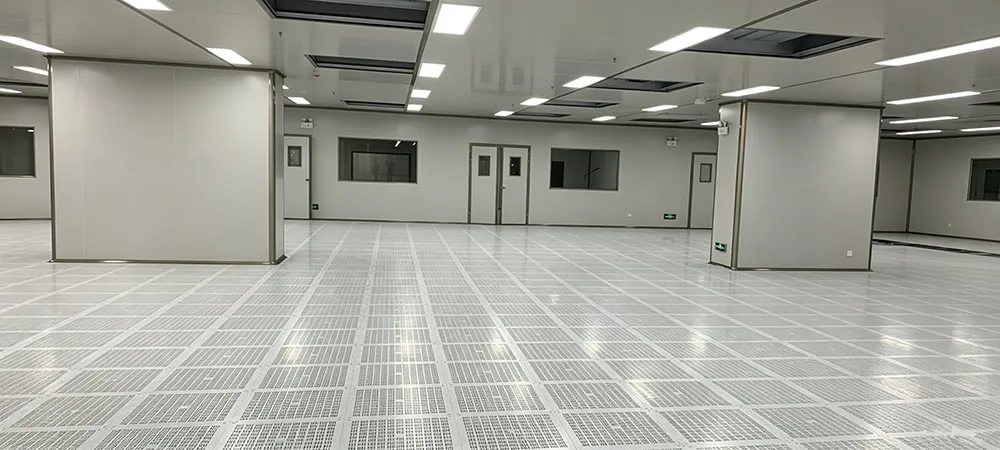
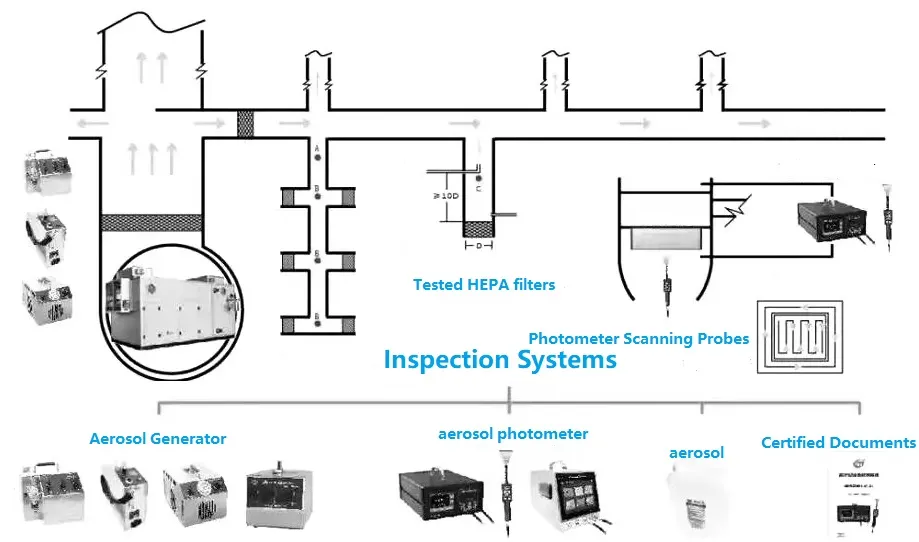
In situ ULPA filter scans, performed by a photometer, are conducted to verify the integrity of each filter. This is standard Deiiang procedure.
What Do You Need to Provide for a Correct ISO 5 Quote?
For an accurate quote for an ISO 5 cleanroom, Deiiang™ requires the following:
- City/country of the proposed site
- Square meters of cleanroom and the height of the cleanroom ceiling
- Desired ISO class (5, 6, 7, or 8)
- What you are building and the type of process taken
- Total number of process operators with an inclusive equipment listing
- What is the process tool kW value of the heat load?
- Describe the temperature and humidity control including the acceptable range for tolerance
- What is the required range of pressure differential?
- How many volts of electrical power do you require? Do you need a backup supply? What are the GMP, FDA, or other requirements for construction?
- Expected start and end of the construction
Do you want a quote? Send Deiiang™ your project description and you will receive a preliminary budget in approximately 48 hours.
Comparison of ISO 5 and ISO 7 Cleanrooms
ISO 5 Benefits
- ✓ Better control over particles
- ✓ Processes that are more sensitive can be processed here
- ✓ Low risk of contamination
- ✓ Processes that are safe to lose in terms of value can be performed here
Disadvantages of ISO 5
- ✗ Higher initial Capital Expenditure (CAPEX)
- ✗ More energy is required to run
- ✗ Higher complexity involved in maintenance
- ✗ Longer time to test and commission
ISO 5 isn’t always the answer. For products that are not sensitive to particulates, a full ISO 5 may be a poor use of the budget.
Common questions
How much do ISO 5 cleanrooms cost per square meter?
What is the starting price? This will be determined based on the size of the cleanroom, location, HVAC design, filter grade, temperature control, the scope of the validation, and the cost of the local labor. The unit cost will be greater for smaller, higher-spec projects. For a price estimate, please provide the parameters of your project.
Is ISO 5 and Class 100 equivalent?
Yes, ISO 5 and former Class 100 are equivalent. Always check iso 14644-1 and your specific project conditions.
Why is ISO 5 priced higher compared to ISO 7?
The cost is justified because of the higher filtration density, control of the environment and airflow, control system sophistication, testing validation, and quality of the materials.
Can I build ISO 7 and convert to ISO 5 later?
Sure, but it's expensive. If you don’t allocate design airflow, design power, design height, control the interfaces, and design the control systems, the cost of upgrading from ISO 7 to ISO 5 can be 40% to 60% more than the cost of directly designing the system to ISO 5.
Is it necessary to have an entire ISO 5 system?
Not necessarily. Establish ISO 5 zones to localize the system at a workstation if that has a lower overall cost. Consider the exposure time of the product and the risk of the process while flow of the product to make your final decision.
Is a certification cost part of the project?
Some of the vendors have inclusions that include certification, while others do not. Clarify what these certifications entail: testing the particle systems, filters’ integrity, the pressure controls and flow, and the required documentation.
What is driving the cost most?
About 40% to 50% of your overall capital expenses is going to be HVAC, FFUs, filtration, control of temperature and humidity. Each of these can be accounted as a significant cost.
What is the time frame for construction of ISO 5?
The time frame can be 14 to 24 weeks and can vary greatly depending on the area of construction, how modular the design is, the context of the site, the procurement of equipment, and the subsequent validation. The final construction of the Deiiang 180 m² project took only 16 weeks.
References
- iso 14644-1:2015 — Cleanrooms and associated controlled environments, Part 1: Classification of air cleanliness
- IEST-RP-CC006 — Testing of Cleanrooms
- ASHRAE Standard 52.2 — Method of Testing General Ventilation Air-Cleaning Devices
- FDA Guidance for Industry — Sterile Drug Products Produced by Aseptic Processing
© 2026 Deiiang™ — cleanroom engineering & Validation. Product Designer: Jason Peng. All project data is indicative and subject to site-specific conditions.