+86 13638632902
 Jason@cleanroomequips.com


 MENU
MENU
If you are looking for a cleanroom pass-through that is highly efficient (more than 40 openings per shift) but have no wall space to spare, high-speed roll-up doors are the popular choice. Go to sliding doors if you need iso 5+ cleanroom classification, static pressure-critical performance, or a restricted budget.
Pass-through openings sit between ISO 5 and iso 8 zones. They control particles entering the cleanroom, hold pressure stability, and set the cleaning time of the forklift. Only three numbers really matter in any roll up vs sliding cleanroom door comparison: cycle time, leakage rate, and headroom.
This guide compares both designs on airflow, throughput, contamination, footprint, safety, wear cycles, and five-year total cost. Deiiang catalogue data and international standards provide the reference points, with review by lead product designer Jason Peng. The section lets you choose a model without guessing, whether the final answer turns out to be a high speed or sliding door.

Core Operating Principles for Material Pass-Through Doors
The difference between a sliding cleanroom door and cleanroom roll up doors comes down to the mechanism. The seal strategy changes with the mechanism, so the high speed or sliding door decision starts here.
Sealing is an engineering discipline problem. Both types must prevent particle ingress and hold room pressure, and they ACHieve that with two different sealing techniques. That is why roll-up doors for cleanroom duty need careful seal selection from day one.
Sliding Cleanroom Door Panel & Track Operation
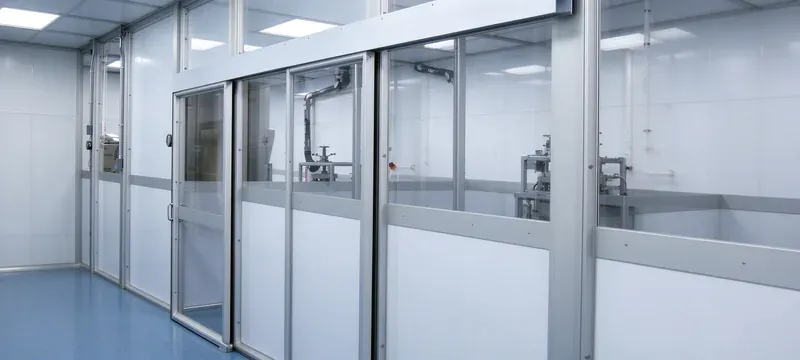
A sliding cleanroom door works horizontally, moving a rigid leaf along an upper track. The leaf slides sideways and can be lifted on and off with self-locking hardware.
Panel specifications (Deiiang catalogue data):
- Leaf: rigid galvanised steel, honeycomb core, 0.8 mm thick
- Leaf travel: 0.3–0.5 m per second
- Gasket compression on closing: 3–5 mm for a reliable static seal
Panel mass matters. A rigid honeycomb steel leaf of 1500 × 2100 mm weighs about 60–90 kg. The perimeter gasket compresses 3–5 mm at closure, which produces that static seal.
High-Speed Roll-Up Door Drive & Curtain Mechanism
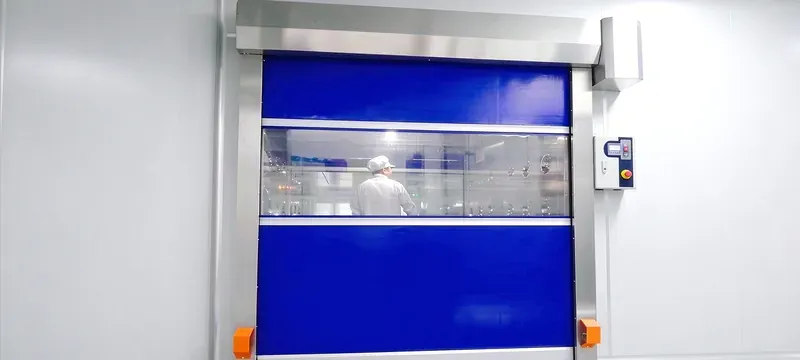
A cleanroom rapid door rolls a flexible PVC curtain around a barrel inside a headbox. The headbox holds the servo drive that clears the opening in roughly one second.
Operating specifications (Deiiang catalogue data):
- Opening speed: 0.8–1.2 m/s
- Closing speed: 0.6–1.0 m/s
- Curtain: 0.8 mm double-coated PVC, Class 8.2 fire-rated
Sealing here is dynamic. Double-row brush seals with a PVC base run along both tracks, and the bottom beam presses onto the floor. The curtain is UV-resistant. Rapid rollup doors for cleanroom use also benefit from that vertical curtain travel.
Airflow & Pressure Integrity Performance
Pressure integrity separates these two doors more than any other consideration. Both types leak during the opening process, but to differing degrees and for different durations.
Leakage is integrated over time rather than being instantaneous. For that reason a faster cycle can compensate for the weaker instantaneous seal in the roll up vs sliding cleanroom door comparison.
Table 1: Airflow and pressure integrity baseline
| Parameter | Sliding cleanroom door | High-speed roll-up cleanroom door |
|---|---|---|
| Sealing method | Compressed perimeter gasket | Double-row brush + bottom beam |
| Typical static leakage | 3–5 m3/h per metre of perimeter | 8–15 m3/h per metre of perimeter |
| Open phase duration | 4–6 seconds | 1.5–2.5 seconds |
| Airflow disturbance direction | Lateral sweep | Vertical lift |
| iso 14644-3 recovery | Sliding door (reference baseline) | 30–50% faster |
| Parameter | Sliding | Roll-up |
|---|---|---|
| Sealing method | Compressed gasket | Brush + bottom beam |
| Static leakage | 3–5 m3/h per m | 8–15 m3/h per m |
| Open duration | 4–6 s | 1.5–2.5 s |
| Airflow direction | Lateral sweep | Vertical lift |
| ISO 14644-3 recovery | Baseline | 30–50% faster |
Test conditions: 1500 × 2100 mm opening, 20 Pa differential pressure, per iso 14644-3:2019 methodology [1].
Differential Pressure Retention During Full Door Cycles
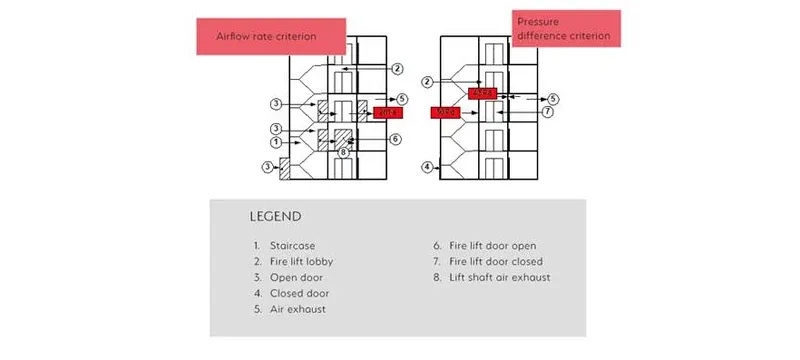
The static hold scenario is where sliding doors have the distinct advantage. A compressed perimeter gasket holds 20–50 Pa with leakage below 5 m3/h per metre of perimeter in typical cleanrooms.
A roll-up curtain seals by brush contact, so closed-door leakage rises by 2–4 times. Clean room roll-up doors therefore need tighter track tolerances than typical industrial units.
A sliding door stays open 4–6 seconds, while a clean room roll up door closes in about 1.5 seconds. Including the leakage-over-time factor, the faster design loses less total air per cycle.
Tests on an electronics ISO 7 airlock (Deiiang, Jason Peng, 2024) recorded 32% faster pressure recovery with roll-up doors than sliding doors across 500 cycles. That is a 32% gain in a real high speed vs sliding cleanroom door test.
unidirectional airflow Disruption Comparison
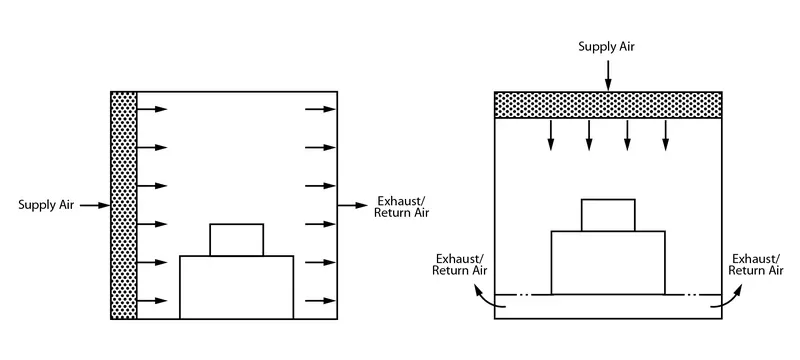
Laminar downflow is delicate. A unidirectional stream moving at 0.45 m/s is disturbed by lateral air movement near the airlock entrance. A sliding leaf sweeping sideways is the worst case for a downflow booth.
The roll-up curtain moves vertically, so it does not fight the downward air movement. Reported turbulence recovery after a completed cycle improves by 30–50%. That result applies to any cleanroom roll up door with vertical curtain travel.
Cycle Speed & Material Throughput Efficiency
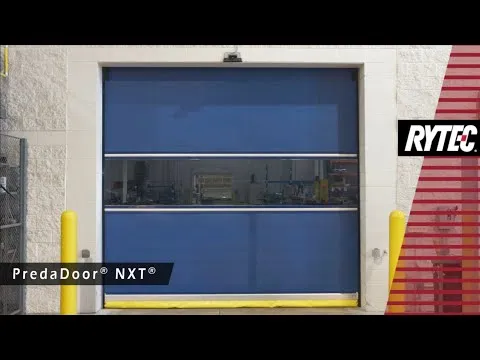
Throughput is where the roll up vs sliding cleanroom door comparison turns financial. Every extra second of open time is a second of unfiltered air exchange and a second of forklift waiting.
Deiiang catalogue data gives concrete numbers for both designs, and the rapid rollup doors for cleanroom line is where most of the speed gain shows up.
Table 2: Cycle time and throughput performance data (Deiiang catalogue data)
| Metric | Sliding cleanroom door | Rapid roll-up cleanroom door |
|---|---|---|
| Speed of opening | 0.3–0.5 m/s | 0.8–1.2 m/s |
| Speed of closing | 0.3–0.5 m/s | 0.6–1.0 m/s |
| Full cycle, 1500 × 2100 mm | 8–12 seconds | 2.5–3.5 seconds |
| Theoretical cycles per hour | 300 | 1,000 |
| Standard Deiiang size | 1200/1500 × 2100 mm | 1800 × 2400 mm |
| Curtain or panel material | 0.8 mm steel + honeycomb | 0.8 mm coated PVC |
| Metric | Sliding | Roll-up |
|---|---|---|
| Opening speed | 0.3–0.5 m/s | 0.8–1.2 m/s |
| Closing speed | 0.3–0.5 m/s | 0.6–1.0 m/s |
| Full cycle 1500×2100 | 8–12 s | 2.5–3.5 s |
| Cycles per hour | 300 | 1,000 |
| Standard size | 1200/1500 × 2100 | 1800 × 2400 |
| Material | Steel + honeycomb | Coated PVC |
Full-Open Cycle Time Benchmarks by Standard Door Size
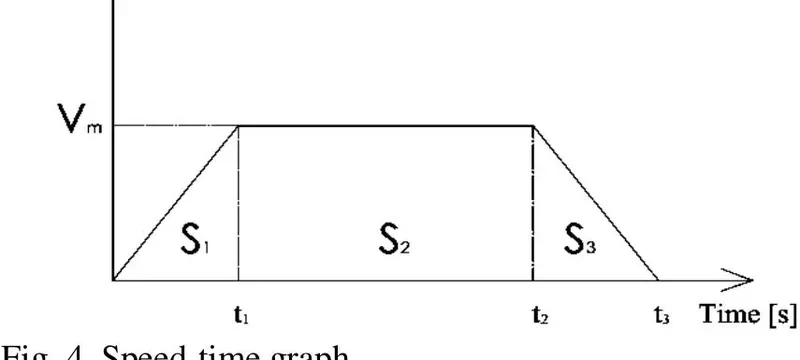
Using a 1500 × 2100 mm opening as the reference, a sliding door moving 1.5 m at 0.4 m/s needs 3.75 seconds each way. Add 0.5 seconds of dwell and seal compression, and the full cycle takes about 9 seconds.
A Deiiang rapid door at 1.0 m/s clears the same opening in 1.5 seconds, plus 0.3 seconds of acceleration and 0.4 seconds of closing overlap, so about 3 seconds per cycle. The threefold advantage scales with opening height, and it also holds for any clean room roll-up doors built to the same speeds.
High-Frequency Pass-Through Productivity Impact
Assume a forklift makes 60 passes per hour. At 9 seconds per sliding cycle the door is open 540 seconds per hour, or 15% of the time. At 3 seconds it is open only 180 seconds, or 5%.
An 8-hour shift saving 120 seconds per hour recovers 960 seconds, roughly 16 minutes per shift per door. Across three dock doors that is about 48 minutes every day.
At a $25 per hour forklift operator rate, 16 minutes per shift is worth $6.67 per door per shift. Across three doors and 250 working days, annual labour savings reach about $5,000.
cleanroom classification & Contamination Control
Particle control is subject to iso 14644-1 limits [2]. ISO 7 permits 352,000 particles at ≥0.5 µm per cubic metre; ISO 5 allows 3,520. A single door cycle can push the count above the permitted threshold.
Transient spikes are the bigger threat than the steady count, because shorter open time reduces ingress. That logic carries over from the airflow section above, and it applies equally to high speed or sliding door selections.
ISO 14644-1 Particle Contamination Risk Assessment
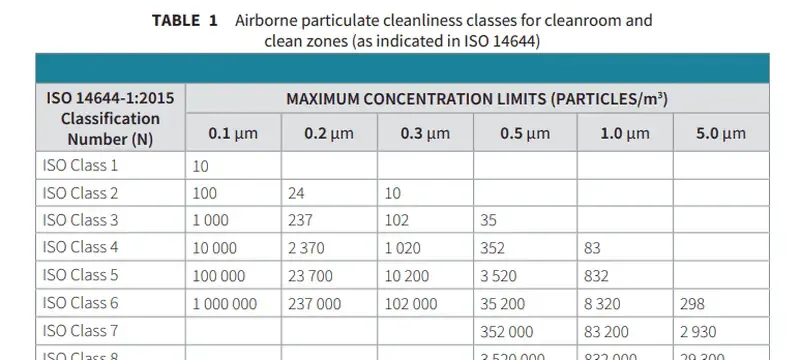
Ingress through a door scales with open area × open duration × particle concentration. Doubling the open duration doubles ingress; halving it halves ingress. That is the most compelling case for a cleanroom rapid door in ISO 7 and ISO 8 spaces.
Field data indicates ISO 7 chambers recover to class in 20–40 seconds with a cleanroom roll-up door, versus 60–90 seconds with a sliding door. ISO 5 rooms need the extra sealing measures described next.
Deiiang trials on a pharmaceutical ISO 7 packaging line measured peaks of 120,000 particles/m3 after sliding cycles versus 48,000 after roll-up cycles. Both returned to class limits within those recovery windows.
EN 1822 Seal Integrity & Leakage Performance Ratings
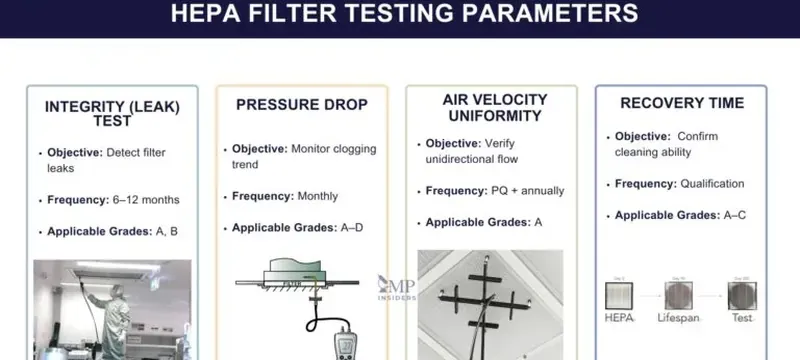
EN 1822 defines HEPA filter leakage testing methodology; its pressure-decay approach is widely adapted for cleanroom door seal verification [3].
A 3–5 mm gasket compression on a sliding door tends to produce lower leakage than brush contact. IEST-RP-CC001 specifies comparable cleanliness testing processes for cleanroom equipment [4].
Design pitfall (Jason Peng): single-row brush seals leak 2–3 times more than double-row units at 20 Pa, failing ISO 5 requirements in 90% of Deiiang audits. That single-row brush pitfall appears in most roll-up doors cleanroom projects Deiiang reviews.
Installation Footprint & Structural Requirements
Feasibility is determined by the installation footprint. Sliding doors need lateral wall space for the parked leaf plus a track, while roll-up types need headroom for the barrel and headbox. Neither fits every retrofit.
The table compares the dimensional envelope for the roll up vs sliding cleanroom door choice at a 1500 × 2100 mm opening.
Table 3: Rough opening, headroom and side clearance comparison
| Requirement | Sliding cleanroom door | High-speed roll-up cleanroom door |
|---|---|---|
| Rough opening width | 1200–1500 mm | 1800 mm standard |
| Rough opening height | 2100 mm | 2400 mm standard |
| Headroom above opening | 150–250 mm (track) | 350–450 mm (headbox and barrel) |
| Side clearance | 1.0–1.2 × leaf width | 220–300 mm |
| Structural load | 60–90 kg + track | 120–180 kg headbox |
| Wall type compatibility | Sandwich panel or masonry | Sandwich panel or masonry |
| Requirement | Sliding | Roll-up |
|---|---|---|
| Rough width | 1200–1500 mm | 1800 mm standard |
| Rough height | 2100 mm | 2400 mm standard |
| Headroom | 150–250 mm | 350–450 mm |
| Side clearance | 1.0–1.2 × leaf width | 220–300 mm |
| Structural load | 60–90 kg | 120–180 kg |
| Wall type | Panel or masonry | Panel or masonry |
Wall Opening & Structural Load Specifications
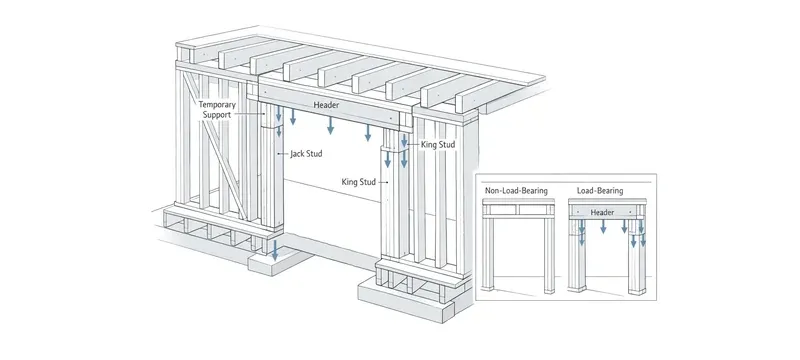
Deiiang steel clean doors come in 900 × 2100, 1200 × 2100 and 1500 × 2100 mm sizes, mounted on 50–100 mm sandwich panels using centre-T aluminium profiles. The automatic sliding variant uses the same panel sizes with a surface-mounted track.
The Deiiang high-speed roll-up door measures 1800 × 2400 mm and uses a 304 stainless steel frame, 1.2 mm horizontal and 1.5 mm vertical. Load transfers through the vertical frame, so local reinforcement above the opening is required.
Retrofits often skip structural load checks. Jason Peng notes that 30% of roll-up door retrofit delays trace back to un-reinforced sandwich panels above the opening.
Pre-installation checklist:
Maintenance Access & Side Clearance Comparison
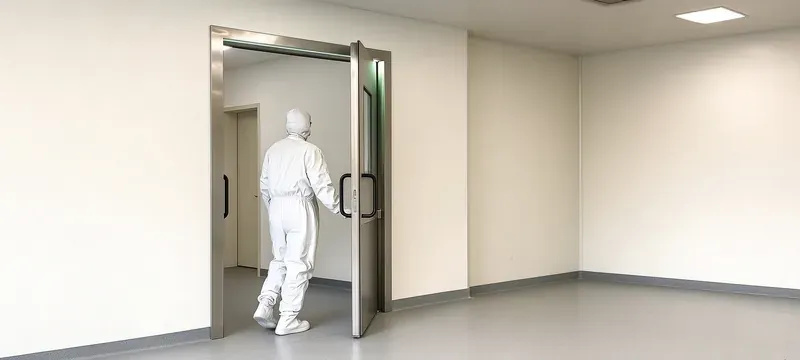
Sliding doors also need a side pocket roughly equal to one leaf width, around 1500–1800 mm of unusable wall. That is often what pushes the specification toward a clean room roll-up door instead.
In a typical Deiiang installation, 300 mm of side clearance and 130 mm of top clearance are reserved on rigid units. Front access is enough to change the brush seal.
Operational Safety & Ergonomic Design
Safety performance varies more than most buyers expect. A rigid sliding leaf carries momentum; a soft curtain carries almost none. That is a real advantage for cleanroom roll-up doors in mixed pedestrian and forklift traffic.
Both systems must comply with egress rules regardless of mechanism.
Personnel & Material Collision Protection Features
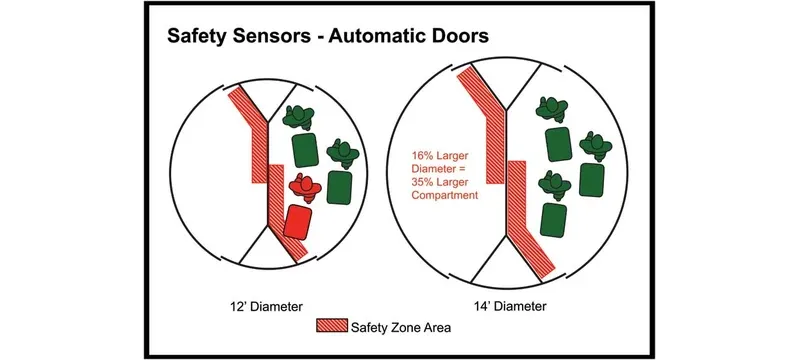
Standard collision protection on a cleanroom high-speed door includes photoelectric sensors, light curtains and a flexible bottom edge. These let the curtain reverse or self-recover after an impact.
Deiiang high-speed doors provide automatic derailment recovery and photoelectric track sensors. Deiiang sliding doors add anti-pinch control and obstacle detection through a microcomputer controller.
Noise levels differ too. Sliding doors produce 55–60 dB(A) at 1 m; high-speed roll-up doors reach 62–68 dB(A). Noise-sensitive laboratories can specify sound-dampening headbox liners.
Power Failure & Manual Override Protocols
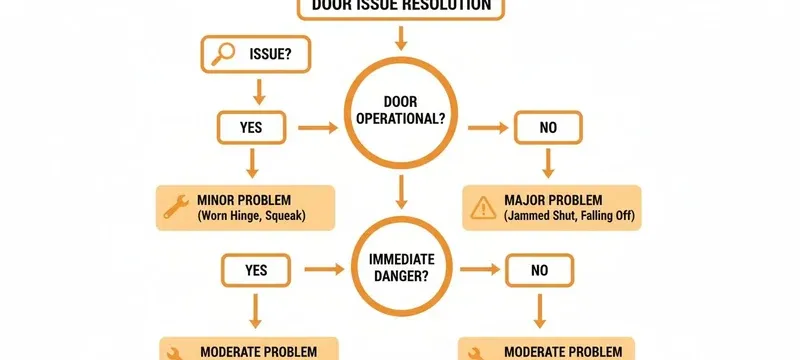
During a power failure a sliding door can fail closed and trap a pallet inside the airlock, so failure scenarios need to be defined at the design stage.
Deiiang roll-up doors accept a manual hand crank for emergency operation. Sliding doors use a release lever that disengages the belt so the leaf can be pushed by hand. Fail-safe behaviour is set per project.
Maintenance Requirements & Total Cost of Ownership
Across five years of total ownership cost there is a clear split. On purchase price, sliding doors are cheaper; on energy and maintenance in high-frequency service, high-speed roll-up doors fall considerably lower.
For a quick estimate, give our engineer your daily pass total, the differential pressure and your local power cost.
Table 4 shows the Deiiang cost structure over five years. These are illustrative indices, not fixed prices.
Table 4: Indicative 5-year cost breakdown (illustrative, per door)
| Cost element | Sliding cleanroom door | High-speed roll-up cleanroom door |
|---|---|---|
| Purchase cost | 1.0× | 1.4–1.8× |
| Maintenance cost | 1.0× | 0.6–0.7× |
| Wear parts | 2 gasket sets per year | 1 brush set per year |
| Energy loss (60 passes/hour) | 1.0× | 0.35–0.5× |
| Total cost, 5 years | 1.0× | 0.85–1.05× |
| Cost element | Sliding | Roll-up |
|---|---|---|
| Purchase cost | 1.0× | 1.4–1.8× |
| Maintenance | 1.0× | 0.6–0.7× |
| Wear parts | 2 gasket sets | 1 brush set |
| Energy loss | 1.0× | 0.35–0.5× |
| 5-year total | 1.0× | 0.85–1.05× |
Baseline 1.0× is the capital cost of a standard 1500 × 2100 mm Deiiang automatic sliding door. Energy is based on 16-hour daily operation, 20 Pa differential pressure and 60 passes/hour.
Component Wear Rates & Scheduled Service Intervals
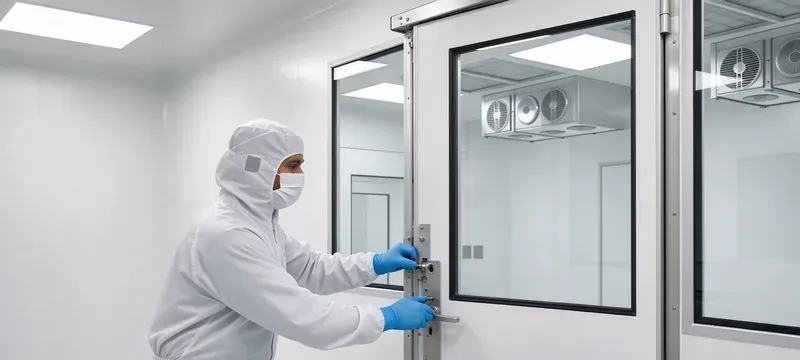
Sliding doors wear gaskets, belts and rollers. Perimeter gaskets are generally replaced every 18–24 months in high-frequency areas, and the track is cleaned at least quarterly for a smooth run.
Roll-up doors wear brushes, the bottom beam and the curtain. Double-row brush seals last about 18 months, and PVC curtain life runs 500,000 to 1,000,000 cycles. Both motor types should last about a decade in normal use.
Deiiang maintenance best practices (Jason Peng):
- Wipe track seals weekly with isopropyl alcohol to prevent particle buildup
- Lubricate sliding door rollers every 6 months with food-grade grease
- Inspect brush bristle length quarterly; replace when wear exceeds 30%
-Year TCO Breakdown for Deiiang Door Models

The Deiiang sliding models use galvanised steel leaves and honeycomb cores, which keeps the initial investment reasonable. Deiiang roll-up models use 304 stainless frames with servo drives, costing more upfront but losing less energy.
As an illustration, at 60 passes per hour and 16 hours per day, the energy saving alone can reach 20–30% of the total five-year cost. Above about 40 passes per shift, the roll-up door breaks even within 24–36 months.
Final Selection Framework for Material Pass-Through
Use the matrix below to evaluate your own situation, and treat it as a high speed vs sliding cleanroom door scorecard rather than a fixed rule.
Decision Matrix by Cleanroom Application Type
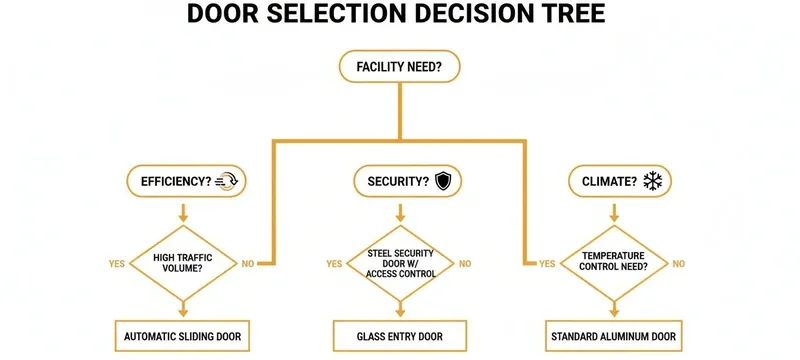
Assign weights to your criteria to reflect your priorities. If throughput and wall space carry the most weight, the score will always favour rapid rollup doors for cleanroom duty.
For ISO classes below ISO 5, the sliding door wins. At ISO 7 and ISO 8, cycle rate favours the high-speed roll-up cleanroom door.
Table 5: Weighted decision matrix (score 1–5, 5 is best)
| Criterion | Weight | Sliding | Roll-up |
|---|---|---|---|
| ISO class capability (ISO 5 and cleaner) | 25% | 5 | 3 |
| Throughput above 40 passes/shift | 25% | 2 | 5 |
| Wall space | 20% | 2 | 5 |
| Static pressure hold | 15% | 5 | 3 |
| Capital budget | 15% | 5 | 3 |
| Weighted total | 100% | 3.5 | 4.1 |
| Criterion | Sliding | Roll-up |
|---|---|---|
| ISO class capability — 25% | 5 | 3 |
| Throughput above 40 passes/shift — 25% | 2 | 5 |
| Wall space — 20% | 2 | 5 |
| Static pressure hold — 15% | 5 | 3 |
| Capital budget — 15% | 5 | 3 |
| Weighted total — 100% | 3.5 | 4.1 |
A downloadable pre-installation checklist covers rough opening sizes, load capacity, ISO classification, power supply and maintenance access.
Deiiang Recommended Model Matching Guide
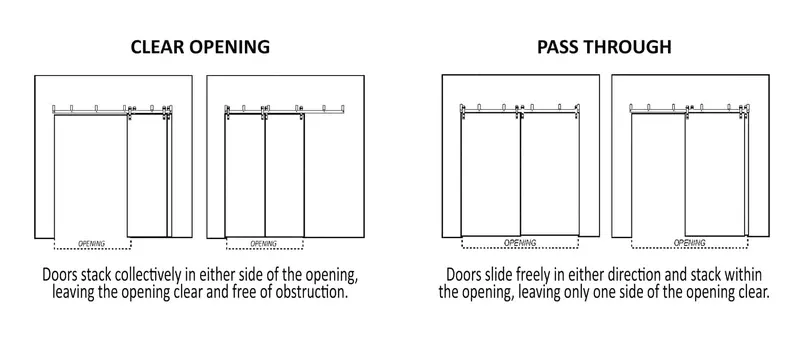
Match the use case to the catalogue model, then compare dimensions against the rough opening. Deiiang supplies both families, so the recommendation stays objective.
Table 6: Deiiang recommended model matching guide
| Use case | Recommended Deiiang model | Key data |
|---|---|---|
| Standard material pass-through, ISO 7–8 | High-Speed Roll-Up Door | 1800 × 2400 mm, 0.8–1.2 m/s |
| Low-frequency laboratory, ISO 5 | Airtight Automatic Sliding Door | 1200/1500 × 2100 mm |
| Large opening pass-through, ISO 7 | Airtight Automatic Sliding Door | 1200/1500 × 2100 mm |
| Forklift traffic, ISO 8 | High-Speed Roll-Up Door with radar | 0.8 mm PVC curtain, brush seals |
| Mixed pedestrian and cart traffic, ISO 7 | High-Speed Roll-Up Door with light curtain | 1,000,000 operating cycles |
| Use case | Deiiang model | Key data |
|---|---|---|
| Standard pass-through ISO 7–8 | High-Speed Roll-Up Door | 1800 × 2400 mm |
| Low-frequency lab ISO 5 | Airtight Automatic Sliding Door | 1200/1500 × 2100 |
| Large opening ISO 7 | Airtight Automatic Sliding Door | 1200/1500 × 2100 |
| Forklift traffic ISO 8 | Roll-Up Door with radar | 0.8 mm PVC curtain |
| Mixed pedestrian ISO 7 | Roll-Up Door with light curtain | 1,000,000 cycles |
All models support custom sizes up to 3000 × 3000 mm. Standard lead time is 15 working days for stock sizes and 25 working days for custom builds (Deiiang production data, Jason Peng).
Frequently Asked Questions
Which door is better for high-volume ISO 7 material pass-through?
A high-speed roll-up cleanroom door is the better option. At 60 operations per hour it is open about 5% of the time versus 15% for a sliding door, so transient particle ingress is significantly reduced. ISO 7 recovery normally runs 20–40 seconds.
Can a clean room roll up door match sliding door pressure ratings?
Not completely. Static leakage with brush seals runs 2–4 times higher than with a compressed gasket. Over the complete cycle the faster door performs better, so ISO 14644-3 recovery results can be virtually equal [1].
How much headroom does a cleanroom rapid door need vs sliding doors?
A roll-up door needs 350–450 mm above the opening for the headbox and barrel. A sliding door needs only 150–250 mm for the overhead track. If overhead space is below 300 mm, sliding configurations are usually the only option.
Are roll-up doors cleanroom suitable for iso 5 classified areas?
Yes, provided the specification meets ISO 5 constraints: a cleanroom roll-up door with double-row brush seals, a Class 8.2 fire-rated PVC curtain, and a bottom beam that compresses against the floor. ISO 5 also requires cascading pressure and validated recovery testing.
What is the typical service lifespan of roll-up vs sliding cleanroom doors?
A roll-up curtain should last 500,000 to 1,000,000 operations. Sliding gaskets last 18–24 months, though steel panels exceed 10 years. With proper maintenance both products should reach a service life of 10 to 15 years.
Do high speed or sliding door systems require more ongoing maintenance?
Sliding doors need quarterly track cleaning and gasket replacement every 18–24 months. Roll-up doors need brush replacement every 12–18 months but carry lower costs on other maintenance items. Annual maintenance cost favours the roll-up design by roughly 30–40%.
References
- [1] ISO 14644-3:2019 — Cleanrooms and associated controlled environments — Part 3: Test methods (door recovery and airflow testing).
- [2] iso 14644-1:2015 — Classification of air cleanliness by particle concentration.
- [3] EN 1822-1:2019 — High efficiency air filters (EPA, HEPA and ULPA) — Part 1: Classification, performance testing, marking.
- [4] IEST-RP-CC001 — HEPA and ULPA filters, cleanroom hardware guidance.
- [5] Deiiang Door & Window product catalogue — clean doors, airtight automatic sliding doors, high-speed roll-up doors. Product designer: Jason.peng.
- [6] GONICE high-speed door technical datasheets — operating speeds, cycle ratings and safety accessories.