+86 18186671616
 Jason@cleanroomequips.com


 MENU

If you are comparing hpl or stainless cleanroom door options, you have probably seen one vendor call stainless "the only Grade A choice" and another say HPL is "just as good." Both overstate the case. The right answer depends on your disinfectant regime, how often the door cycles, what the floor and cart traffic actually do to the leaf, and what evidence your QA team can defend in an audit.
This page compares the two materials as they actually appear on a Cleanroom door — not as raw material data sheets. It separates what the standard requires, what a lab test shows, what is our engineering judgment, and what still needs project-specific evidence.
- Stainless steel (304 / 316L) is typically selected where the door sees repeated wet disinfection, vapor-phase sterilization (VHP), heavy cart traffic, or where the surface must tolerate repeated chemical wipe without face degradation.
- HPL compact panel can be a reasonable option in lower-risk zones if the edge banding and bottom seal are engineered for wet cleaning, and the specific HPL grade + adhesive + seal combination has compatibility data for your disinfectants.
- Material alone does not determine a cleanroom grade. A door's compliance comes from the whole assembly — surface finish, seams, welds, gaskets, hardware, drive, and installation — validated against your URS.
In Brief: Why the Material Question Is Harder Than It Looks
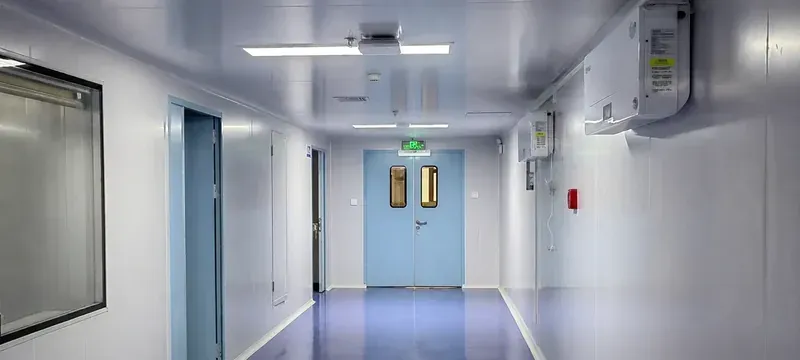
QA walks the room at acceptance and runs a gloved finger along the door frame corner. They are looking for a surface that can take the cleaning routine your SOP actually specifies, a gap and seal arrangement that does not shed particles when the door opens, and a door leaf that does not develop hidden cavities where material can collect.
What they are not checking is a material name. GMP and ISO standards describe surface performance and cleanliness, not "this material is required." The selection that holds up in an audit is the one backed by test data for the actual door assembly, not the one that sounds the most expensive.
Three things drive the comparison:
- Disinfectant compatibility. The door gets wiped — possibly daily, possibly with oxidizing agents, possibly in VHP cycles. Whether the face material, the edge band, and the gasket survive that routine is a question for test data, not a generic "chemical resistance" claim.
- Surface and seam condition. Roughness (Ra) is one number, but the wipe also has to reACH the weld, the vision-panel trim, the handle base, and the seal groove. A low Ra on a smooth face does not help if the corner behind the hinge is a food trap.
- Lifecycle cost. The leaf panel is rarely the first thing replaced. Seals, hinges, and closers are. The material choice affects that cost only indirectly — mainly through how heavy the leaf is and how it handles impact.
Public market reports put stainless steel at roughly 38%–50% of global cleanroom door revenue and HPL/compact panel at roughly 14%–20% of the pure cleanroom-door category, but these figures come from different research firms with different counting rules and disagree by more than 11 percentage points. We cite them as a range, not a number.
The way this usually goes wrong on site is treating the material decision as a leaf-surface decision. The leaf is one component. The seal, the closer, the drive mechanism, and the installation are what determine whether the door actually holds the differential pressure your HVAC was designed for.
Comparative Material Analysis
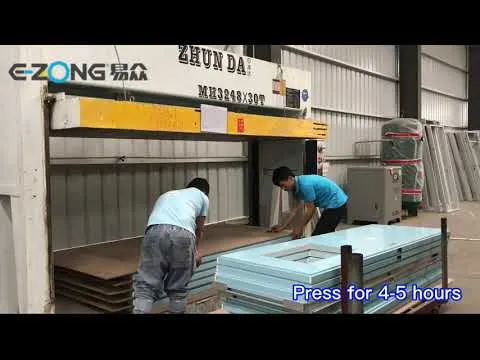
- This page compares door leaf face materials in typical cleanroom construction: solid compact HPL (6–13 mm), HPL-faced composite Doors (HPL face over mineral or aluminum core), and stainless-faced composite doors (304 / 316L sheet over a mineral or PU core).
- Material tensile / impact data come from the relevant material standards (ASTM A240 for stainless, EN 438-2 for HPL). These test methods differ and cannot be converted into a "which material is stronger" ratio.
- Whole-door behavior (impact, airtightness, sag) depends on frame thickness, core, edge construction, hinges, and installation. We compare those separately where data exists.
- This page does not cover explosion-proof, radiation-shielded, or BSL-3/4 biosafety cabinet doors — those have their own standards and should be evaluated separately.
What "HPL Door" and "Stainless Door" Actually Mean
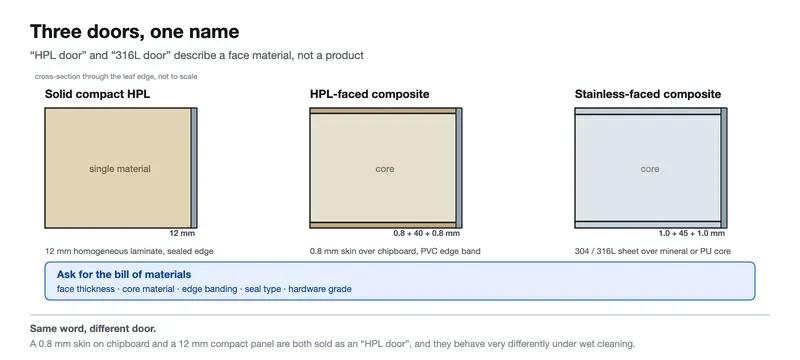
Walk into a supplier room and you will see two doors both labeled "HPL." One may be a 12 mm solid compact laminate panel with a sealed edge; the other may be a 0.8 mm HPL skin glued over a particleboard core with a PVC edge band. They behave very differently under wet cleaning. Same word, different door.
Similarly, "316L door" often means only the face sheet is 316L. The frame, the fasteners, the hinges, and the closer may be 304 or mild steel. Ask for the bill of materials, not the product name.
We recommend requesting a cutaway or material list for every door you evaluate, including face sheet thickness, core material, edge banding, seal type, and hardware grade.
Chemical Resistance: Conditions Matter More Than the Material Name
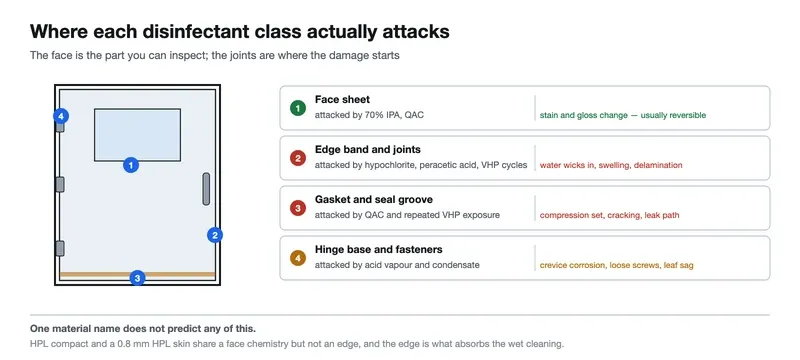
Pharma disinfectants are not one product. Alcohol, quaternary ammonium, oxidizing agents, and vapor-phase sterilization each attack the material differently. A material that passes a 24-hour wipe test may still degrade after hundreds of VHP cycles. The table below shows what each material family typically tolerates under normal conditions — your actual SOP may be more aggressive.
| Disinfectant class | Typical agents | Stainless 304 / 316L | HPL compact panel (cleanroom grade) |
|---|---|---|---|
| Alcohols & quaternary ammonium | 70% IPA, QAC | No known effect under routine wipe use | Stain-resistant under EN 438-2 lab test conditions |
| Oxidizing wipes | Dilute H₂O₂, peracetic acid, hypochlorite | 316L shows good resistance; 304 may show tea-staining or pitting over years of repeated contact with hypochlorite, especially at crevices | Cleanroom-grade HPL tolerates routine dilute wipes; commercial-grade HPL may fade or degrade. Requires the specific manufacturer's compatibility data for your formulation |
| Vapor-phase sterilization (VHP / ClO₂) | Isolated-room bio-decontamination cycles | Stainless is commonly used, but long-term behavior depends on concentration, condensation, cycle count, and gasket / adhesive compatibility — not just the face sheet | Cannot be assumed compatible. Requires the specific HPL grade, adhesive, and seal combination to have completed VHP cycle testing. Do not extrapolate from surface stain ratings |
Stainless: no known effect
HPL: stain-resistant per EN 438-2 lab test
Stainless: 316L good; 304 may tea-stain
HPL: cleanroom-grade OK routine; commercial-grade fades — get manufacturer data
Stainless: commonly used, depends on cycles, condensation, gaskets
HPL: cannot assume; requires full cycle test for the specific assembly
When you ask a supplier for chemical resistance, do not accept "compatible with pharma disinfectants." Ask for the product formulation, concentration, contact time, temperature, number of cycles, and the acceptance criterion. A 24-hour spot test is not a VHP cycle validation.
On the stainless side, 316L contains roughly 2.0–3.0% molybdenum per ASTM A240 [5], which improves pitting resistance compared to 304. That does not mean 316L is immune to chloride — it means it has more margin. In practice, 304 is often adequate in zones where hypochlorite is used infrequently and the surface is rinsed; 316L is selected where oxidant exposure is daily and residues are not routinely wiped away.
Surface Finish: Ra Is Necessary, Not Sufficient
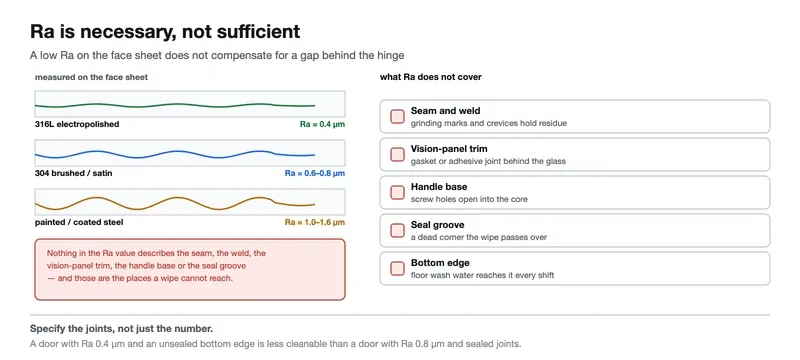
Surface roughness (Ra) gets a lot of attention, and it matters. But a cleanable surface is also about seams, welds, the vision-panel trim, the handle base, and the seal groove. A low Ra on the face sheet does not compensate for a gap behind the hinge that nobody can reach.
| Surface finish | Typical Ra | What evidence to request | Typical use context |
|---|---|---|---|
| 316L electropolished | ≈ 0.4 μm | Ra test report; weld finish; passivation certificate | High-care aseptic zones where wet disinfectant and VHP are routine |
| 304 stainless, brushed or satin | ≈ 0.6–0.8 μm | Ra test; note grain direction vs wipe direction | General pharma and biotech zones with routine wipe-down |
| HPL compact panel | < 0.5 μm (face) | Edge banding construction; bottom-edge seal; wipe test per your SOP | Lower-risk zones where VHP is not used; edge construction is the critical detail |
| Painted / coated steel | ≈ 1.0–1.6 μm | Coating integrity; chip repair procedure | Support corridors, change rooms, storage |
Do not read the "typical use context" column as a rule that the material is required for that grade. It is a description of where the construction is commonly chosen. Whether it meets your URS depends on the project's surface integrity requirements, measured at the seams and welds, not just the face.
In our experience, the most common cleanability issues are not on the face sheet — they are at the hinge corner, the bottom edge, and the seal groove. Ask to see close-up photos of those areas, not just the rendered door front.
Airtightness: The Whole Assembly Matters
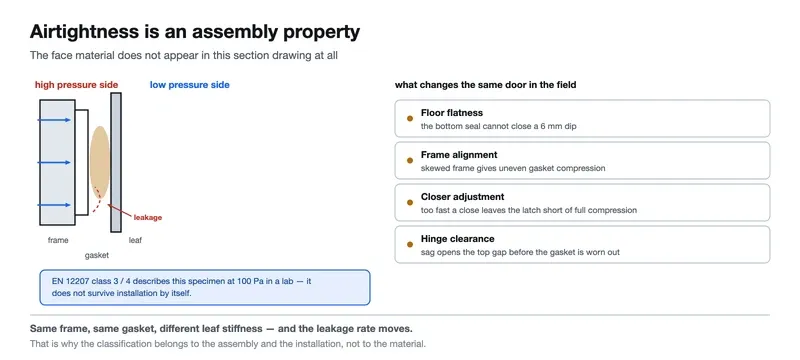
A door's airtightness is determined by the frame geometry, the gasket material and compression, the locking mechanism, and the installation — not by the face material. A stainless door and an HPL door on the same frame and gasket can perform very differently depending on how the leaf is rigidized.
EN 12207 [7] classifies window and door air permeability at a reference pressure (commonly 100 Pa) in a lab. Class 3 and Class 4 describe lab leakage rates for the specimen tested. That classification is useful for comparing two door designs, but it does not by itself guarantee field performance after installation — floor flatness, frame alignment, and closer adjustment all change the seal contact.
When a supplier quotes an EN 12207 class, ask: what was the reference pressure, what was the test specimen, and what size was the door? A Class 4 rating on a 900 × 2100 mm door does not directly transfer to a 1500 × 2100 mm double-leaf door.
Our engineering advice: factory test data confirms the design; field acceptance confirms the installation. Both are needed. A door that passes the bench test but is installed on an out-of-level floor may not seal on site.
Mechanical Impact: Compare the Whole Door, Not the Material
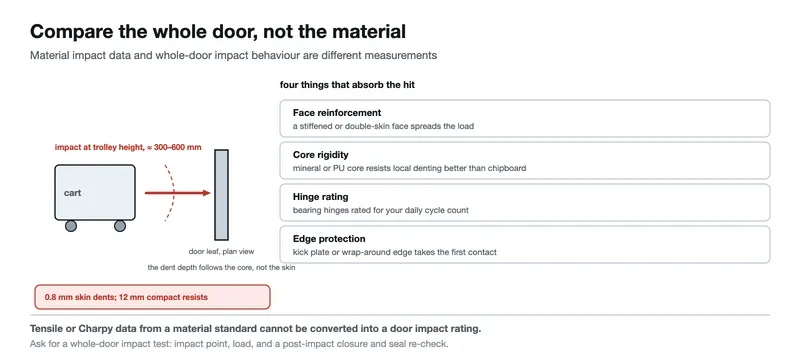
Material tensile strength and whole-door impact resistance are different questions. 316L sheet is a much stronger material than HPL, but a 1.2 mm skin over a lightweight core can still dent permanently under a cart bump. That dent is not the same as "oil-canning" (the panel waviness that comes from thin skin over an unsupported frame) — they are two different failure modes with different fixes.
What actually matters for a door in a cart corridor:
- Does the local impact cause a permanent dent that becomes a cleanability trap?
- Does the leaf still close and seal after the bump?
- Does the hardware (hinges, closer) stay aligned?
We recommend asking suppliers for whole-door impact test reports (per your specified trolley load and impact point), not material tensile data. The whole-door result is what predicts field behavior.
For high-traffic material corridors, our free-swing impact door uses 304 stainless leaf 1.2 mm, frame 1.0 mm, XPS core, and impact hinges rated over 500,000 cycles — a hybrid that adds a protective face without forcing the entire door to be solid stainless. This is one configuration; your own traffic pattern may call for a different approach.
Pros, Cons, and Open Questions
Below, we avoid the green-check / red-cross pattern that implies one material is universally better. Instead, each item is marked as a confirmed advantage, a conditional trade-off, or an open question that needs project-specific evidence.
| Stainless Steel (304 / 316L) | HPL Compact Panel |
|---|---|
| ✅ Confirmed: Acceptable face material for repeated wet disinfectant and VHP regimes when the gasket and adhesive are also rated | ✅ Confirmed: Lower face-material cost than stainless; lighter leaf reduces hinge load |
| ✅ Confirmed: Electropolished finish reaches low Ra values that are easy to validate | ✅ Confirmed: Hard face surface; shallow scratches do not leave a curled metal burr |
| ⚠️ Conditional: 304 may show tea-staining under repeated hypochlorite; 316L provides more margin but is not chloride-proof | ⚠️ Conditional: Edge banding and bottom edge are the weak points — water ingress causes delamination. Quality of edge sealing is the deciding factor |
| ⚠️ Conditional: Thin skin dents under cart impact; heavy leaf requires heavy bearing hinges or sag develops | ⚠️ Conditional: VHP compatibility depends on the specific HPL grade, adhesive, and seal combination — not on "HPL" as a category |
| 🔍 Open question: Long-term behavior in your specific VHP cycle (concentration, cycles/year, condensation) | 🔍 Open question: Whether your disinfectant formulation has been tested on the exact supplier's HPL assembly |
| 🔍 Open question: Whether the frame, fasteners, and hinges are also stainless (not just the face) | 🔍 Open question: Whether the bottom edge is sealed against the floor wash water that accumulates outside the seal |
✅ Confirmed: good for wet/VHP regimes when gaskets also rated
✅ Confirmed: low Ra achievable
⚠️ Conditional: 304 may tea-stain; 316L not chloride-proof
⚠️ Conditional: dents under cart bump; needs heavy hinges
🔍 Open: VHP cycle behavior; whether frame/fasteners are also stainless
✅ Confirmed: lower cost; lighter leaf
✅ Confirmed: shallow scratches, no metal burr
⚠️ Conditional: edge banding is the weak point
⚠️ Conditional: VHP needs specific assembly test
🔍 Open: disinfectant compatibility; bottom-edge seal
What Usually Fails First
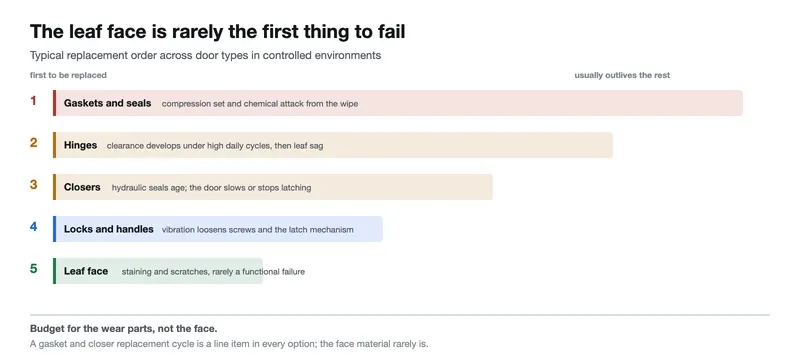
Across door types in controlled environments, the leaf face is rarely the first component to fail. The typical sequence is:
- Perimeter gaskets and seals — compression set, chemical attack from disinfectant wipe. This is the component most likely to need replacement, on a schedule that depends on cycle count and chemical exposure.
- Hinges — non-bearing hinges can develop clearance under high daily cycles, leading to leaf sag and uneven seal pressure.
- Door closers — hydraulic seals age; the closer may leak, slow down, or fail to latch fully.
- Locks and handles — vibration loosens screws, latch mechanism sticks.
This means your maintenance budget should be built around seals and hardware, not around replacing the leaf. A door leaf that lasts 10–15 years is not a claim — it is the expected life if the seals and hinges are maintained on schedule.
When to Choose Stainless Steel vs HPL (By Use Case)
Rather than saying "Grade X must use material Y," we describe the operating conditions that push the decision one way or the other. Your cleanroom grade is context; the actual disinfectant regime, traffic pattern, and maintenance routine are the decision drivers.
Use Case 1: Routine wet disinfection with VHP cycles
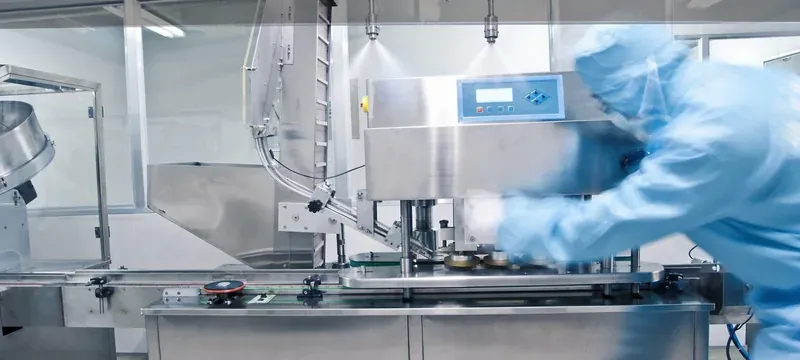
Where the room undergoes isolated-room VHP decontamination, stainless steel is the more common choice. This is not because the standard mandates it, but because the face sheet, gaskets, and adhesives all need to survive repeated VHP cycles, and stainless assemblies have more field history in that regime. If you are evaluating HPL in a VHP zone, require cycle-compatibility test data for the exact assembly before you consider it.
Use Case 2: Daily oxidizing wipe, no VHP

Where the routine is daily wipe with dilute H₂O₂ or peracetic acid but no vapor-phase cycle, 304 stainless is often adequate. HPL compact panel can also be considered — provided the specific HPL grade and edge construction has been tested against your formulation. The deciding factor is the edge banding, not the face.
Use Case 3: Heavy cart / forklift traffic
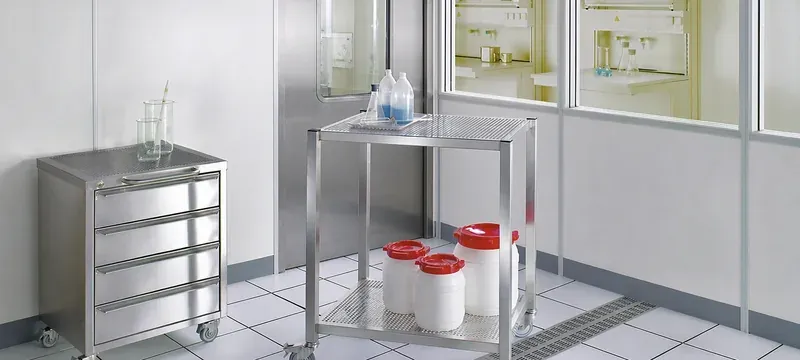
Material corridors with trolley traffic need whole-door impact resistance, not material strength. Look for a door with a reinforced face, a durable core, and impact hinges rated for your cycle count. The material choice here is secondary to the impact protection and hinge selection.
Use Case 4: Low-frequency support zones (corridors, change rooms, storage)
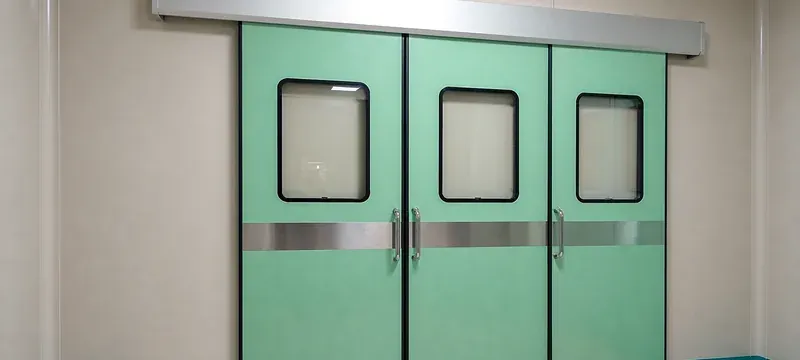
Where the door sees infrequent use and no direct product exposure, a painted or HPL-faced door is often the practical choice. The budget goes to the seal and closer, not to the face material. This is where over-specifying 316L wastes money without reducing risk.
Use Case 5: ESD-sensitive or specialized environments
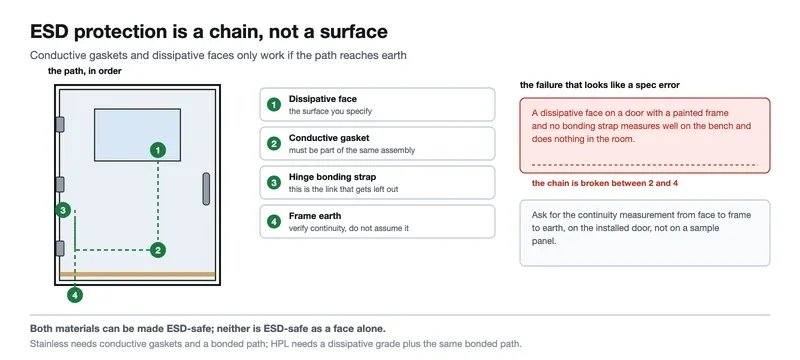
If the zone has ESD requirements, note that both materials can be modified (stainless with conductive gaskets, HPL with dissipative surface) but the conductive path must be part of the whole-door design. Do not assume the face material alone provides ESD protection.
Reference Project Notes (Publicly Disclosed Data)
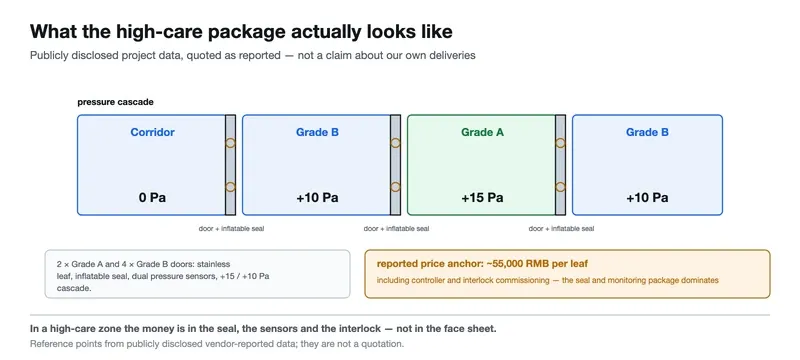
The following are drawn from publicly disclosed project data, not from Deiiang's own deliveries unless noted. They are reference points, not a claim that Deiiang delivered them.
Project A — Aseptic filling suite (publicly disclosed, vendor-reported). 2 × Grade A + 4 × Grade B doors. Stainless leaf, inflatable seal, dual pressure sensors, +15 Pa / +10 Pa cascade. The reported price anchor was ~55,000 RMB per leaf including controller and interlock commissioning. Reported as passing GMP first pass. This configuration illustrates that in high-care zones, the seal and monitoring package often cost more than the leaf itself — worth comparing when you get quotes.
Project B — Vaccine production suite (publicly disclosed). 6 interlocked Hermetic doors, 304 stainless, magnetic card interlock, pressure sensor. Reported measured leakage at close was 0.3 m³/(m²·h) against the project's acceptance target of ≤0.5 m³/(m²·h) — note this is the project's URS target, not a universal GMP limit. The pre-retrofit note: the original belt-driven sliding door was reported to shed micro-particles that pushed 0.5 μm counts over spec; after switching to brushless direct drive, counts returned to spec. This improvement is consistent with reduced particle shedding, but the retrofit was not a controlled experiment isolating the belt as the sole cause.
Project C — Solid-dose facility (cross-referenced from public industry practice). C-grade weighing, granulation, and coating areas typically use HPL compact or 304 doors with vision panels; D-grade corridors and change rooms use painted or HPL-faced swing doors. C/D-grade doors commonly make up the majority of door count but a minority of total door cost. These proportions vary by project; treat them as a planning reference, not a rule.
The Australia hollow-core lesson. A production facility found dust buildup on the door ventilation grille leading to a buffer corridor. Sampling inside the hollow door core confirmed bacterial growth. The root cause was a hollow-skin construction with internal cavities — regardless of face material. The door was replaced with a solid, joint-free GRP molded leaf. This case shows that material choice is not enough: internal cavities and non-cleanable surfaces are a separate design risk.
Scope note: these project results apply to the specific configurations, disinfectant regimes, and installation conditions described. They should not be generalized to other HPL brands, other VHP formulations, or other door drives. Your own selection should be validated against your URS and site test data.
MYTH: "Stainless Steel Is Always the Safer Choice"
Myth: "Stainless never rusts, so it's the right answer everywhere."
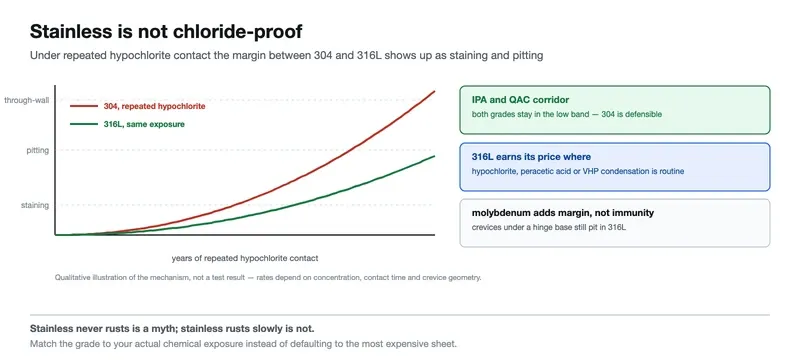
Stainless 304 under repeated hypochlorite contact can develop tea-staining and pitting over years. That is why 316L exists — it adds molybdenum for more margin, not because 304 fails catastrophically. In a corridor that only sees IPA and QAC, 304 is a defensible choice. The selection should match your actual chemical exposure, not a default assumption that "more stainless = safer."
Myth: "HPL isn't clean enough for pharma."
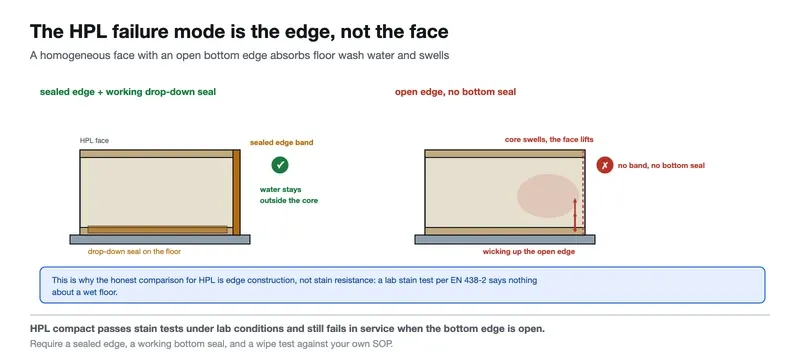
HPL compact panel is a homogeneous, low-porosity surface that passes EN 438-2 stain tests under lab conditions. In zones where VHP is not used and the edge construction is properly sealed, it is a widely used and defensible choice. The failure mode is not the face — it is the edge banding absorbing water from floor cleaning. If the edge is sealed and the bottom has a working drop-down seal, HPL can perform well for its intended life.
What the standard actually says
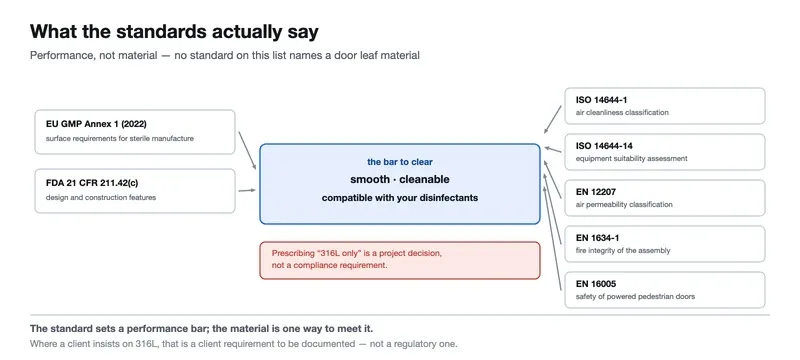
EU GMP Annex 1 (2022 revision) requires surfaces that are smooth, cleanable, and compatible with the disinfectants used in the room [4]. It does not name a material. iso 14644-1 classifies air cleanliness [11], and ISO 14644-14 addresses equipment suitability assessment [10] — neither of them prescribes a door leaf material. The standard sets a performance bar; the material is one way to meet it.
Purchase Price vs. Lifecycle Cost
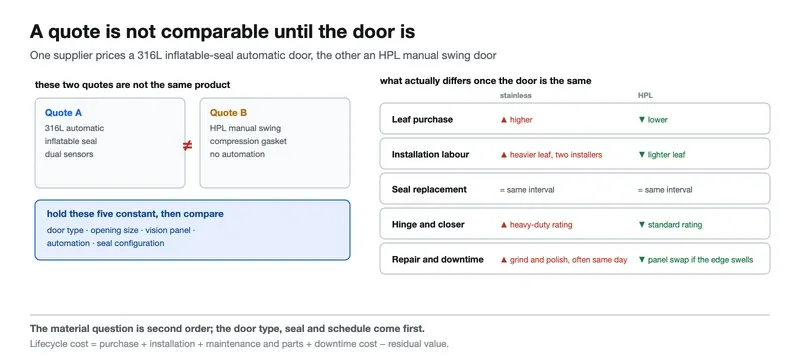
A door quote is not apples-to-apples when one supplier prices a 316L inflatable-seal automatic door and another prices an HPL manual swing door. They are different products. To compare materials fairly, hold the door type, opening size, vision panel, automation, and seal configuration constant — then compare the cost of the leaf face, the maintenance schedule, and the downtime risk.
The lifecycle cost formula is straightforward:
Lifecycle Cost = Initial Purchase + Installation + Maintenance & Parts + Downtime Cost − Residual Value
| Cost line item | Stainless leaf (same door type, same hardware) | HPL leaf (same door type, same hardware) |
|---|---|---|
| Initial leaf purchase (face material contribution) | Higher | Lower |
| Installation labor | Heavier leaf may require two installers; same anchor pattern otherwise | Lighter leaf; same anchor pattern |
| Seal replacement (scheduled) | Same seal, same interval — material does not change this | Same seal, same interval |
| Hinge / closer replacement | Heavy leaf may require heavy-duty hinges; heavier leaf loads closer | Lighter leaf reduces hinge load; standard hinges may suffice |
| Leaf repair (dent, scratch, edge delamination) | Dent may be polished out; scratch may leave a burr that needs grinding | Edge delamination requires panel replacement; surface scratch is cosmetic |
| Downtime during repair | Leaf repair often same-day; hinge replacement may require removing the door | Edge delamination may require panel swap — longer downtime if stock is not local |
[Local data: Deiiang's own quotes for comparable door configurations, spare-part prices, and actual labor hours — pending]. When you collect quotes, require each supplier to specify: whether the price includes installation, commissioning, and tax; what is the warranty period; and what spare parts are stocked locally. A low quote that saves on edge construction or test reports may cost more in year 3.
Our engineering note: the price difference between the two leaf faces is real but smaller than most buyers expect. The larger cost drivers are the seal system, the automation, the interlock, and the local service response time. Do not make a 5-year budget decision on the leaf face price alone.
Decision Checklist: Evidence Status, Not a Score
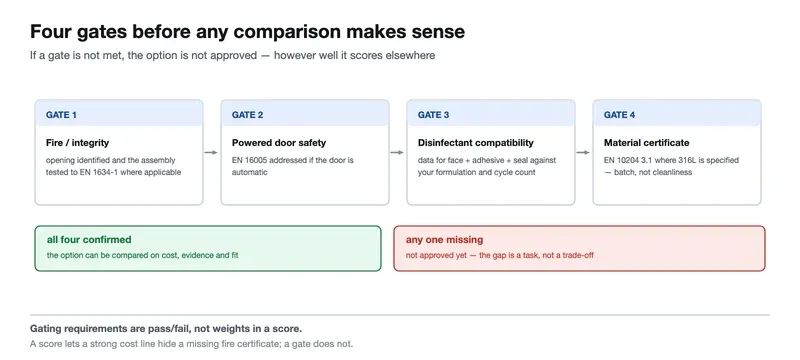
Rather than a numeric score that implies a regulatory verdict, this checklist helps you track what evidence you have and what is still open. Life-safety, fire, and disinfectant compatibility are gating requirements — if they are not met, the option is not approved, regardless of how well it scores on other dimensions.
Gating Requirements (must be confirmed before selection)
Evidence Status Tracking
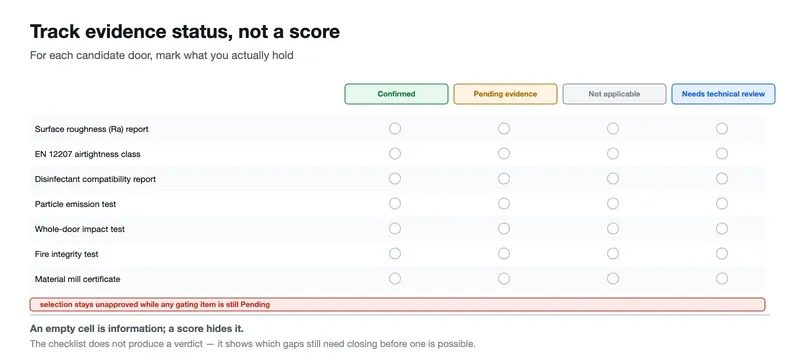
For each candidate door, mark the evidence state:
- ✅ Confirmed — test report provided, method and scope understood, applicable to your configuration
- ⚠️ Pending evidence — supplier claims it but has not yet provided the report; selection is not yet approved
- ❌ Not applicable — this requirement does not apply to this door type or zone
- 🔍 Needs technical review — evidence exists but the test condition does not match your use case; engineering review required
| Evidence item | When it applies | What to ask for |
|---|---|---|
| Surface roughness (Ra) report | Where your URS specifies a surface finish | Measured value, measurement location, and surface treatment (not just the word "smooth") |
| EN 12207 airtightness classification | Where differential pressure is a critical design parameter | Class, reference pressure, test specimen size, and lab |
| Disinfectant compatibility report | For any room with a defined chemical cleaning or vapor sterilization regime | Formulation, concentration, contact time, temperature, cycle count, and acceptance criterion for the complete assembly |
| Particle emission test | Where iso 14644-14 assessment is relevant [10] | Test method, door open/close cycle count, and particle size range — note this is not a universal door certification |
| Whole-door impact test | Where cart or trolley traffic is expected | Impact point, load, post-impact closure and seal re-check |
| Hardware cycle life | Where daily cycle count exceeds ~500 | Closer rated cycles; note EN 16005 covers powered door safety, not all closer cycle ratings |
| Fire integrity test | Where the opening is in a fire-rated wall | EN 1634-1 or equivalent; EI rating; note this applies to the door assembly, not the face material |
| Material mill certificate | Where 316L or 304 stainless is specified | EN 10204 3.1 certificate; note this certifies the material batch, not door cleanliness |
If a gating requirement is not met, the option is not approved — do not compensate with a higher score on aesthetic or cost. If evidence is pending, mark the selection as "pending" and wait for the report rather than making a provisional decision.
FAQ
1. How do I choose between HPL and stainless steel for a cleanroom door?
Start with your cleaning SOP: what disinfectants do you actually use, at what concentration, how often, and is there any VHP cycle? Then look at your traffic pattern and daily cycle count. The material follows from those conditions, not from a default assumption that one material is "better." If the supplier cannot give you compatibility data for your specific disinfectant on the specific door assembly, that is a gap to close before you decide.
2. Does the iso cleanroom grade require a specific door face material?
No. ISO 14644-1 classifies air cleanliness by particle count. It does not specify a door material. Whether a door is suitable for a given zone depends on the whole assembly's surface finish, cleanability, and particle emission — validated against your URS and site monitoring. A material name alone does not determine the grade.
3. Can an HPL door be used in a room that uses vaporized hydrogen peroxide (VHP)?
Not by default. HPL face, adhesive, and seal materials each respond differently to VHP cycles. You need test data for the complete door assembly (face + adhesive + gasket + edge band) under your actual VHP concentration, cycle duration, and number of cycles. A surface stain rating (EN 438-2) is not a VHP cycle validation. If the supplier cannot produce this, do not assume compatibility.
4. How do I choose between 304 and 316L stainless?
Look at your actual chemical exposure. If the room uses IPA and QAC with occasional dilute oxidizing wipes and routine rinsing, 304 is often adequate. If the room uses repeated hypochlorite, peracetic acid, or VHP cycles, and residues are not routinely wiped away, 316L provides more margin through its molybdenum content. Do not choose 316L by default — choose it based on the exposure your door actually sees.
5. Why do two suppliers quote very different prices for the same material?
Because "same material" rarely means same door. Differences show up in core material, face sheet thickness, edge construction, gasket quality, hinge and closer grade, automation level, and whether test reports are included. A low quote may have saved on edge banding or omitted the disinfectant test you actually need. Ask for a side-by-side bill of materials and test report list before comparing price.
6. If the door face gets damaged, can it be repaired locally, and how do I verify it is still suitable?
For stainless, a dent or scratch may be polished out by a qualified fabricator; the repaired area must be re-checked for surface finish and cleanability. For HPL, a surface scratch is cosmetic, but an edge delamination usually means panel replacement. After any repair, re-clean and re-inspect the area, and confirm the repaired surface still meets your URS. If the repair is in a high-care zone, document the work and the re-validation.
Need a door material recommendation for your specific room? Talk to our engineering team — tell us your disinfectant regime, daily cycle count, and URS, and we will map you to a configuration and a test report list, not a catalog.
References
- Dataintelo, Cleanroom Doors Market Report — material revenue split (2025). Cited as a range; different research firms disagree by >11 percentage points.
- Market Intelo, Cleanroom Door Market Research Report — material segment and door-type split (2025).
- FDA 21 CFR 211.42(c), Design and construction features. eCFR
- EU GMP Annex 1 (2022 revision, effective 25 August 2023), Manufacture of sterile medicinal products — surface requirements. EU GMP Guides
- ASTM A240 / A240M, Standard Specification for Chromium and Chromium-Nickel Stainless Steel Plate. ASTM
- EN 438-2:2016, High-pressure decorative laminates (HPL) — Determination of properties. Surface stain and scratch tests apply to the laminate sheet, not to a complete door assembly. EN Standard
- EN 12207:2016, Windows and doors — Air permeability — Classification. Lab classification at a defined reference pressure; not a field acceptance criterion. EN Standard
- EN 16005:2012, Powered pedestrian doorsets — Safety in use — Test methods and requirements. Applies to automatic door safety; not a universal door-closer cycle rating standard. EN Standard
- NFPA 80, Standard for Fire Doors and Other Opening Protectives. Applies to fire doors; not directly to cleanroom doors. NFPA
- ISO 14644-14, cleanrooms and associated controlled environments — Assessment of suitability of use of equipment. Applies to equipment assessment; not a universal door certification. ISO
- iso 14644-1:2015, Cleanrooms and associated controlled environments — Classification of air cleanliness by particle concentration. ISO
- EN 10204, Metallic products — Types of inspection documents. A 3.1 certificate certifies the material batch; it does not certify whole-door clean performance.
Author: Jason Peng — cleanroom engineering Technology Manager at Deiiang, a supplier of cleanroom doors and related containment products. This page compares materials on an engineering basis. Where Deiiang's own project data is cited, it is marked as such; where data comes from public sources or material standards, it is attributed. No independent third-party reviewer is listed because no external review has been commissioned for this page.