+86 18186671616
 Jason@cleanroomequips.com


 MENU

Deciding between manual and automatic cleanroom Doors is not merely a question of moving from basic to premium doors, but it is a risk-based operational choice.
Short Answer
- A manual door may be installed in places with little traffic as confirmed through a risk assessment and may use door closer and electrical interlocks.
- On the other hand, an automatic door is suitable for situations which require the use of trolleys, hands-free entrance and automatic access regular entries.
- The need for interlocks and their appropriate form should be judged according to the standard regulations, the cleanroom zone and the type of contamination control being dealt with, rather than the door operation.
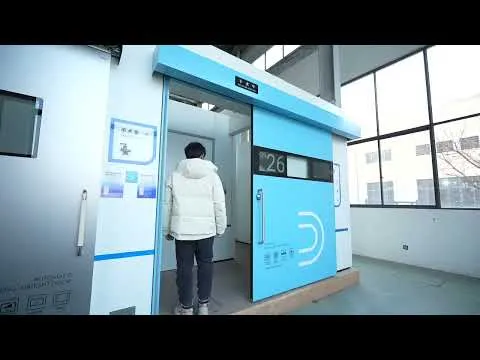
Automatic and manual cleanroom door systems are supplied to fit your specifications in terms of materials, sealing, and control interfaces, with their suitability determined during installation, commissioning and qualification of the systems.
Door Selection as a cleanroom design Factor
Cleanroom access doors serve a bigger purpose than just blocking one area off from another. Characteristic features of cleanroom doors impact differential pressure, the flow of air, as well as contamination avoidance from increased contact points.
Picking between a manual door and an automatic cleanroom door is a matter of balancing the initial investment and ongoing operational costs with contact risks and repair difficulties.
Before comparing drive types, keep one principle in mind: compare like-for-like configurations.
- Remember that when comparing the automatic and manual cleanroom door options you should compare like-for-like systems.
- To ACHieve an accurate comparison of automatic and manual solutions, avoid changes in doors size, materials and seals, and conditions of service.
Swings and sliding doors differ when it comes to disturbance in functioning of the door, meaning that you cannot blame automation for all the issues in doors functioning.
Core Metric Comparison
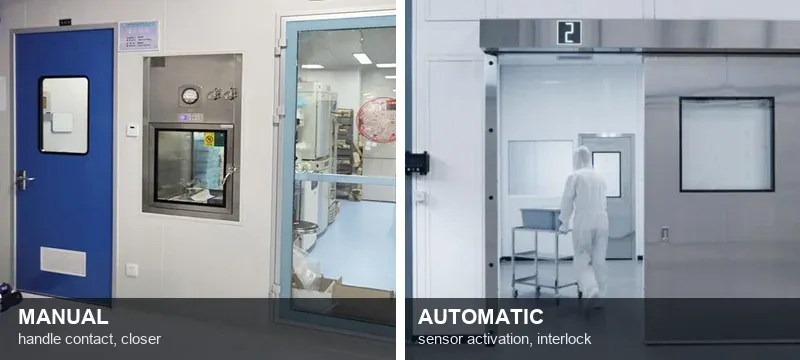
There are three primary dimensions that delineate between the manual and automatic cleanroom door. These include capital and lifecycle cost, hygiene risk profile, and passage throughput.
| Metric | Manual cleanroom door | Automatic cleanroom door |
|---|---|---|
| Initial procurement & installation cost | Lower baseline | Higher, driven by drive, controls and safety hardware |
| Hygiene contact profile | Regular handle contact required | Reduced direct contact via sensor activation |
| Passage throughput potential | Limited by manual operation speed | Higher, consistent cycle times |
| Maintenance demand | Lower, mostly hardware inspection | Higher, includes electrical and sensor calibration |
Initial procurement & installation cost
Manual: Lower baseline
Automatic: Higher, driven by drive, controls and safety hardware
Hygiene contact profile
Manual: Regular handle contact required
Automatic: Reduced direct contact via sensor activation
Passage throughput potential
Manual: Limited by manual operation speed
Automatic: Higher, consistent cycle times
Maintenance demand
Manual: Lower, mostly hardware inspection
Automatic: Higher, includes electrical and sensor calibration
Cost and performance vary not just for type of door but also size, how seals are constructed, interlock requirements, safety sensors, site work and service conditions in the relevant area. This table provides only rough estimates and not a quotation or performance guarantee of any kind.
How throughput is actually measured
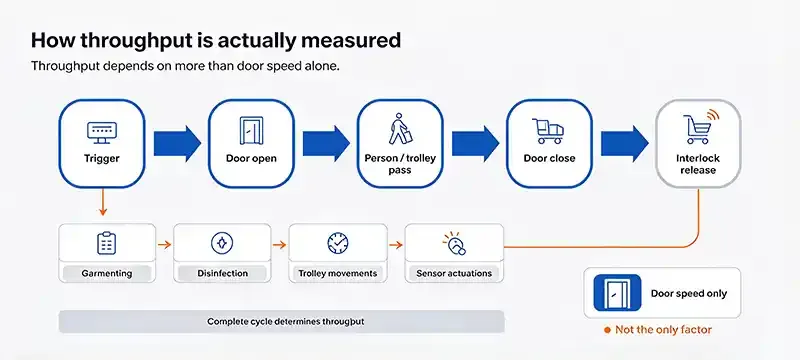
Throughput depends on more than door speed alone. A full passage cycle includes:
Trigger → Door open → Person / trolley pass → Door close → Interlock release / next passage permission
Airlock throughput gets bottlenecked by garmenting procedures, disinfection steps, trolley movements and several actuations by the sensors, and not just with the operation of the door.
Total Cost of Ownership: Beyond Initial Price
The purchase cost is merely a small part of total cost of ownership. TCO analysis includes the following aspects:
| Cost category | Included items |
|---|---|
| Capital expenditure | Door panel, drive unit, safety sensors, interlock system, power wiring, installation, control integration |
| Commissioning & qualification | Adjustment, function testing, project-specific qualification activities |
| Operation & maintenance | Drive power consumption, scheduled maintenance, spare parts, seal replacement, service labour |
| Operational impact | Queue time, downtime during failure, isolation during maintenance, production recovery time |
Capital expenditure
Door panel, drive unit, safety sensors, interlock system, power wiring, installation, control integration
Commissioning & qualification
Adjustment, function testing, project-specific qualification activities
Operation & maintenance
Drive power consumption, scheduled maintenance, spare parts, seal replacement, service labour
Operational impact
Queue time, downtime during failure, isolation during maintenance, production recovery time
Basic TCO formula for evaluation period:
TCO over evaluation period = Capital expenditure + Total O&M cost over period + Downtime & disruption cost
Simple payback period, if net annual benefit is positive:
Simple payback = Additional investment of automatic option / Annual net benefit
Note: The time savings attributed to the use of the technology should not be thought of in terms of monetary savings in labour cost. Do not express the same gains in different categories.
TCO Simple Payback Calculator
Enter your project figures to compare manual vs automatic door total cost of ownership. All values are optional; leave blank if unknown.
Additional capital investment:
Annual O&M difference:
TCO difference over evaluation period:
Simple payback period:
Note:It should also be noted that this is a high-level estimation tool and the results do not consider the costs associated with down time, commissioning, qualification, or disposal cost.
Cleanroom Door Automation: Logic & Impact
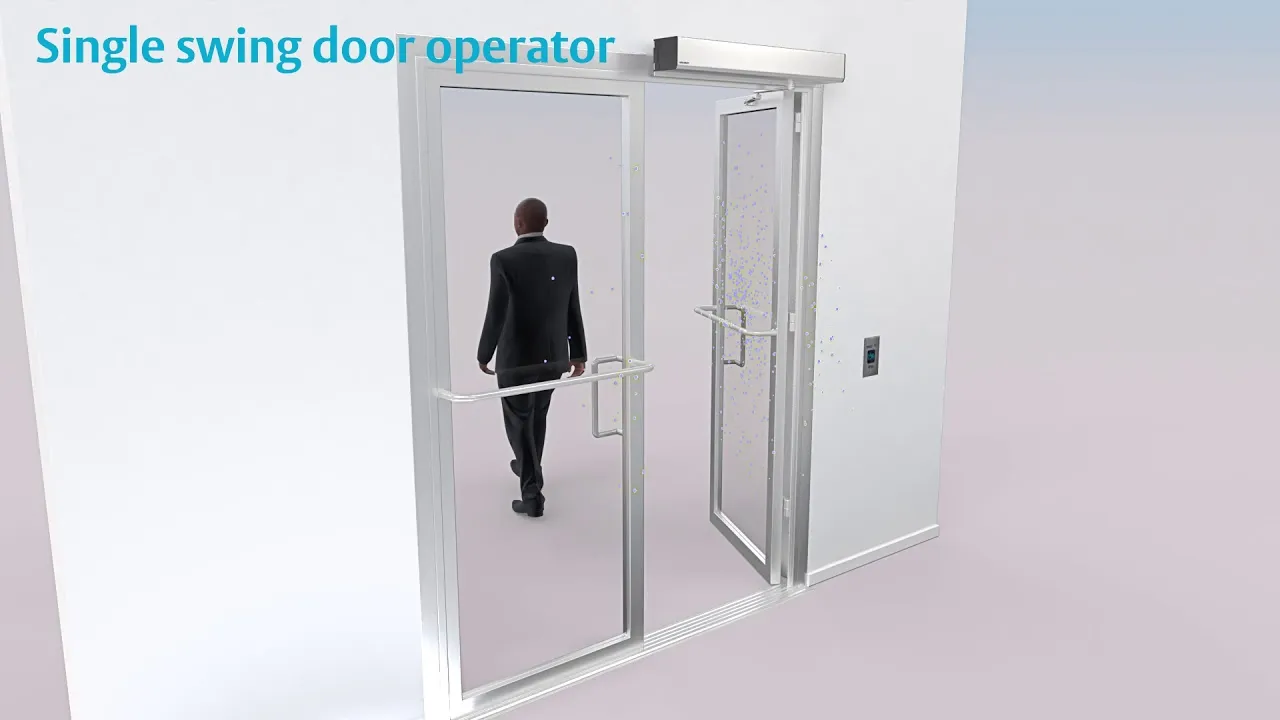
Cleanroom door automation ensures consistent sequences for door opening and closing. However, automation cannot by itself guarantee GMP compliance or pressure control.
Core control functions typically include:
- Activation: Typical activation methods include radar detection, and infrared curtain, foot pedal and card reader access.
- Interlock sequence: According to the interlocking principle, in airlock applications the second door is only allowed to open after the first door is completely closed.
- Safety functions: These include hysteresis, pinch detection, reverse motion obstruction, and emergency release.
Pressure changes during door actuation occur because of various factors such as size of the door, the movement speed and acceleration, the value of differential pressure established, the airlock volume capacity, and the HVAC operation. Moreover, it should be noted that the motor size alone does not indicate the size of the pressure wave.HVAC system response. Motor size alone does not determine the magnitude of the pressure spike.
Key parameters to verify during commissioning:
- Static pressure with the door sealed
- Minimum differential pressure during the opening process
- Period of time when the pressure is below the project parameters
- Recovery time after door closes
- Time it takes for the pressure value to come back to normal after the door being closed
Failures on this parameter happen due to specifying the speed of doors without analysis of air displacement and pressure drop in relation to HVAC operations.
Decision Framework: Scenario Based Selection
- Automation describes how the door moves.
- Interlock describes whether two doors can open at the same time.
- Access control describes who is allowed to pass.
Separate writing of each of these three functions and separate testing in course of commissioning and acceptance process is essential.
Simply cleanliness class will not allow to determine type of door. The evaluation should take into account risks associated with the process, ways of personnel and material movement, pressure policy followed, ways of emergency exiting and maintenance conditions.
| Application condition | Options to evaluate | Points to verify |
|---|---|---|
| Low-frequency personnel passage | Manual door + appropriate door closer | Sealing performance, closing reliability, cleaning procedure, operation workflow |
| Trolley or hands-free passage | Automatic door or assisted opening solution | Clear opening width, sensor coverage, anti-pinch protection, actual cycle time |
| Airlock requiring prevention of simultaneous opening | Manual or automatic doors + validated interlock system | Door position feedback, fault alarm, emergency release and recovery logic |
| Aseptic production related access | Selected per Contamination Control Strategy | Personnel/material flow separation, cleaning disinfection, airflow and pressure recovery |
| Dust or high-activity material zones | Designed separately per containment target | Negative pressure strategy, leakage control, operator protection |
Low-frequency personnel passage
Options: Manual door + appropriate door closer
Verify: Sealing performance, closing reliability, cleaning procedure, operation workflow
Trolley or hands-free passage
Options: Automatic door or assisted opening solution
Verify: Clear opening width, sensor coverage, anti-pinch protection, actual cycle time
Airlock requiring prevention of simultaneous opening
Options: Manual or automatic doors + validated interlock system
Verify: Door position feedback, fault alarm, emergency release and recovery logic
Aseptic production related access
Options: Selected per contamination control strategy
Verify: Personnel/material flow separation, cleaning disinfection, airflow and pressure recovery
Dust or high-activity material zones
Options: Designed separately per containment target
Verify: Negative pressure strategy, leakage control, operator protection
Application Scene Matching
As the zones of cleanrooms will have very different hygiene requirements, traffic and material handling characteristics door fittings should correspond to that situation rather than to introduce general requirements for all cases.ACH scenario rather than applying uniform specifications site-wide.
Pharmaceutical Weighing & dispensing rooms
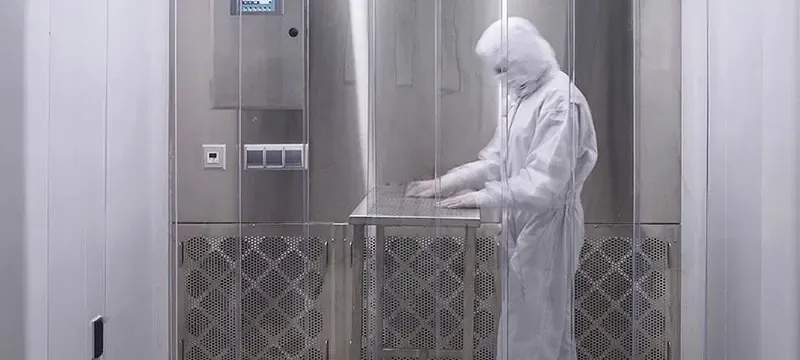
Popular locations have a low volume of personnel flow, but high requirements for hygiene. The manual cleanroom door, used in conjunction with appropriate disinfection procedures, will generally suffice.
In high-grade projects, the use of lightweight automatic sliding doors may be specified to minimize touching surfaces even further. The most important thing is that the panels should be easy to clean and feature strict sealing along the perimeter.
Large Logistics Transfer Openings & Cargo Airlocks
When there is heavy usage of forks and trolleys, high-speed options of automatic doors are generally the mode of choice.
When selecting the opening speed of the door account has to be made of the door type, type of vehicle and risk assessment. A high speed would result in better hygiene levels, but with higher risks of mechanical faults.
Laboratory Buffer Zones & Personnel Airlocks
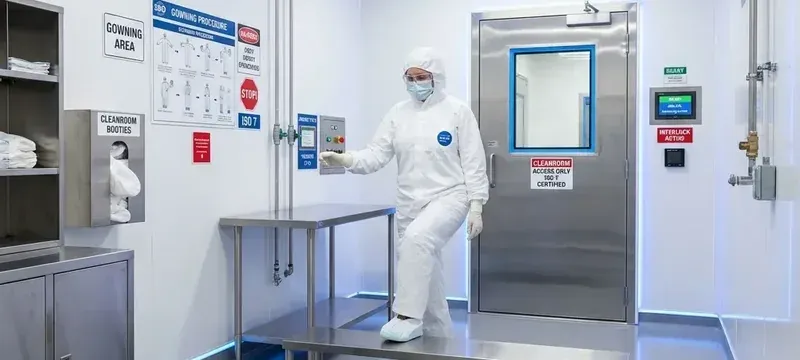
Personnel garment pass-through points should be considered. They are fundamental for contamination control.
Interlocking is generally needed for classified air locks, while an automatic system will make the operation easier for the staff carrying their goods.
Hygiene Performance & Cleanability
While touchless operation minimizes contact transmission risk, the level of cleanliness achieved is determined by more than the type of drive used.
| Factor | Manual door | Automatic door |
|---|---|---|
| Hand contact points | More frequent direct handle contact | Reduced, but still present at emergency devices |
| Surface & crevice complexity | Simpler construction, fewer hidden gaps | Tracks, covers, sensors and seals may add hard-to-clean areas |
| Disinfectant compatibility | Requires verification per material | Requires verification per material, sensor and seal |
Hand contact points
Manual: More frequent direct handle contact
Automatic: Reduced, but still present at emergency devices
Surface & crevice complexity
Manual: Simpler construction, fewer hidden gaps
Automatic: Tracks, covers, sensors and seals may add hard-to-clean areas
Disinfectant compatibility
Manual: Requires verification per material
Automatic: Requires verification per material, sensor and seal
Procurement checkpoints for cleanability:
- Factors such as the presence of difficult-to-clean bottom tracks or grooves.
- The accessibility of the drive housing for cleaning and inspection purposes.
- Whether the door panels and seals are suitable for site sanitizers.
- The levels of particles generated during normal operation as well as wear levels.
- The need to re-clean the site and recover the environment after maintenance work has been carried out.
Common Myth
Myth: Automatic doors without touch are superior in hygiene compared to manual doors.
Reality: The use of touch-free doors will minimize one type of transmission risk. However, the overall level of hygiene depends on additional factors such as cleanroom design, cleaning method used, material compatibility, and maintenance of the door.
According to iso 14644-4:2022, contamination control is based on several factors working together and not on just one hardware component.
Failure, Emergency & Maintenance Considerations
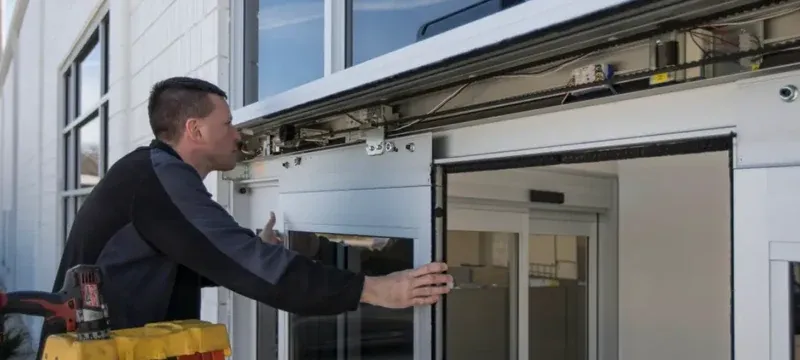
Automatic door systems add operational complexity. Verify the following points during specification and acceptance:
| Situation | Must be confirmed at selection / FAT / SAT |
|---|---|
| Power failure | Door position on power loss, manual operation method, UPS backup if required |
| Fire & evacuation | Coordination with local fire code and evacuation requirements |
| Personnel entrapment | Emergency release method, alarm, authorisation level, reset procedure |
| Sensor failure | Safe stop logic, fault indication and recovery workflow |
| Door not fully closed | Interlock inhibit behaviour, alarm signal and escalation |
| Maintenance work | Energy isolation method, protection against unexpected movement |
| Spare parts lead time | Critical part availability and temporary workaround solution |
Power failure
Confirm: Door position on power loss, manual operation method, UPS backup if required
Fire & evacuation
Confirm: Coordination with local fire code and evacuation requirements
Personnel entrapment
Confirm: Emergency release method, alarm, authorisation level, reset procedure
Sensor failure
Confirm: Safe stop logic, fault indication and recovery workflow
Door not fully closed
Confirm: Interlock inhibit behaviour, alarm signal and escalation
Maintenance work
Confirm: Energy isolation method, protection against unexpected movement
Spare parts lead time
Confirm: Critical part availability and temporary workaround solution
Retrofit Evaluation Example
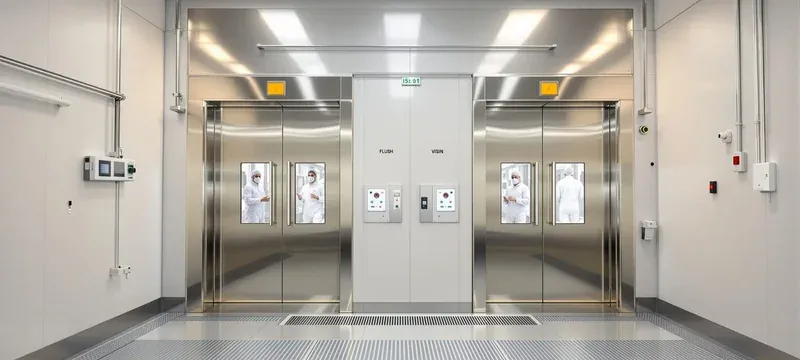
Automatic door installations increase complexity. Make sure to review these guidelines during the spec and acceptance phases:
This example is just for illustration, not to be taken as a record of a project already undertaken. This considers a typical iso class 7 production area upgrade where original manual doors are coming out, being replaced with interlocking automatic sliding doors in personnel access points and high-speed rolling doors at material transfer points.
Increased throughput, consistent interlock sequence and shorter opening times is what you expect to achieve.
Real pressure stability, particle size and throughput changes depend on baseline conditions, accompanying HVAC modifications and operational procedures.
Frequently Asked Questions
Q: Which is better for GMP settings, the manual or automatic cleanroom door?
A: There is no definitive answer to this question. Automatic and manual cleanroom doors can be used in low-traffic areas, such as clean weighing rooms, as long as they are specified correctly. With regards to airlocks, the interlock must be validated, regardless of whether the door is automatic or manual.
Q: Do automated doors create pressure differentials?
A: Opening any door causes a temporary disruption in pressure, regardless of the type of opening mechanism. The amount of pressure changes depends on the size of the door, the speed of opening, the amount of air moved, and the efficiency of the HVAC system. While proper sequence and airlock system design will mitigate some of the problems, it will never eliminate them completely.
Q: What are the main issues with maintaining automatic doors?
A: The major issues associated with keeping automatic doors operational include regular calibration of the door opening mechanism and sensors, and replacement of the working elements, such as seals and rollers. It is also essential to provide access to maintenance, which is often overlooked.
Q: When should manual doors be chosen over automatic doors?
A: Manual doors should be selected when funding is limited and the expected usage rates are low or if there are secondary auxiliary zones in the cleanroom environment where interlocks are not needed. Manual doors can sometimes also be fitted with closers and switches.
Q: How to determine the financial benefits of automation of cleanroom doors?
A: The TCO model should be used to identify the operating costs and capital expenses of this technology while also calculating the savings that arises from shortened manual operation time, better air exchange and more efficient logistics.
References
- ISO 14644-4:2022, cleanrooms and associated controlled environments — Part 4: Design, construction and start-up, https://www.iso.org/standard/77688.html
- EU GMP Annex 1: Manufacture of Sterile Medicinal Products (2022), https://health.ec.europa.eu/
- GB 50457-2019, Code for design of pharmaceutical industry clean rooms
- iso 14644-1:2015, Cleanrooms and associated controlled environments — Part 1: Classification of air cleanliness by particle concentration, https://www.iso.org/standard/61251.html
- iso 14698-1:2003, Cleanrooms and associated controlled environments — Biocontamination control — Part 1: General principles and methods, https://www.iso.org/standard/34229.html