+86 13638632902
 Jason@cleanroomequips.com


 MENU

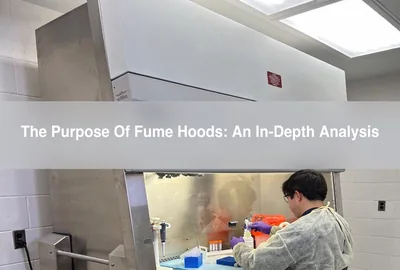
What are the functions of fume hoods? Their task is to capture harmful fumes and vapors as well as particulate matter before the workers inhale them. Here is the briefest answer.
The present article elucidates the operation of fume hoods and their different applications as well as their general principle of operation and validation. It also considers the advantages of cleanroom fume hoods and their performance in industrial establishments.
Fume hoods are used in controlled areas such as cleanrooms according to GMP (Good Manufacturing Practice) requirements and industrial laboratories. The fume hood function is explained through personnel protection and the maintenance of process integrity.
Therefore, it is important to know what do fume hoods do for process integrity in order to accomplish GMP requirements. Various companies can face problems connected with unaccomplished GMP audits or the risk of an operator being harmed due to misunderstood functions of fume hoods.
The following guide uses Deiiang knowledge gained over 15+ years in cleanroom airflow designing.
Jf9bTeIj354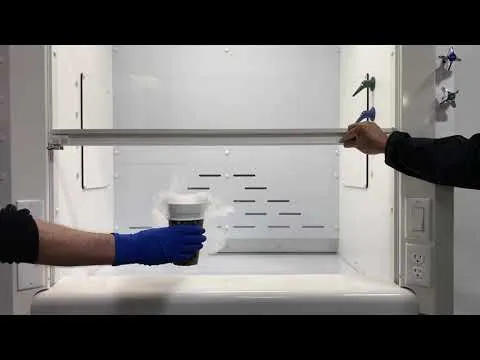
Core Fume Hood Function and Primary Purpose
The main fume hood function lies in containing and enclosing the work area. Air is sucked in by means of the fan. Effectively, air moves from the exterior environment into the workspace.
Therefore, fume hoods protect both the people and the samples used during the work process. The purpose of fume hoods covers people, samples, and the facility itself, in that order of priority.
What Do Fume Hoods Do: Core Operational Definition
What do fume hoods do? They work as primary containment devices. The velocity at which air flows via the sash opening is termed the face velocity, and it is the main parameter of performance concerning hood containment.
Apart from the face velocity, the presence of items in the work area and quick hand movements may also impact the effectiveness of capture. A cluttered bench can cut capture efficiency noticeably even when the face velocity looks correct.
The hood does not preserve any chemicals but just continuously eliminates toxic air contaminants. Capture efficiency here depends on face velocity, sash height, and baffle profile.
The face velocity of fume hoods is quite stable, typically spanning between 0.4 and 0.6 m/s [1]. If the face velocity falls short of the 0.4 m/s minimum level, the containment fails.
The Deiiang pressure sensor transmits the differential pressure between the hood interior and the surrounding air, which is instantly revealed to the control system. The PLC then adjusts the dampers to sustain the setpoint face velocity as filter resistance rises.
Core Purpose of Fume Hoods in Regulated Settings
There are four main fume hood uses in regulated environments. EACH of these four purposes imposes certain requirements, and each carries a compliance consequence.
- Prevent exposure to toxic vapors — reduces occupational illness risk and meets OSHA permissible exposure limits [5].
- Control product contamination — protects sample integrity and supports batch release decisions.
- Meet facility environmental emission limits — avoids permit violations and community exposure complaints.
- Reinforce process safety — limits flammable vapor accumulation that can cause fire or explosion [6].
How Do Fume Hoods Work: Operational Mechanics
ITbJpmIk6Bs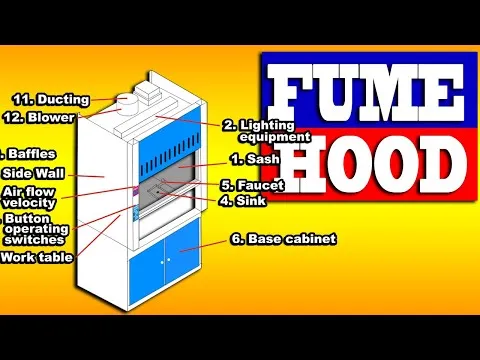
How do fume hoods work? They make use of negative pressure as well. The fan on the hood pulls the air out of the hood, thus creating the necessary negative pressure inside it, which makes air come into it from the room.
Two types of fume hoods exist: ducted ones that eliminate the contaminated air outside. Ductless hoods purify the air in the room and are designed to operate with low-risk and low-volume applications only.
Face velocity control keeps the barrier in place. The position of the sash regulates the amount of available space, so a lower sash height reduces exhaust volume and saves energy. Ductless hoods utilize either a HEPA or a carbon filter.
Airflow Dynamics and Containment Mechanism
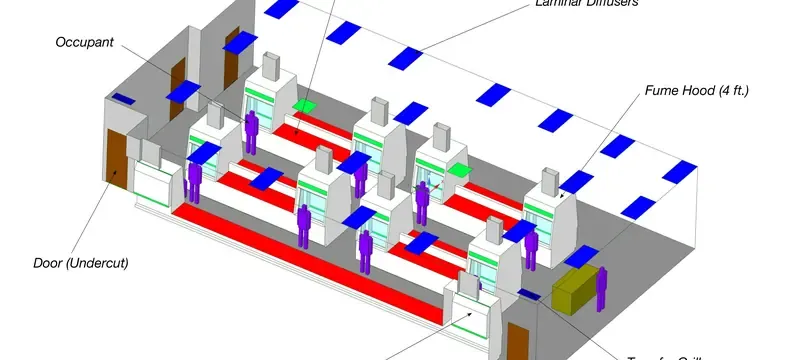
The workspace remains under negative pressure, with air entering through the sash port. The velocity of air equals 0.4–0.6 m/s for the standard hoods. Overall, the airflow acts like a moving barrier.
The pressure difference principle regulates the performance of the hood at -5 to -10 Pa compared with room pressure [7]. Below -5 Pa, fumes can spill into the room during normal operation. Above -10 Pa, excessive airflow wastes energy and creates turbulence that breaks containment.
As soon as the fan in the exhaust system stops working, the backdraft damper closes. Deiiang produces such dampers with a leakage rate not exceeding 0.5% per JB/T 7228-94 [13].
This <0.5% leakage rate means minimal contaminated air escapes during a power failure, meeting the duct tightness requirements of GB 50243-2016 [11].
Field-test quick-check instrument:
Formula: Face velocity (m/s) = Airflow rate (m³/s) ÷ Sash opening area (m²)
Example: 0.3 m³/s exhaust airflow ÷ 0.6 m² sash opening area = 0.5 m/s face velocity
Formula: Face velocity (m/s) = Airflow rate (m³/s) ÷ Sash opening area (m²)
Example: 0.3 m³/s exhaust airflow ÷ 0.6 m² sash opening area = 0.5 m/s face velocity
Exhaust and Filtration Flow Path
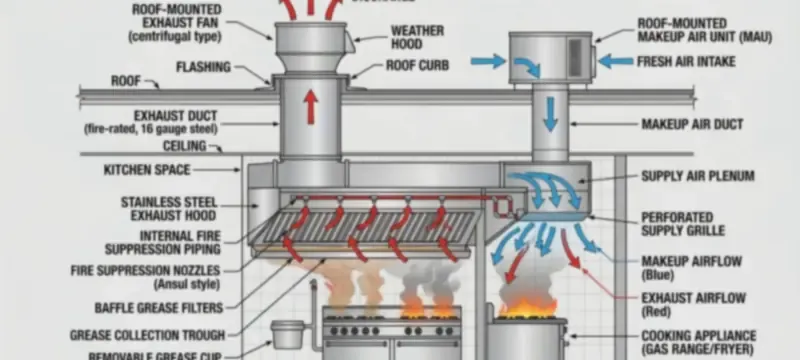
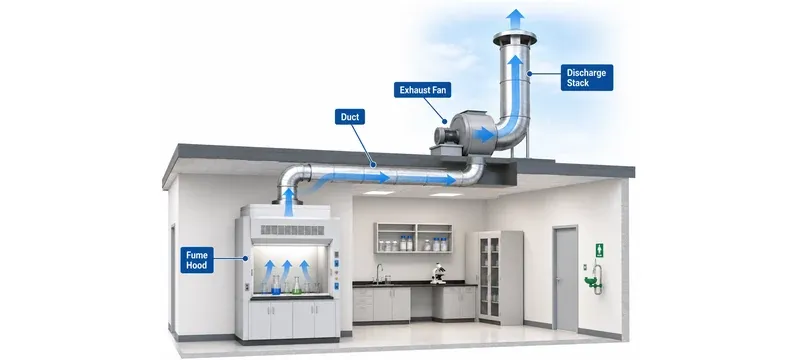
- Air is drawn through the sash opening — the inward flow creates the containment barrier at 0.4–0.6 m/s.
- Fumes are captured in the work zone — the baffle system redirects heavier and lighter fumes to the exhaust opening.
- Air passes through a HEPA or carbon filter — HEPA captures 99.97% of 0.3 µm particles, while carbon adsorbs organic vapors.
- Filtered air is discharged to a safe location in the external environment — a stack is situated above the roofline.
Fume Hood Uses Across Laboratory and Industrial Settings
Fume hoods serve the primary function of chemical handling in a laboratory environment. In contrast, industrial fume hoods are responsible for batch processing systems or electronics. Even though both types offer the same containment principles, they differ in the volume of materials processed and in the way they are constructed.
While the regular laboratory hood can exhaust around 0.3-0.6 m³/s, the industrial one can exhaust up to 2 m³/s. In the table below, the characteristics of both types of equipment are analyzed.
Laboratory Fume Hood Purpose and Common Use Cases
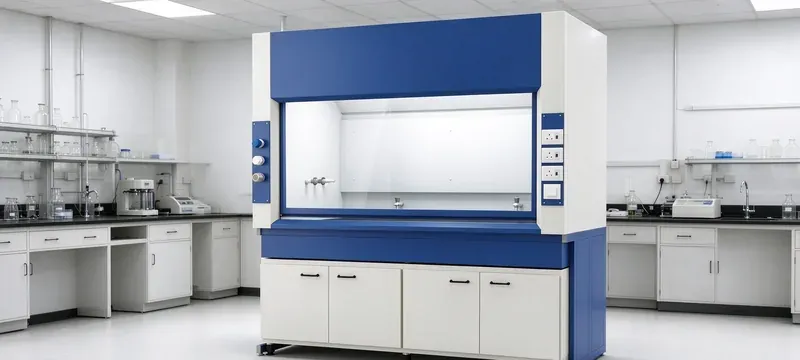
The design of the fume hood must be developed in accordance with the demanded function. The laboratory fume hood purpose therefore varies with the task.
- Chemical reagent handling (acids, solvents) — requires corrosion-resistant PVC linings and activated carbon filtration.
- Sample preparation — requires a work surface resistant to stains and a low working sash position.
- Testing hazardous materials — requires continuous airflow monitoring and audible alarms.
- USP compounding — requires iso class 5 air quality and documented particulate control [3].
Industrial Fume Hood Applications in Manufacturing
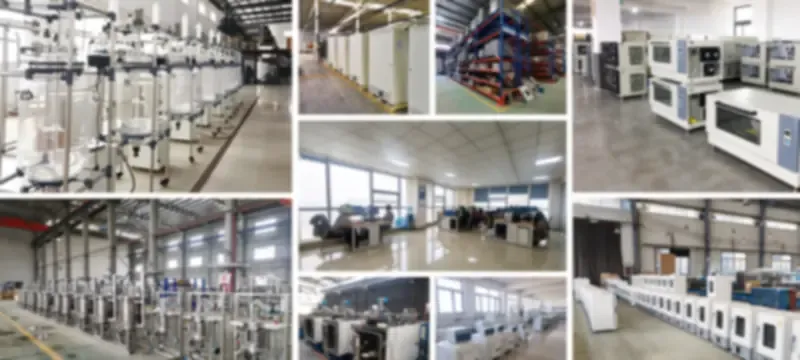
Some of the industrial fume hood applications include pharmaceutical batch manufacturing and electronic chip etching. Cosmetic production demands the use of volatile oils and powders, while battery work requires control over lithium dust and solvent vapors.
As stated in Jason Peng's 15-year experience at Deiiang, the wafer etching hood is fitted with PTFE lining and separate acid-gas filtration responsible for hydrofluoric acid containment.
These procedures are generally conducted continuously, with a requirement for constant monitoring of face velocity and alarms. A drop below 0.4 m/s can release hazardous vapors into the operator zone.
Using oversized exhaust fans is a typical design blunder that causes high energy bills and internal turbulence, which in turn lowers containment efficiency.
Laboratory vs Industrial Fume Hood Use Comparison
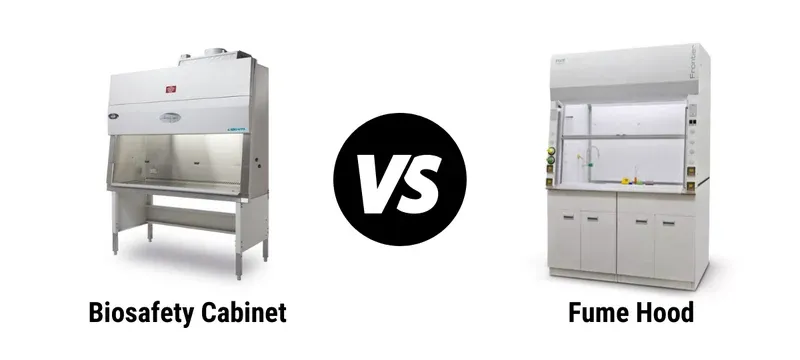
Table 1: Laboratory vs industrial fume hood use comparison
| Setting | Degree of Containment | Airflow Rate | Compliance Standards | Standard Construction | Typical Operations |
|---|---|---|---|---|---|
| Laboratory | Primary, low to moderate hazard | 0.3-0.6 m³/s | EN 14175 [1], OSHA 1910.1450 [5], ANSI/AIHA Z9.5 [4] | Epoxy worktop, PVC or polypropylene lining | Reagent preparation, sample testing |
| Industrial | Primary, high hazard | 1.0-3.0 m³/s | NFPA 45 [6], ANSI/ASHRAE 62.1 [10], GB 50019 [12] | SUS304 or PTFE lining, heavy steel frame | Batch processing, wafer etching |
| Setting | Airflow Rate | Typical Operations |
|---|---|---|
| Laboratory | 0.3-0.6 m³/s | Reagent preparation, sample testing |
| Industrial | 1.0-3.0 m³/s | Batch processing, wafer etching |
Cleanroom Fume Hood Benefits for GMP-Compliant Facilities
The standard laboratory fume hood was not intended for the control of particulate emissions to the surrounding environment, and therefore it may compromise cleanroom classification levels.
Cleanroom fume hood benefits start with iso 14644 compliance [7]. Deiiang provides exhaust and filtration engineering for these hoods, including H14 HEPA filters and differential pressure transmitters.
It is crucial to be aware of what do fume hoods do in the context of process integrity, which is necessary for GMP compliance. The aim is to preserve cleanroom class while purging fumes. Cleanroom fume hood benefits also include audit readiness in line with EU GMP Annex 1 requirements.
Core Cleanroom Fume Hood Benefits for Controlled Environments

- Maintains iso class 5-8 cleanroom classification — cleanroom hoods restrict particle release to <100 particles/m³ against up to 10,000 particles/m³ in standard models, per ISO 14644-1 [7].
- Protects sterile products — mitigates contamination risk in sterile dispensary processes.
- Reduces personnel contamination risk — directed airflow minimizes the escape of particles shed by the worker.
- Supports audit compliance — airflow logs and alarm records allow an inspector to verify compliance.
Deiiang Cleanroom Fume Hood Specification Benchmark
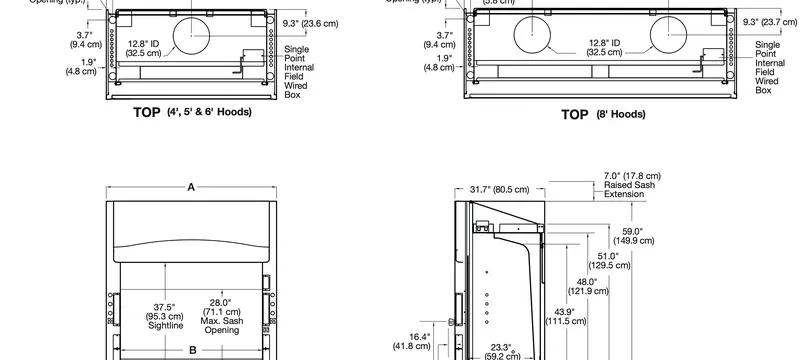
The following are Deiiang 2026 catalogue specifications for cleanroom fume hood supporting hardware. Note that Deiiang is not a fume hood manufacturer; it supplies the containment, exhaust, filtration, and monitoring components a hood depends on.
- ISO Class 5 compatible H14 HEPA filter: 99.995% efficiency at 0.3 µm [8].
- SUS304 construction for the airflow regulator and housing.
- Adjustable face velocity from 0.3 to 0.7 m/s.
- CCY11 differential pressure transmitter: 0.25% FS accuracy over -100 to 100 kPa.
Current industry models can only provide 0.5% FS precision. The CCY11 from Deiiang can achieve 0.25% FS for tighter process control.
Critical Fume Hood Safety Features for Regulatory Compliance
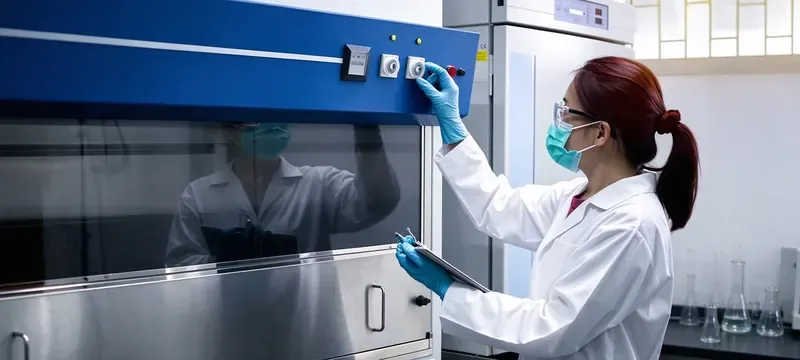
The fume hood safety features are able to protect the operators in case of airflow failure. An airflow monitor shows the actual face velocity. The sash position limiter prevents the sash from opening too much. An audible signal is used when the velocity drops below 0.4 m/s.
Fire protection in a fume hood consists of non-flammable protective materials and fire dampers [6]. A system of shut-off valves is included and works in case of airflow failure.
Mandatory Fume Hood Safety Features per GMP Standards
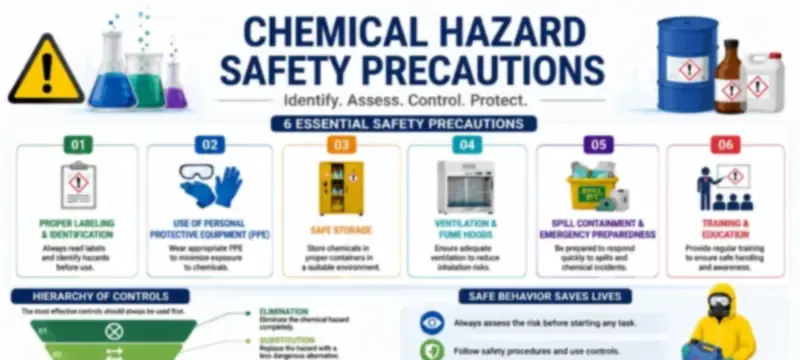
Each item below carries a regulatory purpose and a failure consequence.
- Constant face velocity control (±10% of setpoint) — required by EN 14175 [1] to guarantee consistent containment performance.
- Low airflow visual and audible alarm — notifies users of events that might lead to their exposure.
- Sash height limit switch — ensures the sash does not open beyond the validated containment envelope.
- Exhaust pressure sensor (4-20 mA output) — sends the signal for both alarm and interlock logic.
- Emergency purge function — eliminates a sudden vapor release within seconds.
Safety Feature Alignment with Global Regulations
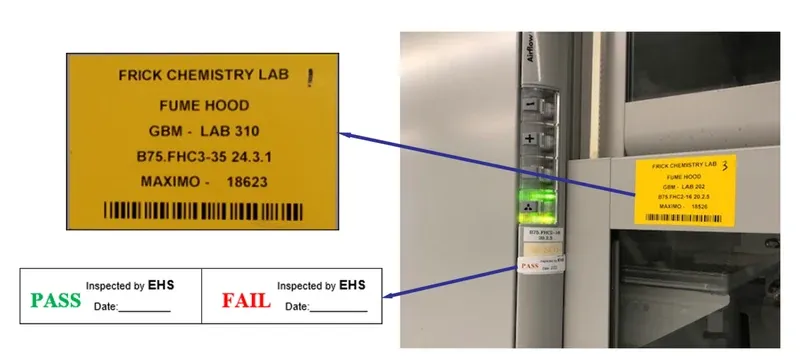
The requirement of FDA 21 CFR 211 is that alarm monitoring be documented, which is enabled by Deiiang CCY11 transmitters. According to iso 14644-3, the methods of testing airflow and recovery are provided [7]. PIC/S GMP audits expect documentation of the tests conducted.
The Deiiang 2024 university laboratory project included six ducted hoods connected to a single roof fan, all equipped with backdraft dampers, CAV valves, and silencers. Project-reported results confirmed that airflow was maintained within ±3% of the values set in advance after installation.
A reduction of the operator's noise of 8 dB(A) was also reported. The alarm indicating low flow had been tripped before the face velocity fell outside the established range. Such results are project-reported and not guaranteed.
Fume Hood Validation and Maintenance Best Practices
Validation processes confirm that the hood performs according to its design. Initial validation is performed after the hood has been set up. Further testing is performed regularly. The aspects most often ignored are filter loading and sash drift.
Maintenance frequency depends on usage. High-use hoods should have maintenance performed once every three months, instead of only once a year for low-use hoods. The same rule should be applied to filter replacement.
For average laboratory usage, filters must be replaced every 12–24 months, while heavy acid industrial usage requires replacement every 6–12 months. Filters must be replaced when the pressure rises 50 Pa above the baseline level.
According to laboratory test reports from Deiiang, a rise of 50 Pa in the resistance of the filter leads to a decrease of 0.05 m/s in face velocity for a standard 1.2 m wide fume hood.
GMP-Compliant Fume Hood Validation Protocol
Each step contains acceptance criteria.
- Face velocity measurement (0.4-0.6 m/s) — passes if nine readings fall within ±10% of the setpoint value, per EN 14175 [1].
- Smoke pattern containment test — passes if smoke does not escape the sash plane, per ASHRAE 110 [2].
- Filter leak test — passes if the downstream scan shows no leak exceeding 0.01% of the challenge concentration [8].
- Alarm function verification — passes if the alarm activates within five seconds of simulated low flow.
Based on Deiiang experience in field validation, one should test the face velocity at the sash heights where operators actually use the hood every day, rather than only at the maximum opening.
Quarterly GMP maintenance checklist:
Verify the audible and visible functions of the low airflow alarm, and record the result in the calibration log.
Inspect the sash seals and baffles, and document any damage in the maintenance log.
Record the differential pressure of the filter and trend the reading for change control.
Calibrate the face velocity sensor and keep the certificate for audit review.
Common Fume Hood Performance Misconceptions

Table 2: Myth and fact of fume hood performance
| Myth | Fact |
|---|---|
| It is better for performance to have higher airflow. | The optimum velocity is 0.5 m/s; excessive airflow causes turbulence that weakens containment. |
| All types of hoods are suitable for cleanrooms. | Cleanroom hoods must meet iso 14644 and EU GMP Annex 1 requirements [7]. |
| The purpose of a fume hood is to protect the specimen. | A fume hood protects the operator; a biosafety cabinet protects both user and specimen. |
| Ductless hoods are universal and work with any chemical. | Ductless hoods only suit low-toxicity substances; they cannot contain carcinogens. |
| Having the sash fully open ensures safety. | Full opening can drop velocity below 0.4 m/s, which breaks containment. |
| Myth | Fact |
|---|---|
| It is better for performance to have higher airflow. | The optimum velocity is 0.5 m/s; excessive airflow causes turbulence that weakens containment. |
| All types of hoods are suitable for cleanrooms. | Cleanroom hoods must meet ISO 14644 and EU GMP Annex 1 requirements [7]. |
| The purpose of a fume hood is to protect the specimen. | A fume hood protects the operator; a biosafety cabinet protects both user and specimen. |
| Ductless hoods are universal and work with any chemical. | Ductless hoods only suit low-toxicity substances; they cannot contain carcinogens. |
| Having the sash fully open ensures safety. | Full opening can drop velocity below 0.4 m/s, which breaks containment. |
Frequently Asked Questions
What is the main purpose of a fume hood in a laboratory?
The primary function of a fume hood is to ensure the safety of the staff working in the laboratory. It captures the toxic gases and keeps the breathing area clean. Secondary functions relate to the safety of the samples and the laboratory in general.
How does a fume hood create a safe work zone?
It creates negative pressure inside the fume hood. Air enters the hood at 0.4–0.6 m/s, creating a barrier against escaping gases. Further details are found in the mechanics section.
Can standard fume hoods be used in iso 5 cleanrooms?
No, they cannot. Standard hoods are not meant for dealing with particulate matter, so they cannot be used in iso 5 cleanrooms. Cleanrooms require special hoods suitable for ISO Class 5 operation with an H14 HEPA filtration system.
What safety features are required for GMP-grade fume hoods?
Such fume hood safety features as consistent face velocity control, low airflow alarm, sash limit switch, and exhaust pressure sensing should be applied, as mentioned in FDA regulations. See the safety features section for the full list.
What is the acceptable face velocity range for fume hoods?
The normal range of face velocity is considered to vary from 0.4–0.6 m/s. Up to 0.3–0.7 m/s adjustable velocity is possible in the case of cleanroom fume hoods [1].
What industrial processes rely on fume hood containment?
Main processes where fume hoods are used include the production of pharmaceutical products, etching of electronic wafers, creation of cosmetic products, and handling of battery materials. See the industrial fume hood applications section for more.
References
- [1] EN 14175, fume cupboards, parts 1-7. The link directs to the CEN catalogue where the standard can be located: https://standards.iteh.ai/catalog/standards/cen/
- [2] ASHRAE 110, Method of testing performance of laboratory fume hoods.
- [3] SEFA 1, Laboratory fume hoods.
- [4] ANSI/AIHA Z9.5, Laboratory ventilation.
- [5] OSHA 29 CFR 1910.1450, Occupational exposure to hazardous chemicals in laboratories.
- [6] NFPA 45, Fire protection for laboratories using chemicals.
- [7] ISO 14644-1 and ISO 14644-3, Cleanrooms and associated controlled environments.
- [8] EN 1822 / ISO 29463, High-efficiency air filters (HEPA and ULPA).
- [9] ISO 16890, Air filters for general ventilation.
- [10] ANSI/ASHRAE 62.1, Ventilation for acceptable indoor air quality.
- [11] GB 50243-2016, Code for construction and acceptance of ventilation and air conditioning works.
- [12] GB 50019, Code for design of heating, ventilation and air conditioning.
- [13] JB/T 7228-94, Damper leakage classification.