+86 13638632902
 Jason@cleanroomequips.com


 MENU
MENU
Introduction: The Foundation of Cleanroom performance
Effective cleanroom air flow design in layout serves as the cornerstone of contamination control in sensitive environments. Without proper airflow management, even the most advanced filtration systems fail to protect products and processes. The strategic implementation of cleanroom air flow design in layout directly impacts product quality, regulatory compliance, and operational efficiency across pharmaceutical, Electronics, and healthcare facilities.
When planning your facility's contamination control strategy, the cleanroom air flow design in layout must be considered as the primary defense mechanism against particulate contamination. Deiiang™ specialists emphasize that successful cleanroom air flow design in layout integrates mechanical systems with operational workflows to create seamless protection. This comprehensive approACH to cleanroom air flow design in layout ensures that every aspect of your facility works in harmony to maintain the required cleanliness standards.
Video Demonstration: Cleanroom Airflow Patterns in Action
Dynamic visualization of laminar and turbulent airflow patterns in cleanroom environments
Part 1: Understanding Cleanroom Contamination and Airflow Control Principles
Successful cleanroom air flow design in layout begins with understanding contamination sources and control mechanisms. Contamination originates from both internal sources (personnel, equipment, materials) and external sources (environmental infiltration). The cleanroom air flow design in layout must address these through three primary control methods: dilution, removal, and isolation of contaminants.
Core Parameters & Standards
- cleanroom classification (iso 14644): Defines maximum allowable particle counts
- air changes Per Hour (ACH): Critical for contamination dilution
- Pressure Differential: Maintains directional airflow between zones
- Temperature & Humidity: Prevents condensation and static electricity
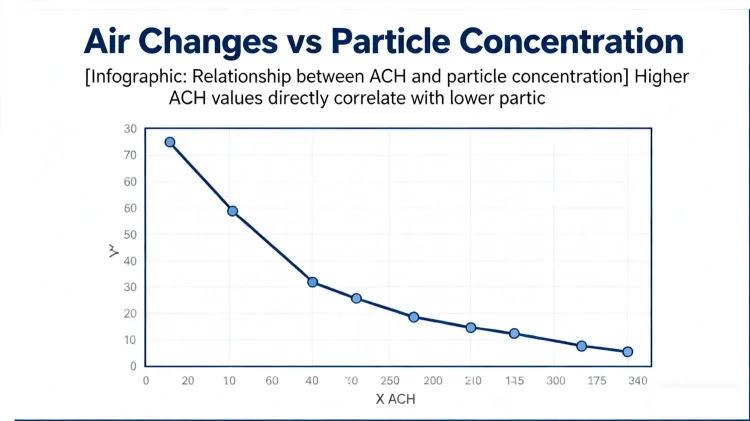
Higher ACH values directly correlate with lower particle counts
Quantifying Airflow Requirements
Proper cleanroom air flow design in layout requires precise calculation of air changes per hour (ACH). For example, an iso 7 cleanroom typically requires 30-70 ACH, while an iso 5 cleanroom may need 200-600 ACH. The formula for calculating ACH is:
ACH = (Total Airflow Rate in m³/h × 60) / Room Volume in m³
Deiiang™ engineers apply this formula with precision, ensuring that each cleanroom air flow design in layout meets both regulatory requirements and operational efficiency targets. For instance, a 100m³ ISO 7 Cleanroom requiring 50 ACH would need an airflow rate of approximately 83.3 m³/min.
Part 2: Cleanroom Airflow Pattern Types and Selection
The selection of appropriate airflow patterns represents a critical decision in cleanroom air flow design in layout. Different applications require specific airflow configurations to achieve optimal contamination control. Deiiang™ experts categorize these into three primary patterns, each with distinct characteristics and applications.
2.1 Unidirectional Flow (Laminar Flow)
Unidirectional flow, commonly known as laminar flow, provides the highest level of contamination control in cleanroom air flow design in layout. This system directs air in parallel streams at uniform velocity across the entire work area, effectively sweeping particles away from critical processes.
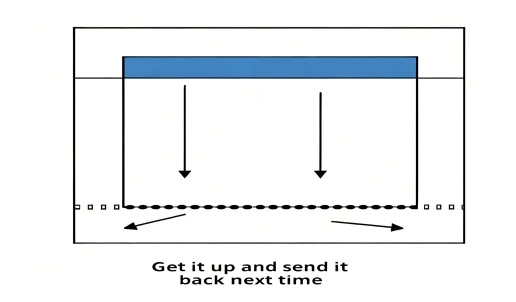
Vertical Laminar Flow: Air enters through ceiling, exits through floor
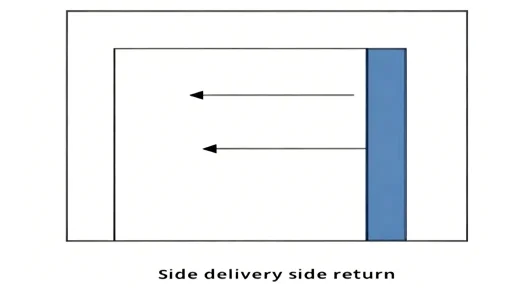
Horizontal Laminar Flow: Air enters through wall, exits through opposite wall
2.2 Non-Unidirectional Flow (Turbulent Flow)
Non-unidirectional flow, or turbulent flow, utilizes mixed air distribution to dilute contaminants through multiple air changes. This approach to cleanroom air flow design in layout offers cost-effective solutions for less critical environments while maintaining adequate contamination control.
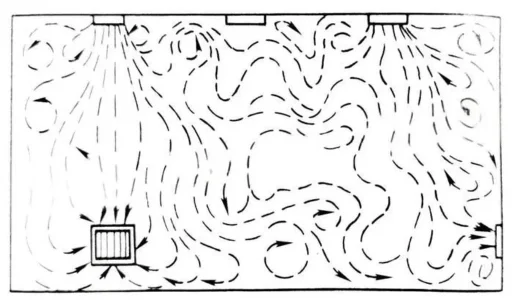
Turbulent Flow: Mixed air distribution with irregular patterns
2.3 Mixed Flow / Zoned Laminar Flow
Mixed flow systems combine the benefits of both unidirectional and non-unidirectional approaches in cleanroom air flow design in layout. This hybrid solution places laminar flow protection specifically where needed, optimizing both performance and cost efficiency.
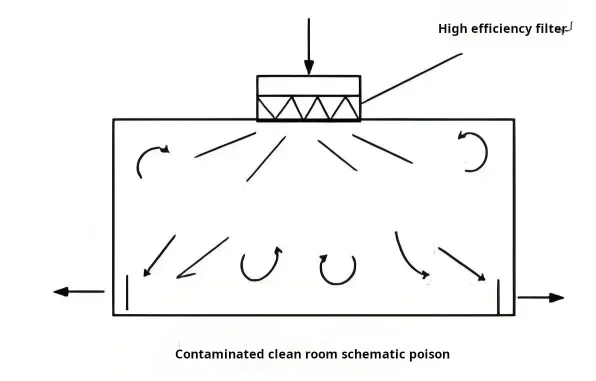
Mixed Flow System: Localized laminar protection within turbulent background
Jason.peng from Deiiang™ notes that selecting the appropriate airflow pattern requires balancing technical requirements with budget constraints. The cleanroom air flow design in layout must align with both current needs and future scalability considerations.
Part 3: Key Considerations in Cleanroom Airflow Layout Design
Effective cleanroom air flow design in layout extends beyond selecting airflow patterns to encompass comprehensive integration with facility operations. Deiiang™ approach emphasizes that successful implementation requires addressing multiple interconnected factors that influence contamination control performance.
3.1 Cleanroom Zoning and Pressure Cascade Design
The foundation of effective cleanroom air flow design in layout lies in establishing proper zoning and pressure differentials. A typical pharmaceutical facility might implement a pressure cascade from ISO 5 (highest pressure) to iso 8 (lowest pressure), with each step maintaining a 10-15 Pascal differential.
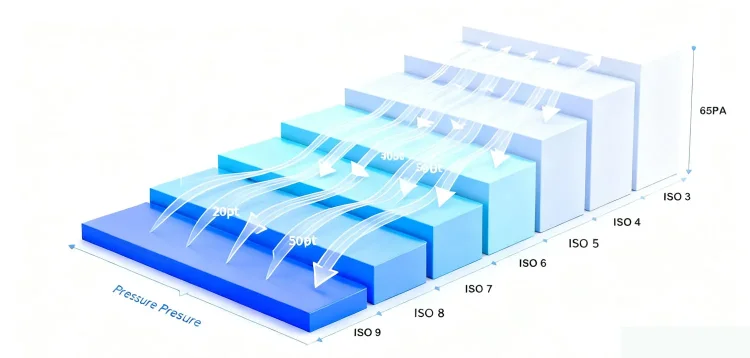
Pressure Cascade: Maintaining directional airflow from clean to less clean areas
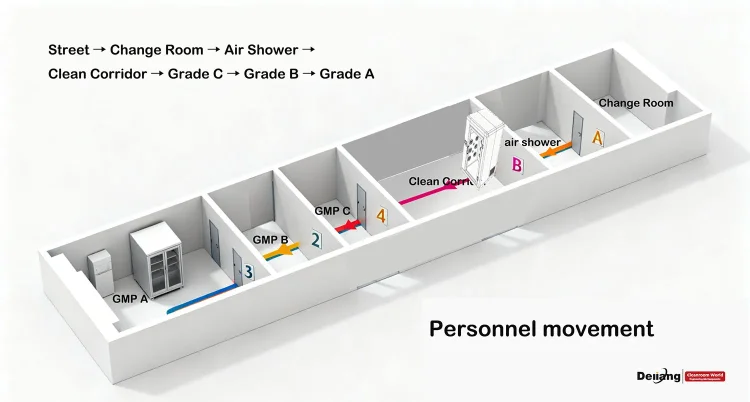
3.2 Personnel and Material Flow Impact on Airflow
Personnel movement represents one of the largest contamination sources, making proper flow design essential in cleanroom air flow design in layout. Deiiang™ protocols typically include:
Material Flow Path
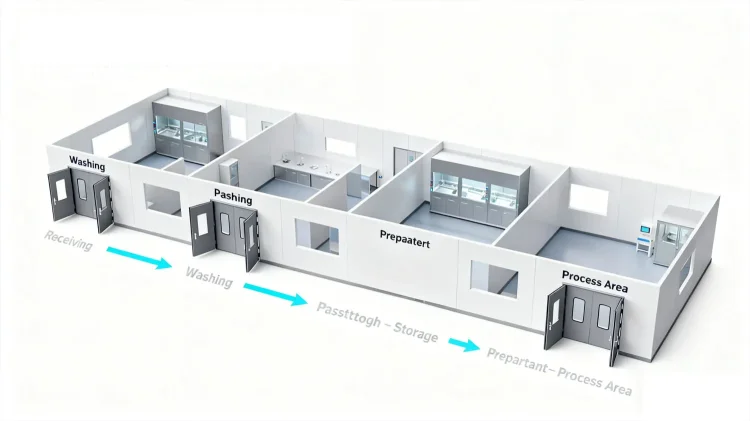
Receiving → Washing → Pass-through → Storage → Preparation → Process Area
3.3 Supply and Return Air Outlet Design
The strategic placement of supply and return outlets significantly impacts the effectiveness of cleanroom air flow design in layout. HEPA/ULPA filter coverage typically ranges from 60-100% of ceiling area for unidirectional flow and 20-40% for non-unidirectional flow systems.
3.4 Equipment Layout and Airflow Interference
Equipment placement can create turbulence, dead zones, or airflow obstructions if not properly considered in cleanroom air flow design in layout. Large equipment should be positioned to minimize disruption to primary airflow patterns, with clearance of at least 18-24 inches from walls and critical airflow paths.
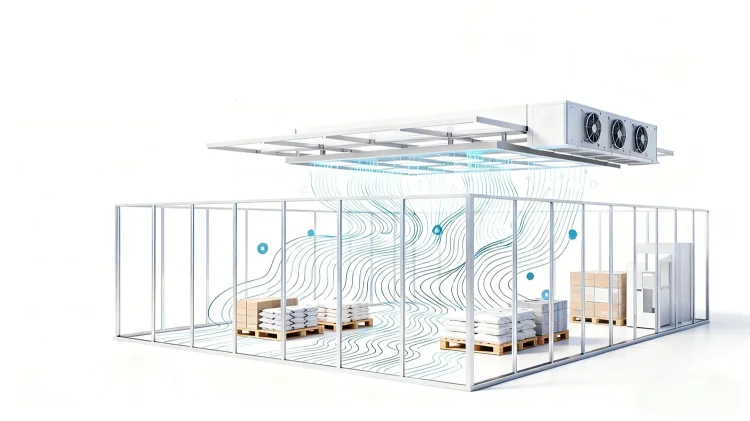
Equipment Impact: Proper placement prevents airflow disruption
3.5 HVAC System Integration
The HVAC system forms the mechanical heart of cleanroom air flow design in layout, with air handling units (AHUs) sized to accommodate specific airflow, filtration, and conditioning requirements. A typical ISO 7 Cleanroom HVAC system might process 10,000-50,000 CFM, with 30-40% allocated to makeup air and the remainder recirculated.
Deiiang™ engineers calculate that proper cleanroom air flow design in layout can reduce energy consumption by 15-25% through optimized airflow paths and equipment selection, while maintaining or improving contamination control performance.
Part 4: airflow design Case Studies Across Applications
Real-world implementation of cleanroom air flow design in layout varies significantly across industries and applications. Deiiang™ has successfully deployed optimized airflow solutions across multiple sectors, each with unique requirements and challenges.
Case Study 1: Pharmaceutical Sterile Manufacturing
A recent Deiiang™ project involved designing an ISO 5-7 pharmaceutical facility with strict EU GMP compliance requirements. The cleanroom air flow design in layout incorporated vertical unidirectional flow in critical zones (ISO 5) with pressure cascades maintaining 15 Pa between adjacent classifications.
Case Study 2: Electronics Microfabrication
For a Semiconductor manufacturer requiring ISO 4 conditions, Deiiang™ implemented a comprehensive cleanroom air flow design in layout featuring ceiling-to-floor vertical laminar flow with 500+ ACH. The design included specialized vibration control and temperature stability within ±0.1°C.
Case Study 3: Hospital Operating Room/Isolation Room
In healthcare applications, Deiiang™ cleanroom air flow design in layout focused on infection control through precise pressurization. Positive pressure operating rooms (15-20 Pa) prevent infiltration, while negative pressure isolation rooms (-15 to -25 Pa) contain contaminants.
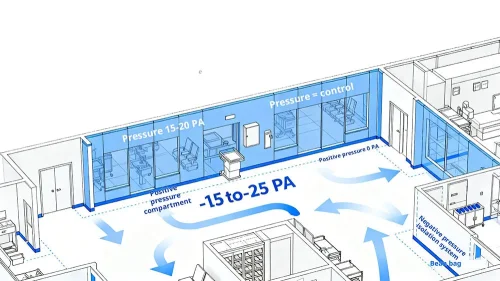
Healthcare Layout: Specialized pressurization for infection control
According to Jason.peng, "Each application demands a tailored approach to cleanroom air flow design in layout. What works for pharmaceutical manufacturing may be completely inappropriate for Electronics or healthcare applications."
Part 5: Cleanroom airflow design Validation and monitoring
Verification and ongoing monitoring ensure that the theoretical cleanroom air flow design in layout performs as intended in practice. Deiiang™ implements comprehensive validation protocols aligned with regulatory requirements and industry best practices.
| Validation Phase | Key Activities | Acceptance Criteria |
|---|---|---|
| Design Qualification (DQ) | Document review, specification verification | Compliance with user requirements and regulations |
| Installation Qualification (IQ) | Equipment verification, installation checks | Proper installation per design specifications |
| Operational Qualification (OQ) | Airflow velocity, ACH, pressure differential tests | Performance within specified operating ranges |
| Performance Qualification (PQ) | Particle counts, recovery tests, airflow visualization | Consistent performance under simulated production conditions |
Critical Testing Parameters
Deiiang™ validation protocols include comprehensive testing to verify cleanroom air flow design in layout performance:
Pressure Differential
10-25 Pa
Between adjacent zones
Filter Efficiency
99.99-99.999%
HEPA/ULPA performance
Continuous monitoring systems track these parameters in real-time, with automated alerts triggering when values deviate from established limits. This ensures that the cleanroom air flow design in layout maintains consistent performance throughout operational lifecycles.
Conclusion: Achieving Excellence in Cleanroom airflow design
Mastering cleanroom air flow design in layout represents a critical competency for organizations operating in contamination-sensitive industries. The comprehensive approach outlined in this guide demonstrates that successful implementation requires integrating technical knowledge with practical operational considerations.
From initial concept through validation and ongoing monitoring, every aspect of cleanroom air flow design in layout contributes to the ultimate goal of reliable contamination control. Deiiang™ experience across multiple industries confirms that investments in proper airflow design yield substantial returns through improved product quality, regulatory compliance, and operational efficiency.
Ready to Optimize Your Cleanroom airflow design?
Contact Deiiang™ today for a customized consultation on your cleanroom air flow design in layout requirements.
Product Designer: Jason.peng | Deiiang™ Cleanroom Solutions
Frequently Asked Questions
What ACH rates are required for different cleanroom classifications?
ISO 5 (Class 100) typically requires 200-600 ACH, ISO 6 (Class 1,000) needs 90-180 ACH, ISO 7 (Class 10,000) requires 30-70 ACH, and ISO 8 (class 100,000) needs 10-25 ACH. Specific requirements depend on contamination sources and activities.
How can we avoid airflow dead zones in cleanroom design?
Proper cleanroom air flow design in layout addresses dead zones through strategic placement of supply and return outlets, avoiding equipment obstructions, implementing appropriate airflow patterns, and utilizing computational fluid dynamics (CFD) analysis during design phases.
What are the most common mistakes in cleanroom airflow design?
Common errors include inadequate consideration of equipment interference, improper pressure differentials, insufficient air changes, poor placement of returns, and failure to account for personnel and material movement patterns in the cleanroom air flow design in layout.
How can we balance airflow design with energy efficiency?
Deiiang™ employs several strategies: variable Air volume systems, high-efficiency motors, energy recovery systems, optimized room pressurization, and smart control systems that adjust airflow based on occupancy and activity levels.
Do you offer computational fluid dynamics (CFD) analysis services?
Yes, Deiiang™ provides comprehensive CFD analysis to simulate and optimize cleanroom air flow design in layout before construction. This virtual modeling identifies potential issues and allows for design refinement, reducing costly modifications during construction and commissioning.