+86 13638632902
 Jason@cleanroomequips.com


 MENU
MENU
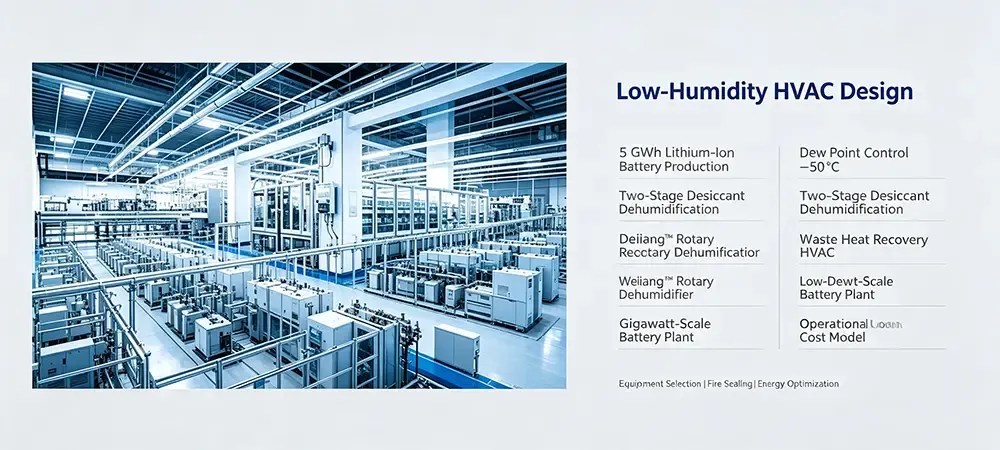
The low-humidity air conditioning design for the 5 GWh lithium-ion battery plant is presented. The paper focuses on the five process zones that require dew point control of ≤ −50 °C. The core technology of the two-stage Desiccant Dehumidification System is presented through the psychrometrIC process analysis as well as Deiiang™ case studies. The waste heat recovery is shown to significantly reduce the regeneration energy consumption. A practical reference for the low-dew-point HVAC design in the gigawatt-scale battery plants is provided.
Introduction
Output of lithium batteries for Global NEV demand in China has reACHed an annual volume of more than 800 GWh. The manufacturing process for such lithium batteries requires a production environment which is kept low in humidity by air conditioning. In drying rooms for example the absolute humidity has to be kept below 0.024 g/kg. Fire protection as well as air-tight sealing of the production area is essential in these low-dew-point HVAC applications, because any leakage would pose a risk to safety and process stability. This design approach is demonstrated by operating data from a plant that was put into operation in 2017.
Key Environmental Requirements
Each production stage demands specific temperature, humidity, and cleanliness conditions. Electrode coating requires very low absolute humidity to prevent lithium salt hydrolysis, while assembly areas need controlled relative humidity to avoid electrostatic discharge. The table below summarizes key parameters for a LiFePO₄ line.
| Process Zone | Temp. | Humidity / Dew Point | Cleanliness |
|---|---|---|---|
| Positive Electrode Coating | 23°C±5°C | RH ≤ 20% | iso 8 |
| Drying Room (Pre-injection) | 23°C±5°C | Dew Point ≤ −30 to −50°C | ISO 8 |
| Electrolyte Injection Room | 23°C±5°C | Dew Point ≤ −50°C | ISO 8 |
| Formation / Aging Room | 23°C±5°C | Dew Point ≤ −30°C | ISO 8 |
ZonePos. Electrode Coating
HumidityRH ≤ 20%
ZoneDrying Room
Dew Point≤ −30 to −50°C
ZoneInjection Room
Dew Point≤ −50°C
Moisture reacts with LiPF₆ to form HF, degrading the SEI layer. Just 50 ppm moisture increase can reduce first-cycle capacity by 3–8% and raise internal resistance by 12–20%. Where cooling dehumidification cannot economically achieve the required dew point control, desiccant dehumidification is essential.
Dehumidification Technology Comparison
Selecting the right method requires understanding psychrometric process limitations. Cooling dehumidification works above 45% RH but is energy-intensive for deeper drying. Desiccant dehumidification systems using solid adsorbents capture water vapor independently of the saturation curve, making them uniquely suited for absolute humidity below 1 g/kg.
| Technology | Min Dew Point | Best For | Energy (kW/1000m³/h) |
|---|---|---|---|
| Cooling Dehumidification | +5 to +10°C | RH ≥ 45% | 3.5–5.0 |
| Single-Stage Rotary Desiccant | −20 to −30°C | RH ≤ 20% | 6.0–9.5 |
| Two-Stage Rotary Desiccant | −50 to −70°C | Drying/Injection Rooms | 9.0–14.5 |
TechCooling Dehumid.
Min Dew Pt+5 to +10°C
TechSingle-Stage Rotary
Min Dew Pt−20 to −30°C
TechTwo-Stage Rotary
Min Dew Pt−50 to −70°C
For lithium battery plants, two-stage desiccant dehumidification is the preferred technology for low-dew-point HVAC. Selection logic:
The decisive advantage of a two‑stage rotary desiccant configuration lies in its ability to overcome the fundamental psychrometric limitation of single‑stage wheels.
A single‑stage wheel, when regenerated at practical temperatures below 150 °C, cannot drive the absolute humidity below approximately 0.3 g/kg (dew point ≈ −30 °C). This is because the silica‑gel adsorbent reaches its equilibrium moisture content and can no longer extract additional water vapour.
For critical zones such as drying and injection rooms where a dew point of −50 °C or lower is mandated by GB 51377, a two‑stage system becomes essential.
In a two‑stage system, the moisture removal duty is split into bulk dehumidification and deep drying. The first wheel removes the majority of the water vapour, typically reducing absolute humidity from 8.3 g/kg to around 1.26 g/kg.The air then passes through an inter‑stage cooling coil, where it is cooled to approximately 23 °C. This temperature drop significantly increases the relative humidity at the inlet of the second wheel, greatly enhancing its adsorption efficiency.
The second wheel, optimised for low‑humidity operation, polishes the air down to 0.024 g/kg (dew point −50 °C). This staged approach delivers several practical benefits.Each wheel operates at its own optimal regeneration temperature, which reduces the overall regeneration energy demand by up to 25 % compared with a single oversized wheel attempting the same final moisture content.
Independent control of the two regeneration circuits allows the system to adapt smoothly to varying ambient loads while maintaining stable dew point control.
Furthermore, the configuration integrates readily with waste heat recovery from coating or formation exhaust, lowering operating costs still further.
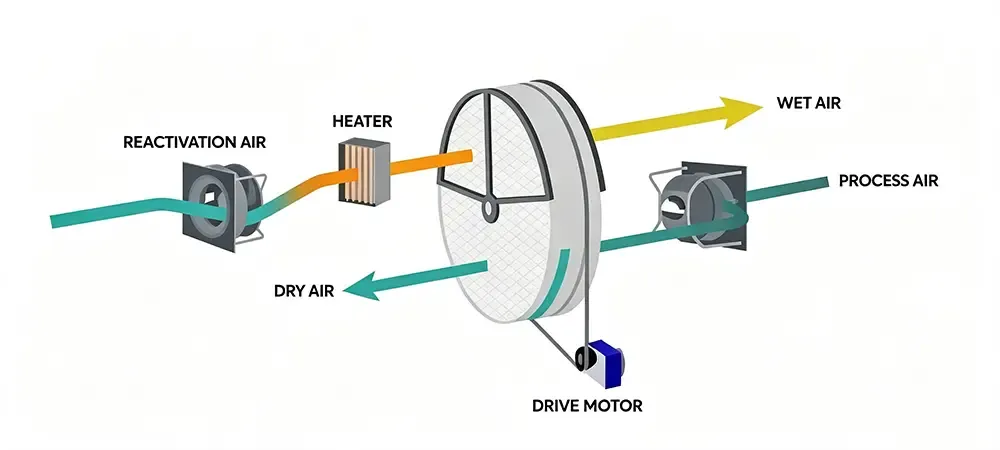
Deiiang™ two‑stage units incorporate inter‑stage cooling and independent regeneration as standard features, delivering reliable low‑dew‑point HVAC for the most demanding lithium battery production environments.
Design Process & Deiiang™ Product Data
Design follows five steps: define inputs (36°C DB, 80% RH worst-case), calculate moisture load (15 operators ≈ 1,800 g/h), determine supply air per GB 51377 (50 ACH for −50°C rooms), select single/two-stage desiccant dehumidification based on target dew point control, and integrate redundancy. Deiiang™ units—engineered by Jason.peng—feature silica-gel composite wheels rated to 140°C regeneration.
| Parameter | RDW-22400 (Single) | RDW-16000-D (Two-Stage) |
|---|---|---|
| Supply Airflow | 22,400 m³/h | 15,940 m³/h |
| Moisture Removal | 32.6 kg/h | 65 kg/h |
| Regen. Power | 49 kW | 120 kW total |
| Achievable Dew Point | −20 to −30°C | −50 to −60°C |
ModelRDW-22400
Airflow22,400 m³/h
Dew Point−20 to −30°C
ModelRDW-16000-D
Airflow15,940 m³/h
Dew Point−50 to −60°C
Case Studies
Single-Stage Project (Electrode Roll Storage): 1,200 m² zone requiring 23°C, RH≤20%. A Deiiang™ RDW-22400 handles 22,400 m³/h supply air with 3,360 m³/h fresh air at 36°C/80% RH. The psychrometric process pre-cools air to 12°C before the wheel, reducing moisture to 3.5 g/kg. Regeneration uses 49 kW; results show stable RH 18–20% and annual consumption of 429,000 kWh (≈¥1,760/day).
Two-Stage Project (Drying Room): 4,500 m² room requiring dew point ≤−50°C. The RDW-16000-D two-stage desiccant dehumidification system supplies 15,940 m³/h. The psychrometric process achieves 0.024 g/kg absolute humidity through inter-stage cooling at 23°C—without it, second-wheel capacity drops 60%. Post-commissioning maintains −48 to −52°C dew point. Waste heat recovery from coating exhaust (100°C) cuts regeneration cost from ¥2,304 to ¥1,440/day, saving ¥420,000 annually.
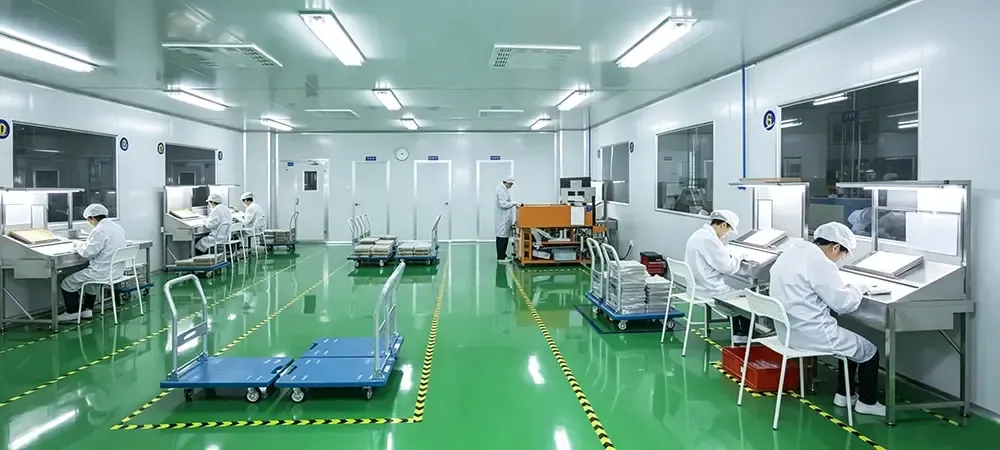
Fire Protection & Sealing
In low-humidity air conditioning environments, fire safety and sealing integrity are paramount. Key requirements include:
GB 8624 B1-rated panels with mineral wool cores for low outgassing.
Fire-rated silicone sealant (≥3 mm bead) at all junctions.
EPDM gaskets (density ≥65 kg/m³) maintaining +15 Pa pressure differential.
Intumescent collars with silicone tape at all penetrations.
Anti-static epoxy flooring (10⁶–10⁹ Ω) verified per iso 14644-8.
Door-fan tests (ASTM E779) with leakage ≤0.5 L/s·m² at 50 Pa.
Energy Optimization & Waste Heat Recovery
Total regeneration capacity across all low-dew-point HVAC units reaches 5,900 kW, costing ¥78 million annually. Three waste heat sources enable waste heat recovery: coating exhaust (100°C, recovering ~184 kW per line), formation cabinet exhaust (50–60°C, saving 12–18%), and air compressor discharge (70–80°C, ~50 kW recoverable). Key measures include heat exchangers (effectiveness ≥70%), optimized regeneration temperature (110–120°C), VFD fans, and zonal dew point control.
Maintenance & FAQ
Absolute humidity sensors require quarterly calibration (±0.5°C). Desiccant wheels last 8–12 years but degrade 5–10% after 5 years. Annual regeneration for RDW-16000-D: 1,051,200 kWh (¥840,960), with spare parts budget of ¥120,000–180,000/year.
Q: Can single-stage achieve −50°C dew point? No—psychrometric process limits it to −25 to −30°C. Two-stage desiccant dehumidification with inter-stage cooling is required.
Q: Best regeneration heat source? Electric is simple but costly; waste heat recovery from coating lines (100°C) is the most economical long-term, reducing costs 35–50%. Deiiang™ supports hybrid configurations.
Q: Fire-rated sealing for low-dew-point HVAC? Use GB 8624 B1 silicone, EPDM gaskets (>65 kg/m³), and intumescent collars—all functional below 0.1 g/kg absolute humidity.
Persona & Conclusion
Persona: Li Gong
Age: 36
Work Title: Senior HVAC Manager in Guangdong designing an 8 GWh expansion of an 8GWh lithium battery manufacturing facility with 8,000 employees spread over a number of different campuses. His EHS Mandate includes the GB 8624 B1 requirement as well as ensuring no leakage higher leakage rates than 0.4 L/s·m². He was allotted a total budget of ¥8.5M, and he can build the suggested system for approximately ¥7.9M with a corresponding 2.8 year payback. His Recommended Design was Deiiang™ RDW-18500-D (5,750 m³/h @ <0.06g/kg with hybrid regeneration down to -85°C) a rotary dehumidifier used as part of a two-stage desiccant dehumidification system with waste heat recovery for corresponding downrating of 135kW to 78kW (savings of 42%) - Figure 8.
Utilizing waste heat, two-stage desiccant dehumidification systems reach an absolute humidity of 0.024 g/kg while decreasing the regeneration costs by 35–50%. In five steps the methodology, which has been tested on a 5 GWh plant, brings cost effective, fire-safe, low-dew-point HVAC systems to lithium battery manufacturing, which is constantly growing. To reach the lowest total cost of ownership Jason.peng and Deiiang™ are developing new designs for rotary dehumidifiers.
Micro-Glossary
Desiccant Wheel: Rotating adsorbent structure for continuous desiccant dehumidification.
Dew Point: Saturation temperature at given absolute humidity; primary metric in low-dew-point HVAC.
Absolute Humidity (g/kg): Mass of water vapor per dry air mass, fundamental in psychrometric process calculations.
GB 51377-2019: Chinese standard for lithium battery factory dew point control and air change rates.