+86 13638632902
 Jason@cleanroomequips.com


 MENU
MENU
Optical systems and components are delicate. A large contaminant can be noticed in a finished product, but typically defects are small and go unnoticed because they arise from small-scale contamination mechanisms which are not addressed by typical cleanrooms.
In optics assembly, the failures of cleanrooms can be attributed to lens surface contamination, the electrostatic charge that causes dust to adhere to the lenses, volatile organic compounds (VOCs) in the adhesives and outer packaging, adsorbed moisture and other volatile contaminants (AMC) that modify coatings and adhesives, and the cleanroom's inability to control airflow and temperature.
To control electrostatic discharge and molecular level contamination, a cleanroom system should provide filtration at the particle level, static control, and molecular contamination control with integrated, balanced airflow.
Deiiang™ provides cleanroom integration, systems, and engineering with ESD and AMC control. This article shows how to transition from basic particle control to comprehensive cleanroom contamination control for optical lens assembly.
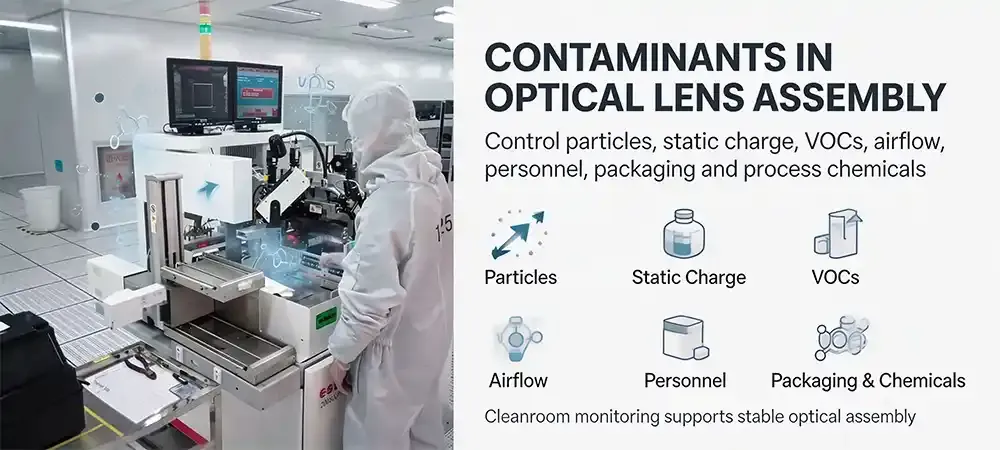
Fig. 1 Contaminants in optical lens assembly cleanrooms — Particles, static charge, VOCs, AMC, airflow, human contamination, packaging, process chemicals
What is the Difference in Optical Lens Assembly Cleanroom Design?
Optics cleanroom design for lens assembly must go beyond particle counting. The real challenge lies in controlling static charge and molecular contaminants that compromise optical surfaces.
An optical surface can be compromised by micro-particles. Micro-particles cause scratches and other forms of contamination that lower the quality of optics and result in an increase of non-conforming product rates.
For optical products, the location of particles is more important than the quantity of particles. These include:
- The distribution of particles near the lens surface.
- The distribution of particles that shed from workstations, fixtures, and gloves.
- Cross-contamination that occurs when transferring materials to the clean zone.
- Contaminants may be carried toward the optical surface due to the airflow.
With Deiiang™ projects, particle counts are conducted at different levels and locations to identify contamination hotspots, rather than relying only on average room readings.
Static electricity is more effective in attracting particles.
Static charge not only causes damage to electronic components but it also attracts particles present in the air to optical surfaces. This is the main reason why ESD control cleanroom design is essential for lens assembly.
The static charge is built up in the following manner:
- Charging surfaces, lens surfaces, and fixtures or packaging (Charged surfaces create an electrostatic field that attracts particles).
- The movement of personnel causes a charge transfer.
- An insufficient number of ions to replenish the balance leads to a delay in the dissipation of static charge.
The end result is contamination of the lens surface, repeated cleanings, and a loss in production yields. This problem can be mitigated through proper design of an ESD control cleanroom, with adequate placement of ionizers and grounding, and a selective choice of materials.
Why does an optical cleanroom require ionizers? ESD control is essential due to static charge attracting particles that will contaminate the surfaces which should remain clear.
Airborne Molecular Contaminants (AMC) can damage coatings, adhesives, and sensitive surfaces.
AMC control cleanroom design covers a range of contaminants, including acids, bases, volatile organic compounds (VOCs), siloxanes, amines, and residual solvents.
AMC disrupts many aspects of optical manufacturing including:
- Decreased performance of optical coatings
- Thin films or haze on lens surfaces
- Inconsistent curing of adhesives
- Corrosion of metal components
- Drift in sensors and inspection equipment
- Decreased reliability of products over time
AMC sources in optical cleanrooms include cleaning agents, adhesives, and solvents, along with packaging, outgassing by personnel, HVAC components, and emissions from adjacent production areas.
AMC sources and transmission paths in optical manufacturing consist of cleaning agents, adhesives, and solvents as well as packaging, personnel, HVAC components, and adjacent areas.
AMC Sources and Transmission Paths in an Optical Cleanroom.
Effective optics cleanroom design treats particles, static, and AMC as interconnected threats. Each requires a distinct control strategy within an integrated framework.
Determining the Proper Cleanroom Classification for Lens Assembly
ESD control cleanroom classification must align with process sensitivity, not just product type. Different assembly steps demand different cleanliness levels.
Focus on process sensitivity instead of just product
In optical lens assembly there are numerous processes involved such as storage and cleaning of raw materials, inspection of coatings, assembly, and curing and calibration, as well as the final inspection and preparation for shipment.
Different steps require different cleanliness, ESD control cleanroom, and AMC specifications. Choosing a standard ISO classification typically results in over-engineering for some steps and under-engineering for others.
Here are some examples:
- Material buffer zone: Focus more on managing personnel and materials.
- Lens cleaning area: Focus more on particles and chemicals.
- Lens assembly area: Focus more on ESD, particles, and airflow.
- Dispensing area: Focus more on solvents and VOCs with local exhaust.
- Final inspection: Focus on consistent temperature/humidity with low contamination and background noise.
ISO ranking with local cleanliness zones
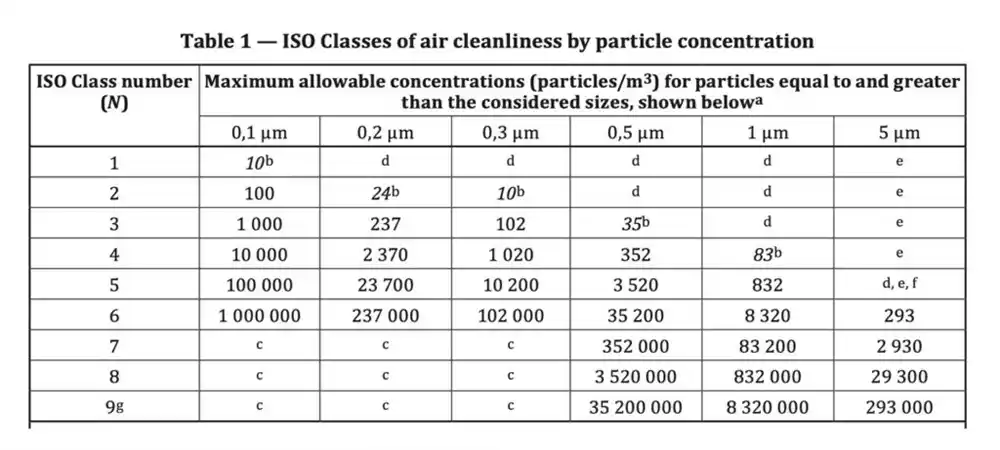
iso 14644-1 breaks down clean room classes into nine levels based on airborne contaminant concentration. In optics, assembly can use cleanliness classes from iso 5 through ISO 7. In your own clean room assembly, consider the sensitive processes, the products, the requirements of the cleanliness verification, and contaminant control. Don't use the criteria of the industry as a standard.
| Component area | Principal Risk | Principal Control Measure | Confirmation Data |
|---|---|---|---|
| Lens Cleaning | Contamination of the Lens by particulates and/or by residual chemicals. | HEPA filters and local protection | Filtration of particulates and residuals. |
| Lens Assembly | Particle deposition and electrostatic fields. | ffus (fan filter units), ionizers, grounding | Surface potential and ion balance. |
| Dispensing/Adhesive | Volatile Organic Compounds (VOCs) and Adsorbed Molecular Contaminants (AMCs). | Extract ventilation and adsorption of chemicals. | AMCs and VOCs. |
| Final Inspection | Particulates and the measurement of temperature and humidity. | A controlled airflow and environmental stability. | Temperature measurement, humidity measurement, and particulate monitoring. |
Integrated ESD Control Cleanroom Design
An ESD control cleanroom must provide protection throughout the entire process. Integrated design ensures that static charge is neutralized at every critical point.
ESD (Electrostatic Discharge) Control should provide the same protection throughout the process
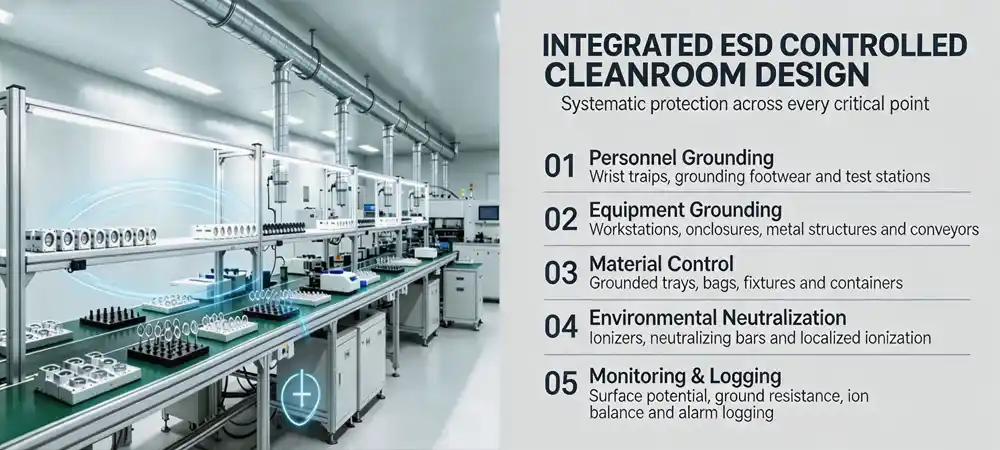
Integrated ESD Control Cleanroom Design does not only mean installing ionizers on work stations. It is a systematic approach that involves the following 5 levels of protection:
- Grounding of personnel: Grounding wrist straps, and grounding footwear, along with grounding testing stations.
- Grounding of equipment: Grounding of workstations, housings, and structures in a metal form, as well as grounding on conveyors.
- Control of materials: Grounding trays, grounding bags, grounding fixtures, and grounding containers for material handling
- Environmental neutralization: Ionizers and neutralization rods, as well as localized ionization.
- Monitoring and recording: Surface potential, ground resistance, ion balance, and alarms monitor and record.
Deiiang™ engineers inspect and assess all
Ionizer position and interaction with airflow
Ionizer interaction with airflow must be considered. Important factors include:
- Is all critical workspace areas covered with ionized air?
- Are there areas that remain ionization blocked?
- Do the ionizers disrupt the settling of the particles?
- Do the ionizers introduce contaminated airflow toward the product?
- Does the ionizer introduce particles?
- Is the ionizer easy to maintain and/or clean?
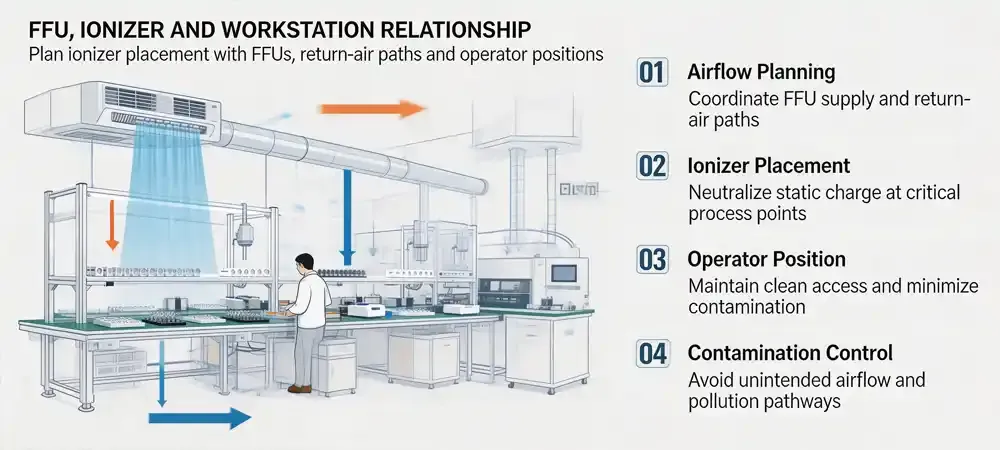
Design principle: placement of ionizers should be planned in conjunction with FFU placement, return airflow paths and the working positions of operators to avoid inadvertent contamination pathways.
Figure 3: Relation of FFU, ionizer, and workstations in an optical cleanroom
Metrics of ESD Validation — Quantified ANSI/ESD S20.20
Validation of described parameters is a must for any ESD control cleanroom project. The table below includes parameters and their limits based on ANSI/ESD S20.20 and the best practice in the optical assembly industry.
| ESD Parameters | Limit for Optical Assembly | Referencing Standard |
|---|---|---|
| Static Decay Time | < 1.0 s (from +1000 V to -100 V) | ANSI/ESD S20.20 |
| Residual Surface Voltage | < ±50 V on Surfaces | ANSI/ESD S20.20 |
| Ionizer Neutrality Offset | < ±5 V | ANSI/ESD S20.20 |
| Grounding Resistance | < 1 × 10⁹ Ω (workstation) | ANSI/ESD S20.20 |
| Grounding of Personnel | < 35 MΩ (wrist strap + cord) | ANSI/ESD S20.20 |
Credit: ANSI/ESD S20.20-2021 — Protection of Electronic Devices, Assemblies and Equipment
Optical Manufacturing AMC Controlled Cleanroom Design
AMC control cleanroom design starts with source identification, not filter selection. Understanding the contaminant profile is the first step toward effective removal.
Design based on Cleanroom
Design based on AMC cleanrooms starts from source recognition, not a filter choice. Common sources can be:
- Adhesives and bonding materials
- Alcohols and solvents used in cleaning
- Oils and lubricants used in vacuum pumps and equipment
- Packagings and linings
- Sealants and gaskets
- Low-quality construction air
- Emissions from nearby industrial processes
- Fresh and outdoor air
When surveying AMC profiles, chemical filtration sees ambiguity and without specifying which AMC profile has been surveyed, chemical filtration is simply a lot of guesswork. Regarding this, Deiiang™ performs on-site AMC profiling surveys to help characterize the specific composition of contaminants and therefore directs its efforts to filtration solutions.
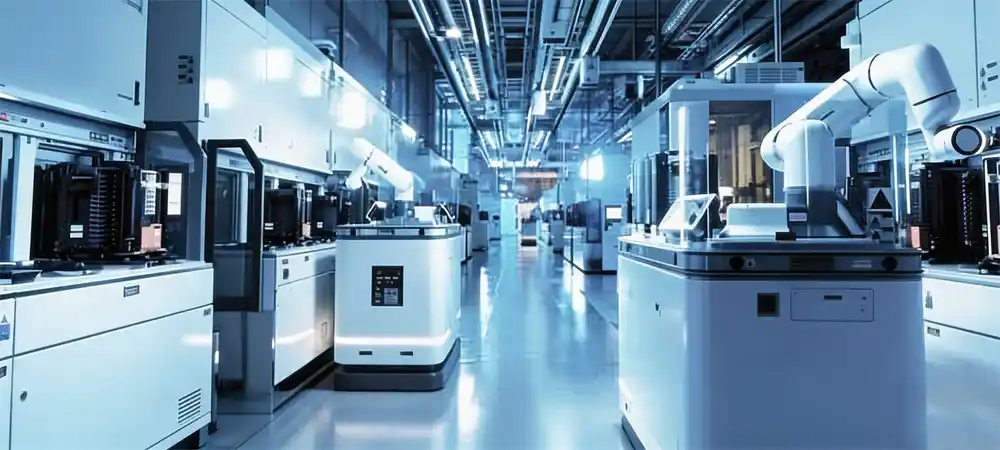
Selecting filtration media based on the contaminant composition.
The AMC types dictate the media and/or combination of media to be used. A general strategy to combat AMC control within a cleanroom environment may involve the following:
- HEPA/ULPA grade particle filtration
- Activated carbon for organic vapor control
- Impregnated media for acidic gases
- Chemically impregnated media for control of basic gases
- Selective adsorbents for the removal of specific VOCs
- Local exhaust on emission sources
If contaminants are being emitted from the process source continuously, relying solely on recirculated air filtration may lead to an overburdening of the filtration system. Design should integrate the enclosure of a source, local exhaust, fresh air ratio, return air path planning, chemical filtration, scheduled filter replacements, and differential pressure monitoring.
AMC monitoring and filtration
The AMC control cleanroom capability of a cleanroom focused on optics is reliant on operations and maintenance in the long run, and not just the initial installation. Of particular importance are:
- Monitoring of filter service lives
- Trends in differential pressures
- Chemical media saturation
- Placement of sampling points
- Frequency of monitoring (continuously or not)
- Alarm parameters for the concentration of AMC
- Documentation of replacement logs
- External verification testing
Air flow, HVAC, and Pressure Cascade Design
Optics cleanroom design requires airflow that protects the product, not just moves air. Unidirectional flow, operator positioning, and thermal loads all influence contamination risk.
The flow of air must be designed to safeguard the product versus just transporting air
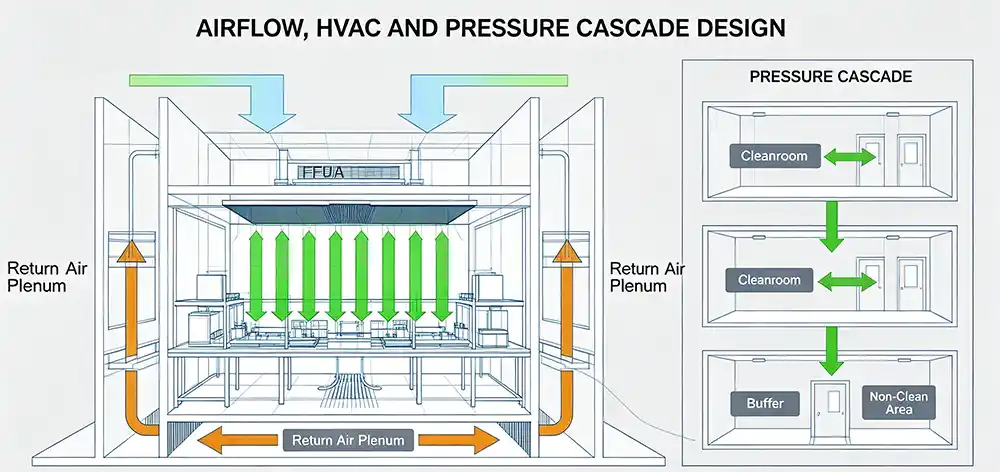
When designing optics cleanrooms, airflow may involve consideration of unidirectional or non-unidirectional flow, localized air protection at the operator's workstations, interference from the operator, equipment's thermal load, placement of return air, and differential pressures in the various zones.
Even for iso class 5, the typical airflow velocity ranges from 0.3 to 0.5 m/s with 240–480 air changes per hour, although the values stated must be modified based on the optics process and the associated risk of contamination.
Deiiang™ applies CFD modeling to understand airflow to determine filter location, return air pathways, and where to position operators, all before construction.
High-humidity regional challenges: Southeast Asia perspective
In tropical regions (like Singapore, Vietnam, and Malaysia), ambient RH (Relative Humidity) can reach 85% all year. In such environments, humidity can adversely affect the optical lens assembly. Humidity can lead to coating water marks. It can also lead to lens and fixture growth and fungus.
With energy recovery wheels, Deiiang can reduce the humidity to 40 to 45% with less energy consumption when the temperature is at 22 degrees with a tolerance of ±1°C. In a 320 m² project based in Vietnam, these systems reduced 38% of reheat energy with only the use of cooling DX (Direct Expansion) systems.
Important design strategies for regions with high humidity:
- 8 to 10 row pre-cooling coils for latent cooling.
- Deep dehumidification with a rotor that has a dew point of less than 5°C.
- Heat is recovered to pre-heat supply in the air transition seasons.
- Stainless steel with a drainage slope of ≥5° to avoid water pooling.
- Alarms should be set for continuous humidity monitoring that are triggered when humidity exceeds 50%.
Creation of a pressure difference and zoning
A well-designed pressure difference system provides an airflow barrier to prevent external contaminants from entering the critical optical assembly area. Typical zoning includes:
- Personnel entrance and gowning area
- air shower
- Material pass-through
- Buffer zone
- Core assembly area (highest positive pressure)
- Dispensing or cleaning area (moderate pressure)
- Waste and contaminant exit (lowest pressure)
Pressure differences of 10 to 15 Pa are maintained between zones, with continuous monitoring and alarm capability.
Diagram showing the organization of personnel flow, material flow, and airflow in an optical cleanroom
Figure 4: Optical cleanroom layout showing personnel flow, material flow, and pressure cascade
Project Overview: Deiiang Optical Cleanroom Project Case Study
Deiiang™ delivered a turnkey optics cleanroom design for a module manufacturer in Vietnam, integrating ESD and AMC controls with minimal production disruption.
Deiiang™ constructed a cleanroom for the delicate assembly of optical components for a module manufacturer based in Vietnam. The project required the upgrade of an existing facility with minimal production downtime, while addressing contamination, ESD, and AMC challenges.
Project Parameters: 320 m², ISO Class 5 core assembly area, ESD control and AMC control, delivery in 14 weeks.
User Persona and Situation
- Job Title: Optical Manufacturing Facility Manager
- Region: Southeast Asia
- Main Goal: Enhance cleanroom capabilities with minimal production disruption
- Challenges: High levels of particle contamination on lens surfaces, suspected issues with ESD control and VOCs from the dispensing and an absence of AMC filtration, and a very tight timeline.
By 8:30 a.m., the Facility Manager had analyzed inspection data from the previous day, noting that although cleanroom particle counts were acceptable, several lens assemblies had surface contamination. He understood that contamination of the cleanroom is not caused by a dirty room. He suspected a combination of static electric charge, airflow, and the presence of chemically active contaminants.
Project challenges:
- Limited space available in the cleanroom footprint
- Production could not be stopped for extended periods
- ESD issues concentrated at assembly stations and fixtures
- The dispensing process released VOCs
- The existing HVAC system could not accommodate AMC filtration
- Personnel and material flow crossed paths
- The client required complete testing and documentation for validation
- Local engineering data – Southeast Asia deployment
For this Vietnam project, Deiiang focused on region-specific conditions including average outdoor dry bulb humidity at 34°C, 82% RH, and frequent grid voltage fluctuations (±10%). The solution included:
- Line reactors and voltage stabilizers for ionizer power supplies
- Desiccant rotor with 65% sensible heat recovery
- Maintenance of indoor conditions at 22±1°C, 42±3% RH
- Improvement of total system COP by 27% compared to conventional chilled-water design
Deiiang's engineering solution:
- Solution 1 — Cleanroom zoning: The cleanroom was divided into the cleaning, assembly, dispensing, inspection, and packaging zones. Local high-cleanliness protection was installed for critical assembly stations, with buffer zones and optimized pressure gradients.
- Solution 2 — Air purification system: FFUs were designed with HEPA/ULPA filters based on the target ISO class. Air supply and return paths were redesigned to eliminate direct impact of the airflow on the surfaces of the lenses. Local exhaust was provided for chemical sources.
- Solution 3 — ESD control: Anti-static workstations, equipment grounding and personnel grounding systems were incorporated. Critical workstations with verified coverage and ion control balance were equipped with ionizers. Daily static control testing was implemented.
- Solution 4: AMC Control AMC sources include adhesive, solvent, and packaging emissions. Suitably selected chemical filtration media were used based on the identified AMC profiles. AMC monitoring locations were established along with procedures for filter change and performance evaluation.
- Solution 5: Monitoring and Validation The project involved the following: testing of particulates, validation of temperature and humidity, verification of pressure differentials, visualization of air flow, ESD testing, AMC and VOC sampling, testing of filter integrity, and validation of continuous operation of the system.
Project Results
| Metric | Before | After | Improvement |
|---|---|---|---|
| Particles ≥ 0.5 µm/m³ | 3,520 (ISO Class 6) | 350 | ▼ 90% reduction |
| Surface static voltage | > 500 V (High ESD Risk) | < 45 V | ▼ 91% reduction |
| First-pass yield | 89% | 97.2% | ▲ 8.2% improvement |
Based on the client’s production records for the 3 months following validation. Results will vary.
Four Visual Assets for the Case Study
- Asset 1: Project Layout — Filename: optical-lens-assembly-cleanroom-layout.jpg — Caption: Shows flow paths and zones for personnel, materials, and stations.
- Asset 2: ESD Equipment Installation — Filename: esd-ionizer-installation-optical-cleanroom.jpg — Caption: Critical assembly station features an ionizer and grounding and anti-static work systems.
- Asset 3: AMC/VOC Testing, On Site — Filename: amc-voc-testing-optical-cleanroom.jpg — Caption: On-site AMC/VOC Sampling at a dispensing station.
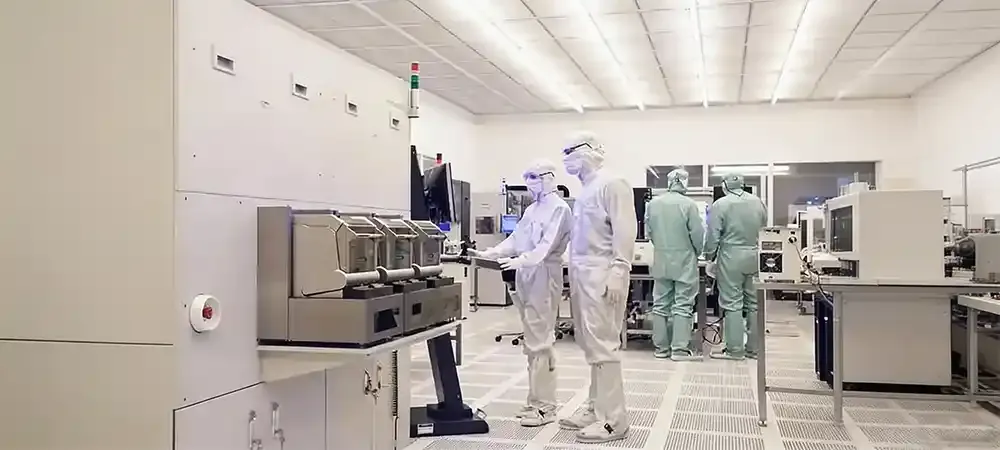
- Asset 4: View of finished project — Filename: completed-optical-assembly-cleanroom-deiiang.jpg — Caption: Assembled cleanroom containing FFU array, workstation, pass-thru and operator station.
Cleanroom Design and Delivery of Optical Assembly
Optics cleanroom design follows a structured delivery process: assessment, classification, HVAC/ESD/AMC design, pricing, manufacturing, testing, and training.
Step 1 — Study and assess the process and the possible contamination
Deiiang™ collects: type and size of product, flow chart of the process, where you can find contamination, list of solvents and adhesives, equipment heat, how many people, what's the capacity, what's the condition of the building, local rules and regulations.
Step 2 — cleanroom class and Zoning
Deliverables include: classifications of cleanroom, recommendations of classes, design of zoning, layout of flow of room, room pressure gradients, position of critical equipment, and local protection of critical equipment/stations.
Step 3 — Design of HVAC, Filters and ESD
Deliverables include: airflow calculations, number of FFUs, filter grades, design of return air and control of temperature and humidity, placement of ionizers, design of ESD and grounding, and AMC filters.
Step 4 — Pricing
Cleanroom assembly pricing is broken down by: cleanroom walls, HVAC assembly, FFUS and filters, control and assembly of ESD and humidity and temperature, lighting and electrical work, control and assembly of ESD and humidity and temperature, ESD assembly, AMC filters, control and assembly, and prices of work and validation.
Pricing is influenced by the cleanroom area, ISO class, retrofitting vs. a new build, number of equipment, type of filter, level of AMC, temperature and humidity control, location, installation requirements, and delivery timeline.
Step 5: Manufacturing and assembly
Deiiang™ provides: procurement of materials and equipment, modular cleanroom assembly, HVAC structures and installation, ESD assembly and controls, grounding, and AMC modules, along with assembly and coordination with the assembly and safety inspections.
Step 6 — Testing and commissioning
Testing Procedure: After all other procedures for setting up the cleanroom, equipment is operated without load first. This is followed by evaluation of airflow and air change rates, air pressure differentials, temperature and humidity, particulates and dust quantity, types and grades of airborne contaminants, ESD verification, integrity testing, ESD and AMC/VOC, continuous testing and data stabilization, and documentation.
Step 7 — Training and After Sales Services
After the sale: Training operators in cleaning methods, daily cleaning and filter replacement, ESD inspections and AMC log keeping, responding to alarms, service request time management, managing spare parts and responding to after sales requests.
Cost, Delivery Time, and Purchasing Considerations
When selecting a partner for ESD control cleanroom and AMC control cleanroom projects, consider total cost of ownership, not just first-build cost.
Questions to ask before choosing a cleanroom supplier:
- Have they worked in optical or precision manufacturing?
- Are they able to address particles, ESD, and AMC simultaneously?
- Are their designs and drawings?
- Are they able to offer a third party testing or validation?
- Is the cost for filters and maintenance provided?
- Are they able to support a cleanroom build versus a cleanroom retrofit?
- Are they able to comply with statutory requirements and customer needs?
- Are their warranties and after sales services clearly stipulated?
Design for more than cleanroom first build cost
First build costs that are low, generally result in poor quality, high energy, short filter times, AMC control that is out of control, rework of the process area, validation of cleanrooms that have failed, and increased down time of production.
Optical Lens Assembly Cleanroom Acceptance Inspection
A rigorous acceptance inspection validates that the optics cleanroom design meets all operational requirements for particles, ESD, AMC, airflow, and HVAC.
Design and zoning
- Confirmed cleanroom class for product and process.
- Defined personnel, material, and waste flow paths.
- Established gowning and buffer zones.
- Confirmed local clean protection for critical stations.
- Assessed contamination risks from dispensing, cleaning, and packaging areas.
Airflow and HVAC
- Completed airflow volume and air change calculations.
- Confirmed supply and return air paths.
- Completed pressure gradient design.
- Checked that airflow does not impact lens surfaces.
- Defined the range of temperature and humidity with alarm.
ESD Control
- All workstations and equipment are grounded.
- Establishment of a personnel grounding test.
- Complete coverage of critical operations with ionizers.
- Ion balance and static decay time are verified.
- A complete range of anti-static materials and fixtures.
- Establishment of an ESD log for daily entry.
AMC Control
- Identification of the sources of various emissions including adhesives and solvents.
- Establishment of a VOC/AMC risk assessment.
- Establishment of AMC filters for matching contaminants.
- Reasonable AMC sampling points.
- Establishment of a routine for the replacement of filters.
- Establishment of AMC and alarm monitoring logs.
Testing and Handover
- Cleanroom class verification.
- Integrity testing of all filters.
- Testing for airflow and pressure differentials.
- ESD testing.
- Testing for AMC and VOC.
- Receipt of full validation report.
- Completion of Operator Training.
- Confirmation of After Sales and Spare Parts Support.
Why Collaborate with Deiiang for Optical Cleanroom Projects?
Deiiang™ delivers integrated optics cleanroom design with a focus on application-oriented solutions, project execution, and local service in Southeast Asia.
Engineering Integration
Deiiang™ provides an integrated design for cleanroom structure, HVAC, filtration, ESD control, AMC control, monitoring, commissioning, and validation.
Application-Oriented Design
Every solution for every optical product is thoroughly customized based on the type of optical product, steps in the process, sources and types of contamination, target ISO class, existing building conditions, budgetary constraints, and the desired lead time.
Project Execution Capability
Deiiang offers the complete suite of services from design and manufacturing to on-site installation of the product, system commissioning, validation testing, training, and comprehensive after-sale services. All of these services support the installation of optical cleanrooms.
Local Service
From Deiiang's project experience in Southeast Asia, the on-site engineering team supports a full cleanroom delivery with an expected response time of 24-48 hours, and the estimated project time for similar optical cleanroom projects is 10-16 weeks.
Designer: Jason.peng
Frequently Asked Questions
Common questions about ESD control cleanroom and AMC control cleanroom design for optical lens assembly, answered by Deiiang™ engineers.
What ISO class is recommended for Optical Lens Assembly?
There is not one ISO class for every optical application. It is based on the sensitivity of the process, the allowable tolerances of the product, and what the client wants. Cleaning, assembly, dispensing, and inspection processes may require different zone classifications.
Why is ESD Control Important in an Optical Cleanroom?
A static charge will attract contaminants to the surfaces of lens and will discharge onto sensitive camera modules or sensors. It is a requirement for an optical cleanroom that grounding, materials, ionization and monitoring should all be considered as part of ESD control.
What is AMC in a cleanroom?
AMC, or Airborne Molecular Contamination, refers to the presence of volatile organic compounds (VOCs), various acids, bases, and other chemical vapors that can leave residual damage to coatings, adhesives, metals, and adversely affect long-term reliability.
Can HEPA Filters Remove AMC?
HEPA filters are designed to trap particulate matter and do not remove gaseous contaminants. AMC requires Chemical Filter Media that are adapted to the specific contaminants.
What is the time frame for a cleanroom project?
Project time frames can range substantially based on the area of the project, desired ISO classification, purpose and placement of specialized equipment, retrofit vs. new build status, and project locality. Generally, cleanroom projects are complete between 10 and 20 weeks from design to the final handover.
What is the cost of an optical lens assembly cleanroom?
The cost of an optical lens assembly cleanroom is difficult to quote due to variance in project location, the ISO class of the end desired cleanroom, the configurations of the cleanroom's HVAC and filtration, the cleanroom's ESD and AMC systems, and the complexity of the monitoring equipment. Additionally, total cost of ownership must be assessed as compared to the initial cost of construction.
A reliable optical cleanroom truly is not marked by the cleanliness of the surfaces of the cleanroom. Reliable optical cleanrooms are marked by the measurable control of particles and static as well as the control of molecular contamination and process reliability.
References
- iso 14644-1:2015 — Cleanrooms and associated controlled environments, Part 1: Classification of air cleanliness by particle concentration
- iso 14644-8:2022 — Classification of airborne molecular contamination
- ANSI/ESD S20.20-2021 — Protection of Electronic Devices, Assemblies and Equipment
- Deiiang™ — Cleanroom Integration, ESD & AMC Control
© 2026 Deiiang™ • Designed by Jason.peng • All rights reserved.