+86 13638632902
 Jason@cleanroomequips.com


 MENU
MENU
Effective Pressure Cascade Design is essential for maintaining airflow direction across multi-room cleanrooms. By controlling differential pressure, air moves from cleaner to less clean zones, preventing cross-contamination, supporting regulatory compliance, and protecting sensitive processes, products, personnel, and environmental integrity consistently.
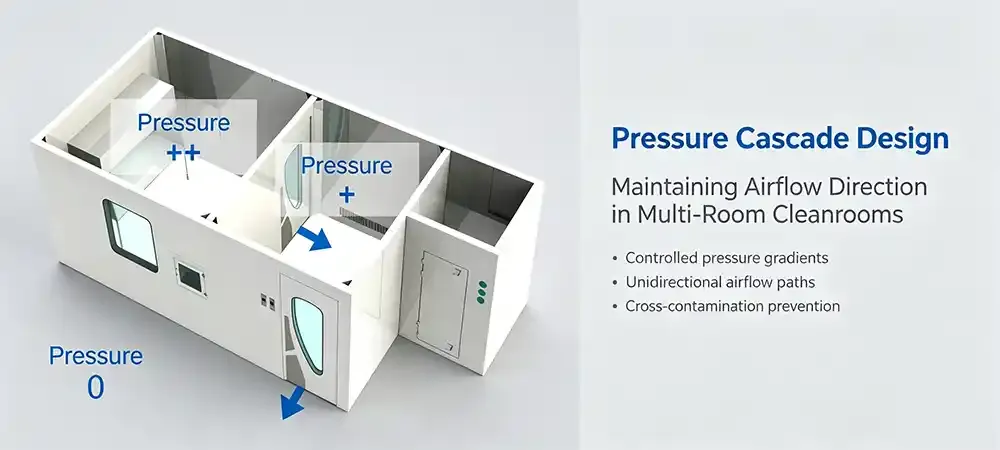
Pressure cascade principle: corridor → buffer → clean zone → critical process area
Why Pressure Cascade Defines Cleanroom Success
In multi-room cleanroom facilities, controlling contamination isn’t just about how well the HEPA filter performs.
If the differential pressure relationship is not properly designed or controlled, clean air backflow may occur, this causes dusty and bacteria-laden air to flow back into the high-cleanliness area.
Doors, airlocks, and return air paths are usually the key point with the highest risk of cross-contamination.
What Is Pressure Cascade Logic
The main function of differential pressure cascade logic is to establish a progressively decreasing pressure gradient between interconnected rooms.
Air will continuously flow from high-pressure areas to low-pressure areas, move along a controllable path.
In a cleanroom with a multi-room layout, this feature effectively prevents accidental cross-migration of particulate matter and aerosols.
EACH functional area needs to have a suitable differential pressure level set specifically for it. In practice, there is no universally applicable "one-size-fits-all" solution.
Positive vs Negative Pressure Cleanroom
Choose between positive pressure or negative pressure cleanroom configuration, depends entirely on the specific application scenario.
Neither of these two designs is absolutely superior, only by choosing a design that is more suitable for your usage scenario can you ensure both security and performance.
Positive Pressure Cleanroom
✅ Advantages
- Blocks unfiltered external air from entering clean zones
- Simpler balance and lower long-term maintenance cost
- Works well for general precision manufacturing
✅ Key Industries
- Electronics, semiconductors, food production
- Precision assembly, medical device manufacturing
✅ Control Mechanism
Supply air volume exceeds return air; clean air leaks outward.
❌ Limitations
- Cannot contain internal hazardous or bioactive agents
- Excessive pressure causes door operation difficulties
Negative Pressure Cleanroom
✅ Advantages
- Contains internal contaminants inside controlled zones
- Prevents hazardous agents from escaping to public areas
- Supports biosafety and toxic process requirements
✅ Key Industries
- Biosafety labs, pharmaceutical high-containment zones
- Pathogen research, hazardous material handling
✅ Control Mechanism
Return air volume exceeds supply air; internal air does not leak out.
❌ Limitations
- Higher risk of external particle ingress into the zone
- Requires dedicated exhaust and air treatment systems
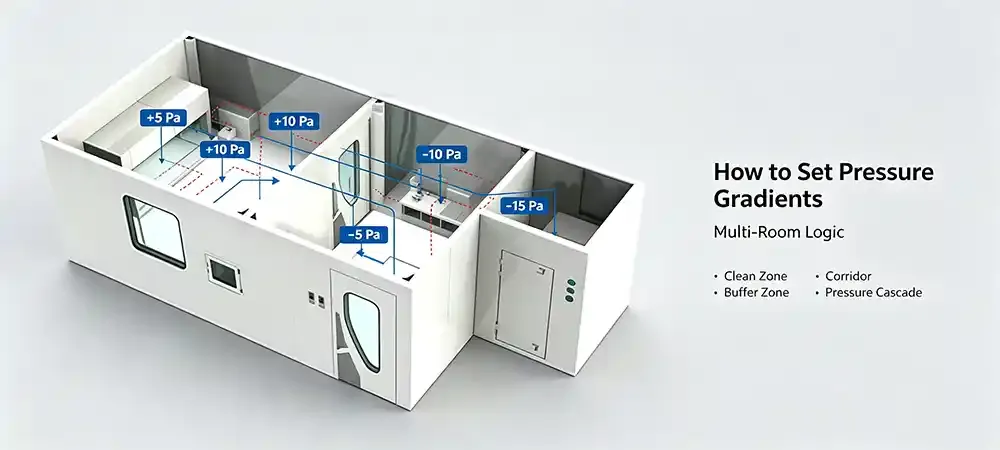
How to Set Pressure Gradient: Multi-Room cleanroom design Logic
The design of pressure differential gradient in cleanrooms should follow the principle of gradual change in pressure differential in each area.
An appropriate pressure difference must be maintained between adjacent rooms, to ensure that the airflow direction is always controlled.
Multi-Room Pressure Relationships
For a typical positive-pressure cleanroom suite, a 5 Pa step per zone is standard practice:
- General corridor: 0 Pa (reference baseline)
- Buffer airlock: +5 Pa relative to corridor
- Main cleanroom: +10 Pa relative to corridor
- Core process zone: +15 Pa relative to corridor
For negative containment suites, values reverse with the core zone at the lowest pressure.
Airlock Topology Options
Airlock design is the backbone of pressure cascade stability. Three common topologies serve different risk profiles:
Cascade Airlock
Pressure: Mid-point between two adjacent rooms
Use case: Standard positive-pressure cleanroom suites, general manufacturing
Note: Most common, lowest energy cost, suitable for low-to-medium risk zones
Bubble Airlock
Pressure: Higher than both adjacent rooms
Use case: Between high-contamination and high-cleanliness zones
Note: Prevents cross-migration in both directions, ideal for mixed-risk layouts
Sink Airlock
Pressure: Lower than both adjacent rooms
Use case: Biosafety labs, toxic material handling, negative containment suites
Note: Absorbs air from both sides, prevents hazardous agent escape
Factors to Consider in Pressure Design
- Primary function and risk level of each room
- Door opening frequency and personnel traffic volume
- Return air layout and overall air balance
- Filter resistance increase over service life
- Outdoor temperature and humidity seasonal variations
- Airflow stability of the central HVAC system
Core Design Objectives
- Maintain consistent unidirectional airflow between zones
- Minimize cross-contamination, odor and particle transfer
- Reduce pressure dip recovery time during door openings
- Optimize fan energy use while meeting cleanliness rules
Global Regulatory Standards for Pressure Differentials
Designing a compliant pressure cascade requires adhering to international guidelines. Below is a quick reference for pharmaceutical and critical cleanroom environments:
| Regulatory Body | Guideline / Standard | Required Pressure Differential (Adjacent Zones) |
|---|---|---|
| EU GMP | Annex 1 (Manufacture of Sterile Products) | 10 Pa to 15 Pa (guidance value) |
| FDA (USA) | Aseptic Processing Guidance | 0.05 inches of water (approx. 12.5 Pa) |
| ISO | iso 14644-4 | 5 Pa to 20 Pa (depending on risk assessment) |
EU GMP Annex 1
10 Pa to 15 Pa between adjacent clean zones
FDA Aseptic Guidance
0.05 in W.C. (≈12.5 Pa) differential pressure
ISO 14644-4
5 Pa to 20 Pa per risk assessment
Door Gap Air Leakage Calculation
Airflow is compensated for by addressing air leaks caused by door gaps, wall perforations, and sealed seams, to maintain the pressure differential.
The makeup air volume required to maintain the target pressure differential can be estimated using the standard orifice flow equation:
Multiply by 3600 to convert to CMH (m³/h)
⚡ Door Gap Leakage Estimator
Estimate the supply make-up airflow required to maintain a specific pressure differential across a closed door.
*Formula based on standard orifice flow equations. Actual values depend on gap discharge coefficients, air density and seal conditions.
Pressure cascade design workflow and room-to-room transmission path
Why Pressure Gets Out of Control: Common Engineering Issues
Many cleanrooms pass static commissioning but fail to hold pressure under real operating conditions.
Several common root causes account for most pressure instability issues in the field.
- Unbalanced initial air distribution across branch ducts
- Rising filter resistance as particles accumulate over time
- Frequent door cycling breaking the pressure balance
- Unstable fan speed control and slow response times
- Large indoor-outdoor temperature/humidity swings
- Poor differential pressure sensor placement
- Commissioning only under static no-traffic conditions
Many differential pressure control systems performed well during acceptance testing, but begin to fail after three months of operation.This is usually caused by wear on the door’s bottom seal strip. As the gap gets larger, air leakage can double, eventually causing the room’s pressure differential to collapse.Therefore, it is important to reserve a 15%–20% safety airflow margin for variable frequency fans during the selection phase, to compensate for the performance degradation caused by long-term mechanical wear.
Systems that rely solely on digital differential pressure sensors are at risk of "silent drift".Digital sensors may malfunction due to long-term operation, aging, temperature and humidity fluctuations, or calibration errors.Therefore, please be sure to install an analog Magnehelic differential pressure gauge as a secondary reference, and it is cross-calibrated monthly.Sensor measurement deviations are one of the main reasons why differential pressure faults are not detected in a timely manner in GMP facilities.
“Pressure control doesn’t end when you dial in a static setpoint. It requires the system to consistently maintain airflow direction under real operating conditions.”
Deiiang Technical Solutions
If you want to adjust the supply and return air volumes in real time based on the differential pressure reading, then I highly recommend Deiiang's precision environmental control system.
The system was designed by our professional engineer, Jason Peng, pressure control accuracy can reach ±1 Pa, the response time is less than 3 seconds.
In multi-room cleanroom scenarios, the linked control logic keeps the pressure cascade locked in at a stable gradient across the whole system.
This solution is particularly effective in environments with frequent door opening cycles, high humidity, or round-the-clock multi-shift operations.
- Variable-frequency fan range: 15%–100% stepless adjustment
- Automatic compensation for filter resistance drift
- Door-opening signal linkage for pre-adjustment of airflow
- Up to 20% energy savings compared with fixed-speed systems
Deiiang Case Study: Real-World Implementation
Project Background
Multi-room Pharmaceutical cleanroom facility covering packaging, filling and support zones.
Project goal: stable differential pressure, zero cross-contamination risk, full EU GMP Annex 1 compliance.
Project Challenges
- Long pressure cascade chain across 12 connected rooms
- High personnel and material transfer frequency
- High local humidity causing seasonal pressure drift
- Initial system showed frequent pressure fluctuation events
Deiiang Solution
- Zoned pressure cascade design with dedicated bubble airlock buffers
- Linked supply-return fan control with dynamic airflow trimming
- Real-Time Differential Pressure Monitoring + analog Magnehelic backup at all critical interfaces
- Door interlock optimization and airlock airflow stabilization
Project Results: Performance Comparison
Performance comparison before and after integrating Deiiang™ dynamic VFD control in the 12-room GMP facility:
| Metric | Legacy Fixed-Volume System | Deiiang™ Dynamic Cascade |
|---|---|---|
| Baseline Pressure Fluctuation | ± 4.5 Pa (Unstable) | ± 0.8 Pa |
| Pressure Recovery Time (After Door Open) | > 45 Seconds | < 12 Seconds |
| Cross-Contamination Events (Annualized) | 3 Recorded Incidents | 0 Incidents |
| Annual HVAC Energy Consumption | Baseline (100%) | 78% (-22% Savings) |
Common Misconceptions
Many people have some misconceptions about differential pressure cascade design. These misconceptions often lead to design errors, even increase many unnecessary operating costs.
Higher positive pressure always means better protection.
Actually, that's not the case. Excessive positive pressure not only makes doors harder to open, but also increases energy consumption. And it may disrupt the pressure balance between adjacent areas, thus affecting overall stability.
Negative pressure cleanrooms are inherently more dangerous.
This statement is inaccurate. Negative pressure is merely a control method for a specific process, the real risk comes from poor design, rather than the direction of the pressure itself.
More supply air guarantees more stable differential pressure.
Whether the differential pressure is stable depends on whether the supply and return air volumes are balanced, it's not simply about the air volume. A higher air volume does not necessarily mean a more reliable system.
Static test values reflect real-world pressure performance.
Real-world usage scenarios are often more complex than static testing, frequent opening and closing of doors, personnel movement, and aging filters are the main causes of differential pressure drift. If you only look at static tests, you will often overestimate the stability of the system.
One pressure template works for all cleanroom layouts.
Different processes, different functions, and different risk levels all have different requirements for differential pressure cascading. Therefore, customized designs must be made according to the actual situation.
Comparison Matrix: Pressure Control Strategies
Differential pressure control approaches vary in stability, cost and suitability for multi-room facilities.
Below is a side-by-side view of three common strategy pairs used in cleanroom engineering.
| Strategy Pair | Advantages | Disadvantages | Best Fit |
|---|---|---|---|
| High pressure setpoint vs Low pressure setpoint | High setpoint: stronger barrier effect Low setpoint: lower energy cost, quieter doors | High setpoint: high energy use, door strain Low setpoint: weaker contamination defense | High setpoint: high-risk core zones Low setpoint: support and buffer zones |
| Single-room control vs Multi-room cascade control | Single-room: simple commissioning Multi-room: coordinated gradient, lower cross-zone risk | Single-room: poor zone-to-zone coordination Multi-room: more complex tuning logic | Single-room: standalone labs Multi-room: full production suite layouts |
| Fixed pressure control vs Dynamic pressure control | Fixed: low upfront cost, simple hardware Dynamic: adapts to load and filter aging | Fixed: drifts over time, higher energy waste Dynamic: higher initial investment | Fixed: low-usage auxiliary rooms Dynamic: critical process and high-traffic zones |
High Pressure Setpoint
Pros: Stronger contamination barrier
Cons: Higher energy use, door operation strain
Best for: High-risk core process zones
Multi-Room Cascade Control
Pros: Coordinated gradient, lower cross-zone risk
Cons: More complex commissioning logic
Best for: Full production suite layouts
Dynamic Pressure Control
Pros: Adapts to load and filter aging
Cons: Higher initial system investment
Best for: Critical process and high-traffic zones
FAQ
Conclusion & Call to Action
In a multi-room cleanroom, pressure cascade is what keeps the airflow direction stable and under control.
You must choose between positive or negative pressure based on the actual application scenario;choosing the wrong option can lead to significant risks and problems.
Multi-room systems cannot be judged solely by one-time static test values, instead, the goal is to achieve stability, dynamism, and validation.
Deiiang™ provides custom pressure-cascade solutions and on-site engineering support for pharmaceutical, electronics, and laboratory cleanroom projects.
If needed, we can provide you with customized differential pressure cascade design solutions and downloadable differential pressure calculation templates for multi-room cleanrooms. Alternatively, you can contact Deiiang directly for professional engineering advice.