+86 13638632902
 Jason@cleanroomequips.com


 MENU
MENU
The real safety boundary of a cleanroom is formed by three pillars: the structural fireproofing, the complete airtight seal and the differential pressure that can be verified. Deiiang™ has gained experience with over 100 projects and clearly can confirm that without measurement of the pressure, also fire- and sealing strategies are not proven.

How Fireproofing, Sealing and Pressure Gradients Interact in cleanrooms
A fire-rated wall that leaks air undermines cleanroom pressure differential. The interaction follows ΔPactual = ΔPdesign − ΔPleakage. When leakage exceeds 15–20% of design pressure, the cascade degrades.
Fire Compartments in GMP and iso cleanrooms
GB 50016 & GB 50457-2019: Fire walls, floors, Doors must contain flame/smoke for 60–120 min.
EU GMP Annex 1: Pressure cascades ensure airflow from clean to less clean zones.
NFPA 45/101: Compartment requirements for labs and healthcare.
Smoke follows pressure gradients. Unsealed penetrations turn a rated wall into a smoke path. Differential pressure measurement is the only real‑time verifICation that fire compartments work.
Why Sealing Quality Decides Whether Fireproofing Works
The Leakage rate (L/s per meter at 50 Pa) defines the pressure stability. From the measurement data of Deiiang™ in 2025 at the project location in Suzhou: After secondary airtight sealing of the unsealed fire‑door gaps in the corridors, the pressure fluctuation changed from ±4 Pa to ±1 Pa, air loss was decreased by about 18%, which corresponds to an energy saving of about 12,000 kWh/year.
Figure 2 — Pressure Stability
Example: Room setpoint 15 Pa, leakage area 0.02 m² → actual pressure ~9–11 Pa (below GB 50457-2019 limit of 10 Pa). Reduce leakage to 0.005 m² → pressure recovers to 13–15 Pa. Differential pressure detection must pair with a sealing audit.
The Cleanroom Pressure Trio: Gauge, Handheld Device, Sensor
Three device classes, eACH with a distinct GMP compliance role. Mixing them creates audit deficiencies.
Wall-Mounted Mechanical Pressure Gauge: Local Visual Check Only
Pure mechanical, no power. Accuracy ~2–5% FS (e.g., ±1.2–3.0 Pa on a 60 Pa gauge). No data, no audit trail. Cleanroom pressure differential indication only — not for validation.
Pros: No power, robust, low cost
Cons: Low accuracy, no record, no alarm
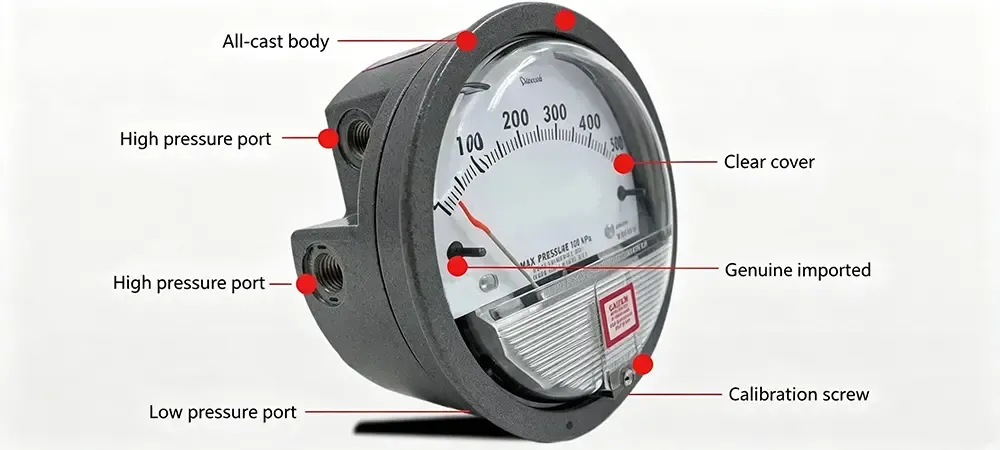
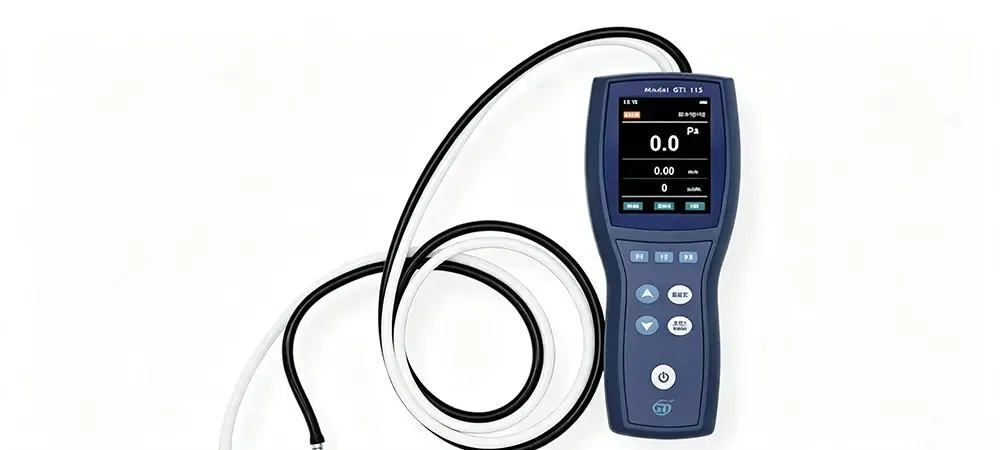
Handheld Digital Differential Pressure Meter: Validation Baseline
MEMS chip, temperature compensated, accuracy ≤±1% FS or ±0.2 Pa. The only recognised tool for GMP validation and fire‑compartment verification. Deiiang™ specs: range ±250 Pa, resolution 0.1 Pa, >10,000 points log, ISO 17025 traceable to JJF 1363-2012.
Annual GMP validation
Post‑sealing acceptance tests
Fire door pressure spot‑checks
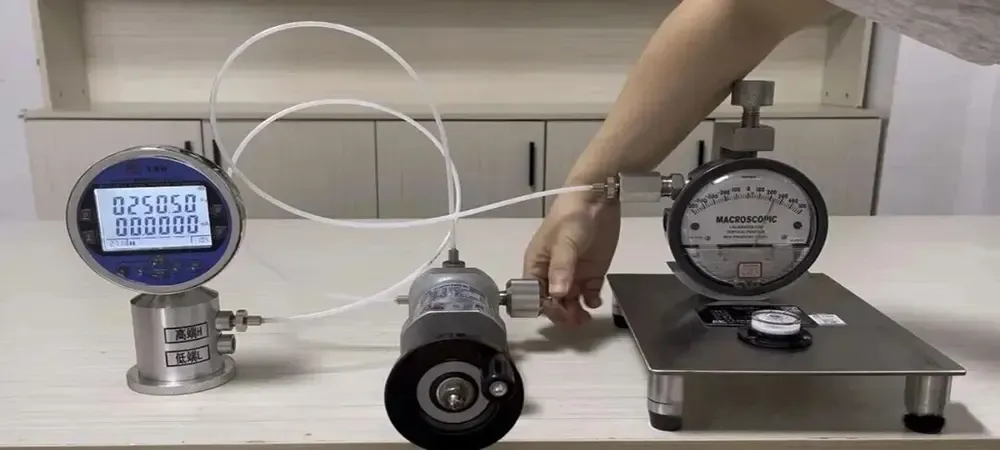
Differential Pressure Transmitters: 24/7 Online Monitoring
The module supplies 4-20 mA or RS485 to BMS/EMS in the Grade A/B areas and fire-critical zones. Deiiang™ sensors are used with zero drift <±0.1 Pa over 12 months, IP65 and response time <1 s. The module continuously monitors differential pressure and issues alarm.
| Device | Use Case | Data Integrity | Accuracy |
|---|---|---|---|
| Mechanical Gauge | Local visual check | None | ~2–5% FS |
| Handheld Digital Meter | Validation, fire verification | High (logged) | ≤±1% FS or ±0.2 Pa |
| Pressure Sensor | 24/7 monitoring, BMS alarm | High (audit trail) | ≤±1% FS, drift‑controlled |
| Device | Main Role | Accuracy |
|---|---|---|
| Mechanical Gauge | Visual only | ~2–5% FS |
| Handheld Meter | Validation baseline | ≤±1% FS or ±0.2 Pa |
| Pressure Sensor | 24/7 monitoring | ≤±1% FS |
Table: The Cleanroom Pressure Trio — non‑interchangeable roles.
How Good Sealing and Pressure Monitoring Support Cleanroom Fireproofing
A cleanroom fireproofing strategy without airtight envelopes and verified differential pressure monitoring is only a drawing. Below are the most frequent failure points.
Critical Interfaces: Where Fireproofing and Sealing Fail Most
Fire door gaps (5–8 mm) — can reduce pressure by 30–50%.
Penetrations without secondary airtight seal — fire mastic alone leaks air, bleeding 3–5 Pa.
Plenum spaces — where fire walls stop at ceiling grid, smoke bypasses the occupied zone.
Deiiang's Measurement Data: 100+ Projects
After systematic sealing remediation (2020–2025):
72% of projects: critical pressure alarms reduced >50%.
Commissioning time shortened 20–30%.
Audit deficiencies related to pressure dropped to near zero.
Deiiang Case Study: From Leaky Fire Doors to Stable Pressure Cascades
Project: GMP Sterile injectable facility, Suzhou. iso class 7/8, multiple fire compartments. Initial problem: corridor pressure<15 Pa design, fluctuations ±5 Pa across fire boundaries.
Persona: Mr. Li, Facility Engineering Manager
Facing EU GMP and domestic audits, his team manually adjusted dampers before inspections. He searched for “cleanroom fireproofing” and “differential pressure monitoring for fire compartments”.
Key Challenges
Fire door gaps 5–8 mm → leakage ~45–65 m³/h per door.
Cable bridge penetrations fire‑stopped but not airtight.
Three sensors showed zero drift +1.8 to +3.2 Pa due to missed calibration.
Deiiang's Integrated Solution
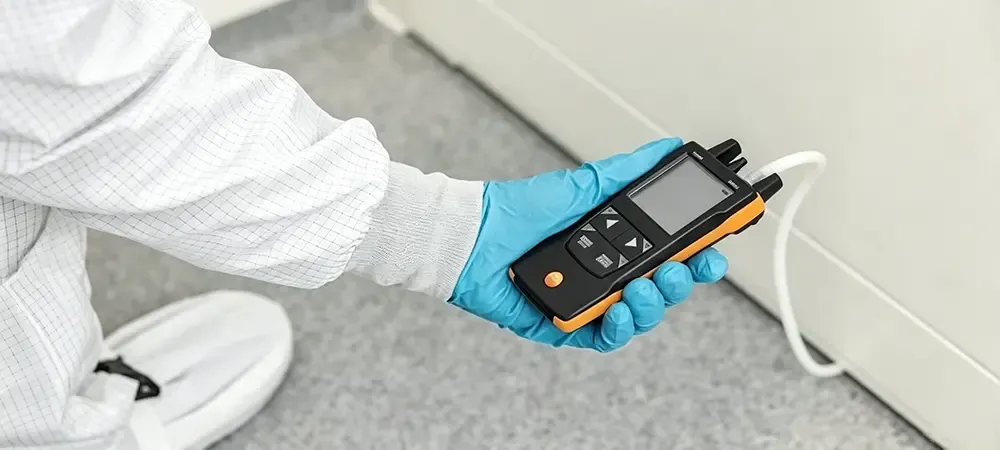
A baseline survey of over 30 rooms with a handheld pressure meter generated a pressure heatmap.
Sealing: Door perimeters, penetration double‑layer (fire + airtight), plenum junctions sealed.
Sensor upgrade: Deiiang transmitters are to be installed (±0.2 Pa resolution), and to be annually calibrated against the handheld meters, with a quarterly comparison to ensure they are reading within JJF 1363-2012 specified limits.
Alarm strategy: warning threshold = ±3 Pa, critical threshold = ±5 Pa; simulated fire scenarios.
Results
Pressure stability improved from ±4–5 Pa to ±1–2 Pa.
BMS false alarms reduced >80%.
EU GMP audit: zero observations on fireproofing/pressure control.
~12,000 kWh annual HVAC saving, payback<14 months.
Design note: Product specifications reflect the work of Jason Peng, Deiiang™ product designer, focusing on VHP resistance and long‑term stability.
Practical Checklist: Fireproof, Seal, Then Verify with the Pressure Trio
Designers & Fire Engineers:
Define fire compartments + pressure cascades together.
Specify airtight sealing standards at barriers.
Include calibrated differential pressure sensors in fire‑critical zones.
Contractors:
Dual‑layer: firestopping + airtight sealant at every penetration.
Verify pressure with handheld meter before handover.
QA & Facility Teams:
Daily: check mechanical gauges for gross shifts.
Annually: validate cascades with calibrated handheld meter.
Continuously: rely on sensor alarms and investigate, don’t ignore.
Conclusion: Fireproofing Only Works When Pressure and Sealing Are Measurable
Cleanroom fireproofing materials, airtight sealing, and the pressure trio form a closed loop. Deiiang™ delivers an auditable pressure evidence chain — making fire and sealing strategies verifiable and sustainable. Without measurement, compliance is only on paper.
Micro-Glossary
Differential Pressure (ΔP): Pressure difference defining airflow direction and smoke movement.
Fire Compartment: Zone separated by fire‑rated elements to contain fire/smoke.
Airtight Sealing: Closing gaps to minimise leakage and maintain pressure cascades.
Differential Pressure Transmitter: Sensor converting ΔP to electrical signal for BMS/EMS.
GMP Annex 1 Pressure Cascade: Controlled gradient ensuring airflow from cleaner to less clean zones.
References
GB 50457-2019 Chinese Standard
GB 50016 Fire Protection Code
EU GMP Annex 1 EudraLex
iso 14644-4:2019 ISO
NFPA 45 / 101 NFPA
JJF 1363-2012 Calibration Standard
Product Designer: Jason Peng | Deiiang™ Cleanroom Pressure Solutions | © Deiiang 2025