+86 13638632902
 Jason@cleanroomequips.com
 MENU
MENU
Introduction
Cleanrooms form the backbone of modern technological advancement, with their core function being precise air contamination control. Understanding the fundamental principles of cleanroom airflow is essential for anyone working in pharmaceutical manufacturing, Semiconductor production, or biomedical research facilities.
The sophisticated principles of cleanroom airflow represent more than simple ventilation - they embody a comprehensive system based on precise physical and engineering principles that work in harmony to maintain sterile environments. This article will explore these critical principles in depth, revealing exactly how cleanroom airflow effectively maintains highly controlled environments.
What you'll learn: The six core principles of cleanroom airflow, their scientific foundations, practical applications, and how they integrate to create effective contamination control systems.
The Foundation: Why Principles Matter?
Before examining the specific principles of cleanroom airflow, it's crucial to understand why these principles are necessary and what challenges they address in contamination control.
1.1 Challenge: Ubiquitous Microscopic Contaminants
Airborne particles and microorganisms present constant challenges in cleanroom environments. These contaminants range in size from large visible particles (≥50μm) to submicron particles (0.1-1.0μm) and microbial contaminants (typically 0.3-10μm). Understanding particle behavior is fundamental to the principles of Cleanroom airflow design.
Particle Size Examples:
- Human hair: 50-100μm
- Bacteria: 0.3-10μm
- Viruses: 0.01-0.3μm
- Smoke particles: 0.01-1μm
1.2 Target: Precision Control and Elimination
Cleanrooms achieve contamination control through deliberate design rather than chance. The principles of cleanroom airflow ensure that particle concentrations remain within specified limits through systematic approaches to air handling, filtration, and movement.
Core Principle 1: Air Dilution & air changes Per Hour (ACH)
The first of our Cleanroom Airflow Principles involves systematically replacing contaminated air with filtered clean air. This dilution principle forms the foundation of non-unidirectional airflow systems.
2.1 Principle Explanation
Air dilution works by introducing large volumes of clean air to reduce the concentration of airborne contaminants. The effectiveness is measured by air changes per hour (ACH), calculated as: ACH = (Supply Air Volume in m³/h) / (Room Volume in m³).
Air Dilution Visualization
As clean air enters, particle concentration decreases over time
2.2 Factors and Applications
The required ACH varies significantly based on the CleanRoom Classification. Higher cleanliness levels demand more frequent air changes to maintain particle counts within specified limits.
For example, a Deiiang™ ISO 5 Cleanroom with dimensions 5m × 5m × 3m (75m³ volume) requiring 400 ACH would need a supply air volume of 75m³ × 400 = 30,000 m³/h. This demonstrates how the principles of cleanroom airflow translate into practical engineering requirements.
Core Principle 2: Unidirectional vs. Non-Unidirectional Flow
Understanding flow patterns is essential to mastering the principles of cleanroom airflow. The two primary flow types serve different cleanliness requirements and applications.
3.1 Unidirectional Flow Principle (Laminar Flow)
Unidirectional airflow, often called laminar flow, moves in parallel streams at consistent velocity (typically 0.3-0.5 m/s ±20%) to push contaminants away from critical areas. This creates a "piston effect" that minimizes turbulence and cross-contamination.
Unidirectional Flow Characteristics:
- Parallel airflow streams
- Velocity: 0.3-0.5 m/s ±20%
- Minimal turbulence
- High particle removal efficiency
- Used in ISO 3-5 cleanrooms
3.2 Non-Unidirectional Flow Principle (Turbulent/Mixed Flow)
Non-unidirectional airflow relies on air mixing and dilution through high air change rates. While less efficient than unidirectional flow, it's more cost-effective for less critical applications.
Non-Unidirectional Flow Characteristics:
- Turbulent airflow patterns
- Lower velocity requirements
- Relies on high ACH for cleanliness
- Significant air mixing
- Used in ISO 6-8 cleanrooms
3.3 Comparative Analysis
| Parameter | Unidirectional Flow | Non-Unidirectional Flow |
|---|---|---|
| Flow Pattern | Parallel, laminar | Turbulent, mixed |
| Cleanliness Level | ISO 3-5 | ISO 6-8 |
| Air Velocity | 0.3-0.5 m/s | Variable, lower |
| Air Changes | 240-600+ per hour | 10-160 per hour |
| Cost | Higher | Lower |
| Applications | Critical processes | Less critical areas |
Deiiang™ engineers like Jason.peng carefully evaluate process requirements to determine the optimal flow pattern, ensuring the selected approach aligns with both cleanliness requirements and operational efficiency.
Core Principle 3: Pressure Differential & Airflow Direction
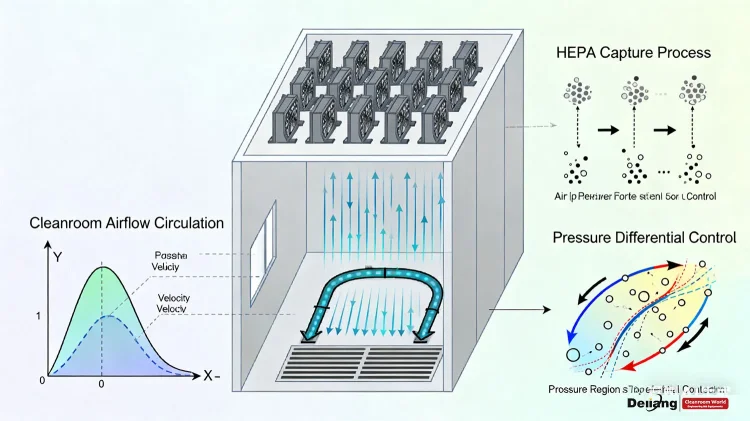
Pressure differentials represent one of the most critical principles of cleanroom airflow, creating directional airflow that prevents contamination migration between spaces.
4.1 Principle Explanation
Pressure differentials create controlled airflow directions that prevent contamination spread. Positive pressure (clean areas) prevents infiltration, while negative pressure (contaminant sources) contains hazards.
Positive Pressure
Clean area pressure > adjacent area pressure
Prevents external contamination
Negative Pressure
Contaminated area pressure < adjacent area pressure
Contains hazardous materials
4.2 Pressure Maintenance Mechanisms
Maintaining precise pressure differentials requires careful balance between supply and exhaust airflow rates. A typical pressure cascade might maintain 15-30 Pa between adjacent cleanrooms, with the highest pressure in the most critical areas.
For example, a Deiiang™ pharmaceutical cleanroom suite might maintain: gowning area (15 Pa) → corridor (20 Pa) → preparation room (25 Pa) → filling room (30 Pa). This pressure cascade ensures airflow always moves from cleaner to less clean areas.
Core Principle 4: High-Efficiency Filtration
Advanced filtration systems represent fundamental cleanroom Airflow Principles that physically remove contaminants from the airstream, with HEPA and ULPA filters serving as the final defense against particle contamination.
5.1 Principle Explanation
HEPA (High Efficiency Particulate Air) and ULPA (Ultra Low Penetration Air) filters employ multiple capture mechanisms to remove particles from airflow:
Filtration Mechanisms:
- Interception: Particles following air streamlines contact fibers
- Inertial Impaction: Larger particles cannot follow air streamlines around fibers
- Diffusion: Small particles exhibit Brownian motion, increasing collision probability
- Electrostatic Attraction: Charged particles attracted to oppositely charged fibers
The Most Penetrating Particle Size (MPPS) typically falls between 0.1-0.3μm, where filtration efficiency is lowest. Filter efficiency ratings are determined at this critical size range.
5.2 Filter Types and Efficiency
| Filter Type | Efficiency Rating | Efficiency at MPPS | Typical Applications |
|---|---|---|---|
| HEPA H13 | 99.95% | ≥99.95% | ISO 5-7 cleanrooms |
| HEPA H14 | 99.995% | ≥99.995% | ISO 4-5 cleanrooms |
| ULPA U15 | 99.9995% | ≥99.9995% | ISO 3-4 cleanrooms |
| ULPA U17 | 99.999995% | ≥99.999995% | ISO 1-3 cleanrooms |
Deiiang™ filtration systems are designed to maintain efficiency while minimizing pressure drop, optimizing both performance and energy consumption in cleanroom airflow systems.
Core Principle 5: Air Velocity & Uniformity
Air velocity and distribution uniformity represent critical principles of cleanroom airflow that directly impact particle control effectiveness and process consistency.
6.1 Principle Explanation
Proper air velocity ensures sufficient momentum to carry particles toward returns while minimizing turbulence. Velocity uniformity prevents stagnant zones where particles could accumulate.
Velocity Profile Analysis:
Ideal Profile
Uniform velocity distribution
Consistent airflow across entire area
No stagnant zones
Problematic Profile
Variable velocity distribution
High/low velocity zones
Stagnant areas with particle accumulation
6.2 Stokes' Law Simplified Explanation
Stokes' Law describes particle settling velocity in air: V = (d² × g × (ρp - ρa)) / (18 × μ) where:
- V = settling velocity (m/s)
- d = particle diameter (m)
- g = gravitational acceleration (9.8 m/s²)
- ρp = particle density (kg/m³)
- ρa = air density (≈1.2 kg/m³)
- μ = air dynamic viscosity (≈1.8 × 10⁻⁵ Pa·s)
For example, a 10μm particle (ρp = 1000 kg/m³) settles at approximately 0.003 m/s, while cleanroom airflow velocities (0.3-0.5 m/s) are 100-150 times higher, effectively preventing settlement.
Understanding these cleanroom airflow principles enables Deiiang™ designers like Jason.peng to create systems that maintain consistent velocity profiles critical for contamination control.
Core Principle 6: Thermodynamics & Airflow
Thermodynamic principles significantly influence cleanroom airflow patterns and must be considered in system design to maintain effective contamination control.
7.1 Principle Explanation
Heat sources within cleanrooms create thermal plumes that disrupt designed airflow patterns. Understanding these effects is essential for proper cleanroom airflow design.
Thermal Effects on Airflow:
- Thermal Plumes: Rising air columns above heat sources
- Equipment Heat Load: Process equipment generating convective currents
- Personnel Effects: Body heat creating upward airflow (≈100W per person)
- Temperature Gradients: Creating natural convection currents
Temperature and humidity control also impact particle behavior through electrostatic effects. Higher humidity (typically 45±5% RH) reduces static charge buildup that can attract particles to surfaces.
7.2 Mitigation Strategies
Deiiang™ addresses thermodynamic challenges through strategic placement of supply and return openings, calculation of thermal loads, and appropriate airflow velocity selection to overcome natural convection forces.
For instance, in A CleanRoom with significant process heat generation (e.g., 5kW from equipment), additional airflow may be required to overcome thermal plumes and maintain designed airflow patterns that follow the fundamental principles of cleanroom airflow.
Integrated Application & Optimization
The true power of cleanroom airflow principles emerges when they're integrated into a cohesive system design. Successful implementation requires understanding how these principles interact and complement each other.
8.1 Principles in Cleanroom design
cleanroom design embodies the application of all airflow principles through strategic placement of FFUs (fan filter units), returns, and room layout that supports contamination control objectives.
Design Considerations:
- FFU placement for optimal coverage
- Low-level returns for effective particle removal
- Equipment placement to minimize airflow disruption
- Personnel movement patterns to reduce contamination
8.2 Computational Fluid Dynamics (CFD) Simulation
CFD modeling transforms theoretical principles of cleanroom airflow into predictable performance through virtual simulation before construction.
CFD Simulation Benefits:
Predicts airflow patterns, velocity profiles, pressure distribution, and particle trajectories
Identifies potential problem areas before construction
Optimizes system design for performance and efficiency
Deiiang™ utilizes advanced CFD analysis to validate that all cleanroom airflow principles are properly implemented and interacting as intended in the final design.
8.3 Continuous Verification & Monitoring
Regular testing ensures that the principles of cleanroom airflow continue to function as designed throughout the facility lifecycle. Key verification tests include:
- Air velocity and uniformity measurements
- Pressure differential confirmation
- Filter integrity testing
- Airflow visualization studies
- Particle count monitoring
These verification activities confirm that the fundamental cleanroom airflow principles remain effective in maintaining the required contamination control levels.
Conclusion
The success of any cleanroom hinges on the precise application and integration of the fundamental principles of cleanroom airflow. From air dilution and flow patterns to pressure differentials and filtration, each principle plays a critical role in effective contamination control.
Understanding how cleanroom airflow works requires appreciating both the individual mechanisms and their synergistic interactions. The fundamentals of cleanroom airflow provide the scientific foundation that enables modern manufacturing and research in critical environments.
At Deiiang™, our approach to cleanroom design, led by experts like Jason.peng, respects these scientific principles while applying practical engineering solutions. The cleanroom airflow mechanisms we implement are proven through both theoretical understanding and practical validation.
Key Takeaway: Effective contamination control isn't accidental—it's the direct result of properly understanding and applying the core principles of cleanroom airflow in both design and operation.
We invite you to explore how Deiiang™ can help implement these principles in your next cleanroom project. Contact our experts to discuss your specific requirements and discover optimized solutions based on proven cleanroom airflow principles.
Appendix
Glossary of Terms
ACH (Air Changes Per Hour): The number of times the total air volume in a room is replaced per hour.
HEPA (High Efficiency Particulate Air): Filter achieving minimum 99.97% efficiency on 0.3μm particles.
Laminar Flow: Airflow in parallel streams with minimal cross-currents.
MPPS (Most Penetrating Particle Size): Particle size at which filter penetration is highest.
Turbulent Flow: Airflow with random velocity fluctuations and mixing.
ULPA (Ultra Low Penetration Air): Filter achieving minimum 99.999% efficiency on 0.1-0.2μm particles.
Frequently Asked Questions
Q: Why can't cleanroom airflow velocity be too high or too low?
A: Excessive velocity creates turbulence and resuspension, while insufficient velocity allows particle settlement. The 0.3-0.5 m/s range optimizes particle carry-off while minimizing turbulence.
Q: How is airflow uniformity ensured in cleanrooms?
A: Through proper diffuser design, balanced air distribution, adequate room geometry, and sometimes flow straighteners. CFD analysis helps predict and optimize uniformity.
Q: What role does CFD simulation play in cleanroom design?
A: CFD predicts airflow patterns, identifies potential problems before construction, optimizes design for performance and energy efficiency, and validates that all principles work together effectively.