+86 13638632902
 Jason@cleanroomequips.com


 MENU
MENU
Getting a sterile production line cleared in Shanghai is simple enough, but passing EU Annex 1 and FDA inspections brings out stark Differences in gmp cleanliness. Sticking an iso 5 label on a cleanroom won’t satisfy overseas auditors.
Any thorough GMP cleanliness classes comparison across global regions reveals major gaps. Even with identical Grade A/B/C/D grading frameworks, conflicting microbial caps, monitoring schedules and data rules can kill your overseas application.
Our Deiiang technical staff often worry about China Grade B settle plate standards failing EU checks. This piece covers real-site data on GMP microorganisms limits by country, conflicting demands of EU vs US vs China gmp cleanroom, and tweaks needed for cross-border GMP cleanroom microbiological monitoring, no generic textbook content included.
UnggHKRzA-U
Global GMP Cleanliness & Microbial Control: The Big Picture
What Cleanliness Grades Actually Mean
iso 14644-1 particle figures only form basic standards. Solid GMP cleanroom microbiological monitoring matters more; ISO 5 particle levels don’t rule out microbial contamination. Deiiang separates particle and microbial risks in all builds.
Regulatory Frameworks Side by Side
A direct GMP cleanliness classes comparison shows obvious Differences in GMP cleanliness. EU GMP Annex 1, FDA, China 2010 GMP and WHO hold mismatched microbial thresholds for Grade B zones, core to GMP microorganisms limits by country.
⚠️ Note: Blindly following single-region standards backfires. Auditors judge multi-market submissions by the strictest EU vs US vs China GMP cleanroom rules you claimed to comply with.
GMP Cleanliness Class Variations: EU, China, US & More
EU GMP Annex 1 vs. China GMP Cleanliness Mapping
Talking through differences in GMP cleanliness, EU GMP Annex 1 vs China GMP for sterile products share the same Grade A B C D grading framework.Work sites under NMPA oversight usually self-impose stricter settle plate rules for Grade B surrounding zones. Inspectors constantly push facilities to keep lifting their microbial control standards.
All sterile filling lines Deiiang™ builds for EU export use isolators paired with Annex 1 Grade A air supply, so there’s no space for compliance disputes.
| Region | Grade | Typical ISO | Typical use case |
|---|---|---|---|
| EU | A | ISO 5 | Filling zone, critical aseptic area |
| EU | B | ISO 7 | Background for Grade A |
| China | A | ISO 5 | Same as EU, local sterilized connections |
| China | B | ISO 7 | Background, often with stricter monitoring |
| WHO | A/B/C/D | ISO 5/7/8 | Adopted widely in generic plants |
US FDA & iso cleanroom Reality
FDA’s 2004 guidance sets ISO 5 as the standard for all critical production steps. There is no formal Grade C classification under US rules, so most auxiliary work areas stick to ISO 7/8 per common industry habits.
We’ve sat through countless pre-approval audits. Regulators barely glance at classification papers. They dig deep into full GMP cleanroom microbiological monitoring records, looking for consistent control trends instead of simple pass or fail results.
Key note for cross-border facility planning
Anyone figuring out how to design GMP cleanroom for multi-country compliance needs to separate regional standards clearly.
GMP microorganisms limits by country and gmp environmental monitoring limits by region shape what eACH audit team will focus on during site reviews.
Pro Tip – Deiiang™
For US-targeted facilities, we emphasize risk-based layout and auditable data streams rather than just slapping an ISO label on the door. A well-documented smoke study often outweighs a shiny classification report.
For US-targeted facilities, we emphasize risk-based layout and auditable data streams rather than just slapping an ISO label on the door. A well-documented smoke study often outweighs a shiny classification report.
Other Regions & WHO Adoption
In Southeast Asia and parts of Africa, WHO GMP forms the backbone. Yet many local regulators now ask for EU-style environmental monitoring data. Our project in Bangladesh, for example, followed WHO but adopted EU Annex 1 microbial limits to satisfy foreign partners. The map below sketches which reference system dominates.
EU-based US/ISO heavy WHO/China hybrid
Regional adoption of GMP reference systems
Microbial Limits & Monitoring: Where Countries Diverge
Typical Viable Limits (Airborne & Settle Plate)
We see real differences in GMP cleanliness between regional regulators,EU GMP Annex 1 vs China GMP for sterile products list identical official viable CFU numbers for Grade A.
Many Chinese production sites tighten their internal alert point to 0 CFU/m³ on their own,Grade B’s 10 CFU/m³ limit also lines up, but FDA reviewers watch trend data closely,Stable readings sitting near 8 or 9 CFU will spark audit questions, no matter you never breach the cap.
| Region | Grade | Airborne viable (CFU/m³) | Settle plate (CFU/4h) |
|---|---|---|---|
| EU | A | ≤1 | ≤1 |
| EU | B | ≤10 | ≤5 |
| China | A | ≤1 | ≤1 |
| China | B | ≤10 | ≤5 |
Monitoring Frequency & Alert/Action Limits
GMP cleanliness classes comparison shows inconsistent monitoring requirements globally.EU Annex 1 requires round-the-clock sampling for Grade A and Grade B zones.China GMP only sets minimum test intervals, so many factories add self-built statistical control tools.
Our Deiiang™ team used P95 threshold rules for Grade B settle plates on one project.False alarms dropped 22%, and FDA auditors recognised this risk control approach as reasonable.
Cross-border facility design notes
If you handle how to design GMP cleanroom for multi-country compliance, do not ignore varying GMP environmental monitoring limits by region.When building EU vs US vs China GMP cleanroom lines, fixed monitoring rules cannot satisfy all three regulators at once.
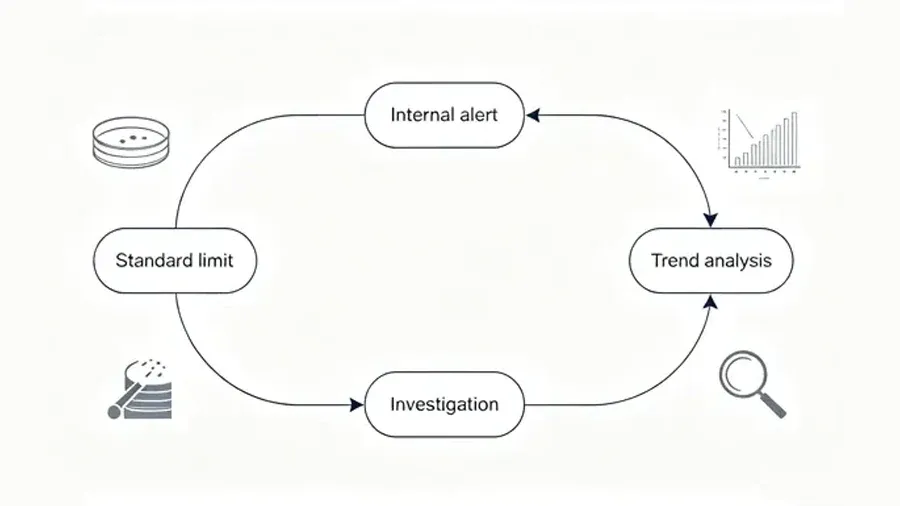
Standard limit →
Internal alert →
Trend analysis →
Investigation
Closed-loop microbial control cycle
Microflora & Local Environment
Talk about differences in GMP cleanliness, humidity makes a huge difference out east,Coastal China and Southeast Asia stay damp year-round. Mold like Aspergillus plus spore-forming microbes pop up far more often here,Basic quat disinfectants cannot handle these tough isolates by themselves.
Custom HVAC and disinfection planning
For teams figuring out how to design GMP cleanroom for multi-country compliance, local microbe data matters a lot.Deiiang™ pulls regional isolate records to plan rotating oxidative disinfectants.We also rework HVAC layouts to cut down hard-to-clean condensation dead legs, matching site-specific GMP environmental monitoring limits by region.
Expert insight – Jason Peng, Product Designer
“our product designer, noted real issues on EU vs US vs China GMP cleanroom builds.Even Grade B spaces with ideal particle counts grow mold in corners under tropical air,We mandate sporicidal disinfectant cycles and full drain slope checks in every design review for EU GMP Annex 1 vs China GMP for sterile products projects.”
“our product designer, noted real issues on EU vs US vs China GMP cleanroom builds.Even Grade B spaces with ideal particle counts grow mold in corners under tropical air,We mandate sporicidal disinfectant cycles and full drain slope checks in every design review for EU GMP Annex 1 vs China GMP for sterile products projects.”
Deiiang™ Project Data: Cleanliness Choices in the Real World
Over the last three years, Deiiang™ handled 45+ GMP cleanroom projects. Around 65% targeted EU registration, 20% US, and the rest China-only or WHO. Nearly 70% of sterile lines used isolator-based Grade A with Grade B background—even when local regs allowed open RABS. This preemptive design avoids retrofitting later.
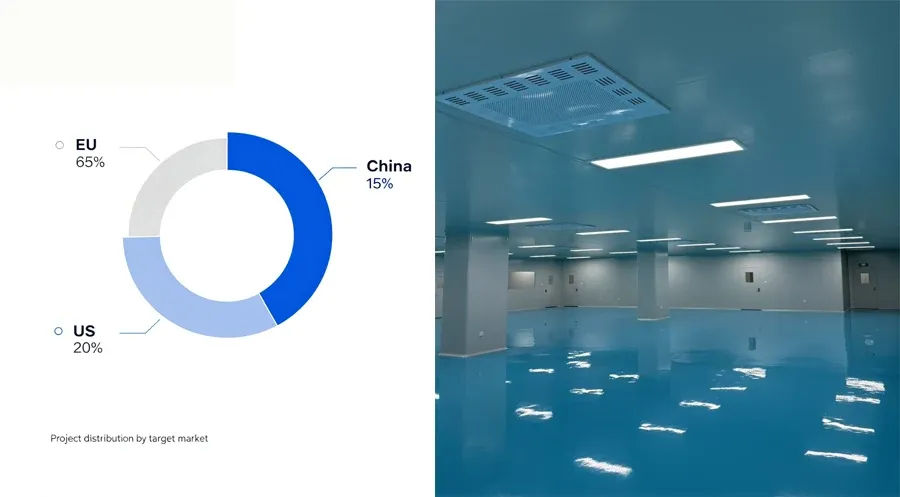
Project distribution by target market (Deiiang internal, illustrative)
In multi-registration projects, background Grade C/D areas were often bumped one level higher to accommodate stricter microbial expectations. For instance, a Grade C solution prep area designed to EU limits also met China's more stringent surface monitoring without additional capex.
Pro Tip
We analyzed 12 sterile injectable sites: after optimizing personnel flow and swapping to a double-glove SOP, microbial excursion rates in Grade B dropped by over 30%—no extra air changes needed.
We analyzed 12 sterile injectable sites: after optimizing personnel flow and swapping to a double-glove SOP, microbial excursion rates in Grade B dropped by over 30%—no extra air changes needed.
Multi-Market Sterile Injectable Facility (China base, EU+US)
Background
We run into clear differences in GMP cleanliness on cross-border projects,This eastern China pharma plant planned sterile injectable production for EU and US filings,Old shared air corridors next to the new suite brought big contamination risks, plus limited funds and strict global audit standards.
Challenges
GMP cleanliness classes comparison highlights multiple pain points here,The team needed affordable Grade B surroundings paired with Grade A isolators,Summer outdoor RH regularly hit over 80%, raising mold risks,Auditors also demanded meaningful GMP cleanroom microbiological monitoring, not just paperwork ticks.
Deiiang™ Solution
• Layout: Isolator in Grade A, background Grade B with pressure cascade of 15 Pa towards older corridors.
• HVAC: Dual return air, terminal HEPA, dew-point control to avoid condensation.
• Micro strategy: Rotating hydrogen peroxide/QUAT regime; settle plates placed at operator hand height during filling.
• Data: Continuous particle counters tied to BMS, with automatic SMS alert if 95% limit approached.
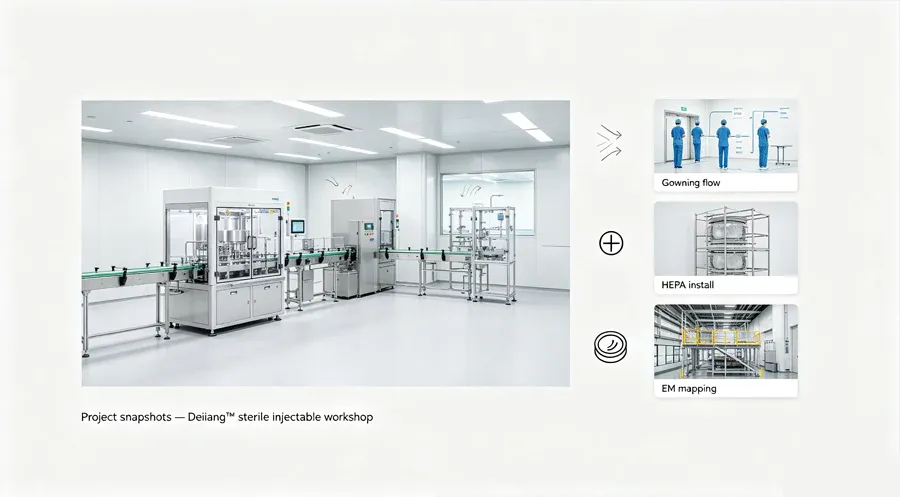
Project snapshots — Deiiang™ sterile injectable workshop
Results (12-month running data)
• Grade A: zero microbial excursions beyond internal alert.
• Grade B: average excursion rate<0.4% (per sample point·frequency).
• EU audit comment: “well-considered layout, consistent EM data.”
• The facility passed NMPA and subsequent FDA inspection without major observations.
Jason Peng reflects: “The real trick wasn't higher classification—it was designing air patterns so that operators never shadowed open product. That's the kind of detail that makes differences in GMP cleanliness irrelevant because you've already exceeded all of them.”
Designing for Multi-Country GMP: Strategy That Works
Plants split two clear paths based on target markets,Factories only selling locally can stick to regional rules, while picking EU monitoring frameworks to lift their control levels,If you build lines for multiple regions, stick to the strictest standard available.
EU GMP Annex 1 vs China GMP for sterile products acts as the baseline, with extra space to meet FDA strict data rules.
Single Market vs. Global Footprint
Our team at Deiiang™ relies on repeatable, modular hardware,Modular HVAC units, pre-tested pressure gradients and stored local microbial data simplify full GMP cleanliness classes comparison.
Our ready-made Grade B unit fits microbial limits in gmp cleanrooms (Grade A B C D / iso 5 7 8) across EU, China and WHO zones.
Deiiang's Standardized Approach
GMP microorganisms limits by country differ widely, and so do GMP environmental monitoring limits by region,This standardized workflow cuts extra redesign work for all EU vs US vs China GMP cleanroom builds, covering all differences in gmp cleanroom classifications among countries with consistent GMP cleanroom microbiological monitoring setups.
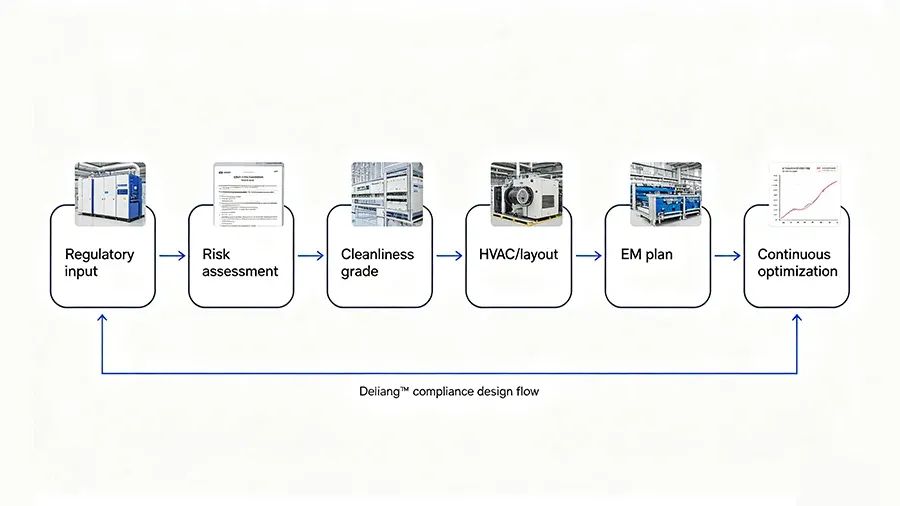
Building Resilient Compliance Across Borders
Differences in GMP cleanliness go beyond textbook rules. They truly impact plant daily workflows, audit preparedness and cost budgets for global pharma sites.
GMP microorganisms limits by country feature identical written standards. Even so, regional regulators enforce rules and data standards in completely different ways. A mature EU vs US vs China GMP cleanroom strategy must build in extra compliance buffer.A simple GMP cleanliness classes comparison is never enough for cross-border certification.
Deiiang™ leverages real-site microflora data and flexible modular designs to adapt to varied compliance demands.We never treat GMP cleanroom microbiological monitoring as a one-off qualification. We run it as a dynamic, ongoing management program. This practical method helps both new and renovated facilities stay ahead of global regulatory inspections.
Need a multi-country GMP cleanroom assessment?
Download our technical white paper or contact Deiiang™ for a project evaluation.
Talk to DeiiangReferences
EU GMP Annex 1 (2022) – EudraLex Vol.4
FDA Guidance: Sterile Drug Products (2004) – FDA.gov
China GMP (2010 revision) – NMPA official annex
WHO Technical Report Series, Annex 2 – WHO GMP
iso 14644-1:2015 – Cleanrooms classification
© Deiiang™ GMP Cleanroom Insights · Product design lead: Jason Peng