+86 13638632902
 Jason@cleanroomequips.com


 MENU
MENU
Why Flooring Matters for cleanroom Fireproofing & Sealing
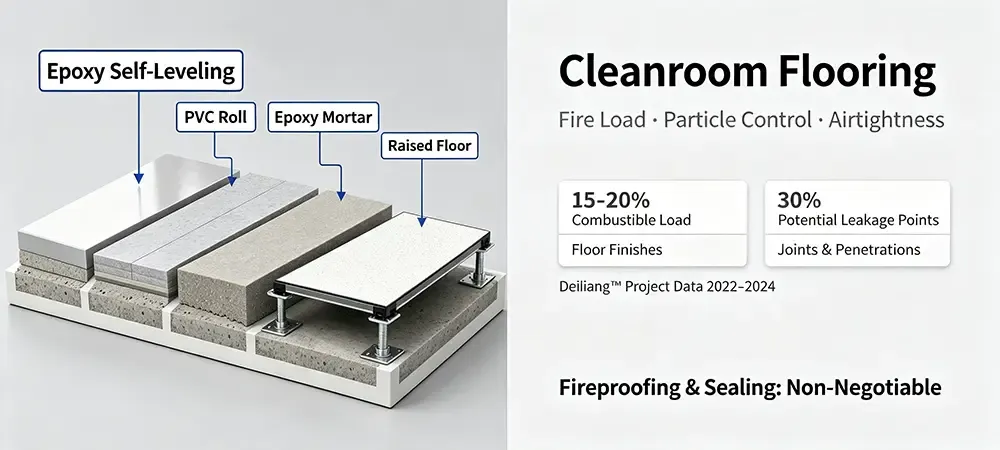
cleanroom flooring must function to control fire load, contain and control partICles and maintain airtightness. Deiiang™ project data, covering the period from 2022 to 2024, outlines how floor finishes contribute to approximately 15% to 20% of the total combustible load for a Pharmaceutical cleanroom. Cleanroom fireproofing and cleanroom sealing therefore function as non-negotiable elements throughout the construction phase.
Our surveys at Deiiang show that a large portion of the combustible load in a pharmaceutical cleanroom comes from the floor coverings. Also, the floor to wall joints and penetration through the floor can account for up to 30% of all potential leakage points. Hence, in the initial design stage, cleanroom fireproofing and cleanroom sealing are non-negotiable. Once the floor is completed it is very difficult to make changes without causing considerable production disruption.
Deiiang's surveys confirm that selecting a fire rated flooring system with documented Bfl-s1 classification is critical for regulatory and insurance compliance. The floor is the one element you cannot easily retrofit without production downtime.
Key Requirements for cleanroom flooring
Balancing mechanical performance, fire reaction, and sealing integrity defines a robust cleanroom flooring specification. Below are the core checkpoints.
Performance
Deiiang™ DE-EP-3 epoxy is designed to be used as an industrial floor coating in GMP settings. The material provides sufficient flatness (FF 35+), high compressive strength and is resistant to disinfectants. In a test, the material ACHieved a compressive strength of ≥ 75 MPa and withstood 10 common disinfectants for 48 hours without any blistering.
Fireproofing
Class Bfl-s1 / B1 should be achieved by floors tested to EN 13501-1, ASTM E84 or GB 8624. Always check the fire test report against the installed system thickness and formulation, as a thinner topcoat can alter the fire resistant flooring classification.
Sealing & Hygiene
Critical leakage areas would be floor to wall joints, expansion joints and penetrations through the floor. Using coved skirting, low VOC fire rated sealants and intumescent collars as part of the passive fire protection system, these can form part of the cleanroom sealing as well.
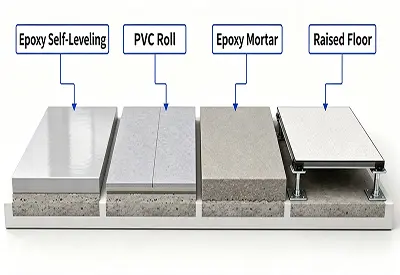
4 Main Cleanroom Flooring Types
Epoxy Self-leveling
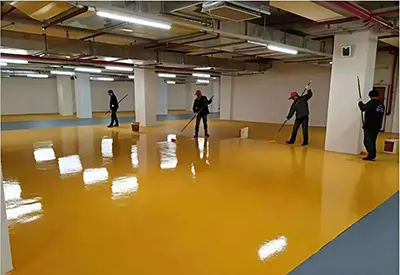
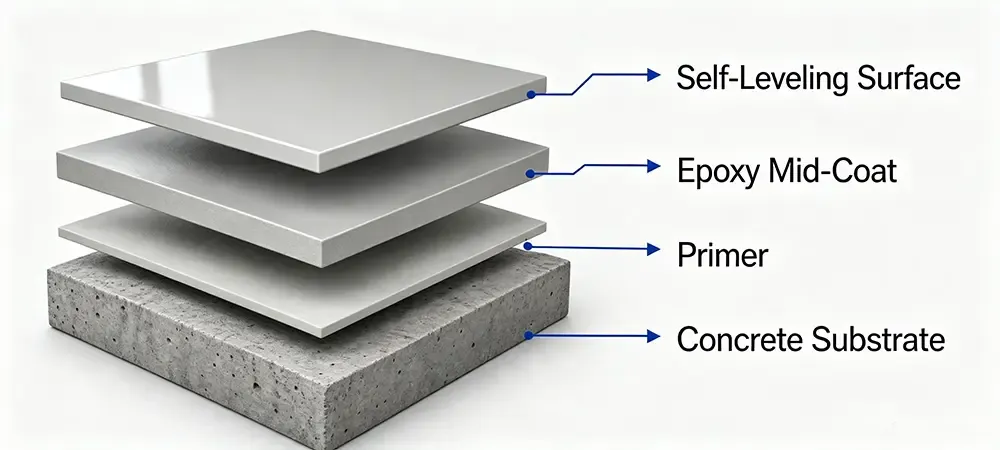
Structure: Primer + epoxy mortar mid-coat + 2–3 mm self-leveling topcoat, seamless.
Use: iso 7–8 pharma, food, electronICs. Fire: Deiiang™ DE-EP-3 rated Bfl-s1.
Seal: Coved skirting and fire-rated joint sealant; substrate moisture ≤ 8% mandatory. This epoxy self leveling system dominates pharmaceutical cleanrooms.
PVC / ESD Vinyl Sheet
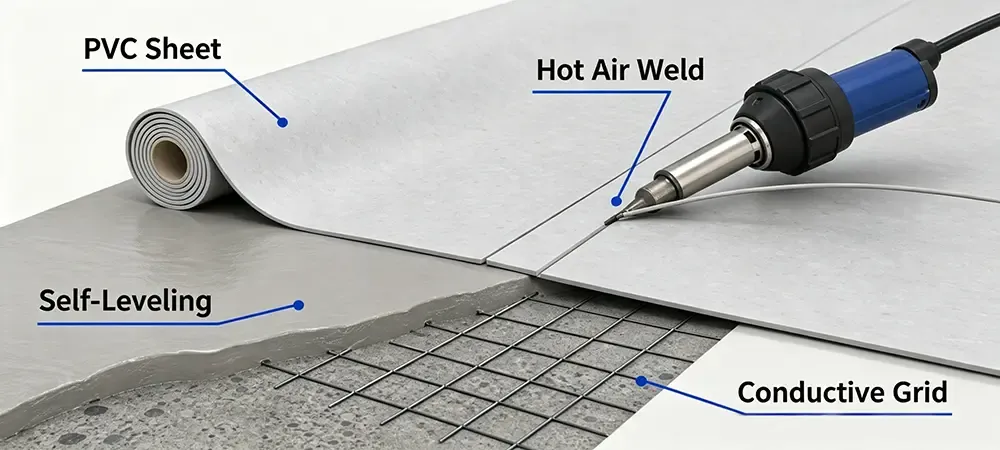
Structure: The combination of self-leveling underlayment, adhesive and 2–3 mm thickness in a sheet format with hot-air welded seams is specified for use in Hospitals, Labs, etc. ESD-sensitive Electronics are often found in these environments.
Fire: Premium PVC Flooring can achieve Bfl-s1/B1. Deiiang™ DE-PVC-ESD achieves B1 fire rating while offering 10⁶–10⁸ Ω surface resistivity.
Seal: The homogeneous welds are critical as well as the 100 mm cove integral to the floor covering. Cold welds will fail under stress.
Epoxy Mortar (Heavy-duty)
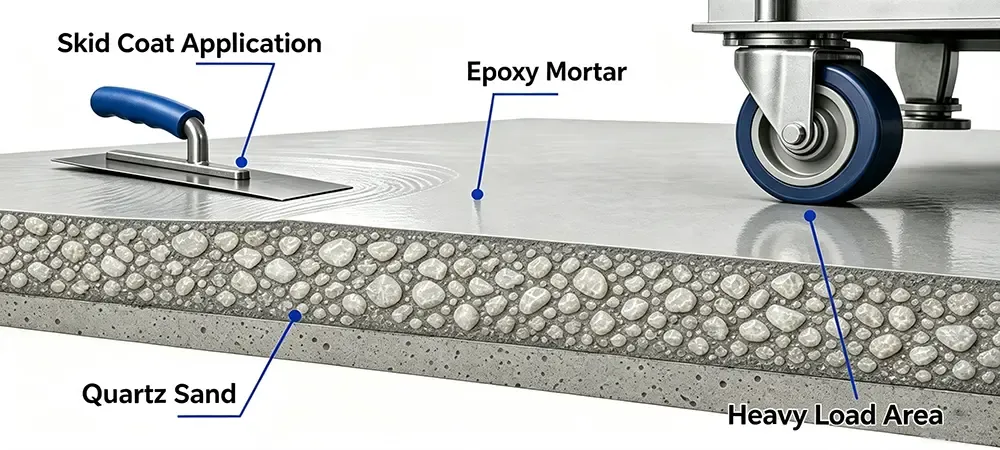
Structure: Epoxy mortar + quartz aggregate 3–5 mm, sealed topcoat.
Use: Forklift aisles, equipment plinths—not a final finish for ISO 7+.
Fire: High aggregate reduces fuel load, but resin binder still needs Bfl-s1/B1.
Seal: Overlay with self-leveling or vinyl flooring for cleanroom sealing; trowel marks must be encapsulated.
Anti-static Raised Access Floor
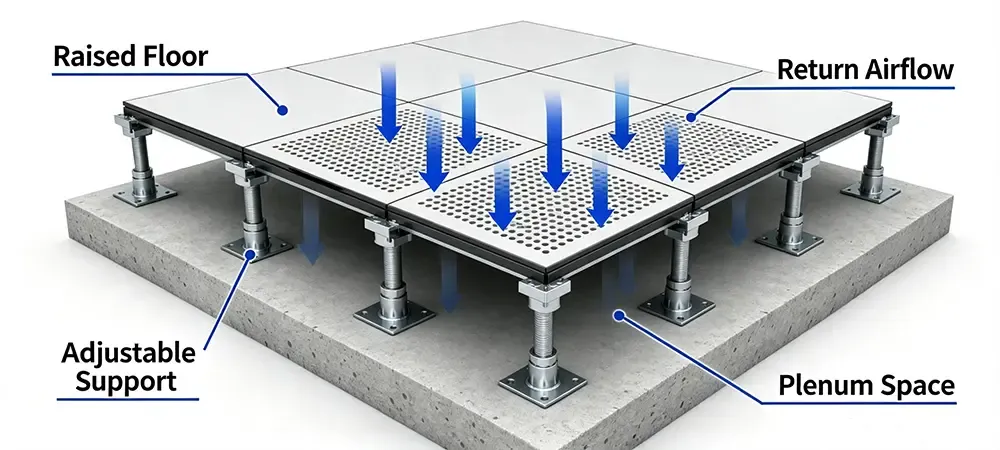
Structure: Pedestals + stringers + 600 mm panels, underfloor plenum for air return.
Use: iso 5–6 semiconductor cleanroom fabs—no alternative for vertical laminar flow.
Fire: Deiiang™ DE-RA-F calcium-sulfate core achieves B-s1,d0; plenum must have fire-stop compartmentation.
Seal: Seal all pedestal bases and cable cutouts; a single 100 mm² leak can depressurize a suite. ESD flooring and fireproofing converge here.
Quick Selection & Acceptance Checklist
Selection by Scenario
| Scenario | iso class | Flooring | Key Driver |
|---|---|---|---|
| Semiconductor | 5–6 | ESD Raised Access | Underfloor air return |
| Pharma/Food | 7–8 | Epoxy Self-leveling | Seamless hygiene |
| Hospital/Lab | 7 equiv. | PVC/ESD Vinyl | Comfort & chemical resistance |
| Logistics | Adjacent | Epoxy Mortar + cap | Heavy load |
ISO 5–6 SemiconductorESD Raised Access Floor
ISO 7–8 Pharma/FoodEpoxy Self-leveling
Hospital/LabPVC/ESD Vinyl Sheet
Heavy Load AreasEpoxy Mortar + overlay
Acceptance Points
Substrate moisture ≤ 8% before primer.
The installed thickness must be in accordance with the fire test report.
The site needs to complete a inspection of all Floor to Wall junctions, Penetrations through walls and to complete a Smoke Test to all Raised Floor Plenums.
Take measurements for anti-static flooring resistance at ≥5 points on 100m² of flooring.
Coved skirting to minimum 30mm radius; PVC upturns to minimum 100mm high, welded with hot-air welder.
Pros vs. Cons Comparison
Epoxy Self-leveling
✔ Seamless, Bfl-s1 options, chemical resistant.
✘ Medium load only; moisture sensitive.
PVC / ESD Vinyl
✔ Comfortable, fast renovation, ESD capable.
✘ Weld-critical; upturn detailing needed.
Epoxy Mortar
✔ High load, impact resistant; low fuel load.
✘ Rough surface; not a hygienic final finish.
Raised Access Floor
✔ Ideal for ISO 5–6, integrated air return.
✘ Higher cost; plenum sealing complex.
Micro-Glossary – Key Terms
Bfl-s1 / B-s1,d0: EN 13501-1 floor classification—limited combustibility, low smoke, no flaming droplets.
Cleanroom Sealing: Eliminating leakage at joints and penetrations via sealants, coves, and fire-stop systems.
ESD Flooring: Surface resistivity controlled (10⁴–10⁹ Ω) to drain static; mandatory for semiconductor cleanroom zones.
References
EN 13501-1 — CEN/CENELEC
ASTM E84 — ASTM International
GB 8624 — GB Standards
JGJ/T 175-2018, GB/T 36340-2018
iso 14644-1:2015 — ISO