+86 13638632902
 Jason@cleanroomequips.com


 MENU
MENU
A cleanroom is a room in which the concentration of airborne particles is controlled. Its construction and use shall minimize the introduction, generation, and retention of particles inside the room. Other relevant parameters such as temperature, humidity, and pressure are controlled as required. The current standard gb50073-2013 Code for Design of Clean Workshop provides the framework for clean room environment management. Effective monitoring of the clean room environment is crucial and ensures that all defined parameters are continuously monitored and are kept under control in order to protect products and people.
An important consideration when designing a strategy for monitoring the clean room environment is an understanding of how dust behaves in a variety of situations. This diagram shows the relative size of dust particles and examples of how contamination can arise from normal activities and be controlled by good clean room environment management.
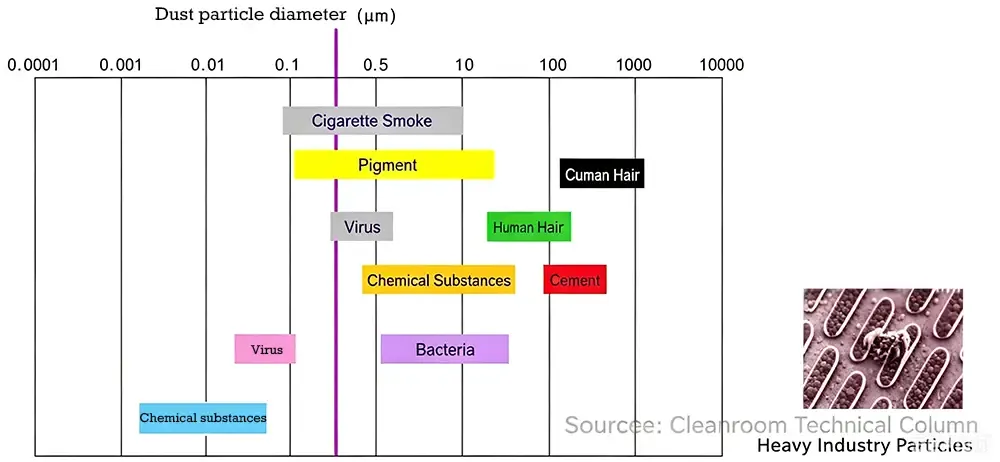
Diagram of dust particle diameters — from sub-micron to visible range.
How is dust generated?
Dust generation in a controlled environment can originate from personnel, equipment, and materials. Even in a seemingly quiet general office, particles are constantly shed. When fluorescent lights are turned off and a high-intensity light source is used, airborne dust becomes dramatically visible — a reminder that clean room environment monitoring must account for both visible and invisible particles. The Deiiang™ team, under the guidance of product designer Jason.peng, has documented extensive comparisons of particle generation scenarios to support better clean room environment management.
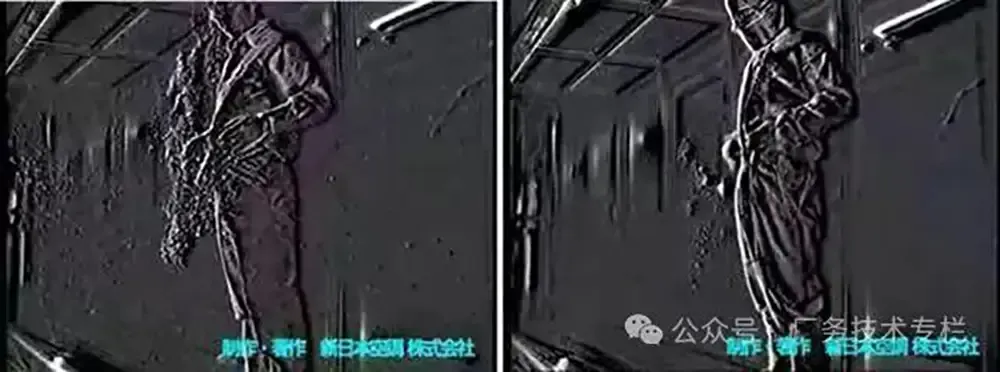
Walking dust generation comparison
The left image of a person walking whilst wearing normal working clothes in contrast to the right image of a person walking in a clean room gown generate a huge amount of particles, some 95% less than ≥1μm for the cleanroom garments. This quantifiable difference underpins the strict gowning protocols in any effective clean room environment management program.
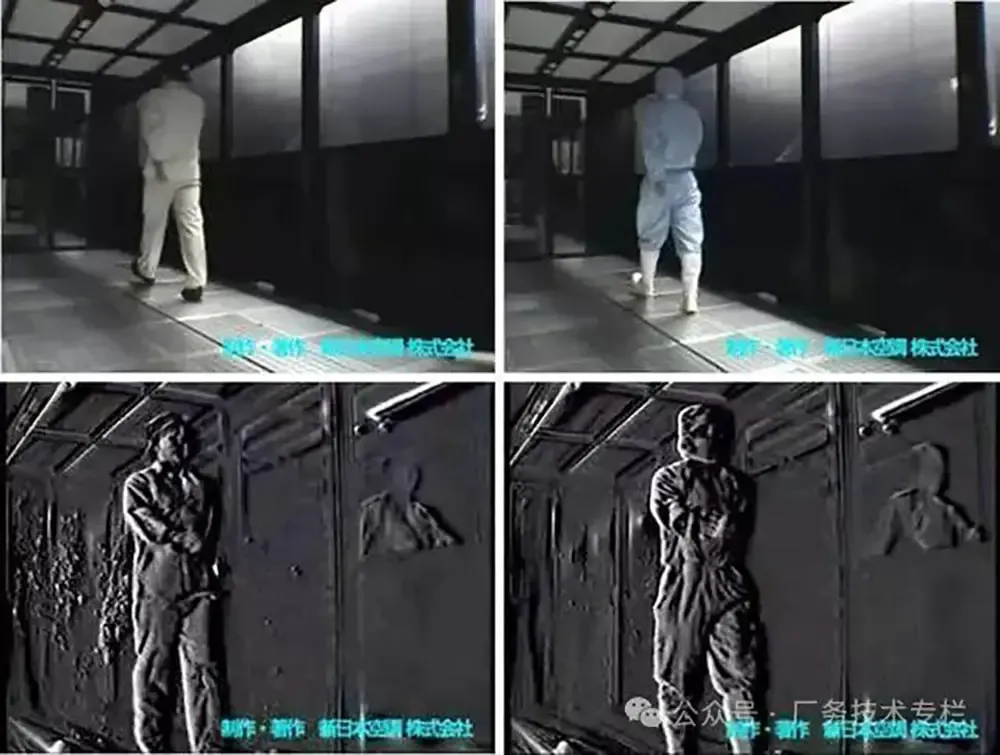
Patting work clothes — particle burst
A single pat of normal work clothing creates a cloud of particles, whereas cleanroom clothing creates very little, if any, particles when patted (left is normal work clothing, right is cleanroom). clean room environment monitoring using monitoring equipment (such as real-time particle counting near the operators) is critical because a single pat of a normal fabric can release over 10,000 particles per cubic foot.
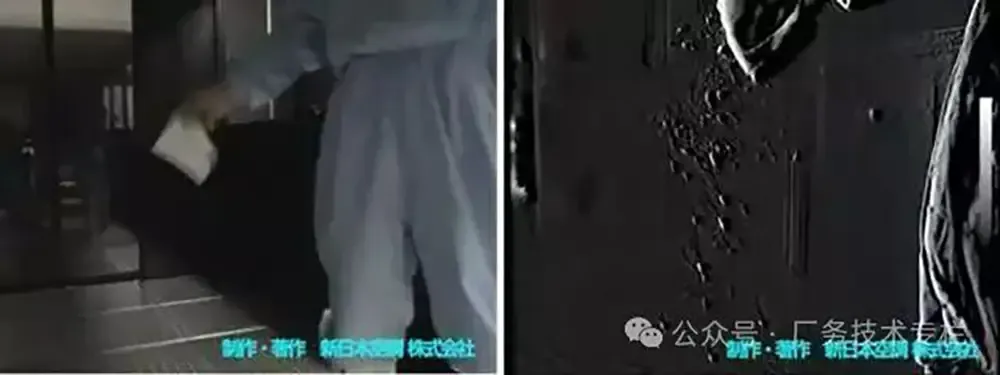
Cleanroom case observation: After an operator passes through, dust adheres visibly to a glass surface. This phenomenon demonstrates that particles do not simply float away — they settle on critical surfaces, making routine clean room environment monitoring essential for contamination control.
Floating particles — ParticleEyeDCF measurement
The ParticleEyeDCF is a device for statistical counting of airborne floating particles. The data from this device is put directly into the clean room environment monitoring system and allows for timely detection of any excursions before they could affect production. For consistent clean room environment management it is important to know which materials are creating the most airborne counts.
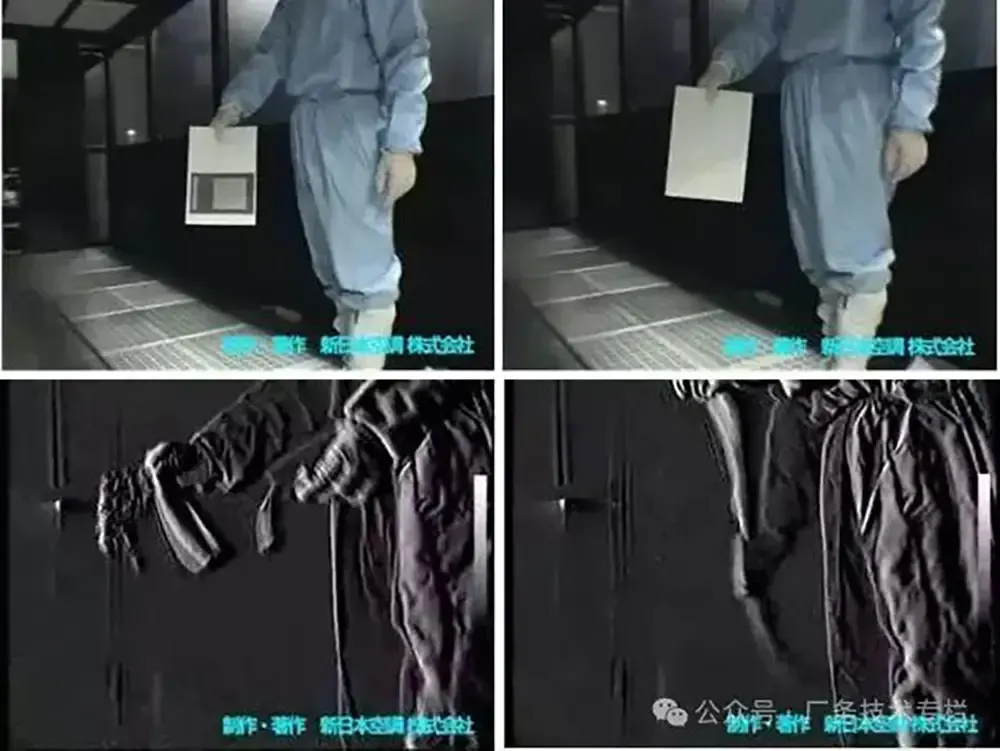
Paper dust generation
Left: ordinary paper. Right: low-particle cleanroom paper. Standard paper can shed over 500 particles ≥0.5μm per sheet when torn or crumpled, while cleanroom paper reduces this by over 90%.
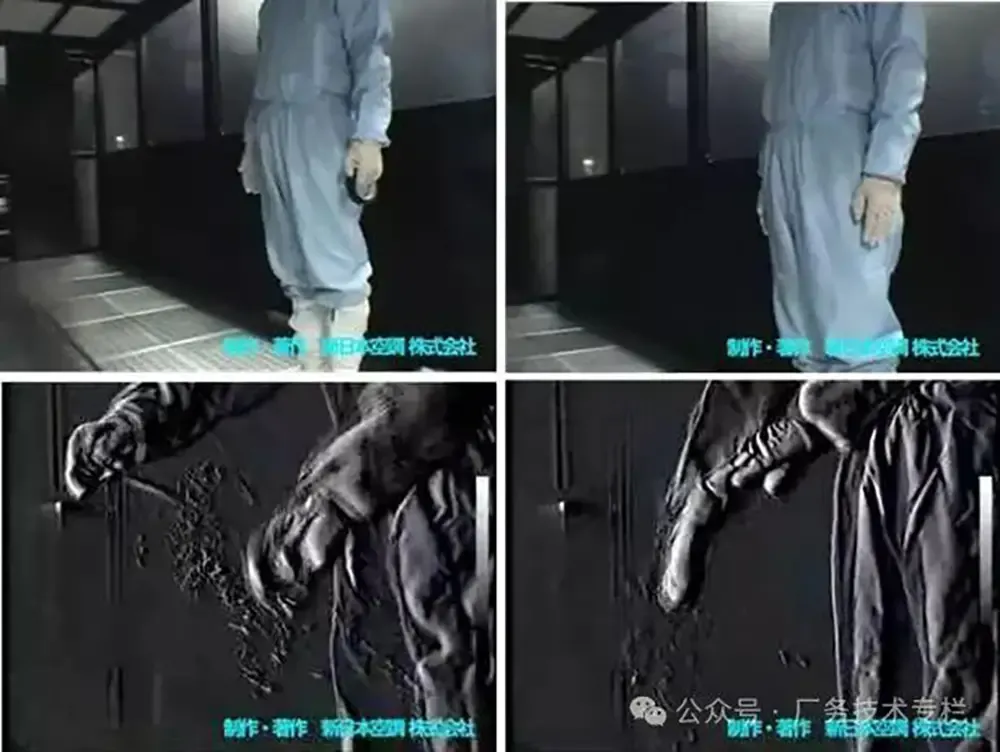
Tape and gloves — particle release
Left: paper-core adhesive tape generates particles upon unwinding. Right: PVC gloves shed particles during donning and use. Selecting appropriate materials is a cornerstone of clean room environment management.
Power tools and vacuum exhaust
Left: an electric drill generates a concentrated stream of particles. Right: a vacuum pump exhaust can leak particles if not properly filtered. Even cleaning equipment must be validated under clean room environment monitoring protocols.
Human-generated particle examples
A large portion of the contamination within a cleanroom comes from the personnel working within it. A single sneeze can send thousands of droplets into the air in an instant. Also, the evaporation of sweat from a person’s arm can introduce large amounts of salt into the air. Cigarette smoke is visible so it can be easier to understand the nature of the contamination that it introduces. The sub-micron particles that make up cigarette smoke can remain suspended in the air for hours. When a person is exercising physically the amount of contamination that they introduce into the air can increase by as much as 10 fold. There have been instances where a person exercising physically has introduced counts of 1,000,000+ particles ≥0.3μm per minute into the air. It is therefore very important to incorporate the strict behavior of the personnel into the environment management of the clean room and into the ongoing environment management of the clean room.
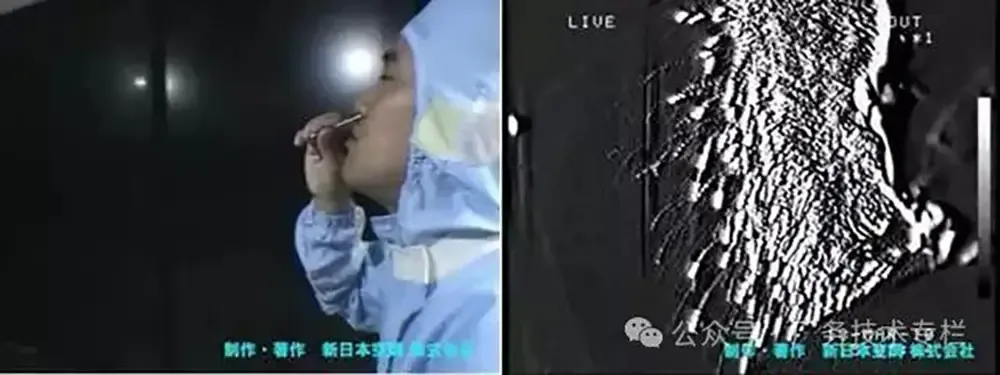
Sneezing droplet leakage
Instantaneous droplet emission from the mouth during a sneeze — a critical event that clean room environment monitoring must be able to detect and recover from quickly.
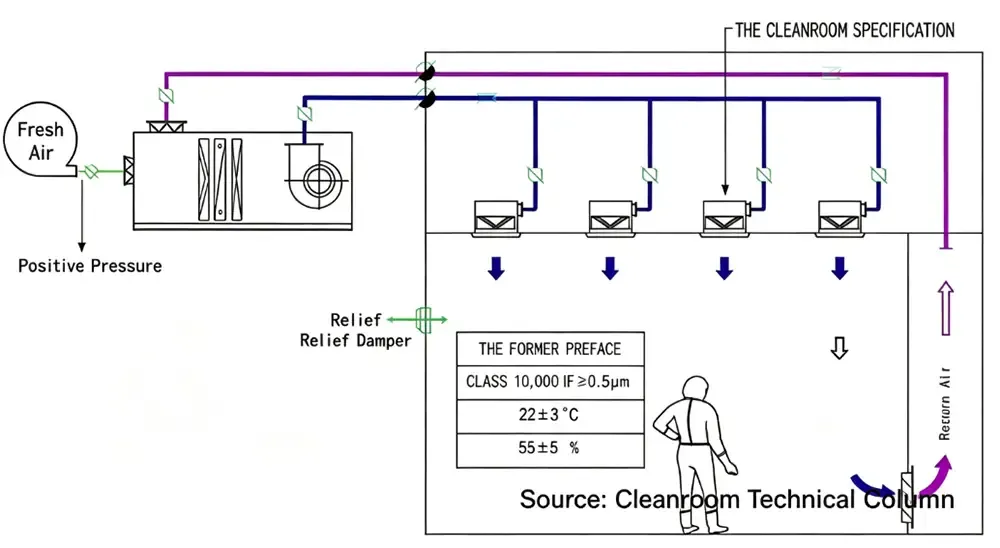
How is dust removed? Cleanroom air purification
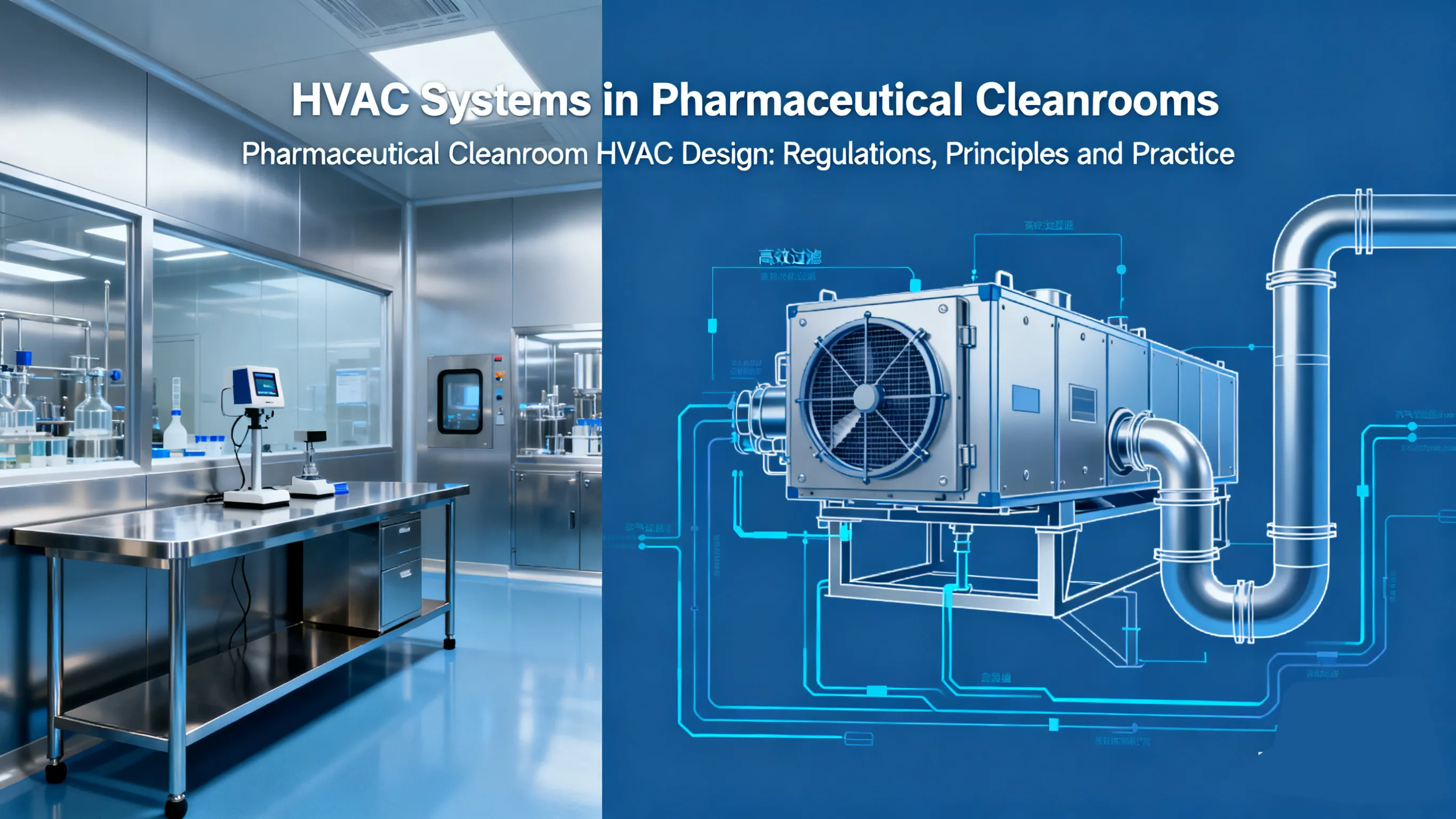
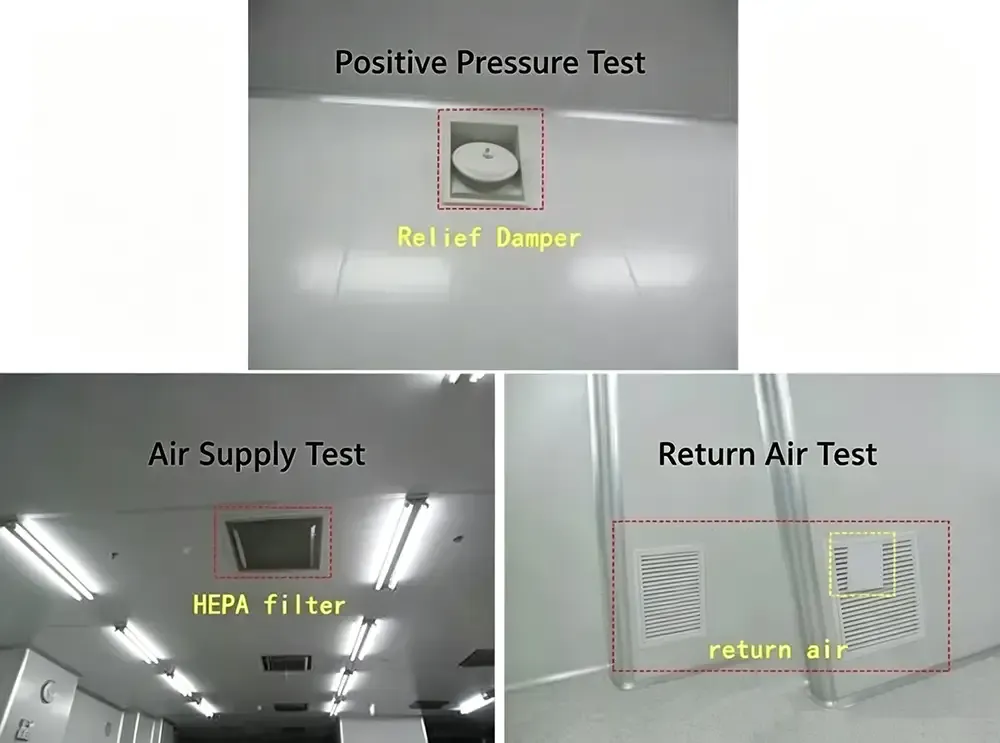
Air in a cleanroom is filtered through a number of stages. The backbone of the clean room filtration system is the HEPA (High-Efficiency Particulate Air) filter. This type of filter is designed to remove a large percentage of particles from the air, with the ability to capture greater than or equal to 99.97% of particles equal to or greater than 0.3 microns.Regular clean room environment monitoring of filter integrity, airflow velocity,
Monitoring of filter integrity, airflow velocity and pressure difference is regularly carried out in order to check whether the air purification system is functioning properly. Deiiang™ way of clean room environment management is managed by scheduled inspection and improved by Jason.peng.
emphasizes proactive clean room environment management through scheduled inspections rather than reactive maintenance.
Common cleanroom instruments and equipment reference
A comprehensive clean room environment monitoring program depends on the correct selection and use of instruments. Below is a summary of key devices, their applications, and technical specifications relevant to clean room environment management.
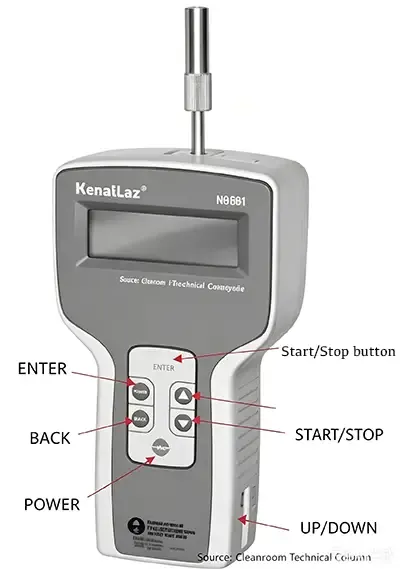
Handheld laser particle counter
Measures the number of airborne particles. Due to size and weight constraints, a handheld laser particle counter typically has a sampling flow rate of 0.1 cubic feet per minute (0.1 cfm), equivalent to 2.83 liters per minute (2.83 L/min). The minimum particle size channel is generally 0.3μm. Both AC power and battery operation is available for these highly portable samplers. Many are offered in dual-channel models to allow for two different particle sizes to be measured in a single sample. A common configuration for these type models would be 0.3 & 0.5μm or 0.5 & 5μm. These units have a small air sample volume which typically results in lower accuracy, however,Their portability makes them ideal for routine cleanroom environmental monitoring. as well as for testing filter efficiency and checking for seal leaks. Data is typically stored on the unit and then downloaded to a computer, however, most models do not have a built-in printer.
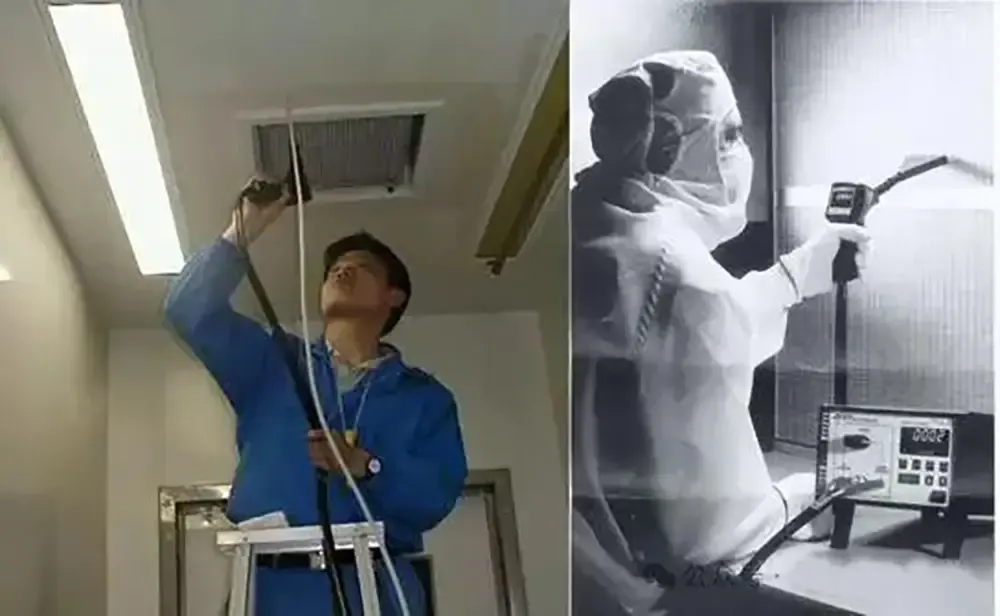
HEPA filter leak testing
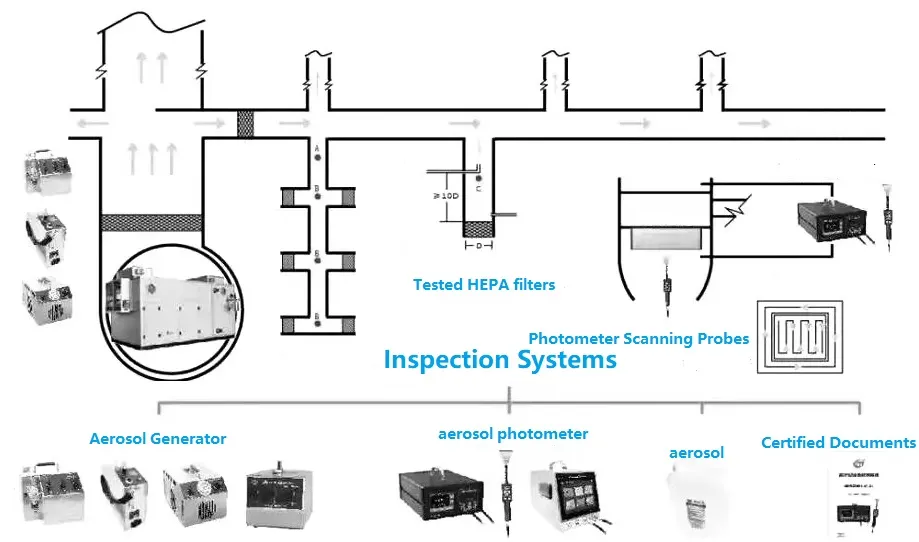
Remove the diffuser plate of the HEPA filter. Scan the entire filter face, the seal between filter and frame, frame-to-frame joints, and the seal between frame and plenum. During scanning, the sampling probe should be held approximately 1 inch (2.54 cm) from the filter face, with a scan speed not exceeding 5 cm/s. Scan in a straight, back-and-forth pattern with overlapping strokes. When an alarm sounds (leakage rate greater than 0.01%) a leak is indicated. Leaks are filled with silicone gel or tightened up and the filter re-scanned. It takes about 5 minutes to check a single filter.Upstream aerosol concentration is to be checked during the test. The test personnel are to wear a mask and goggles as protection.
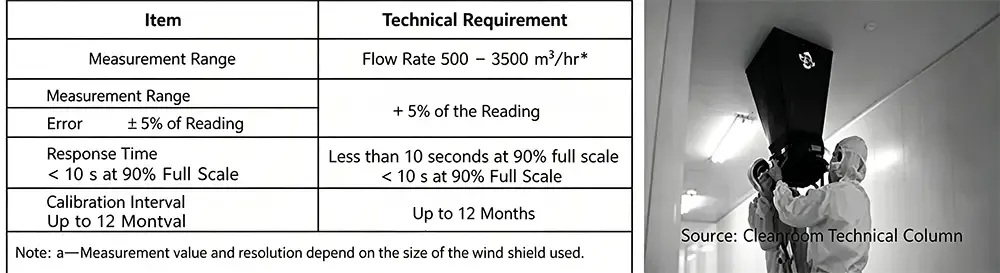
Airflow capture hood
Measures supply air velocity. The hood consists of a capture hood body, a base and a PDA display. Air is collected by the hood and then passed over a velocity uniformizer which is equipped with a thermal sensor. The sensor then measures the changes in air velocity, and using the dimensions of the base of the hood, the volumetric flow rate is then calculated. The large LCD screen of the PDA then displays the air velocity and airflow. The required parameters can be logged at set time intervals. The logged data is stored on a memory card and can be analyzed on a PC after transfer via the serial port. This instrument is essential for verifying that airflow meets the design specifications critical to clean room environment management.
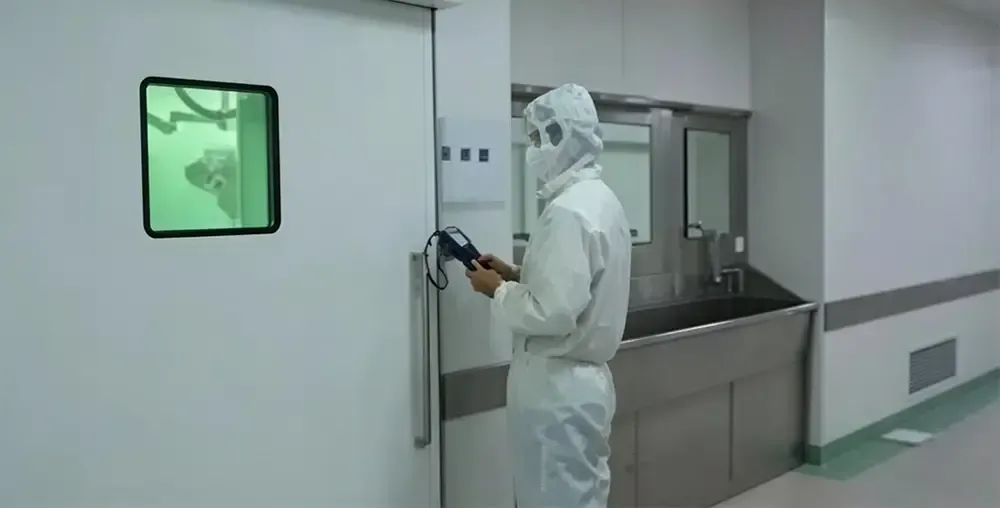
Differential pressure measurement instruments
In typical cleanrooms the pressure difference between adjacent clean and dirty areas (including between different clean areas or between a clean area and a non-clean area) is in the order of 5 to 10 Pa. In biosafety cleanrooms, which are designed to contain hazardous material, it is necessary to create a negative pressure cascade along the entry route to all areas and maintain this at -10 to -30 Pa between rooms. According to GB19489-2008, relative to atmospheric pressure, the contaminated zone should be -40 Pa. Per GB50346-2011, the minimum negative pressure difference relative to an adjacent room in the direction of the outdoors is -10 Pa. Micro-differential pressure gauges must be installed across each stage of air filters, connected to static pressure taps before and after the filter, to continuously monitor pressure drop. Some gauges include adjustable alarm setpoints for clean room environment monitoring.
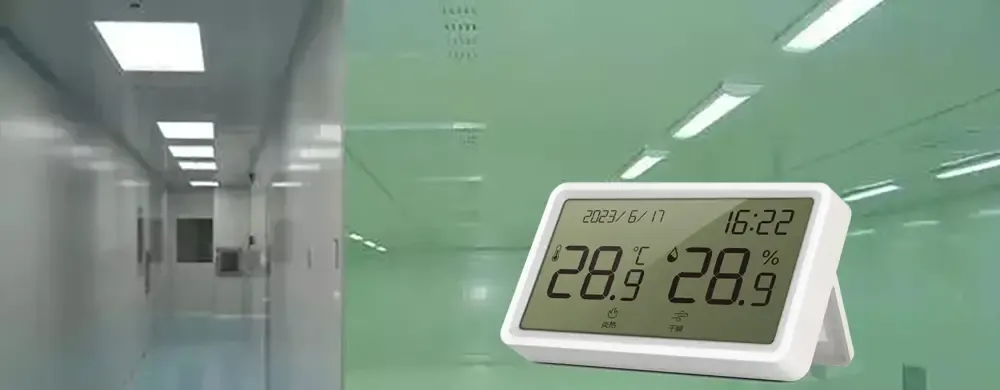
Temperature and humidity meter
Thermo-hygrometers are an essential tool in cleanroom monitoring and testing. They are often used to monitor environmental parameters remotely. A common type of sensor used in these electronic thermo-hygrometers are capacitive and resistive type humidity sensors. There are many types of resistive humidity sensors including porous ceramic bodies that are sintered from nickel oxide or from polymer materials such as lithium perchlorate-polyvinyl chloride. These types of sensors measure humidity by measuring the change in electrical resistance as moisture is absorbed into the sensor material. Of the resistive type of humidity sensors, nickel oxide ceramic sensors are particularly popular as they have a long life and are very stable. Capacitive humidity sensors are also very common and consist of a capacitor with a very thin polymer film as the dielectric. As water molecules are absorbed and released from the film, the dielectric constant of the film changes and thus the relative humidity can be determined by measuring the capacitance.
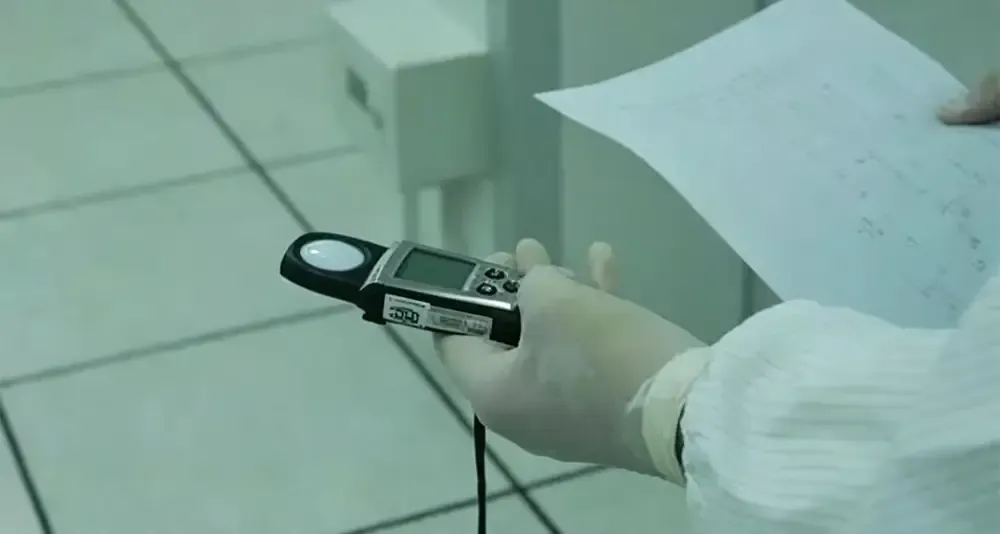
Lighting and illuminance meter
Most Cleanrooms use teardrop-type recessed lighting or other recessed type lighting. When doing illuminance testing of a Cleanroom it is recommended to use a portable digital illuminance meter. To get reliable results the room temperature and the light source(s) must have reached a stable situation. Newly installed Fluorescent light sources must be put into service and allowed to ‘age’ for more than 100 hours. Then after turning the light on for at least 15 minutes take your readings. Take the readings at working height (approximately 0.85m) and at aisle height (approximately 0.2m). The number of test points to take readings at is determined by first dividing the cleanroom area by 50m² then taking a minimum of 1 test point per room. Take the readings at the designated points.
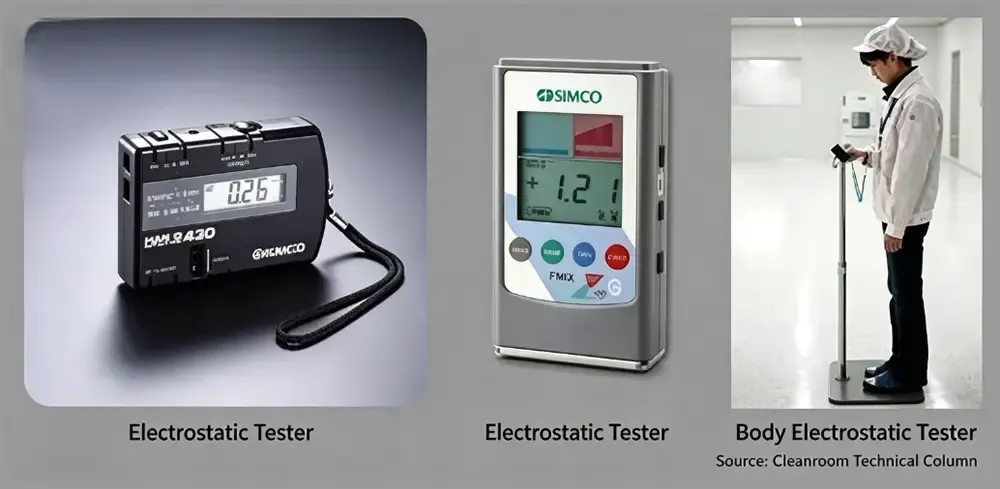
Electrostatic detection instrument
These instruments measure static electricity without direct contact, using the principle of electrostatic induction. A probe is brought near the charged object, and the distorted electric field between the probe and the object is used to measure the surface electrostatic potential. This non-contact method is essential for clean room environment management in ESD-sensitive areas.
Electrostatic discharge (ESD) control
ESD control is a holistic system summarized by the equation: ESD Control = Man + Machine + Material + Method + Environment. Each element must be addressed for effective clean room environment management. Grounding, appropriate footwear, conductive flooring, and humidity control are all variables that clean room environment monitoring must track. The Deiiang™ ESD control framework, designed by Jason.peng, integrates these five pillars into a cohesive monitoring plan.
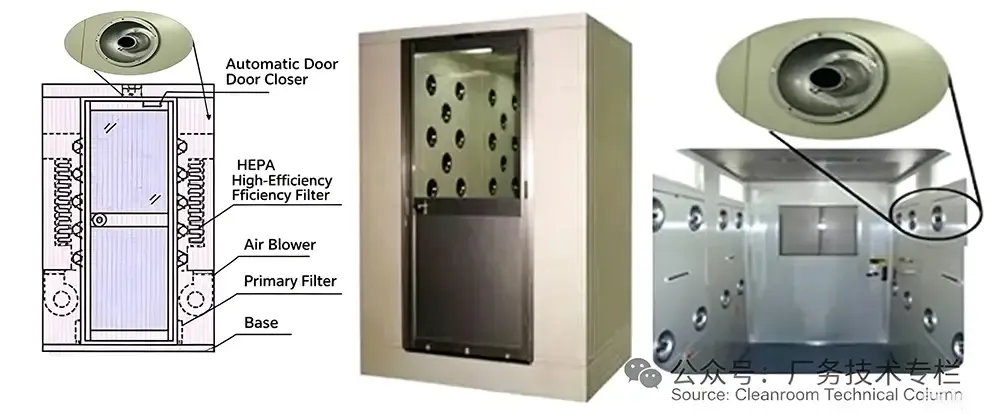
Air shower
An air shower is installed at the entrance to the cleanroom and serves the following functions: personnel regulation; air lock function to prevent cross-contamination; and high-velocity air (20–25 m/s) to blow off and carry away dust from personnel clothing, equipment, materials, and tools. Correct use of an air shower can remove over 95% of particles ≥1μm. Following the voice prompt instructions from the air shower system (e.g., from Deiiang™ equipment) ensures optimal particle removal. This is a critical first step in clean room environment management, and its effectiveness should be verified through periodic clean room environment monitoring.
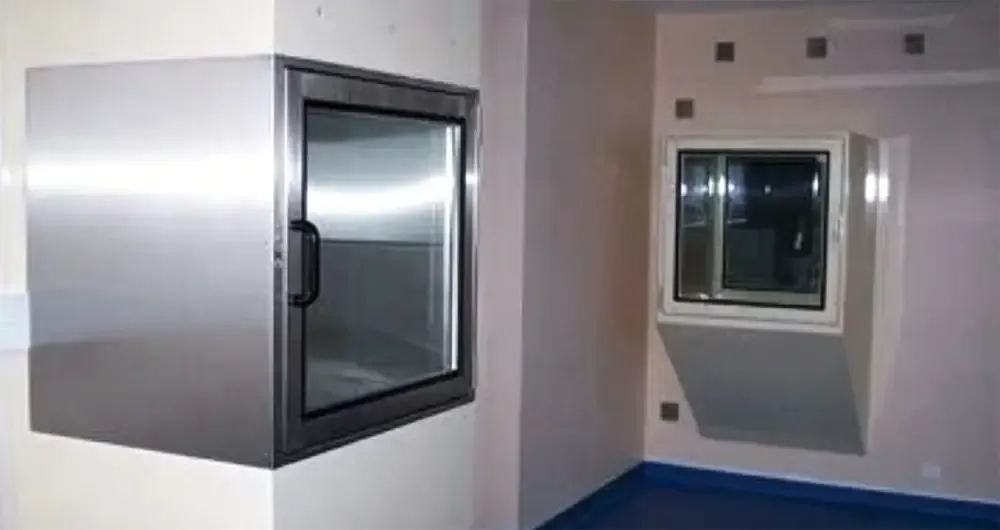
Pass box
Installed in the cleanroom partition wall, the pass box functions as a buffer zone for transferring items between the inside and outside of the cleanroom. It prevents disruption of cleanroom airflow and room pressure when doors are opened during material transfer. It also reduces the time personnel spend walking, thereby preventing dust ingress from external areas. The interlocking control of the doors on opposite sides is designed so that no door can be opened at the same time, thus preventing cross-contamination. This device is a key component of physical clean room environment management infrastructure.
Cleanroom and clean zone cleanliness classes
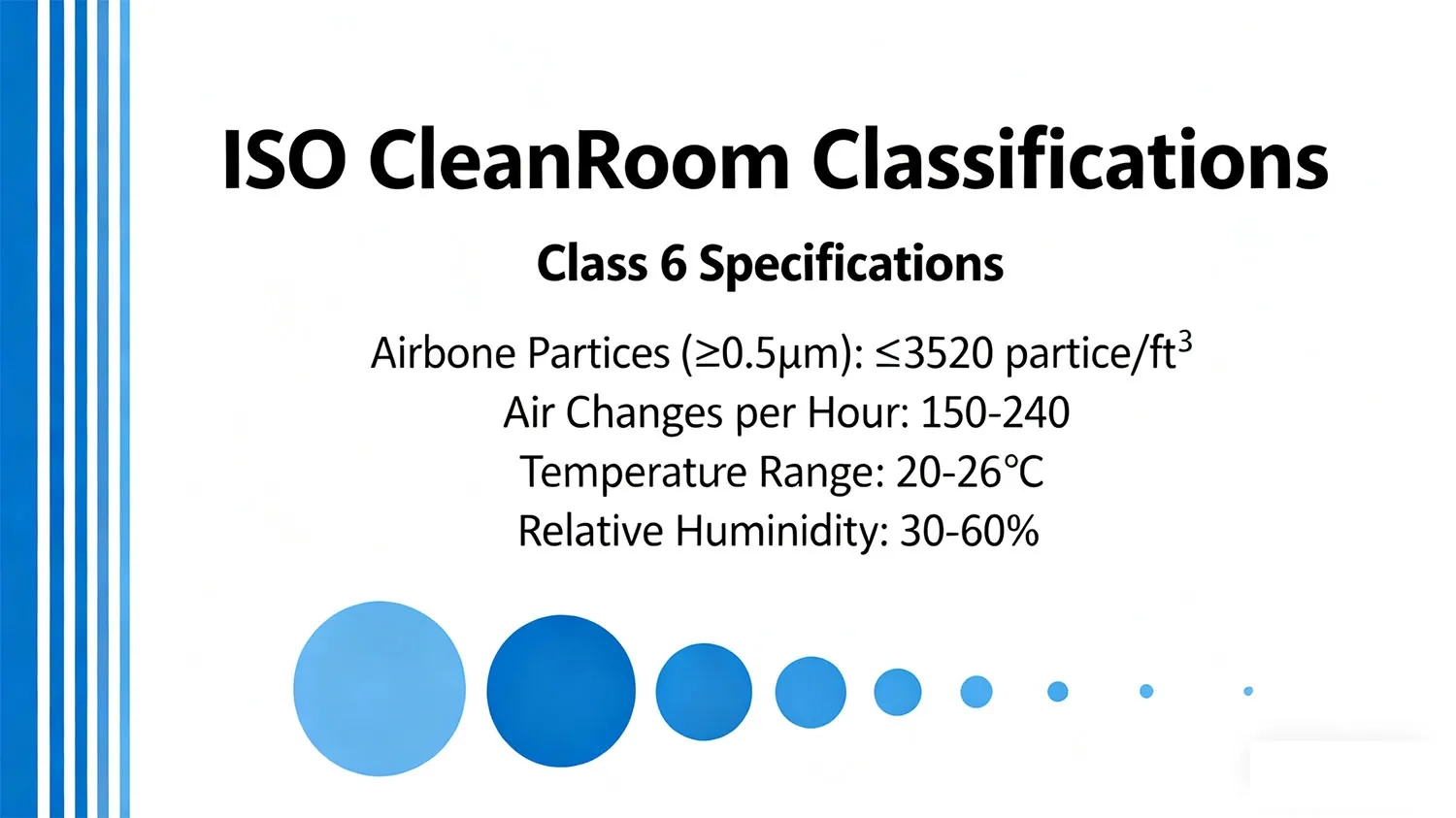
Cleanliness classes are defined by the maximum allowable particle concentration per cubic meter of air. The table below provides a reference for the ISO classification system, which is integral to clean room environment monitoring and clean room environment management worldwide.
| ISO Class | ≥0.1μm particles/m³ | ≥0.2μm particles/m³ | ≥0.3μm particles/m³ | ≥0.5μm particles/m³ | ≥1.0μm particles/m³ | ≥5.0μm particles/m³ |
|---|---|---|---|---|---|---|
| ISO 1 | 10 | — | — | — | — | — |
| ISO 2 | 100 | 24 | 10 | 4 | — | — |
| ISO 3 | 1,000 | 237 | 102 | 35 | 8 | — |
| ISO 4 | 10,000 | 2,370 | 1,020 | 352 | 83 | — |
| iso 5 | 100,000 | 23,700 | 10,200 | 3,520 | 832 | 29 |
| ISO 6 | 1,000,000 | 237,000 | 102,000 | 35,200 | 8,320 | 293 |
| ISO 7 | — | — | — | 352,000 | 83,200 | 2,930 |
| iso 8 | — | — | — | 3,520,000 | 832,000 | 29,300 |
| ISO 9 | — | — | — | 35,200,000 | 8,320,000 | 293,000 |
| ISO Class | ≥0.5μm/m³ | ≥5.0μm/m³ |
|---|---|---|
| ISO 5 | 3,520 | 29 |
| ISO 6 | 35,200 | 293 |
| ISO 7 | 352,000 | 2,930 |
| ISO 8 | 3,520,000 | 29,300 |
| ISO 9 | 35,200,000 | 293,000 |
Four principles of cleanroom management
The foundation of effective clean room environment management rests on four principles: Do not bring dust in; Do not let dust be generated; Do not let dust accumulate; Quickly remove dust. These principles guide every procedure, from gowning to cleaning, and are verified through clean room environment monitoring.
Do not bring dust in
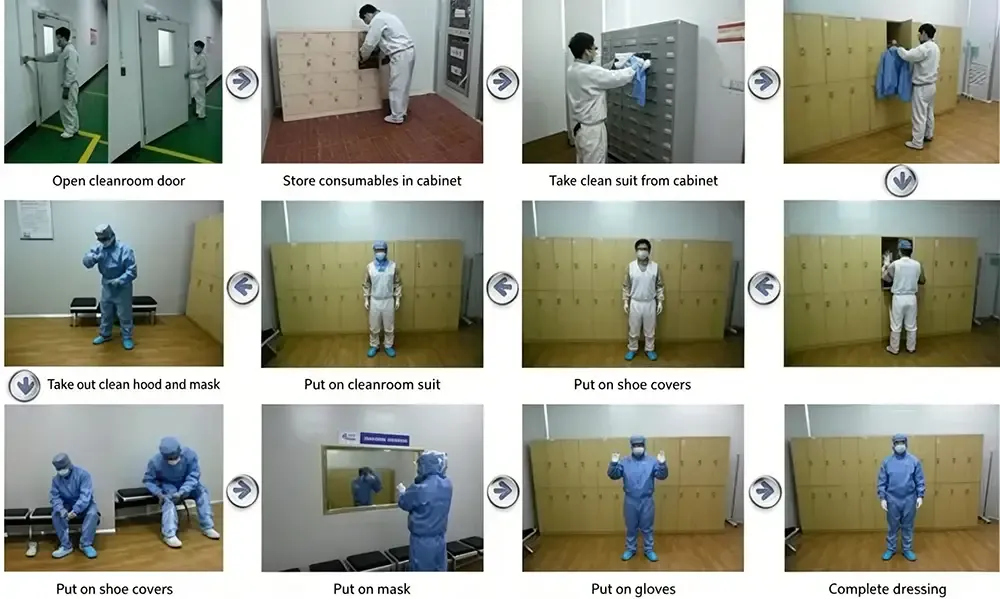
Proper cleanroom garment donning and correct use of the air shower are the first lines of defense. The Deiiang™ protocol, developed by Jason.peng, specifies a step-by-step gowning sequence that minimizes particle transfer. Personnel must ensure no hair or clothing is exposed before entering. Items prohibited in the cleanroom include dust-generating articles, digital products, food, personal belongings, unused items, and uncleaned tools. Only approved cleanroom-specific items are permitted. This strict material control is a cornerstone of clean room environment management.
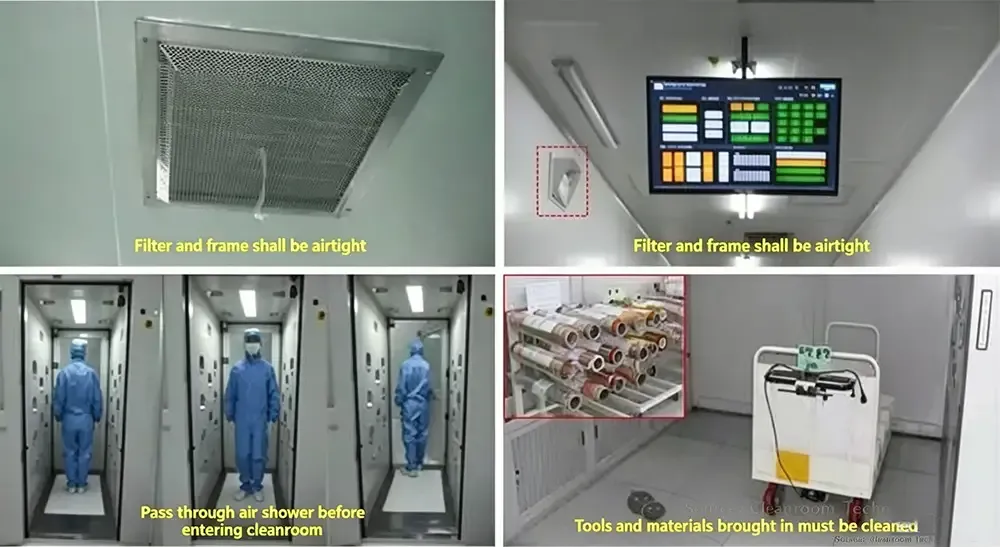
Correct gowning procedure
Wearing the cleanroom suit in the correct order, ensuring all closures are sealed, reduces particle shedding by over 90% compared to improper gowning. Regular clean room environment monitoring at the gowning area exit validates this process.
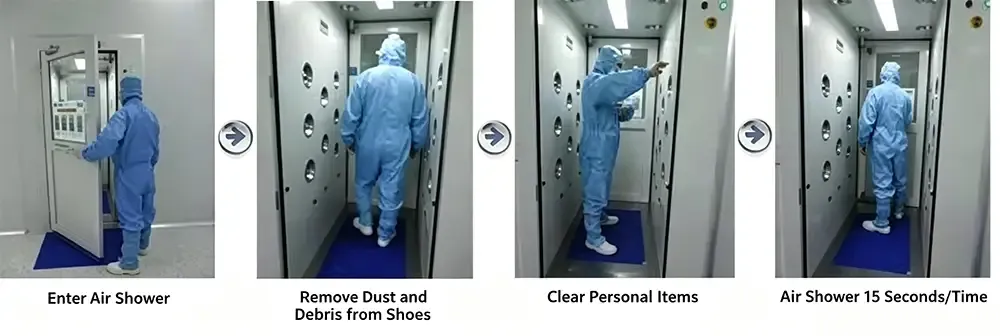
Correct use of air shower — entry procedure
Enter the air shower, stand correctly, raise arms, and rotate slowly to allow the high-velocity jets to dislodge particles from all surfaces. The cycle typically lasts 15–30 seconds. Exiting the air shower improperly can re-contaminate garments; follow the exit protocol carefully.
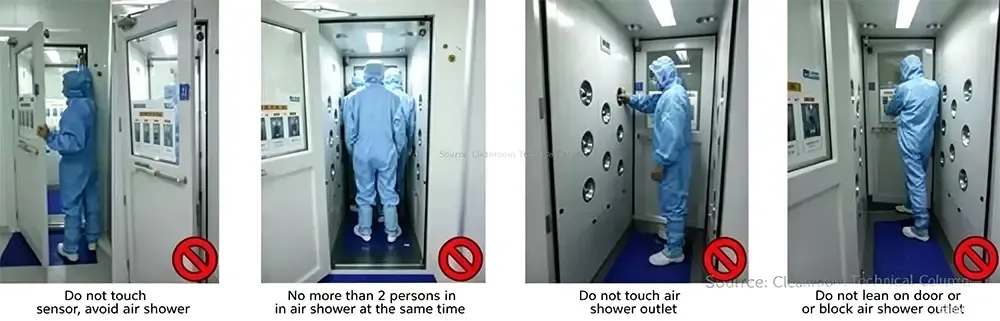
Precautions for using air showers
Prohibited items
Dust-generating articles
Digital products
Food and beverages
Personal belongings
Unused items
Uncleaned tools and materials
Permitted cleanroom-specific items
Only approved cleanroom notebooks, low-particle pens, cleanroom wipes, and validated tools should be used. This material segregation is essential for consistent clean room environment management.
Do not let dust accumulate — Cleanroom cleaning
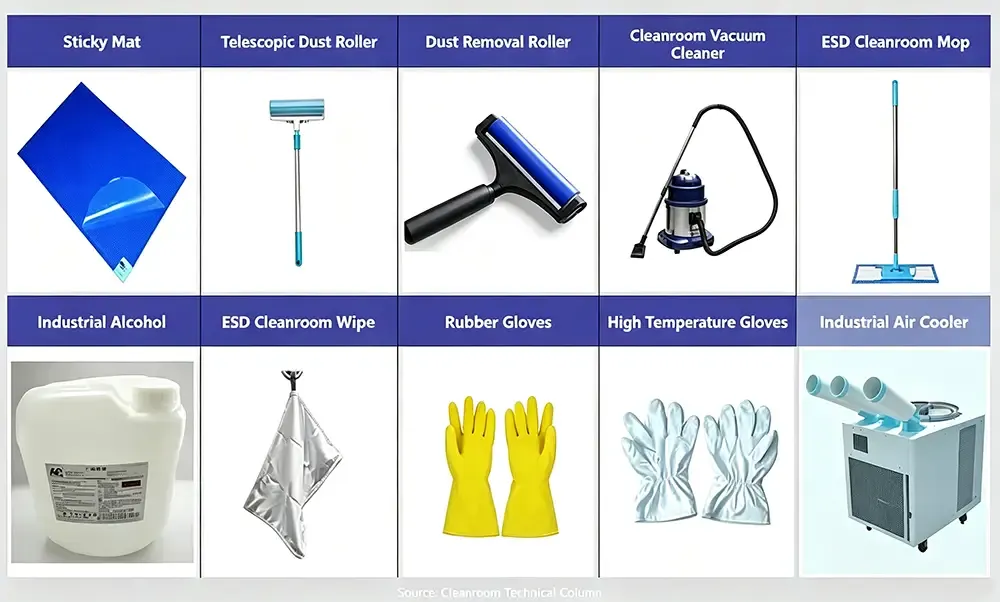
Cleaning must be done from top to bottom and from inside to out, in the sequence A->B->C->E. First clean the highest points and work from the inside out to the exit. Use a single direction for wiping to avoid particles being redeposited. Verification of the clean room environment is done using clean room environment monitoring after every cleaning cycle and as required in accordance with the clean room environment management process.
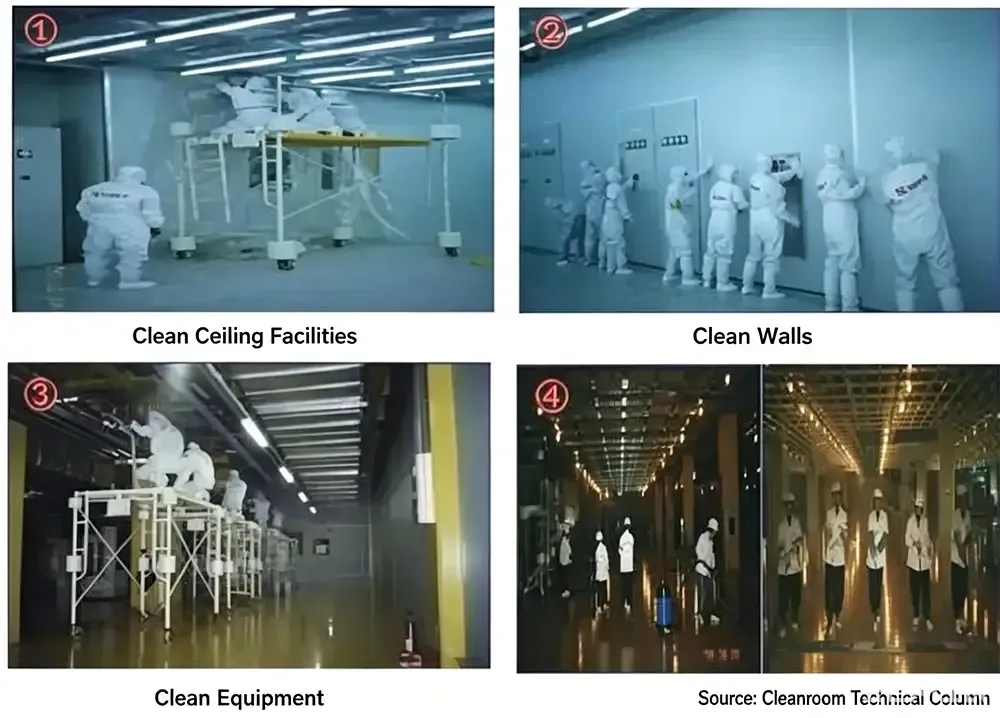
Cleaning sequence zones:
A: Ceiling deck and upper beams — wipe with cleanroom wipes and pure water.
B: Equipment above ceiling — remove all protective film, wipe ducts, pipes, and cable trays.
C: Ceiling deck surface — remove debris, mop with pure water.
D: Equipment below ceiling — dry-wipe electrical contacts, wet-wipe pipes and bridge racks.
E: Floor — remove protective film, collect debris, clean with a cleaning machine, use a cleanroom tacky mop, then wipe with pure water. Allow to dry.
A: Ceiling deck and upper beams — wipe with cleanroom wipes and pure water.
B: Equipment above ceiling — remove all protective film, wipe ducts, pipes, and cable trays.
C: Ceiling deck surface — remove debris, mop with pure water.
D: Equipment below ceiling — dry-wipe electrical contacts, wet-wipe pipes and bridge racks.
E: Floor — remove protective film, collect debris, clean with a cleaning machine, use a cleanroom tacky mop, then wipe with pure water. Allow to dry.
Key points: Take a bucket of pure water up into the ceiling void for wiping and wring out the wipe so as not to leave any residues. Try to keep the area that you are cleaning separate from the area where you are producing. Columns and valves can be cleaned with water and the aluminum honeycomb wall panels wiped down. Production trays are to be dry-wiped by the contractor who is responsible for them.
Cleaning best practices
Clean from top to bottom.
Clean from inside to outside.
Clean in one consistent direction.
Only dedicated cleanroom cleaning tools and products may be used. These include polyester wipes, tacky rollers, and HEPA-filtered vacuums. The Deiiang™ cleanroom consumables line, specified by Jason.peng, meets these stringent requirements for clean room environment management.
Quickly remove dust
While good prevention is better than good cleaning, some particles will find their way into the cleanroom. The air handling system must then be able to quickly dilute and remove these particles. This is achieved by a high number of air changes per hour and the correct airflow patterns that remove particles from the critical area. Clean room environment monitoring systems also record the recovery rate of a room, i.e. the time taken for the room to return to its basic particle count after a contamination event. A well-designed cleanroom returns to its basic particle count within 1–2 minutes for iso class 5–7 clean rooms.
Cleanroom precautions
Adherence to behavioral rules is non-negotiable in clean room environment management. The following checklist, refined by Deiiang™ and Jason.peng, summarizes the essential do's and don'ts that every operator must follow to support clean room environment monitoring objectives.
Do not run in the cleanroom; do not drag anti-static shoes when walking.
No chatting, loud talking, or shouting.
Personal items (mobile phones, watches, etc.) and food are prohibited inside the cleanroom.
All incoming materials and consumables must pass through the air shower or pass box after cleaning.
Persons wearing makeup or nail polish are prohibited from entering.
If hair, eyebrows, or regular clothing is exposed from under the anti-static hood or cleanroom suit, immediately go to the smock room to correct the gowning, then re-enter via the air shower.
replace damaged or contaminated anti-static gloves and finger cots immediately.
If the cleanroom cap, suit, or shoes become damaged or soiled during work, notify the supervisor for replacement.
At the start of work, end of work, and after breaks, use a tacky roller to clean the work surface and surrounding area.
Do not place unnecessary items on the workbench.
Do not rock or lean back while seated in a chair.
Do not lean on equipment, walls, or workbenches.
Do not sit on the floor.
Do not touch skin with gloved hands.
Be cautious of electrical shock from switches, power supplies, and electrical devices.
After completing work, organize and tidy the workbench, tools, and surrounding area before leaving.
References
GB50073-2013 — Code for Design of Clean Workshop. View Standard
GB19489-2008 — General Requirements for Laboratory Biosafety. View Standard
GB50346-2011 — Architectural and Technical Code for Biosafety Laboratories. View Standard
iso 14644-1:2015 — Cleanrooms and associated controlled environments. View Standard
Deiiang™ Cleanroom Equipment Documentation. Visit Deiiang™
© Deiiang™ · Product Designer: Jason.peng · All rights reserved.