+86 13638632902
 Jason@cleanroomequips.com


 MENU
MENU
Let's start with a simple truth: in the world of cleanrooms, air isn't just air—it's either your greatest ally or your worst enemy. Cleanroom panel air tightness might sound like technical jargon, but it's actually the unsung hero that determines whether your cleanroom performs like a Formula 1 car or a beat-up old sedan.
Think about it this way: if your cleanroom panels were as leaky as a sieve, you'd be trying to fill a swimming pool with a hole in the bottom. All that expensive filtered air? Gone. Those carefully controlled particles? Running wild. That's why cleanroom panel air tightness isn't just a nice-to-have—it's the foundation of contamination control, energy efficiency, and regulatory compliance.
In this guide, we're going to unpack everything you need to know about cleanroom panel air tightness, from the basic "what-is-it" to the nitty-gritty of testing and maintenance. Whether you're designing a new facility or troubleshooting an existing one, understanding this topic will save you time, money, and headACHes. And hey, we might even make it fun along the way!
Air Tightness: The Cleanroom's Invisible Shield
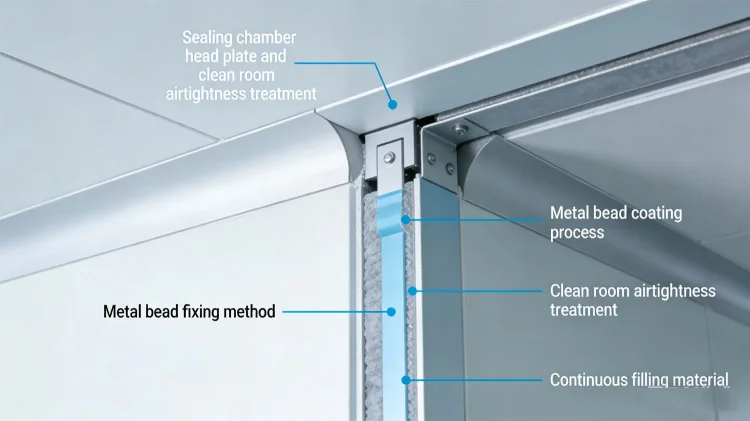
When it's working, you don't notice it. When it fails, everything falls apart.
What Is Cleanroom Panel Air Tightness?
Alright, let's get technical for a moment. Cleanroom panel air tightness refers to the ability of your cleanroom's envelope—walls, ceiling, doors, windows, and all those pesky penetrations—to resist air leakage when there's a pressure difference between inside and outside. In simpler terms: how good are your cleanroom panels at keeping the air where it's supposed to be?
Now, here's where it gets interesting. In a typical ISO Class 5 Cleanroom, you might be maintaining a positive pressure of 15-30 Pascals relative to adjacent areas. That's like trying to keep air in a slightly overinflated balloon. Without proper cleanroom panel air tightness, that air will find every little gap and escape, taking your carefully controlled environment with it. It's not just about leaks outwards either—in negative pressure rooms, poor air tightness lets unfiltered air sneak in, bringing contaminants with it.
Cleanroom Pressure & Leakage Paths
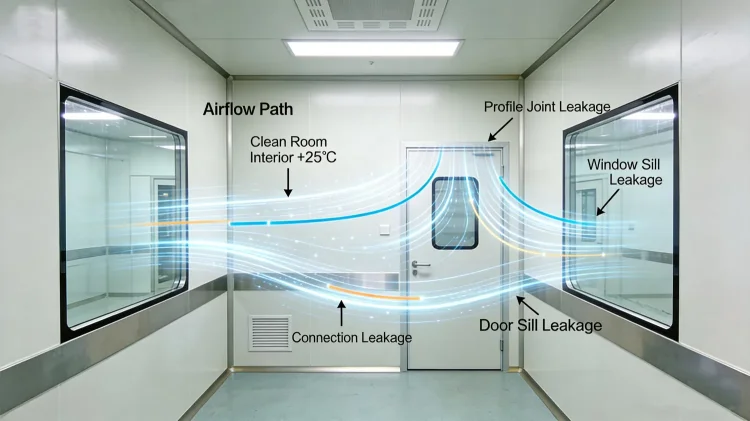
Figure: Air leakage paths in a pressurized CleanRoom
Quick Math: If your cleanroom has a leakage rate of just 0.5 m³/h per m² at 50 Pa, and your cleanroom has 500 m² of panel surface area, you're losing 250 m³/h of conditioned air. At 10 air changes per hour, that's like adding an extra 25 m³ to your cleanroom volume that your HVAC has to handle!
Why Air Tightness Matters in Cleanroom Panels
Let me tell you a story about a pharmaceutical company that learned about cleanroom panel air tightness the hard way. They had a beautiful ISO Class 7 Cleanroom, but they kept failing particle counts during validation. After weeks of troubleshooting, they discovered their panels were so leaky that unfiltered air was bypassing the HEPA filters entirely. The fix? A complete resealing that cost them 3 weeks of downtime and $50,000. Ouch.
The Cleanliness Conundrum
Here's the deal: every cubic meter of air that leaks into your cleanroom bypasses your filtration system. In a Semiconductor fab, that could mean introducing 10,000+ particles per cubic foot. In a pharmaceutical setting, it could mean microbial contamination that ruins an entire batch of product. Proper cleanroom panel air tightness is your first line of defense against this invisible invasion.
The Energy Drain
HVAC systems in cleanrooms aren't just fans—they're energy hogs, typically consuming 50-70% of a facility's total energy. When your panels leak, your system has to work overtime to maintain pressure and cleanliness. We've seen facilities reduce energy consumption by 15-30% just by improving their cleanroom panel air tightness. That's real money back in your budget.
Energy Impact of Different Air Tightness Levels
Tightness
Tightness
Tightness
Figure: Comparative HVAC energy consumption at different air tightness levels
Safety & Compliance
In BSL-3 or BSL-4 labs, or cleanrooms handling hazardous chemicals, cleanroom panel air tightness isn't about efficiency—it's about safety. A leak could mean pathogens escaping or dangerous chemicals spreading. And let's not forget regulatory compliance: whether it's FDA, EU GMP, or ISO standards, they all implicitly require proper containment, which starts with tight panels.
Key Factors Influencing Panel Air Tightness
Think of cleanroom panel air tightness like a chain—it's only as strong as its weakest link. At Deiiang™, we've identified five critical factors that determine whether your cleanroom panels will be Fort Knox or Swiss cheese when it comes to air leakage.
Panel Structure & Materials
The core material matters—a lot. PIR/PUR foam panels naturally have better air tightness than fibrous materials like rockwool because the foam creates a continuous barrier. Surface materials and manufacturing precision also play crucial roles.
Joint & Seam Design
U-type, V-type, tongue & groove, cam-lock systems—each has different air tightness characteristics. The best designs create labyrinth-like paths that dramatically increase airflow resistance.
Sealant Types & Performance
Silicone, polyurethane, EPDM gaskets—they're not all created equal. We've tested sealants that maintain elasticity for 15+ years versus others that crack after 3. The right choice matters for long-term cleanroom panel air tightness.
Installation Workmanship
Even the best panels installed poorly will leak. Proper compression force on joints, continuous sealant application, and precise alignment make all the difference. As our lead installer says: "Measure twice, seal once."
Penetrations & Openings
Doors, windows, utility penetrations—these are the usual suspects in air leakage cases. Each requires specialized sealing solutions tailored to the specific penetration type.
Real-world Example: We once tested two identical cleanrooms with different installation teams. Room A had leakage of 0.8 m³/h·m² at 50 Pa, while Room B (with our trained installers) achieved 0.3 m³/h·m². The difference? Attention to detail at every joint and penetration. That 0.5 m³/h·m² difference translated to 22% lower HVAC energy costs annually.
Comparison of Cleanroom Panel Types by Air Tightness
Not all cleanroom panels are created equal when it comes to cleanroom panel air tightness. The core material is like the foundation of a house—get it wrong, and you'll be fighting leaks forever. Here's our honest comparison based on thousands of tests we've conducted at Deiiang™.
| Panel Type | Core Material | Typical Air Tightness | Pros | Cons / Challenges |
|---|---|---|---|---|
| PIR/PUR Panels | Polyisocyanurate/Polyurethane foam | High - Excellent | Low thermal conductivity, self-adhesive, monolithic structure | Higher cost, requires precise manufacturing |
| rockwool panels | Rockwool (mineral wool) | Medium - Good | Excellent fire resistance, good sound absorption | Fibrous structure can compromise air tightness, relies on joint sealing |
| Paper Honeycomb | Paper honeycomb | Good - Medium | Low cost, lightweight | Lower strength, hygroscopic, requires meticulous joint treatment |
| Aluminum Honeycomb | Aluminum honeycomb | High - Excellent | High strength, excellent flatness, lightweight | Higher cost, requires special edge sealing |
| Glass Magnesium | Glass magnesium | Medium - Good | Fire and moisture resistant | Brittle, flatness control challenging, joints prone to cracking |
Choosing the Right Panel for Your Application
Here's the thing: PIR/PUR and aluminum honeycomb panels often come with better cleanroom panel air tightness straight from the factory because they're more homogeneous. Rockwool and paper honeycomb? They can achieve good results too, but they're more dependent on perfect installation and sealing. For iso class 5 and above, we almost always recommend PIR/PUR or aluminum honeycomb for their inherent air tightness advantages.
Deiiang™ Insight: We recently supplied PIR panels for a semiconductor facility that required iso class 4. The factory-tested air tightness was 0.25 m³/h·m² at 50 Pa. After installation with our proprietary sealing system, the completed cleanroom achieved 0.18 m³/h·m²—well beyond the project requirements. That's the power of combining the right panel with expert installation.
Cleanroom Panel Air Tightness Standards
Standards are like the rules of the road for cleanroom panel air tightness—they tell you what's acceptable, how to measure it, and when you've got a problem. But here's the tricky part: there's no single global standard that says "your cleanroom panels must achieve X air tightness." Instead, we have a patchwork of standards that give us the tools to measure and specify what we need.
| Standard Name | Scope / Summary | Air Tightness Related Clauses | Application / Industry |
|---|---|---|---|
| ISO 14644 Series | Cleanrooms and associated controlled environments | Overall air tightness requirements, pressure difference testing, air leakage rate assessment | Pharma, Electronics, biotech, food (high cleanliness requirements) |
| ASTM E283 | Test method for air leakage through building envelopes | Determines air flow through enclosure at specified pressure difference | Building materials, cleanroom panels, doors/windows (component testing) |
| EN 12114 | Air permeability of building components | Determines air flow through components at specified pressure difference | EU building and laboratory enclosures |
| ISO 17772-1 | Energy performance of buildings | Requirements for air permeability affecting building energy use | Building energy design and assessment |
| GMP Guidelines | Good Manufacturing Practice | Indirect requirements for stable environments, pressure control | Pharmaceuticals, medical devices |
Making Sense of the Standards
Here's how it works in practice: ISO 14644 doesn't give you a magic number for cleanroom panel air tightness, but it says you must maintain proper pressure differentials and cleanliness. To achieve that, you need good air tightness. So we borrow test methods from building standards like ASTM E283 to measure panel performance, then verify the finished cleanroom meets the ISO requirements.
Practical Tip: When specifying cleanroom panels, require test reports according to ASTM E283 or EN 12114. A good target for high-performance cleanrooms is ≤0.5 m³/h·m² at 50 Pa. For critical applications (iso class 5 and above), aim for ≤0.3 m³/h·m². Deiiang™ panels are typically tested at 0.2-0.4 m³/h·m² depending on the panel type.
How to Design Cleanroom Panels for Better Air Tightness
Designing for superior cleanroom panel air tightness is like planning a military operation: you need to think about every possible point of failure before the battle begins. At Deiiang™, we start with air tightness as a core design objective, not an afterthought.
Design Phase Considerations
Choose integrated, modular cleanroom systems with optimized joint designs. The fewer field modifications required, the better your cleanroom panel air tightness will be. Plan all penetrations upfront—every pipe, cable, duct, and light fixture needs a dedicated sealing solution from day one.
Don't forget the support system! Ceiling grids, wall anchors, and floor channels can create leak paths if not properly integrated. We design our Deiiang™ systems so the support structure enhances, rather than compromises, the air tightness.
Material Selection & Joint Design
Precision matters. Factory-made panels with tight dimensional tolerances (±0.5mm) fit together better than field-cut panels. For joints, we prefer interlocking designs with multiple sealing lines—like a maze that air has to navigate through.
Our proprietary tongue-and-groove system with integrated EPDM gaskets creates two barriers: a mechanical interlock and an elastic seal. It's like wearing both a belt and suspenders—overkill? Maybe. Effective? Absolutely.
Sealant Selection & Application
Not all sealants are cleanroom-friendly. We use low-VOC, non-particle-shedding silicones and polyurethanes that maintain elasticity for 10+ years. For gaskets, EPDM rubber is our go-to—it handles temperature swings from -40°C to +120°C without getting brittle or gooey.
✓ Good Joint (Air Tight)
• Continuous sealant bead with no gaps
• Sealant fully contacts both panels
• Proper compression of gasket material
• Panels aligned within 1mm tolerance
Result: <0.3 m³/h·m² leakage
✗ Poor Joint (Leaky)
• Interrupted sealant with gaps/bubbles
• Sealant doesn't adhere to one surface
• Gasket not compressed or missing
• Panels misaligned by >3mm
Result: >1.0 m³/h·m² leakage
Comparison of proper vs improper panel joint sealing
Installation Guidelines to Ensure Air Tightness
Here's an uncomfortable truth: even the world's best cleanroom panels can leak like a sieve if installed incorrectly. We've seen $500,000 cleanrooms fail validation because of $5,000 installation mistakes. At Deiiang™, we train our installation teams like NASA trains astronauts—every detail matters.
1. Pre-Installation Check
Verify panel flatness (<2mm over 2m), clean all surfaces, and check floor levelness. A 3mm floor dip can create a 5mm gap at the ceiling. Yes, it's that sensitive.
2. Joint Compression Control
Bolts and cam-locks need specific torque (usually 8-12 N·m). Too loose = leaks. Too tight = panel distortion = different kind of leaks. Goldilocks was right about cleanroom installation too.
3. Sealant Application
Continuous bead, 45° nozzle angle, 6-8mm bead width. No starts/stops. Our rule: if you have to stop for more than 2 minutes, discard the cartridge and start fresh.
4. Penetration Sealing
Every pipe/cable gets a dedicated sealing collar + secondary sealant. We test each penetration with smoke before moving on. No exceptions.
5. Floor/Wall Transitions
Coved corners with radius ≥50mm, sealed with flexible epoxy or polyurethane. 90° corners are leak magnets—avoid them like the plague.
6. Quality Control
Daily inspections with checklist. 25% of joints smoke-tested randomly. Any failure = recheck of all similar joints. It's tedious but prevents catastrophic failures.
Common Air Leakage Points in Cleanrooms
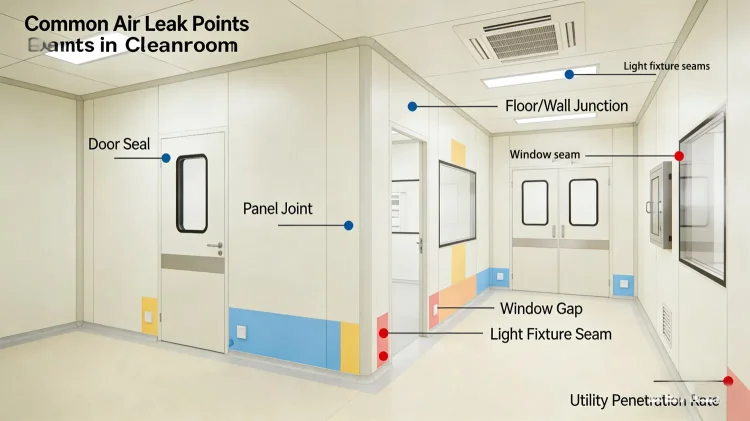
Typical air leakage locations in cleanroom enclosures
Testing Methods for Cleanroom Panel Air Tightness
Testing cleanroom panel air tightness is like getting a medical checkup: you might feel fine, but the tests reveal what's really going on. And just like medicine, we have different tests for different purposes—some for diagnosis, some for monitoring, some for peace of mind.
Blower Door Test
The gold standard for overall cleanroom air tightness. We seal a fan in a doorway, depressurize the room to -50 Pa, and measure how much air we need to maintain that pressure. The math is simple: Q50 = V × n50 / 3,600 where Q50 is airflow at 50 Pa (m³/s), V is room volume (m³), and n50 is air changes per hour at 50 Pa.
For a 500 m³ cleanroom needing 2 ACH50, you'd have Q50 = 500 × 2 / 3,600 = 0.28 m³/s. That's your maximum allowable leakage if you want good performance.
| Test Method | Test Principle | Advantages | Limitations | Typical Application |
|---|---|---|---|---|
| Blower Door Test | Measures airflow needed to maintain specified pressure differential | Quantifies overall leakage, reliable data | Doesn't locate specific leaks | Overall cleanroom acceptance testing |
| ASTM E283 Test | Laboratory measurement of component air permeability | Accurately assesses material performance | Component-level only, not field performance | Panel material verification |
| Smoke Test | Visualizes airflow paths using smoke or fog | Intuitive, quickly locates obvious leaks | Qualitative only, doesn't quantify leakage | Leak location during construction |
| Ultrasonic Detection | Detects high-frequency sound from airflow through gaps | Fast, non-contact, precise leak location | Requires pressure differential, best for small gaps | Troubleshooting, maintenance checks |
Interpreting Test Results
Here's how we categorize cleanroom panel air tightness based on blower door results:
Excellent
ISO Class 5+ ready
Good
ISO Class 6-7 suitable
Poor
Needs improvement
Remember: ACH50 means "air changes per hour at 50 Pascals pressure difference." For reference, a typical house might be 5-10 ACH50. A good cleanroom should be under 2 ACH50. Our Deiiang™ installations typically achieve 0.8-1.5 ACH50.
Common Air Leakage Problems & Troubleshooting Guide
Even with the best design and installation, cleanroom panel air tightness can degrade over time. Materials age, buildings settle, and let's be honest—sometimes things just don't go according to plan. Here's our field guide to diagnosing and fixing the most common air leakage problems.
The Usual Suspects
Panel Joint Failures: Sealant doesn't last forever. After 5-10 years, silicone can become brittle, especially with UV exposure or chemical cleaning agents. The fix is straightforward but tedious: remove old sealant (completely!) and reapply with proper surface preparation.
Door & Window Issues: Gaskets compress over time. A 10mm gasket might compress to 8mm after 5 years of use, creating a 2mm gap. That doesn't sound like much, but a 2mm gap around a standard cleanroom door leaks about 15 m³/h at 25 Pa pressure.
Leak Detection in Action
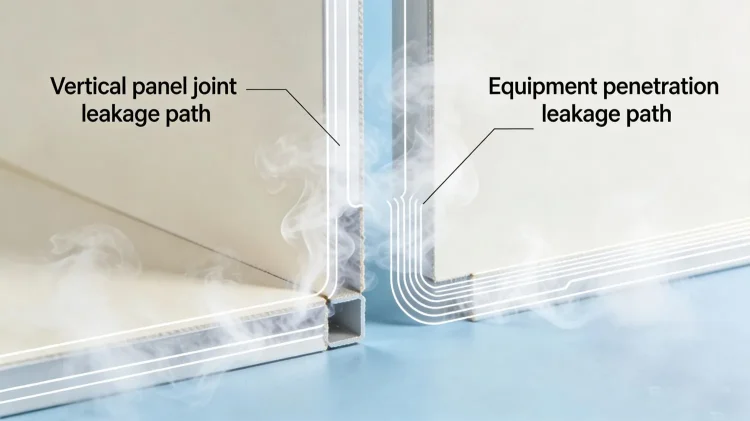
Smoke testing reveals invisible air leakage paths at panel joints and penetrations
| Common Problem | Likely Causes | Detection Methods | Solutions |
|---|---|---|---|
| Pressure Fluctuations | Overall high leakage rate; HVAC system issues | Blower door test; pressure monitoring logs | Comprehensive sealing; identify and fix major leaks |
| Panel Joint Leaks | Sealant aging; installation defects; panel movement | Visual inspection; smoke test; ultrasonic detection | Remove old sealant, reapply properly; reinforce panels |
| Door Seal Failure | Gasket aging/deformation; hardware issues | Door closure test; visual inspection; pressure test | replace gaskets; adjust or replace hardware |
| Penetration Leaks | Seal aging; improper installation; gap around penetration | Smoke test; ultrasonic detection; soap bubble test | Reseal; use proper penetration sealing kits |
| Localized Contamination | Specific leak introducing contaminants | Particle counting; smoke testing | Locate and seal specific leak point |
Case Study: The Mystery of the Failing ISO Class 6 Cleanroom
A pharmaceutical company's cleanroom kept failing particle counts despite recently replaced HEPA filters. Pressure differential was unstable (fluctuating 10-25 Pa instead of steady 15 Pa). Our investigation found:
3 door gaskets had 2-3mm gaps (age + improper cleaning chemicals)
2 cable penetrations had never been properly sealed
25% of panel joints showed sealant shrinkage/cracking
Solution: We resealed all problem areas with cleanroom-grade silicone and replaced door gaskets. Total cost: $8,500. Result: Stable pressure (15±1 Pa) and consistent ISO Class 6 compliance. ROI: 3 months (vs. $50k+ for new HEPA filters that wouldn't have solved the real problem).
Cleanroom Panel Air Tightness: Long-term Maintenance and Management
Think of cleanroom panel air tightness like dental hygiene: ignore it, and things will slowly deteriorate until you have a painful (and expensive) problem. But with regular checkups and proper care, you can maintain excellent performance for decades.
The Maintenance Mindset
Materials age. Buildings settle. Gaskets compress. These aren't failures—they're normal wear and tear. The key is catching issues early, before they affect your cleanroom performance or require major intervention.
We recommend thinking about cleanroom panel air tightness maintenance in three tiers: daily/weekly monitoring, quarterly inspections, and annual comprehensive testing.
Essential Maintenance Activities
Pressure Monitoring: Daily checks. Any deviation >10% from setpoint requires investigation.
Visual Inspections: Quarterly walkthroughs looking for sealant cracks, gasket deformation, panel gaps.
Door Operation Checks: Monthly verification that doors close properly and seals engage fully.
Annual Blower Door Test: Compare against baseline. >20% increase in leakage = time for action.
Sample Maintenance Schedule
Daily/Weekly
• Pressure differential monitoring
• Visual check of critical seals
Quarterly
• Comprehensive visual inspection
• Door and window operation tests
Annually
• Blower door test
• Ultrasonic leak detection survey
As Needed
• Sealant replacement (5-10 year cycle)
• Gasket replacement (3-7 year cycle)
Training Your Team
Maintenance isn't just about schedules—it's about people. Ensure your operations team understands:
Never use abrasive cleaners on seals/gaskets
Report any visible damage immediately (don't wait for scheduled inspection)
How to perform basic smoke tests for leak detection
The cost implications of poor cleanroom panel air tightness (energy, filtration, product quality)
At Deiiang™, we offer maintenance training programs that turn your staff into air tightness champions. Because the best maintenance plan is useless without people who understand why it matters.
How to Select a High Air-Tightness Cleanroom Panel
Buying cleanroom panels isn't like buying office furniture. You can't just pick the prettiest color or the lowest price. Cleanroom panel air tightness should be one of your top selection criteria—right up there with fire rating and cleanliness class.
Critical Selection Criteria
When evaluating panels, don't just take the salesperson's word for it. Ask for proof:
Third-Party Test Reports: ASTM E283 results from an accredited lab, not in-house tests.
Complete System Details: How do panels connect? What seals are used? Are penetrations addressed?
Installation Requirements: Do they provide certified installers or just written instructions?
Case Studies: Similar projects with documented performance data.
Deiiang™ Selection Checklist
✓ ASTM E283 test report provided
✓ Leakage ≤0.5 m³/h·m² at 50 Pa
✓ Complete sealing system included
✓ Certified installation available
✓ 5+ year warranty on air tightness
Application-Specific Recommendations
Different industries have different needs. Here's our quick guide:
Semiconductor/Electronics
Panel Type: PIR/PUR or aluminum honeycomb
Why: Ultra-low particle generation, excellent inherent air tightness, maintains cleanliness in iso class 3-5 environments
Deiiang™ Recommendation: Our PUR panels with cam-lock joints and factory-applied seals
Pharmaceutical/Biotech
Panel Type: PIR or fire-rated rockwool with enhanced sealing
Why: Meets GMP requirements, cleanable surfaces, maintains pressure cascades for containment
Deiiang™ Recommendation: Our PIR panels with coved corners and pharmaceutical-grade seals
Healthcare/Labs
Panel Type: Fire-rated rockwool or glass magnesium
Why: Meets building codes, handles humidity, contains hazards in BSL labs
Deiiang™ Recommendation: Our rockwool panels with double EPDM gaskets
Cost vs. Value Analysis: Yes, high-performance panels cost 15-30% more upfront. But consider: a 500 m² cleanroom with premium panels might save $12,000/year in energy costs and avoid $50,000 in contamination incidents. Payback period: 2-3 years. After that, it's pure savings. That's why cleanroom panel air tightness isn't an expense—it's an investment.
Conclusion + Call to Action
Let's wrap this up with a simple truth: cleanroom panel air tightness isn't optional. It's the foundation that determines whether your cleanroom is an asset or a liability. We've covered a lot of ground—from what air tightness actually means, to how to test it, to how to maintain it over decades of service.
The core principle is this: achieving and maintaining superior cleanroom panel air tightness requires a holistic approach. It's about material selection + precision design + meticulous installation + rigorous testing + ongoing maintenance. Miss any one of these, and you're compromising your entire investment.
At Deiiang™, we've spent years perfecting this approach. Our panels, our installation methods, and our support systems are all designed with one goal: giving you the most reliable, energy-efficient, and compliant cleanroom possible.
Ready to Optimize Your Cleanroom?
If you're planning a new cleanroom or upgrading an existing one, our team of experts can help you achieve optimal cleanroom panel air tightness.
Free initial consultation
Panel sample testing
Custom design solutions
Certified installation teams
Remember: In cleanrooms, what you can't see (air leaks) can hurt you more than what you can see. Don't leave cleanroom panel air tightness to chance.
© 2023 Deiiang™ Cleanroom Technologies | Product Designer: Jason.peng | All rights reserved.