+86 13638632902
 Jason@cleanroomequips.com
 MENU
MENU
The essence of cleanroom operation is contamination control, and airflow stands as its central pillar. Understanding why cleanroom airflow important is fundamental for anyone responsible for cleanroom operations.
This article explores the critical role of cleanroom airflow design and control, highlighting its decisive impact on product quality, personnel safety, regulatory compliance, and operational efficiency. Readers will gain comprehensive insights into the importance of cleanroom airflow - knowledge essential for optimizing cleanroom performance and avoiding costly mistakes.
Part 1: Cleanroom Airflow: The Lifeline of Contamination Control
Properly designed and maintained airflow systems represent the frontline defense against contamination in controlled environments. The importance of cleanroom airflow cannot be overstated when it comes to protecting sensitive processes from airborne particles and microorganisms.
1.1 Particulate and Microbial Contaminants: The Primary Enemies of Cleanrooms
Airborne contaminants originate from multiple sources:
- Personnel: Skin cells, hair, clothing fibers (approximately 1 million particles/minute per person)
- Processes: Equipment operation, chemical reactions, material handling
- Facility: Construction materials, HVAC systems, infiltration
- Microorganisms: Bacteria, fungi, viruses carried on particles
For example, in iso class 5 environments, particle counts must not exceed 3,520 particles (≥0.5μm) per cubic meter - a standard impossible to maintain without proper airflow management.
1.2 How Airflow Actively Removes Contaminants
Cleanroom airflow employs three primary mechanisms for contamination control:
- Dilution: Continuous introduction of filtered air reduces particle concentration. For instance, an iso class 7 cleanroom typically requires 30-70 air changes per hour.
- Carry-away: Laminar or turbulent airflow transports particles away from critical areas toward return air vents.
- Pressure control: Differential pressure prevents unfiltered air from entering clean zones. A minimum pressure differential of 0.02-0.05 inches water gauge is typically maintained.
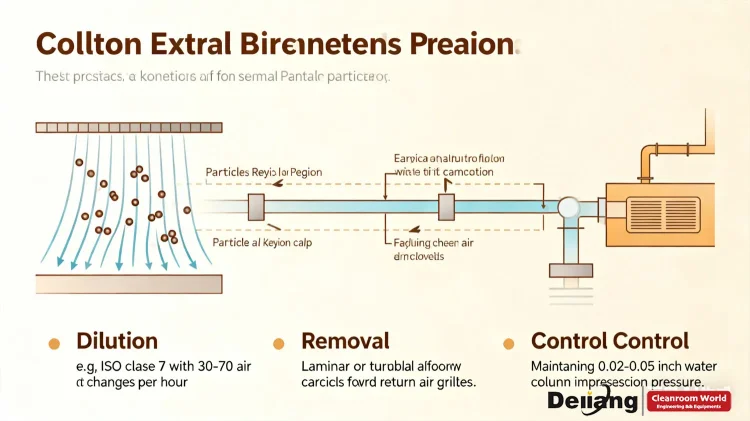
Diagram: Airflow path showing how particles are captured and removed from critical zones
Part 2: The Decisive Impact of Cleanroom Airflow on Product Quality & Yield
The direct correlation between controlled airflow and manufacturing success underscores the fundamental importance of cleanroom airflow in high-technology industries. Proper airflow design directly translates to measurable improvements in product quality and operational efficiency.
2.1 Reducing Product Defect Rates
Microelectronics Industry: Modern semiconductor fabrication requires near-absolute particle exclusion. A single 0.1μm particle can render a advanced chip worthless. With feature sizes now below 5nm, even nanoscale contaminants cause catastrophic failures. Proper airflow can reduce particle-induced defects by up to 95%.
Pharmaceutical Industry: In sterile manufacturing, microbial contamination poses life-threatening risks. Proper unidirectional airflow with velocities of 0.45 m/s ±20% (as per EU GMP Annex 1) ensures aseptic conditions during filling operations.
Medical Devices: Implantable devices require surface cleanliness measured in particles per square centimeter. Controlled airflow prevents adhesion of contaminants that could cause adverse biological reactions.
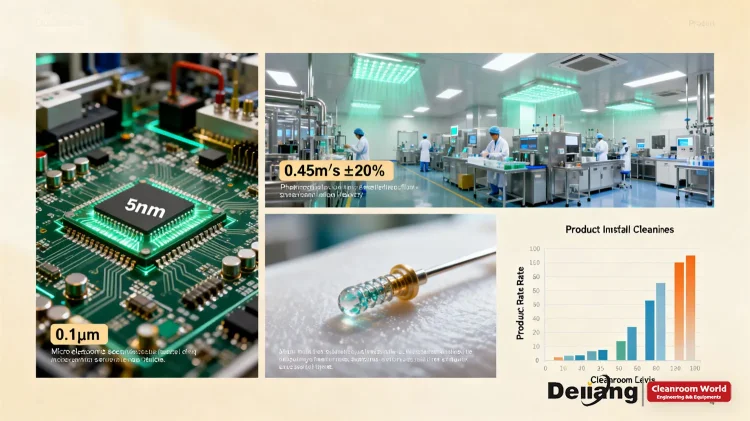
Comparison Chart: Product defect rate vs. cleanroom classification showing inverse relationship
2.2 Improving Production Efficiency and Reliability
The benefits of cleanroom airflow extend beyond quality to operational efficiency:
- Reduced Rework and Scrap: Semiconductor fabs report up to 15% reduction in scrap rates with optimized airflow, translating to millions in annual savings.
- Equipment Protection: Precision instruments and manufacturing tools are shielded from particle accumulation that can cause malfunctions or calibration drift.
- Extended Maintenance Cycles: Properly filtered air reduces equipment wear, extending service intervals by 20-30% according to Deiiang™ case studies.
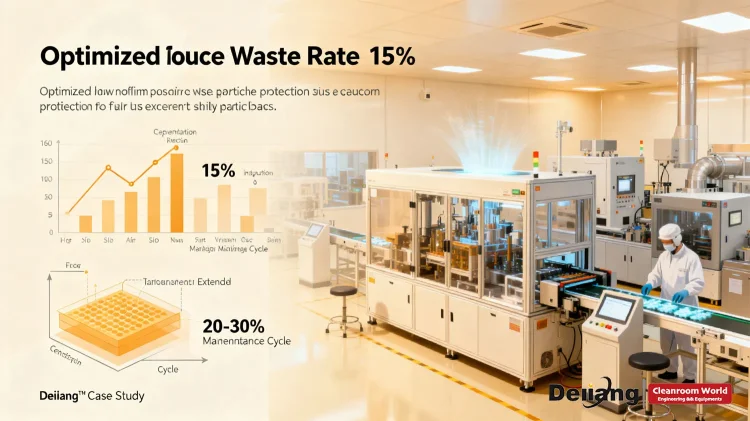
Analysis Chart: Cost savings from reduced defects and improved equipment uptime
Part 3: Compliance & Regulations: Legal and Industry Requirements for Cleanroom Airflow
Regulatory frameworks worldwide explicitly mandate specific airflow parameters, making compliance impossible without understanding the importance of cleanroom airflow. These standards represent minimum requirements for safe and effective operations.
3.1 International and Regional Standards (iso 14644, GMP, FDA)
Cleanroom classifications directly correlate with airflow parameters:
| Standard | Classification | Air Changes/Hour | Air Velocity (m/s) |
|---|---|---|---|
| ISO 14644-1 | Class 5 | 240-600* | 0.45 ±20% |
| EU GMP | Grade A | NA | 0.45 ±20% |
| ISO 14644-1 | Class 7 | 30-70 | Variable |
*Vertical unidirectional flow; horizontal flow requires higher velocities
Legal Consequences: Regulatory violations can result in product recalls, manufacturing suspension, and significant fines. In 2021, a major pharmaceutical company faced $50 million in penalties following airflow system failures that contaminated multiple drug batches.
3.2 Auditing and Validation
Regular testing and documentation are mandatory for compliance. Key airflow parameters requiring periodic verification include:
- Air velocity and uniformity testing (quarterly)
- Airflow visualization studies (annually)
- Pressure differential monitoring (continuous)
- HEPA filter integrity testing (every 6-24 months)
Deiiang™ validation protocols ensure clients meet all regulatory requirements with comprehensive documentation packages.
Part 4: Personnel Safety & Environmental Health: The Protective Role of Cleanroom Airflow
Beyond product protection, properly designed airflow systems serve critical safety functions. The importance of cleanroom airflow extends to protecting personnel from hazardous materials and preventing cross-contamination in sensitive environments.
4.1 Containment and Exhaust of Hazardous Materials
Negative Pressure Cleanrooms: Facilities handling toxic compounds, pathogens, or radioactive materials utilize negative pressure differentials (typically -0.02 to -0.05 inches WG) to prevent hazardous release.
Operator Protection: In pharmaceutical compounding or biotechnology labs, proper airflow patterns prevent operator exposure to potent compounds. air change rates of 12-15 ACH are typically specified for these applications.
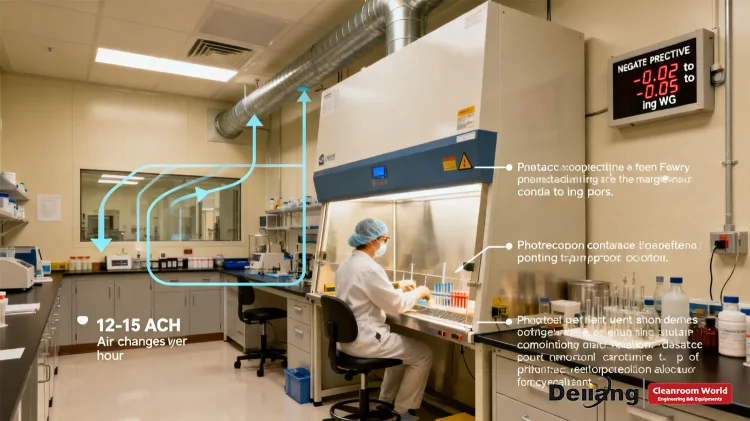
Diagram: Negative pressure cleanroom showing containment airflow patterns
4.2 Preventing Cross-Contamination
Healthcare Facilities: In isolation rooms and operating theaters, directional airflow prevents pathogen transmission. Studies show properly designed surgical suite airflow can reduce surgical site infections by up to 60%.
Pharmaceutical Manufacturing: Dedicated airflow systems prevent cross-contamination between different product lines, particularly important for facilities manufacturing both antibiotics and hormones.
Part 5: Risks & Consequences of Neglecting Cleanroom Airflow
Underestimating the importance of cleanroom airflow leads to severe operational, financial, and safety consequences. These risks are often overlooked until catastrophic failures occur.
5.1 Product Contamination and Recall
Case Study: In 2019, a medical device manufacturer recalled 450,000 units following microbial contamination traced to improper airflow balancing in their packaging area. Total costs exceeded $25 million including recall expenses and lost revenue.
Common contamination risks from poor airflow include:
- Dead zones with particle accumulation
- Turbulence at critical process points
- Insufficient air changes leading to contamination buildup
- Reverse flow from less clean to cleaner areas
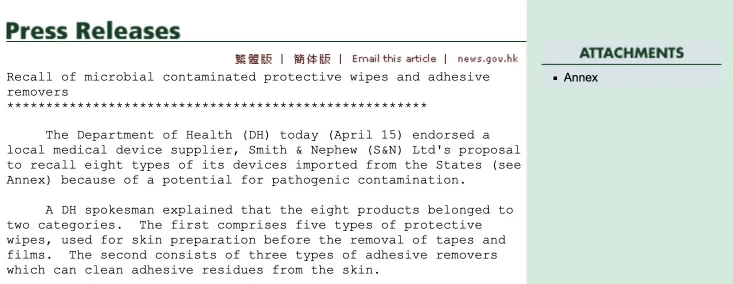
News report screenshot: Product recall announcement due to cleanroom contamination
5.2 Regulatory Penalties and Reputational Damage
FDA Warning Letters frequently cite airflow deficiencies. In 2022, 38% of pharmaceutical facility inspections identified HVAC system issues as significant observations.
5.3 Employee Health Risks
Inadequate containment airflow can expose workers to sensitizing compounds, carcinogens, or pathogens. Proper design by experts like Jason.peng at Deiiang™ ensures both product and personnel protection.
5.4 Increased Maintenance Costs and Equipment Damage
Poorly filtered air accelerates equipment wear. One semiconductor manufacturer reported 40% higher maintenance costs for tools located in areas with suboptimal airflow.
Part 6: Ensuring Effective Cleanroom Airflow
Maintaining optimal performance requires a systematic approach throughout the facility lifecycle. Understanding the ongoing importance of cleanroom airflow informs investment decisions and operational priorities.
6.1 Meticulous Design
Professional design considers process requirements, equipment layout, and personnel movements. Computational Fluid Dynamics (CFD) modeling predicts airflow patterns before construction, identifying potential issues early.
6.2 Rigorous Construction and Commissioning
Proper installation and thorough testing ensure design intent translates to operational reality. Deiiang™ commissioning protocols verify all parameters before facility handover.
6.3 Continuous Monitoring and Maintenance
Regular activities include:
- Filter replacement based on pressure differential (typically 0.8-1.2" WG differential indicates replacement need)
- Quarterly velocity and pressure verification
- Annual comprehensive performance testing
6.4 Staff Training
Proper personnel practices prevent airflow disruption. Training should cover gowning procedures, movement patterns, and equipment operation protocols.
Conclusion
Cleanroom airflow represents far more than simple ventilation - it is the foundational element of contamination control strategy. The comprehensive benefits of cleanroom airflow span product quality, regulatory compliance, personnel safety, and operational efficiency.
Investment in proper airflow design, monitoring, and maintenance represents a strategic commitment to quality and safety rather than merely a compliance expense. Facilities that recognize the fundamental importance of cleanroom airflow position themselves for long-term success in increasingly demanding regulatory and market environments.
Call to Action
Ready to optimize your cleanroom airflow performance? Contact Deiiang™ experts today for a comprehensive airflow assessment or download our complimentary whitepaper "Advanced Cleanroom Airflow Strategies" to deepen your understanding of this critical topic.
Appendix
Frequently Asked Questions (FAQs)
Q: Why are both positive and negative pressure cleanrooms needed?
A: Positive pressure cleanrooms prevent external contamination from entering, protecting sensitive processes. Negative pressure rooms contain hazardous materials inside, protecting the external environment and personnel. Selection depends on whether you're protecting the product from the environment or protecting the environment from the product.
Q: How critical is airflow velocity to cleanroom performance?
A: Extremely critical. Velocity directly impacts particle carrying capacity and turbulence. For unidirectional flow cleanrooms, velocities of 0.45 m/s ±20% are typically specified. Too low allows particle settlement; too high creates turbulence that reintroduces settled particles.
Q: How can I determine if my cleanroom airflow meets requirements?
A: Regular testing against iso 14644 standards is essential. Key parameters include particle counts, airflow velocity and uniformity, pressure differentials, and airflow visualization. Deiiang™ offers comprehensive certification services to verify compliance.
Further Reading
© 2023 Deiiang™ Cleanroom Solutions | Product Designer: Jason.peng