+86 18186671616
 Jason@cleanroomequips.com


 MENU

EU GMP Annex 1 (2022 revision, effective 25 August 2023) moved Contamination Control Strategy (CCS) from a supporting document to a core regulatory requirement. When auditors walk your cleanroom, the door is no longer just a doorway — it is a critical part of your pressure cascade and contamination control barrier.
This guide walks through what Annex 1 actually requires for Cleanroom doors, what QA teams check first, where projects commonly fail, and how to specify and validate a door assembly that holds up through inspection and daily operation.

EU GMP Annex 1 Door Requirements
Annex 1 does not name a specific door material or brand. What it does require is a contamination control strategy that covers how eACH opening maintains pressure differential, prevents ingress of contaminants, and remains cleanable throughout the production day [1].
During GMP inspections, the door is one of the first places auditors look. Why? Because it is the weakest link in the pressure cascade. Every time a door opens, the controlled air balance breaks. The door design determines how quickly it recovers — and whether it sheds particles while doing so.
Three regulatory shifts drive today's gmp cleanroom door requirements:
- CCS is mandatory — the contamination control strategy must be documented and risk-based, not assumed. Doors are explicitly listed as equipment that contributes to contamination control [1].
- Airlock design is specified — Annex 1 §4.24 requires that airlocks are designed to maintain pressure differences between adjacent zones, and that interlocking systems prevent simultaneous opening where required [1].
- Surface requirements are explicit — surfaces must be smooth, cleanable, and resistant to the disinfectants used in the room [1]. No hidden cavities, no unsealed edges that trap residue.
The way this usually goes wrong on site is treating the door as a civil works item. The architect specifies the opening, the contractor picks whatever door fits the frame, and the HVAC team deals with the pressure consequences. By the time commissioning hits, the leakage rate is too high and the interlock logic was never properly verified.
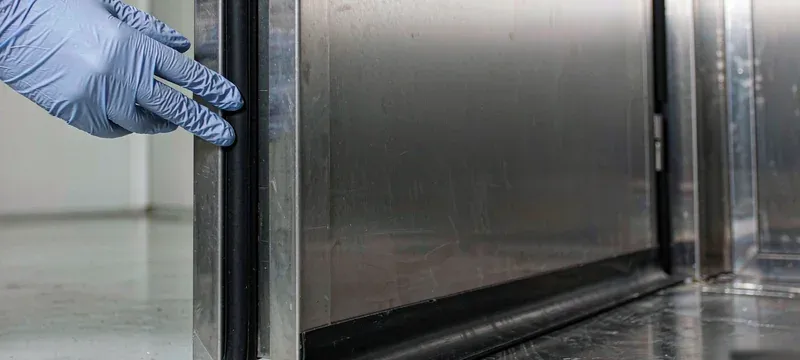
In 15 years of walking alongside QA auditors through pharma projects, I've noticed something: they don't start by flipping through material certificates. They walk straight to the door frame corner, run a gloved finger along the seal joint, and check whether the bottom drop-down sits flush against the floor. They know what Annex 1 is really asking for — not a "perfect material," but continuity in the contamination control strategy. A beautiful 316L face over a gaping corner joint tells them the CCS has a break they can't seal.
In our project records, Deiiang's Hermetic door assemblies for Annex 1 upgrade projects typically include: 304 or 316L stainless steel leaf (1.2 mm double skin over rock wool core), EPDM or silicone gasket rated for VHP, electromechanical interlock with dual pressure sensors, and EN 12207 Class 3 or Class 4 airtightness per EN 12207:2016 [7]. We provide assembly-level test reports, not just material datasheets.
Key Parameters and Selection Criteria
When you evaluate cleanroom door requirements, the spec sheet should cover four dimensions. Don't just ask "what material?" — ask for numbers that tie back to your URS.
| Parameter | Typical requirement | Why it matters |
|---|---|---|
| Surface finish | Ra ≤ 0.6 μm (304 brushed), ≤ 0.4 μm (316L electropolished) | Cleanable, no particle entrapment |
| Airtightness (EN 12207) | Class 3 or better for differential pressure zones | Holds cascade pressure; limits cross-contamination |
| Interlock logic | Two-door interlock with visual + audible status | Prevents simultaneous opening; maintains airlock integrity |
| Disinfectant compatibility | Tested against your actual formulation | Face, gasket, and adhesive must all survive your routine |
You'd be surprised how often a supplier quotes "stainless steel door" without specifying: face sheet thickness, core material, gasket material, or whether the frame is also stainless. The bill of materials matters more than the product name.
Our internal airtightness test data: a 900 × 2100 mm hermetic door with inflatable seal measured 0.3 m³/(m²·h) leakage at close in a B-grade vaccine suite project — against the project's URS acceptance target of ≤ 0.5 m³/(m²·h). Note this is a project-specific URS value, not a universal GMP limit. EN 12207 Class 4 allows ≤ 0.75 m³/(m·h) linear leakage at 100 Pa reference [7].
When a supplier quotes an EN 12207 class, ask: reference pressure, test specimen size, and actual door dimensions. A Class 4 rating on a single-leaf 900 × 2100 mm door does not directly transfer to a 1500 × 2100 mm double-leaf assembly.
One thing buyers often overlook: if your door sits in a fire-rated wall, it needs both an airtightness rating (EN 12207) and a fire integrity rating (EN 1634-1). These are two separate certifications. Many "hermetic doors" have no fire rating at all, and many fire doors can't achieve Class 3 airtightness because the seal design trades off for fire performance. Before you finalize the spec, confirm which wall the opening goes into — that determines whether you need a combined-rated door.
Public project data gives planning anchors (subject to your actual configuration): A-grade 316L inflatable-seal hermetic door ~55,000 RMB/leaf; B-grade 304 interlocked hermetic door ~30,000–45,000 RMB/leaf; C-grade HPL compact panel door ~12,000–20,000 RMB/leaf; D-grade painted steel swing door ~6,000–11,000 RMB/leaf. These are not Deiiang quotes — they're market reference points.
Common Myths and Field Mistakes

"All stainless steel doors perform the same in gmp environments."
Not true. 304 vs 316L differ in pitting resistance under hypochlorite exposure. A 0.8 mm face skin over particleboard behaves very differently from a 1.2 mm double skin over rock wool. Per EU GMP Annex 1 §4.25, surfaces must be evaluated against their intended use and cleaning regime — material grade is not a one-size-fits-all [1]. A 316L door in a corridor that only sees IPA and QAC is over-spec. A 304 door in a hypochlorite-wet zone will tea-stain within two years.
I've been asked on site: "why is my 316L door rusting?" Nine times out of ten, it's not the material — it's installation cross-contamination. The iron filings from cutting nearby stainless pipe got blasted onto the door face during construction, then oxidized under daily wipe-down. That's why I insist on cleaning isolation measures during installation, not just after. The door itself is fine; the install sequence wasn't.
"Airlock doors just need to be regular doors with a lock."
Per EU GMP Annex 1 §4.24, airlocks are designed to maintain pressure differences between adjacent zones [1]. That means the doors need to interlock — you cannot open both sides at once. A regular door with a mechanical lock does not satisfy this. You need an electromechanical interlock system with status feedback, and ideally a pressure sensor that confirms the zone is at the correct differential before allowing door opening.
Swing vs Sliding Doors by Clean Zone
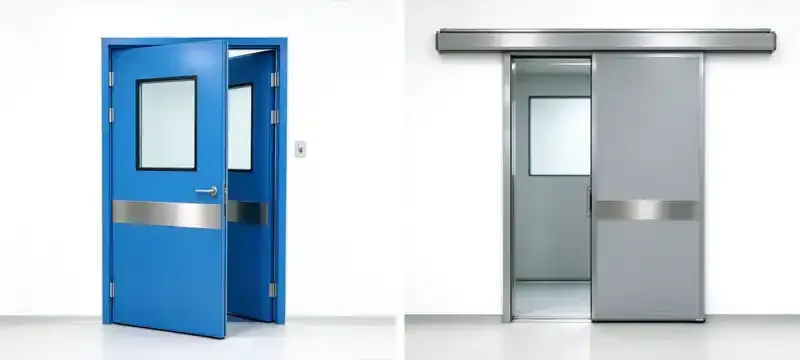
There is no universally correct door type. The choice depends on the clean zone, traffic pattern, and pressure differential requirement.
| Zone | Swing door | Sliding / hermetic door |
|---|---|---|
| Grade A/B (aseptic core) | Not recommended — swing breaks pressure too long | Preferred: hermetic sliding with inflatable seal |
| grade c (background) | Acceptable for low-frequency openings | Common for material corridors with higher traffic |
| Grade D (support / change rooms) | Standard choice — lower cost, simpler maintenance | Only where space constraints prevent swing arc |
Our product designer says the #1 field mistake he sees is specifying a swing door in a high-care zone where the opening cycle disrupts the cascade every time someone walks through. The door swings open, the pressure differential drops, and it takes 15–20 seconds to re-establish. If the room is cycled 50 times a day, that adds up to a lot of unstable minutes.
Sliding doors recover faster because they open on a smaller footprint and the seal re-engages immediately. But they come with their own maintenance burden — drive belts, track cleaning, sensor calibration. Don't just slap a bigger actuator on it and assume it's compliant.
- Grade A/B + VHP + high traffic → Hermetic sliding door, inflatable seal, 316L face
- Grade B + daily oxidizing wipe, no VHP → 304 stainless swing or sliding, perimeter seal
- Grade C + material corridor + trolley traffic → Reinforced sliding door, impact hinges
- Grade D + change room + low frequency → 304 or HPL swing door, standard closer
Vision panels are another audit trap. A double-glazed window flush with the frame, no visible gap at the trim, is what passes. A window with a raised plastic rim where dust collects is what gets written up. I've seen doors with perfect 316L faces fail inspection because the observation window trim had a 1 mm groove nobody could clean.
Based on our maintenance reference data: perimeter gaskets replaced every 2–4 years; automatic bottom drop-down seal every 12–18 months on high-frequency doors; hinges and hydraulic closers every 3–5 years. The leaf panel itself rarely fails before 15 years. Build your maintenance budget around seals and hardware, not around replacing the leaf.
Compliance Action Checklist

When QA walks the room at acceptance, these are the items they check. Use this as a pre-inspection self-audit.
Deiiang provides a standardized on-site acceptance checklist (PDF) covering these six items plus commissioning data points. Our internal engineering evaluation framework weights the non-gating dimensions as follows: surface-grade fit 25%, chemical compatibility 20%, airtightness 15%, lifecycle cost 15%, reliability 10%, delivery and service 8%, certification 4%, aesthetics 3%. This is our internal framework, not a regulatory scoring system.
Project Case Study: Aseptic Suite Upgrade
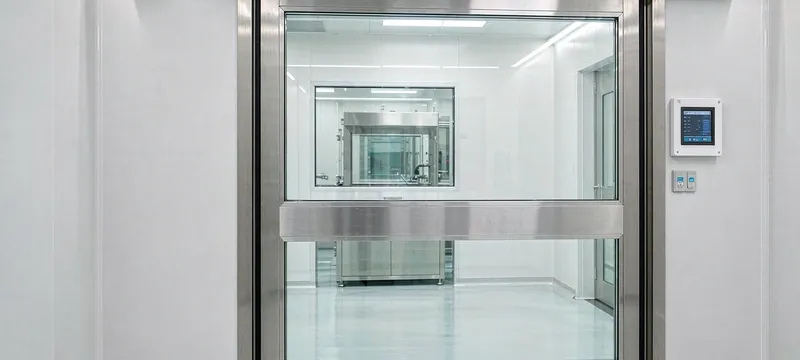
Project: 2024, aseptic filling suite upgrade for a biotech manufacturer in Singapore. The client came to us after a GMP audit flagged their Grade B corridor doors — pressure holding and interlock logic were both open findings.
The pain point: The existing swing doors in the personnel airlock had no interlock at all. Operators would push both doors open at once, and the pressure differential between the Grade B corridor and the Grade A core would drop from +15 Pa to nearly +5 Pa in about three seconds. The auditor wrote it up as a contamination control strategy gap.
What we actually did: You might think the fix was just "bigger pneumatic closer, stronger seal." But my experience told me the real problem was the seal-to-floor contact angle on the existing swing doors. We replaced six doors with hermetic sliding units — 316L stainless faces, inflatable EPDM seals rated for their VHP cycle, and dual pressure sensors that lock the inner door until the cascade reads correct. We also customized the adhesive for their specific cleaning SOP (daily 0.2% peracetic acid + weekly VHP), because off-the-shelf gasket adhesive would have blistered within six months. The full test data package — leakage curve, interlock logic verification, and material compatibility — is available on request.
Acceptance result: Post-retrofit differential pressure held at +15 Pa (Grade A core) against +10 Pa (Grade B corridor), measured leakage at 0.3 m³/(m²·h) per door. The follow-up GMP audit closed with zero findings on the door system. Three weeks of weekend shutdowns — no production days lost.
My takeaway: In high-frequency impact zones, stop obsessing over Ra values. The more urgent parameter is closer cycle count and seal recovery time. A 0.4 μm electropolished door that leaks 15 seconds every cycle doesn't help your CCS.
Second Case: Australian Pharmacy Compounding Suite
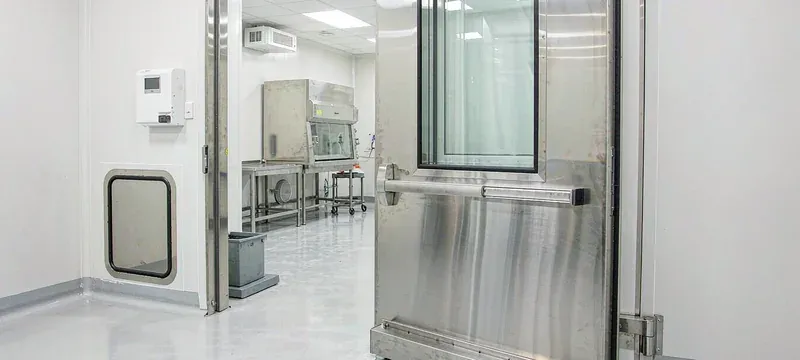
Project: 2025, sterile compounding pharmacy upgrade in Perth, Western Australia. The client needed to bring their USP 797/800 clean compounding area into compliance. You'd think pharmacy requirements are lighter than pharma — but USP 797 puts just as much pressure on the door as Annex 1 does for Grade B.
Pain point: The original doors were standard HPL interior doors with no bottom seal. Floor wash water wicked into the edge banding, and the pressure differential between the ante-room and the compounding room couldn't hold at +8 Pa. The auditor flagged it as a contamination control gap.
Solution: We replaced four doors with 304 stainless hermetic swing doors, bottom drop-down seals, and flush vision panels. The edge banding was sealed with a continuous epoxy bead rather than the standard PVC trim. After installation, differential pressure held at +8 Pa with measured leakage well within their URS target.
Acceptance result: The pharmacy passed the subsequent audit with no findings on the door system. The retrofit took two days — no interruption to dispensing operations.
My takeaway: Don't assume pharmacy cleanrooms are simpler. If you're building a USP 797 compounding suite, the door requirements are closer to pharma than you think — especially the bottom seal and edge construction.
FAQ
1. Must airlock doors meet the EU GMP Annex 1 interlock specifications?
Annex 1 §4.24 specifies that the design of airlocks must allow the maintenance of the required pressure between adjacent zones [1]. This means that in the airlocks between clean zones and less clean zones, interlocked doors are mandatory; if they were opened at the same time, the pressure would be released. The interlock logic does have to be determined and validated in your CCS.
2. How do I select a suitable material for VHP?
Choose the door material based on its VHP concentration, cycle time, and number of cycles. 316L stainless steel with VHP-rated EPDM or silicone gaskets is the preferred solution for the isolation room bio-decon cycles. HPL compact panel can be used in the areas other than VHP; however, assembly testing data must be available for the entire door.
3. Does too much leakage lead to a GMP audit?
A high level of leakage does not necessarily mean failure, but the auditor will be considering the implications of leakage on risk management. If your differential pressure is less than your URS target; and CCS does not account for this, you get a finding. You can defend your position if you can prove that leakage is within limits and pressure cascade is maintained.
4. What does "safe interlock" logic entail?
The definition of a safe interlock refers to the circumstance when only a single door can be opened at any given point in time. The only way to open the inner door is to close the outer door while ensuring that there is the correct differential in the zone. If there is any fault present in the system (e.g., failure of sensors, interruption of power, etc), the system will raise an alarm and it will lock both doors. The way of operations of the system working depends on the risk assessment you perform in CCS, since the materials airlock has different implications compared to personnel airlock.
5. Why are sliding doors more expensive than swinging doors when it comes to maintenance?
The difference in price in the maintenance of both types of doors comes from the fact that sliding doors have more moving parts compared to swing doors. In addition, the gaskets on the hermetic sliding door are more complex components compared to the ones present in swing doors. For high-frequency doors, plan the replacement every 12–18 months and sensor calibration every 2–3 years. As for the leaf of the door, it usually remains intact until 15 years of service, while gaskets and hardware wear down.
6. Is the door of a GMP cleanroom required to have a fire rating?
The door needs to have fire rating only if it is installed in the fire-rated wall. If the opening violates the principles of fire compartment, then the door is to comply with EN 1634-1 and UL 10B standards. Notice, however, that the fire-rated door and the Airtight door are different in their certifications. Thus, the hermetic sliding door, which has EN 12207 Class 4 may not have a fire rating. It is worth consulting with a fire protection engineer to understand which wall the door is going to penetrate in order to gain the exact knowledge about the specifications.
7. And what about vision panels and door hardware?
The vision panels must necessarily be double-glazed and have a flush glass with the frame from both sides so that there is no rim gap where dirt can accumulate. The handle must not have screw heads and be solid with no discontinuities. The hinges and closers must be made of stainless steel and no hardware must be made of zinc-plated metal.
Need a GMP-compliant door specification for your upgrade project? Talk to our engineering team — tell us your clean zone, disinfectant regime, and URS, and we will map you to a door configuration with test reports, not a catalog.
References
- EU GMP Annex 1 (2022 revision, effective 25 August 2023), Manufacture of sterile medicinal products — contamination control strategy and surface requirements. EU GMP Guides
- FDA 21 CFR 211.42(c), Design and construction features — sterile manufacturing facilities. eCFR
- iso 14644-1:2015, Cleanrooms and associated controlled environments — Classification of air cleanliness by particle concentration. ISO
- ISO 14644-14:2023, Assessment of suitability of use of equipment. ISO
- ASTM A240 / A240M, Standard Specification for Chromium and Chromium-Nickel Stainless Steel Plate. ASTM
- EN 438-2:2016, High-pressure decorative laminates (HPL) — Determination of properties. EN Standard
- EN 12207:2016, Windows and doors — Air permeability — Classification. EN Standard
- EN 16005:2012, Powered pedestrian doorsets — Safety in use — Test methods and requirements. EN Standard
- NFPA 80, Standard for Fire Doors and Other Opening Protectives. NFPA
- PDA TR No. 85, Contamination Control Strategy in Sterile Manufacturing — PDA Journal of Pharmaceutical Science and Technology.
- ISPE Baseline Guide Vol. 3, Commissioning and Qualification — ISPE.
- Cleanroom & Controlled Environments magazine, Airlock Design Pressure and Interlock Best Practices (2024). Industry trade publication.
- EN 10204, Metallic products — Types of inspection documents. A 3.1 certificate certifies material batch, not whole-door clean performance.