+86 18186671616
 Jason@cleanroomequips.com


 MENU

Even if by accident we step into a lab walkthrough, the first question posed by the EHS offICer will be about fume hood surface velocity at 18 inches. From my experience of working in cleanroom and HVAC projects in countries like USA, Australia, etc., I can say that this is one of the most disputed but least understood feature of lab ventilation. People have opinions a plenty but few get it completely right. This guide explains what is fume hood surface velocity, why the range of 80-120 fpm keeps appearing in specifications, what happens when we exceed this range, and why it’s wrong to treat this number as a safety measure. No matter whether you’re new to laboratory EHS or just need a refresher on fume hood surface velocity, this help guide gives you everything you need to know to improve your knowledge.
xypR6f2YEbY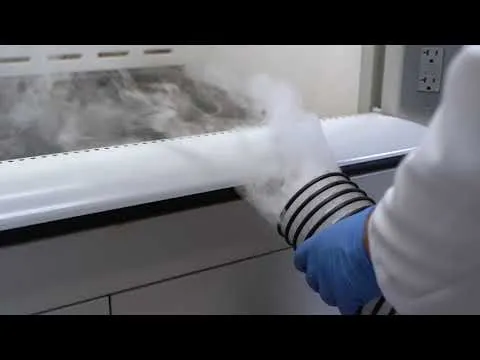
What Is Fume Hood Face Velocity?
In simple engineering terms, face velocity refers to the speed at which the air of the room flows through the sash opening of the fume hood, measured perpendicularly to the opening in feet per minute. In other words, face velocity represents the average speed of the air curtain in front of the hood.
SEFA definition of face velocity is exact: "the average velocity of the air flowing perpendicularly to the face opening toward the respective fume chamber of the fume hood." US National Academies added an engineering definition of face velocity: "the value responsible for the quality of vapor retention."[5].
You can think of it as a door slammed shut on a windy day: if the sucked-in air is not enough, vapors are released into your breathing zone. As for the unit of measurement, the fume hood velocity is expressed in fpm (feet per minute). For your information, 1 fpm is about 0.005 m/s, meaning that a range of 60 to 120 fpm is equal to about 0.3 to 0.61 m/s.
Deiiang Field Note
That is where new lab managers go wrong: reading fume hood face velocity does not mean being able to assure containment. SEFA clearly states that "face velocity does not indicate safety."[3].
Technical Best Practices: How to Run a Valid Grid Test
46pmFt41gqM
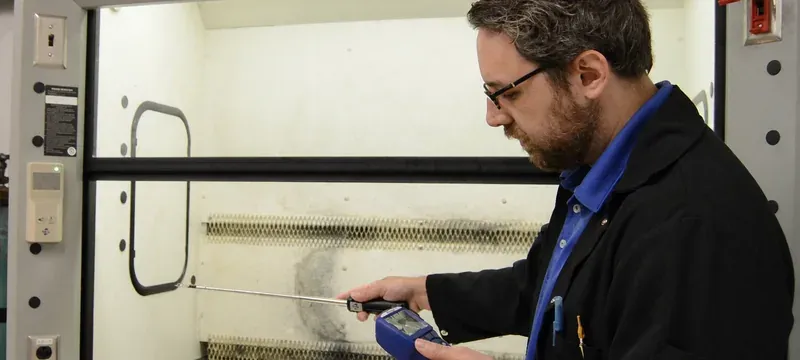
Obtaining a fume hood face velocity result based on the reading given by the hood’s digital display is not equivalent to conducting a valid grid test. We have turned down several “annual Certification tests” that have been carried out while the technician is standing right in front of the sash. The latter one causes turbulence, which makes the results unreliable. Here is the way we conduct our face velocity fume hood acceptance tests at Deiiang commissioning.
- Set the sash to the certified working height — Adjust the fume hood sash to the certified height of approximately 18 inches for general chemistry and ensure it stays this way with a tape measure. Relying on the indicator that the sash has reACHed the height is not recommended, as it can be lost over time.
- Divide the sash opening into roughly 1 ft² grid cells. — On a 6-ft hood that's about 6 cells across × 3 rows. Each cell center is a measurement point. ASHRAE 110 wants a 20-second integrated reading at every point, sampled once per second [2].
- Hold the thermal anemometer probe 1 inch behind the sash plane, — not flush with it. Flush readings sit right in the sash-edge roll-back zone and read artificially low. We position the probe on a ring stand so the tech isn't holding it — hand movement adds ±5-10 fpm of noise.
- Stand to the side of the hood, not in front of it. — Your own body blocks the curtain of incoming air. If you have to stand in front, stay at least 18 inches back.
Calculate the average, then check point-to-point deviation.— Any single point more than ±20% off the average means non-uniform flow — a baffle adjustment job, not a pass. The coefficient of variation (standard deviation ÷ mean) should stay under 15% [5].
The blind spot most techs miss
Within 2 inches away from the sides and bottom sides of the sash frame, there is significant reduction of the signal at the local level of reading (15-25% less), even if the readings from the center cells of the sash show correct outcomes. Edge points must never be averaged into the total result.
The Gold Standard: Why 80-120 FPM Matters
You will see the recommended fume hood face velocity band quoted in almost every lab equipment spec. But walk deeper into the standards and you'll notice something interesting: the exact band has shifted over time, and the newest standard is more nuanced than the old fixed-number approach.
| Standard | Recommended Face Velocity | Tolerance |
|---|---|---|
| ANSI/ASSP Z9.5-2022 [1] | 80-100 fpm starting point (performance-based) | ±20% point-to-point |
| ANSI/AIHA Z9.5-2012 / NFPA 45 | 80-120 fpm | ±20% of average |
| OSHA 29 CFR 1910.1450 App. A [4] | Typically 60-100 fpm | — |
| SEFA 1-2020 [3] | 60-100 fpm most widely accepted | ±20 fpm or ±20% |
| NRC Prudent Practices [5] | 80-100 fpm; 100-120 fpm for high-hazard | ≥150 fpm not permitted |
FPM ↔ m/s Quick Converter (live)
= 0.51 m/s ✓ Optimal band
Below 80 fpm: the invisible leak
Below 60 fpm, even minor room drafts beat the hood. ANSI/AIHA Z9.5 does not recommend operating any hood below 60 fpm at all, because at that point you can no longer reliably measure containment — the reading itself becomes meaningless. On site, what we usually see is a hood that looks fine, sounds fine, and silently lets low-vapor-concentration chemicals creep out at the sash edges.
Above 120 fpm: the turbulence paradox
This is the point that astonishes those who were educated with the idea of "higher airflow is equivalent to more safety" from childhood. The National Research Council's Prudent Practices Manual is straightforward: body speeds of 150 feet per minute or more should not be exercised as they lead to turbulence at the edges of the sash. Also they reduce operating effectiveness of hoods up to bringing particles already settled back into the air stream. Some tests performed by Northwestern University have shown that if the basic speed exceeds 125 feet per minute the retreated eddies will take contaminants to the breathing zone of the staff members by the hood.
The ACGIH claims that safety of air flow is proportional to the size of the eddies formed around the human bodies. That means that there is no proportionate increase of safety with an increase of the airflow speed. On the contrary, an increase of the airflow costs more and results in less effective work of the fume hood, that will lead to losing power for conditioning.
FIELD CASE — ENERGY-SAVING TRAP
We recently visited a VAV hood bank of a Pharmaceutical production laboratory in Southeast Asia where the staff chose the cheapest method possible, with each user in the room addressing its airflow for just 60 feet per minute. The readings during the steady state were good. However, when the sash was lifted, no air was supplied, meaning that for several seconds the operators breathed in contaminated air. Energy savings can be counted only in terms of the moving state of the hood.
Why this is not just an engineering number
In case of any accident related to the excessive speed of airflow at the hood, its manager and EHS will be responsible. In the course of inspections made by OSHA, the absence of the logbooks for the fume hood's flow rate is treated as gross neglect of engineering maintenance of the devices.
Factors Affecting Your Face Velocity
The setpoint on the control panel for the fume hood is just a part of the bigger picture. Whenever a laboratory is walked into, it is seen that there is variation in the readings of the face velocity of the fume hood but that never really indicates a problem with the hood; it is almost always caused by the condition of the room.
Make-up air balance
SEFA 1 – 2020 makes it clear by stating that “correct amounts of make-up air are to be available in laboratories for the operation of any fume hood at the desired face velocity” [3]. This means that if sufficient supply air is not available due to the building having a negative pressure situation, air will find its way through gaps under Doors or Windows. In an ideal situation, laboratories should have slightly more negative pressure than the corridors usually around –5 Pa but not so much that the building starts using the Fume Hoods to breathe.
Sash position and user habits
One of the most notable issues that make the operation of fume hoods more complicated is the positioning of the sash by users.
This means that in the case of a fume hood that has constant air volume and no bypass provision, lowering the sash absolutely destroys the face velocity as it may exceed 1000 fpm near the bottom of the sash, thus resulting in papers flying off the tables and breaking of hot plates. Using variable air volume will only help in keeping constant air velocities as long as the sash is not opened beyond the designated height as air velocity will start decreasing.
Room cross-drafts
This is the least understood failure mode. NRC reported that cross-drafts reach the sash at about 30-50 percent of face velocity failure [5]. Thus, while designing for 100 fpm, the velocity of cross-drafts could be about 30-50 fpm, which is also about 20 fpm – the velocity at which most people feel the air’s motion. WSU has its own standard, which limits the velocity of cross-drafts to 50 fpm (50% of face velocity at best) and recommends locating the fume hood 10 ft away from the door. [7].
- Person walking past:the walking speed of the average person is around 250 fpm, with the vortex behind them being in the same range of velocities–making forces sufficient for overcoming the sash plane.
- Ceiling diffusers: very often, the outlet velocity is between 800 fpm or higher. If the throw of the diFFUser reaches the hood before decaying to 30-50% of the face velocity, it is a constant disturbance.
- Open doors:these are classic examples of the problems with face velocity regulation.
Delinag service record: the major three causes of unstable face velocity in the last three years
According to our analysis of the issues reported by the customers, the main reasons of the issue of the face velocity being not steady are:
- Supply air damper actuator drift —worn VAV damper actuators lose position feedback, making the “constant” velocity to change within ±15% from time to time.
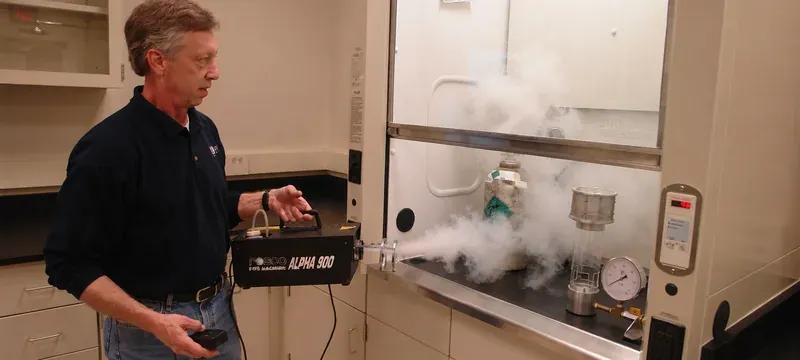
- Torn side gaskets / sash edge seals — undetectable bypass leaks appearing due to smoke pencil.
- Ceiling diffuser aimed at the hood face — usually, it is the air supply equipment that has been rebalanced after the construction process ended.
Comparison Matrix: High vs. Low Velocity
Here's how the fume hood face velocity bands stack up at a glance — green is where containment holds, red is where it doesn't. This is the quick-reference most EHS teams tape inside the sash frame.
| Band | Safety | Turbulence | Energy | Where it fits |
|---|---|---|---|---|
| < 60 fpm | ✗ Fails against room drafts | △ Edge eddies | ✓ Lowest | ASHRAE 110-certified low-flow hoods only |
| 60-80 fpm | ✓ On certified hoods | Needs deep body design | ✓ Savings | Sustainable lab builds, new high-performance hoods |
| 80-120 fpm | ✓ Industry consensus | ✓ Stable laminar inflow | △ Moderate | General chemistry — default recommendation |
| 120-150 fpm | △ Edge roll-back begins | ✗ Vapor spill risk | ✗ High | High-toxicity work, short-term |
| > 150 fpm | ✗ Capture drops | ✗ Severe turbulence | ✗ Very high | Not recommended (NRC / ASHRAE) |
ASHRAE 110 metric (at 90 fpm, 18" sash)
Industry typical
Deiiang standard hood
AM (average containment, ppm SF6)
0.05 – 0.10
0.03
AI (face test, ppm)
0.10 – 0.20
0.06
AU (uniformity test, ppm)
0.15 – 0.30
0.08
Point-to-point deviation
±20%
±12%
Internal Deiiang bench test data, n=18 hoods across 6 widths. Contact us for the full test report PDF.
Myth Busters: Common Face Velocity Misconceptions
MYTH 1 — "Higher face velocity = safer."
Wrong.This is inaccurate. According to ANSI/ASSP Z9.5-2022, the guideline follows a performance-based strategy. The hood must manage the chemicals within, irrespective of required “fpm” number. Once the speed is more than 125-150 fpm, “roll-back eddies” at the edges create backward flow of vapors. ACGIH maintains that higher the “fpm” more dangerous “eddies” around the operator’s body. Hence, modern hoods manage to achieve the same efficiency at lower speed. New hoods work at 60-80 fpm to achieve the same performance as the old and verified models working at 100 fpm with respect to computations according to ASHRAE 110. [1][3].
Wrong.False. The OSHA 29 CFR 1910.1450 Annex A and ANSI Z9.5 say that fume hood with "fpm" measurement will only provide a numerical reading without checking the laboratory environment.Other indicators should be also checked such as: smoke visualization showing no backflow, tracer-gas containment (SF6) for hazardous work, cross-draft levels at the sash, VAV response time under 5 seconds, deviation of the point-to-point averages, turbulence (coefficient of variation) of less than 15%. Even if measured “fpm” shows the number of 100, fume hood may still leak through the edges.
Interactive Checklist: Lab Airflow Health
Run through this at the start of every workday — it takes two minutes and catches most of the problems that annual face velocity certification misses. Tick the boxes and we'll track your progress. If you leave more than a few unchecked at the end, our engineers will tell you exactly which to fix first.
Completed: 0 / 11
Daily
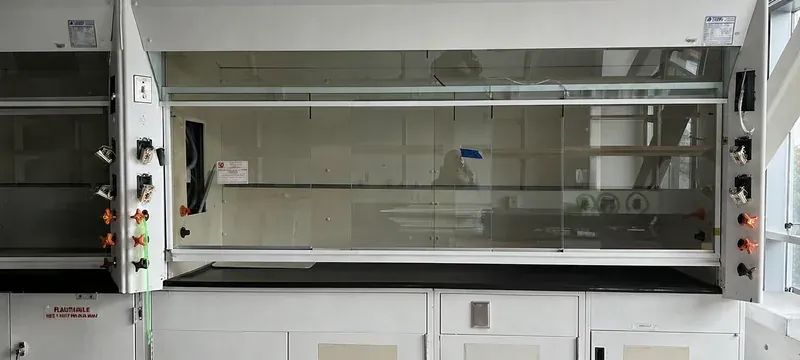
Sash is at the certified working height (typically 18 in) — fully closed when not in use.
Low-flow alarm light and audible alarm are functional.
No visible chemical leakage, stains, or condensation inside the chamber.
Room negative pressure reading is within setpoint (-5 to -10 Pa).
Weekly / Monthly
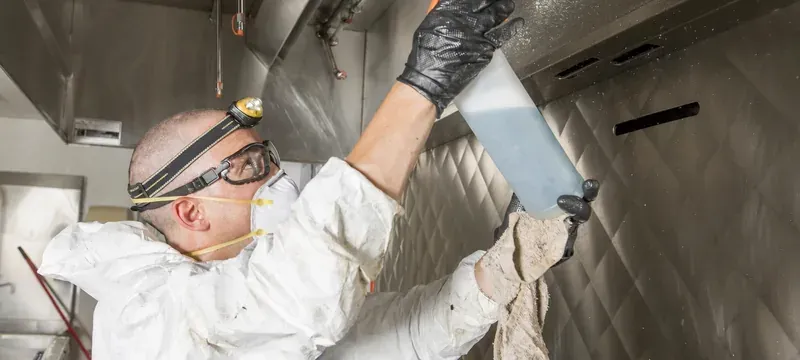
Baffles and side slots are free of debris and chemical residue.
Sash moves smoothly, no cracks in glass, no bent airfoil.
Spot-check face velocity on the installed monitor; compare to last month.
VAV hood: open/close sash — airflow stabilizes within 5 seconds without overshoot.
Annual Certification
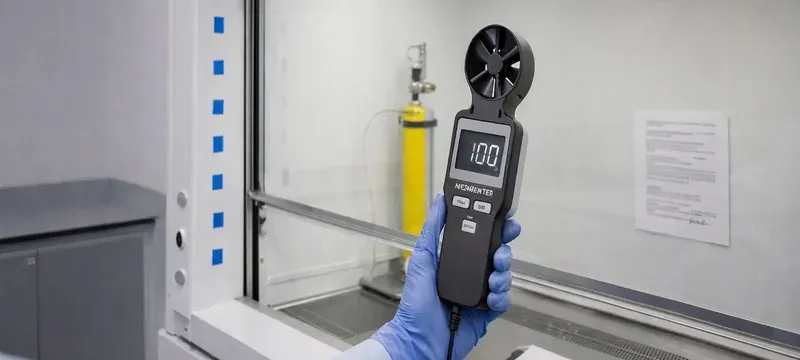
Full ANSI/ASHRAE 110 test: face velocity grid + smoke visualization; add SF6 for high-hazard hoods [2].
Thermal anemometer calibration certificate is current (1-year interval).
Written report filed in the Chemical Hygiene Plan logbook.
FAQ
How often should I test my face velocity?
At least once per year, as per ANSI/AIHA Z9.5 and OSHA laboratory guidelines. Make sure to trigger unannounced testing after any renovation of heating, ventilation and air conditioning (HVAC) systems, fume hood relocation, low-flow alarm occurrence, the shift in chemical classification or the report of some smell.
Can I use a regular anemometer?
Strictly no. ANSI/ASHRAE 110-2016 states that you have to use thermal (hot-wire) anemometer. The results of swinging-vane and rotating-vane devices are not accurate due to lack of constant face velocity, while pitot tubes were manufactured just for high velocity. Smoke tubes do not measure values.
Does room pressure affect face velocity?
The answer is positive, as this is the most frequently observed reason for failure during fume hood face velocity testing. Chem labs should stay slightly negative comparing to corridors. If the room lacks make up air, it shifts to the negative side and the undercuts of the doors become practically its air inlets and the flow reaches 30-50 fpm at the sash.
Optimize Your Lab Safety
Have your air balance properly done, certified testing performed on your fume hood face velocity and have a certified VAV process done. At Deiiang, we are set and trained to complete TAB and ASHRAE 110.
Contact Deiiang Maintenance TeamReferences
- ANSI/ASSP Z9.5-2022, Laboratory Ventilation. American Society of Safety Professionals. https://webstore.ansi.org/
- ANSI/ASHRAE 110-2016, Methods of Testing Performance of Laboratory Fume Hoods. ASHRAE. https://www.ashrae.org/
- SEFA 1-2020, Laboratory Fume Hood Standard. Scientific Equipment and Furniture Association. SEFA 1 PDF
- OSHA 29 CFR 1910.1450, Occupational Exposure to Hazardous Chemicals in Laboratories. osha.gov
- National Research Council, Prudent Practices in the Laboratory (2011 ed.), Ch.9.C. National Academies Press. nap.edu
- Northwestern University Research Safety, Chemical Fume Hood Handbook. northwestern.edu
- Washington State University Facilities Services, Laboratory Fume Hoods Design Standard 11-53-13. wsu.edu PDF
- ACGIH, Industrial Ventilation: A Manual of Recommended Practice (latest ed.), as cited in SEFA 1-2020 §12.1.
Understanding what is face velocity — and why the 80-120 fpm band remains the industry default — is the foundation of every lab safety program. A properly commissioned fume hood face velocity reading is not a target you set once and forget; it's a number you re-verify every year, after every renovation, and every time an alarm goes off. When in doubt, call Deiiang for a professional grid test.
— Jason Peng, cleanroom engineering Technology Manager, Deiiang | Jason.peng@deiiang.com