+86 13638632902
 Jason@cleanroomequips.com


 MENU
MENU
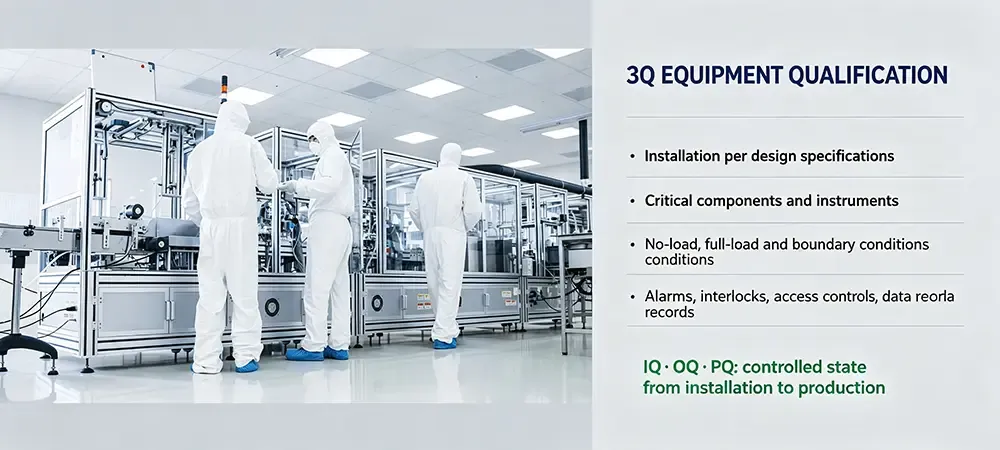
Dry run tests and trials by the equipment manufacturer are often considered to be sufficient to enable start-up of production using the new equipment. In controlled environments however, mandatory qualification of the equipment is required to ensure that all installation activities and all subsequent output from the equipment is under control. This control must be verified from initial installation through to on-going production.
Key takeaway: A factory acceptance test establishes that equipment works at the supplier's site. IQ OQ PQ validation (or qualification) tests to determine if the same equipment will work stably in your plant, under your normal operating conditions and related factors.
.
Why cleanroom Fireproofing, Sealing & materials Affect Equipment 3Q
Penetrations in walls and on the floor also act as leakage points. Since a leakage of air leads to a decrease in pressure in the ISO zones, the area under the affected ISO-zone can in worst cases even reduce to 0 Pa (5 Pa) and thus is not accepted for performance qualification (PQ) in gelling times of <30 minutes. To prevent uncontrolled entry of non-sterile air into the critical zone, unsealed cable penetrations behind filling mACHines are often closed.
For the Installation Qualification (IQ) of firestop materials all products must be checked for batch identification, fire resistance (e.g. 120 minutes according to GB 23864) and correct application. A single penetration that has not been recorded can lead to serious audit findings. To date, Deiiang™ has supplied firestop solutions for 200+ companies covering a total area of over 150,000 m².
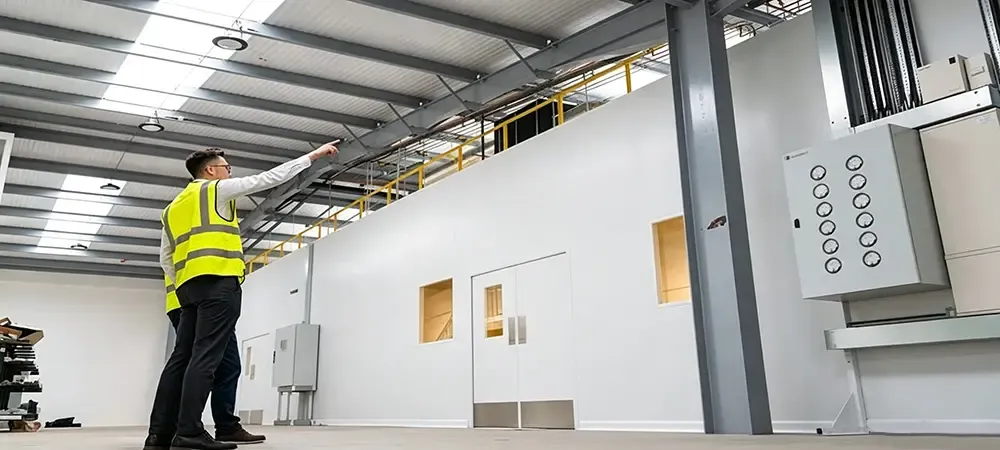
Properly sealed penetrations are a prerequisite for valid IQ/OQ/PQ. Image courtesy of Deiiang™.
Key Terminology at a Glance
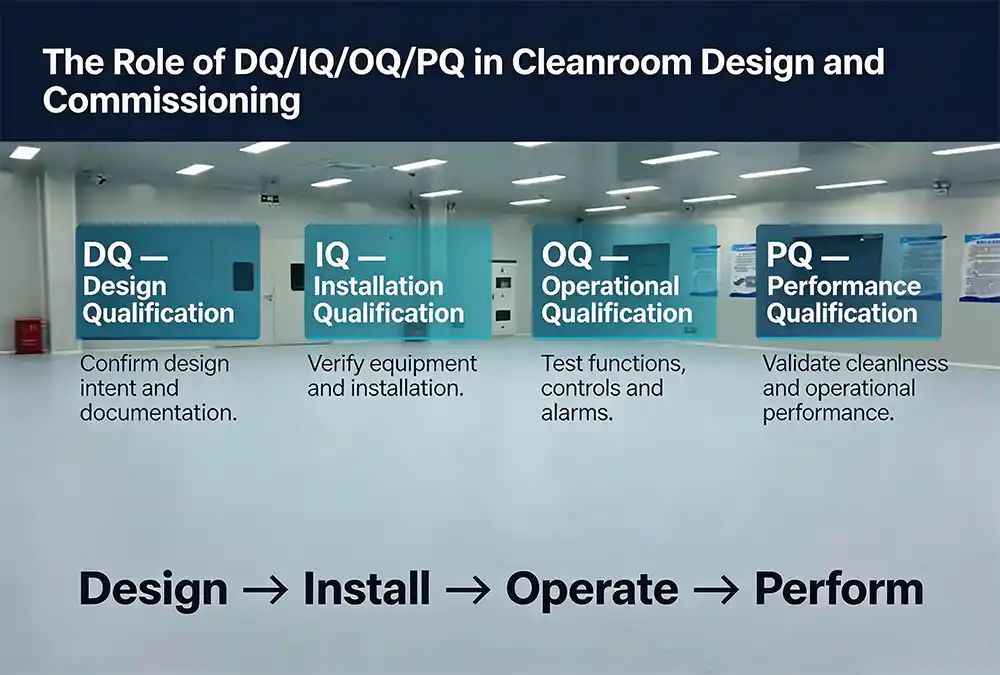
IQ (Installation Qualification) — Verifies correct installation per URS and design documents.
OQ (Operational Qualification) — Confirms functions operate within defined ranges and alarms work.
PQ (Performance Qualification) — Demonstrates consistent output under real production conditions.
URS — User Requirement Specification, the baseline for all qualification.
Cleanroom Firestopping — Fire‑rated sealing systems at utility penetrations that also maintain airtightness.
IQ, OQ, and PQ: A Concise Overview
The sequence is fixed: IQ first, then OQ, finally PQ. IQ confirms correct installation; OQ verifies stable functionality; PQ proves consistent product quality. In cleanrooms, penetration seals are both fire‑safety devices and contamination barriers, directly influencing each phase of equipment qualification.
Golden rule: IQ = installed correctly. OQ = runs stably. PQ = produces compliant results. All depend on room integrity provided by proper firestopping.
IQ: Installation Qualification in Cleanroom Fireproofing & Sealing
Installation qualification must cover every utility penetration. Inspectors verify material batch certificates, dimensional compliance (e.g., Deiiang™ Model A: up to 300 mm diameter, 120‑min fire rating), sealant depth (12 mm ± 1 mm), location documentation, and cleanroom compatibility (low‑VOC, resistant to cleaning agents).
IQ checklist sample:
☐ Equipment model & S/N against URS
☐ All utility penetrations mapped and tagged
☐ Firestop material batch numbers and certificates verified
☐ Annular gap measured & sealant depth checked
☐ Pressure‑decay test passed at ±50 Pa (leakage <0.5 L/s)
☐ Equipment model & S/N against URS
☐ All utility penetrations mapped and tagged
☐ Firestop material batch numbers and certificates verified
☐ Annular gap measured & sealant depth checked
☐ Pressure‑decay test passed at ±50 Pa (leakage <0.5 L/s)
A missed penetration during IQ can cause OQ pressure fluctuations; re‑sealing costs 3‑5× the initial installation expense.
| IQ Check Item | Acceptance Criteria | Deiiang™ Data | Method |
|---|---|---|---|
| Firestop certification | 120‑min test report | Model A: GB 23864 | Document review |
| Max penetration Ø | ≤300 mm | Model A: 300 mm | Calibrated caliper |
| Sealant depth | 12 mm ± 1 mm | Verified in 200+ sites | Depth gauge |
| VOC emission | <50 ppm after cure | Model B: <30 ppm | Air sampling |
| Cleaning resistance | No degradation after 100 cycles | Compatible with IPA, H₂O₂, QUATs | Visual + mass loss |
| IQ Check Item | Criteria / Deiiang™ Data |
|---|---|
| Firestop certification | 120‑min (Model A, GB 23864) |
| Max penetration Ø | ≤300 mm (Model A) |
| Sealant depth | 12 mm ± 1 mm |
| VOC emission | <30 ppm (Model B) |
| Cleaning resistance | IPA, H₂O₂, QUATs compatible |
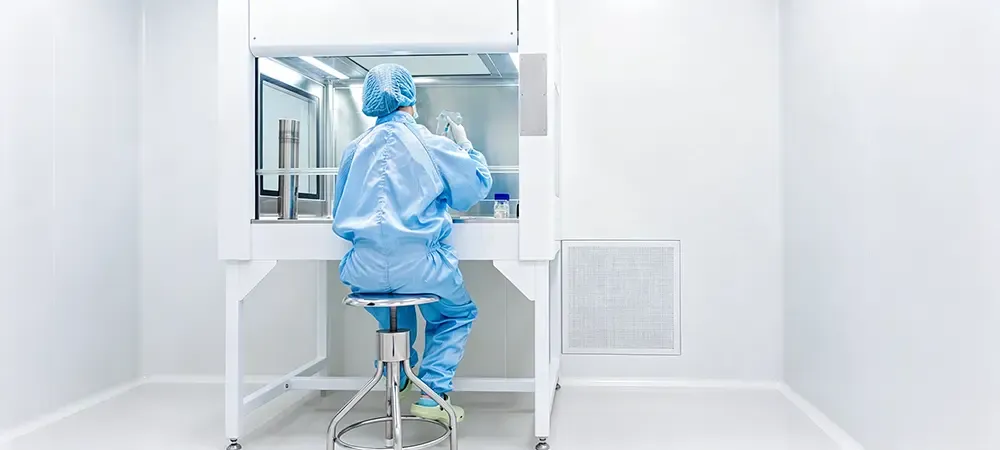
OQ: Operational Qualification in cleanroom environments
Operational qualification tests dynamic performance: pressure stability during equipment cycling (monitored at 1‑sec intervals, staying above 15 Pa), smoke penetration checks at sealed openings, door‑seal leakage (<0.05 m³/h/m for Deiiang™ systems), and fire‑alarm interlock responses. Boundary‑condition tests at low, nominal, and high speeds verify that thermal expansion doesn't compromise seal integrity.
OQ result: After Deiiang™ sealing, pressure fluctuation improved from ±8 Pa to ±1.5 Pa (criterion: 15 ± 3 Pa).
| OQ Test Parameter | Test Method | Acceptance Criterion | Deiiang™ Result |
|---|---|---|---|
| Pressure stability | 1‑sec logging | 15 ± 3 Pa | 15 ± 1.5 Pa |
| Door seal leakage | Pressure‑decay at 50 Pa | <0.1 m³/h/m | <0.05 m³/h/m |
| Smoke penetration | Visual at operating pressure | No visible leak | Pass — zero leakage |
| Alarm interlock | Simulated fire signal | Shutdown <5 sec | 3.2 sec |
| OQ Test | Criterion / Deiiang™ Result |
|---|---|
| Pressure stability | 15 ± 1.5 Pa (criterion ±3 Pa) |
| Door seal leakage | <0.05 m³/h/m (criterion <0.1) |
| Smoke penetration | Pass — zero leak |
| Alarm interlock | 3.2 sec (criterion <5 sec) |

PQ: Performance Qualification in Cleanrooms & Consistent Output
Performance qualification runs real product over 3–5 consecutive batches, monitoring particulates (<352,000/m³ for iso 7), microbes, temperature (±2 °C), and pressure. Statistical capability is mandatory: a Cpk ≥ 1.33 proves the process spread is well within specifications. After Deiiang™ sealing eliminated pressure drift, a fill‑volume Cpk reached 1.41, with particulate counts averaging 187,000/m³ across five batches.
Process Capability — Fill Volume (target: 10.00 mL ± 0.15 mL)
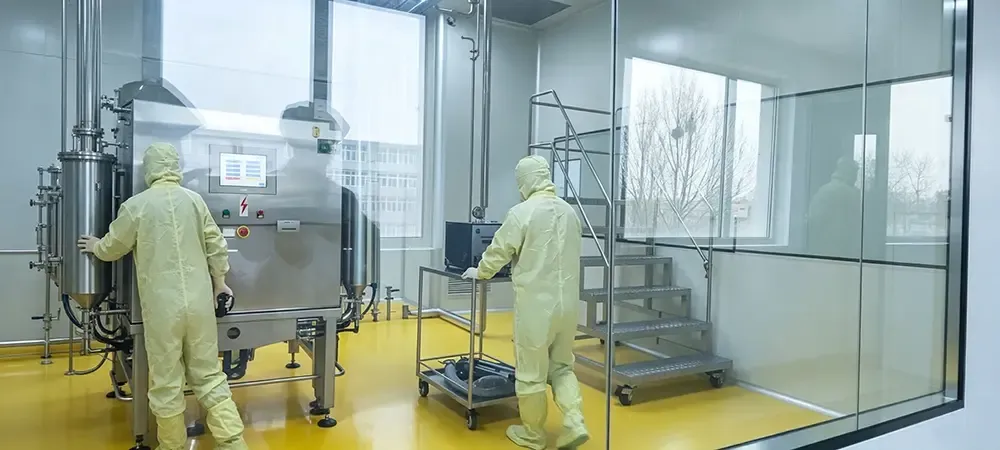
URS and Risk Assessment in cleanroom material selection
The URS must specify fire resistance (≥120 min), air leakage (<0.1 m³/h/m), VOC emissions (<50 ppm), and cleanroom compatibility. A risk matrix then classifies each penetration as Critical (full IQ/OQ/PQ), Major (standard IQ/OQ), or Minor (IQ only).
| Risk Level | Criteria | Example | Action |
|---|---|---|---|
| Critical | Direct sterile boundary impact | iso 5 fill zone to corridor | Full IQ/OQ/PQ |
| Major | Indirect pressure cascade impact | ISO 7 buffer zone cable tray | Standard IQ/OQ |
| Minor | No product quality impact | Technical corridor utility | IQ + visual inspection |
| Risk Level | Action |
|---|---|
| Critical | Full IQ/OQ/PQ |
| Major | Standard IQ/OQ |
| Minor | IQ + visual inspection |
material selection Guide: Cleanroom Fireproofing & Sealing for 3Q Success
| Material Type | Fire Rating | VOC (ppm) | Cleaning | Life | Deiiang™ Model |
|---|---|---|---|---|---|
| Intumescent sealant | 120 min | <30 | IPA, H₂O₂, QUATs | 10–15 yr | Model B-120 |
| Flexible foam | 90 min | <40 | IPA, limited H₂O₂ | 8–12 yr | Model F-90 |
| Metallic through‑sleeve | 180 min | <10 | All agents | 20+ yr | Model S-180 |
| Airtight gasket | 60 min (supp.) | <5 | All agents | 15+ yr | Model G-60 |
| Material / Model | Key Specs |
|---|---|
| Intumescent sealant (B-120) | 120 min, VOC <30 ppm, 10–15 yr |
| Flexible foam (F-90) | 90 min, VOC <40 ppm, 8–12 yr |
| Metallic sleeve (S-180) | 180 min, VOC <10 ppm, 20+ yr |
| Airtight gasket (G-60) | 60 min supp., VOC <5 ppm, 15+ yr |
Beyond fire rating, low‑smoke, zero‑halogen materials prevent corrosion and particulate contamination. Deiiang™ products, designed under the leadership of Jason Peng, meet GB/T 20285 and ISO 14644 requirements.
Compliance & testing standards (Local & International)
| Standard | Scope | 3Q Relevance |
|---|---|---|
| GB 23864 | Firestop material tests (China) | IQ: fire resistance verification |
| iso 14644‑1 | Cleanroom particulate classification | OQ/PQ: airborne particle limits |
| EN 1366‑3 | Fire resistance for penetrations (EU) | IQ: international projects |
| NFPA 101 | Life Safety Code (USA) | IQ/OQ: fire barrier inspection |
| GB 50591 | cleanroom construction & acceptance | IQ: sealing integrity |
| Standard | 3Q Relevance |
|---|---|
| GB 23864 | IQ: fire resistance |
| iso 14644‑1 | OQ/PQ: particle limits |
| EN 1366‑3 | IQ: EU fire resistance |
| NFPA 101 | IQ/OQ: barrier inspection |
| GB 50591 | IQ: construction sealing |
All materials must carry third‑party test reports from accredited labs (e.g., CNAS, Warringtonfire, UL).
Common Misconceptions About Cleanroom Sealing & 3Q
MYTH #1
"Factory testing already validated the equipment."
Reality: A sterile filling line failed PQ due to unsealed cable penetrations. After Deiiang™ sealing, particulates dropped 62% and PQ passed. Re‑validation cost: ~USD 18,000 vs. ~USD 600 for proper sealing during IQ.
MYTH #2
"Only fire resistance matters."
Reality: Some foams emit >100 ppm VOCs during curing, triggering cleanroom alarms. Deiiang™ Model B‑120 stays below 30 ppm.
MYTH #3
"PQ is a one‑time event."
Reality: Sealants age and crack (8–15 yr). Requalification must include periodic re‑inspection and replacement when leakage exceeds baseline by 25%.
Practical Checklists & Acceptance Templates
IQ: Verify equipment model & S/N against URS.
IQ: Map & photograph every utility penetration; assign ID tags.
IQ: Confirm firestop batch numbers & certificates.
IQ: Measure annular gap & sealant depth.
IQ: Pressure‑decay test at ±50 Pa.
OQ: Smoke penetration test under operating pressure.
OQ: Log pressure differentials at 1‑sec intervals during cycling.
OQ: Test fire alarm interlocks & damper closure.
OQ: Run at low, nominal & high boundary conditions.
PQ: 3–5 consecutive batches with full environmental monitoring.
PQ: Calculate Cpk for all critical attributes; target ≥1.33.
PQ: Document deviations & update validation master file.
Ongoing: Annual re‑inspection; replace seals if leakage >25% above baseline.
Deiiang™ supports on‑site inspections in Shanghai, Guangzhou, and Singapore. Contact us for IQ/OQ/PQ templates and sample kits.

Frequently Asked Questions (FAQ)
Q: How often to replace penetration seals?
A: Typically 10-15 years depending on the normal cleanroom conditions; 7-10 years depending on the VHP used for cleaning.
Q: Does firestop sealing affect airflow?
A: We always say that properly installed firestop sealing does not affect airflow. Deiiang™ systems are capable of leakage less than 0.05 m3/h/m, which is nothing compared to 20-60 ACH (air changes per hour) that are typical for clean rooms.
Q: Can the same material be used for retrofit requalification?
A: Yes. If a sealant is within its shelf life and is being re-used for the same configuration, follow the specified surface preparation procedures for adhesion.
Q: Most common 3Q failure related to sealing?
Incomplete documentation of penetration seal acceptance testing in the Installation Qualification (IQ) for 3Q failures such as pressure fluctuations in the Operational Qualification (OQ) tests due to unsealed cable openings, which can be avoided by using a checklist.
Micro‑Glossary
3Q Validation — IQ + OQ + PQ to confirm controlled equipment.
URS — User Requirement Specification, the qualification baseline.
Cpk — Process Capability Index; ≥1.33 indicates a capable process.
Firestop System — Tested assembly restoring fire rating and airtightness at penetrations.
Pressure Cascade — Stepwise pressure differential protecting clean zones.
VOC — Volatile Organic Compounds that can contaminate cleanroom air.
Annular Gap — Space between penetrating item and barrier edge.
Pressure‑Decay Test — Leak quantification by measuring pressure drop over time.
Conclusion & Next Steps
IQ, OQ, and PQ provide evidence that equipment, cleanroom, and firestop systems work together. An integrated approach reduces audit findings and increases batch‑release confidence. Start by inspecting your penetrations — they are often the missing piece in equipment validation.
Strengthen your 3Q validation with certified cleanroom fireproofing.
Contact Deiiang™ for a penetration assessment, template package, or material sample kit. Product design led by Jason Peng.
📧 Jason@cleanroomequips.com | 🌐 www.cleanroomequips.com
References
ISO 14644‑1:2015 – Cleanroom particulate classification. ISO.org
GB 23864‑2009 – Firestop material test method (China).
EN 1366‑3:2021 – Fire resistance for penetrations (EU). CEN.eu
NFPA 101 – Life Safety Code (2024). NFPA.org
GB 50591‑2010 – Cleanroom construction acceptance (China).
ICH Q7 – GMP for Active Pharmaceutical Ingredients. ICH.org
EU GMP Annex 1 – Manufacture of Sterile Medicinal Products (2022). EU Health
ISPE Baseline Guide Vol.5 – Commissioning & Qualification (2nd Ed.). ISPE.org
© 2026 Deiiang™. All rights reserved. Product data shown are representative; actual performance may vary. Product design leadership: Jason Peng.