+86 18186671616
 Jason@cleanroomequips.com


 MENU

A clean room is more than a sealed room with a good filter. It is a controlled environment where every design decision and daily action points toward one goal: keeping contamination away from the process and the product. The cleanroom fundamentals below hold whether you are commissioning a new suite or auditing a room that has already run for a decade.
The rules that govern a clean room are not arbitrary. They map to recognized frameworks such as the iso 14644 series and EU GMP Annex 1, and they are applied through site-specific risk assessment rather than guesswork. Those frameworks supply the cleanroom design standards; a written cleanroom protocol is what turns them into something a shift team can actually follow.
At Deiiang, we design, build and commission clean rooms for pharmaceutical, electronics, medical device and food facilities. This guide explains the principles that actually determine clean room performance, from the air path to the way people move, and the checks we use on site before a room is handed over.
How a clean room works — the short answer
- Stop contamination entering — gowning, airlocks, controlled material transfer and a sealed envelope.
- Limit contamination generated inside — disciplined behavior and smooth, non-shedding surfaces.
- Continuously remove particles — filtered supply air, organized airflow and controlled return or exhaust.
What Are Clean Room Principles?
Definition and purpose
Clean room principles are the combined design and operating rules that keep airborne particles, microbial contamination and surface contamination within defined limits. In everyday language they are the clean room rules that everyone from the designer to the cleaning crew works to. The aim is not sterility of the whole room, but predictable control of the environment around a sensitive process.
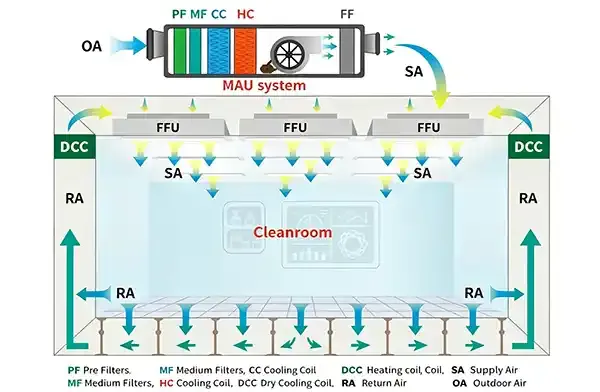
Contamination is any unwanted substance — dust, skin cells, fibers, microbes, chemical residue or films. Even a clean-looking room can carry millions of sub-micron particles that the eye cannot see.
Where the principles come from
They begin with standards that define classification, testing and operation — ISO 14644 for air cleanliness, EU GMP Annex 1 for sterile products — then get translated into facility-specific procedures. The exact limits always depend on the process, the product and the risk it carries.
This is why two clean rooms can look similar yet follow different rules. A sterile filling line and a precision assembly area do not share the same contamination risks.
Who the principles apply to
- Designers define layout, airflow, pressure and the air-handling concept.
- Builders deliver the sealed envelope, penetrations and cleanable finishes.
- Operators follow gowning, behavior and cleaning procedures.
- QA and compliance teams monitor performance and decide when a space is acceptable.
All four groups work from the same cleanroom protocol, so the drawings, the SOPs and the training records have to say the same thing.
Core Design Principles of a Clean Room
Design sets the ceiling for performance. No operating discipline can fully rescue a room with the wrong airflow, weak pressure balance or hard-to-clean surfaces.
Particle and microbial contamination control
Design starts by identifying sources. The main ones are people, supply air, equipment, raw materials and the process itself. People are usually the largest internal source in an occupied room, which is why a cleanroom particle count taken during production rarely matches one taken in an empty room.
Each source is handled at the point where it can be controlled: filtration for air, gowning for people, airlocks for entry and smooth surfaces for cleaning. That is also why particle counts are read together with occupancy and activity, not on their own.
Airflow organization: unidirectional vs non-unidirectional
Airflow decides whether particles are swept out in a steady path or diluted through mixing. The two patterns serve different cleanliness levels and budgets, and the choice belongs in the cleanroom design standards for the project rather than in a catalogue default.
| Aspect | Unidirectional (laminar) | Non-unidirectional (turbulent/mixed) |
|---|---|---|
| Air path | Parallel, steady stream in one direction | Multiple streams that mix and dilute |
| How it controls particles | Sweeps them out of the critical zone | Dilutes concentration through air changes |
| Typical use | Higher-grade critical and sterile operations | General assembly, packaging and lower grades |
| Air volume and cost | High airflow, higher running cost | Lower airflow, more economical |
| Main limitation | Obstructions can disrupt the parallel stream | Less effective at very high cleanliness levels |
Unidirectional (laminar)
Air pathParallel, steady stream in one direction
ControlSweeps particles out of the critical zone
Typical useHigher-grade critical and sterile operations
LimitationObstructions can disrupt the parallel stream
Non-unidirectional (mixed)
Air pathMultiple streams that mix and dilute
ControlDilutes concentration through air changes
Typical useGeneral assembly, packaging and lower grades
LimitationLess effective at very high cleanliness levels
Pressure differential and pressure hierarchy
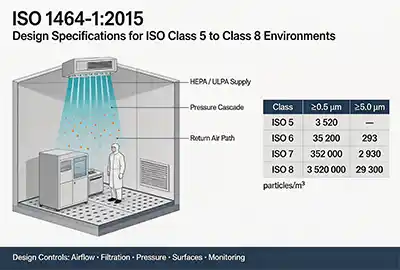
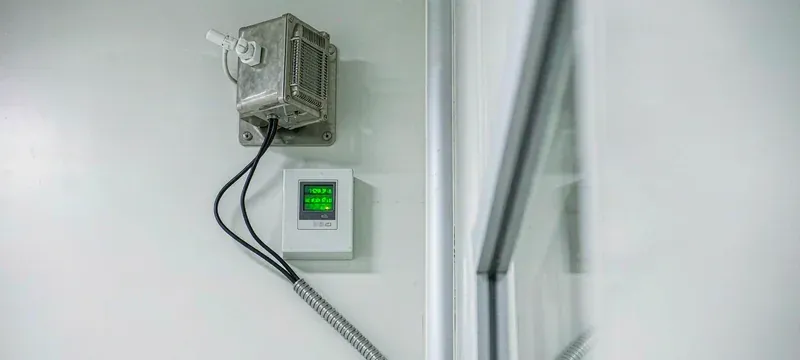
Pressure controls the direction air moves when a door opens or through leakage. Adjacent spaces are kept at different pressures so air always flows along the intended path. Cleanroom pressure differential is usually the first number an auditor asks for, because it shows at a glance whether the cascade is intact.
Positive pressure protects a product: cleaner air flows outward toward less clean areas. Negative pressure contains a hazardous process, such as biological or toxic handling, by drawing air inward. Airlocks manage the transition between zones.Matching cleanliness class to the process
Over-specifying a room wastes energy and capital. Under-specifying it puts product quality at risk. The class should be chosen from process criticality and the standards that apply, not from a desire to simply have the highest grade.
S4VyAOnngAk
Separating personnel and material flow
People and materials should enter through separate routes where practical. Airlocks, pass-through boxes and changing areas prevent the door from becoming a direct path for contamination and keep flows from crossing. These are simple clean room techniques that cost little at design stage and a great deal to retrofit.
Smooth, non-shedding surfaces and materials
Finishes need to be smooth, non-porous, resistant to cleaning agents and easy to wipe. Coved corners, sealed joints and minimal horizontal ledges remove places where particles settle and are hard to remove. They also decide how much of your cleanroom maintenance budget goes into repairing damaged seals rather than routine cleaning.
Temperature and humidity control
Temperature supports both operator comfort and process stability. Humidity matters because high levels can encourage microbial growth and corrosion, while very low levels increase static. cleanroom temperature and humidity standards are normally written zone by zone, because a gowning area and a filling line do not need the same band, so the setpoints should follow the process and the materials rather than one universal value.
Operational and Behavioral Principles
A well-built room still fails if it is run without discipline. Most contamination events in operating clean rooms trace back to behavior, not equipment.
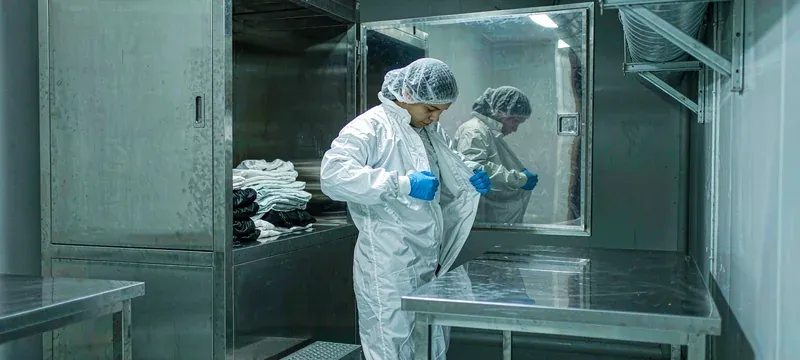
Gowning and entry/exit procedure
- Remove jewelry, watches and loose items, and wash or sanitize hands.
- Enter the changing area and don garments in the defined order and sequence.
- Avoid contact between clean garments and the floor or walls.
- Move through the airlock one person at a time, without holding doors open.
- Exit in reverse, placing reusable garments in the correct handling route.
This sequence is the part of the clean room protocol visitors notice first, and the part most often shortened when a shift is running late.
Personnel behavior and movement limits
Fast or exaggerated movements shed far more particles than slow, controlled motion. Staff should move calmly, avoid unnecessary talking, and keep personal items out of the room. The underlying clean room techniques are simple — walk at a normal pace, keep arms below shoulder height, pause before entering a critical zone — yet they remove more contamination than most equipment upgrades.
People count and activity control
Because people are the dominant internal particle source, occupancy should be limited to the number required for the task. Maximum occupancy is best confirmed during qualification and respected during routine operation.
Cleaning, disinfection and sanitation SOP
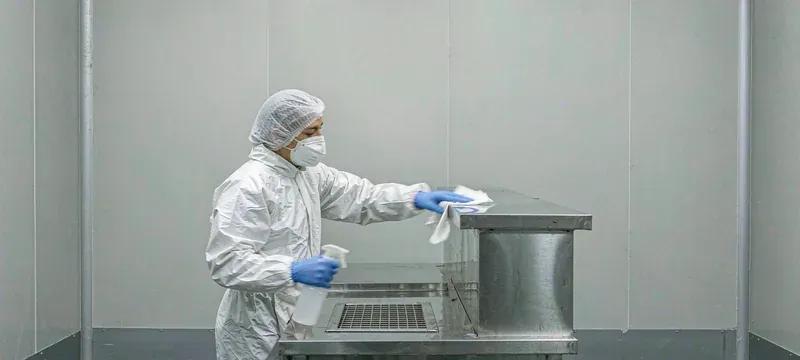
Cleaning follows a documented procedure: approved agents, defined frequency, and a top-down technique so dislodged particles do not fall onto already cleaned surfaces. A workable cleanroom cleaning SOP names the agent, the dilution, the tool, the order of surfaces and who signs off, because clean room cleaning techniques differ by surface type and by cleanliness grade. Effectiveness should be validated and records kept.
Environmental monitoring and out-of-spec response
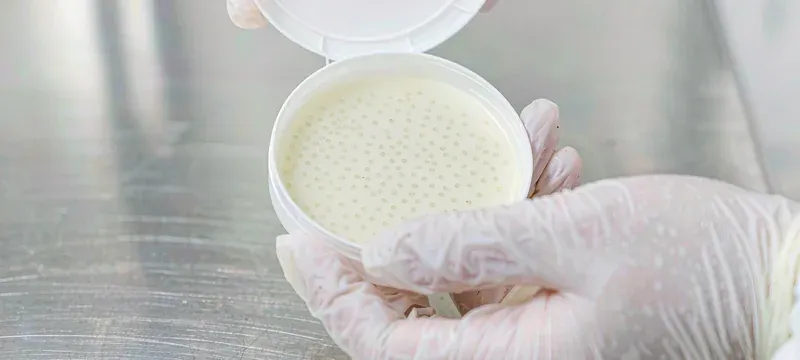
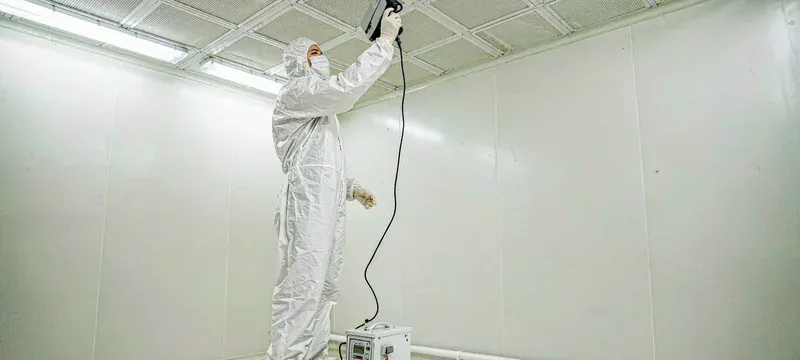
Routine monitoring covers particle counts, pressure, temperature and humidity, plus microbial methods such as settle plates and active air sampling where relevant. In any environmental monitoring clean room programme, the sample points should sit where product or critical surfaces are actually exposed, not on an even grid drawn for convenience. Alert and action limits trigger a defined response, investigation and corrective action before a minor drift becomes a quality event.
Standards and Compliance Basis
The ISO 14644 series
ISO 14644 is the central framework for cleanroom classification and control. Its parts work together rather than in isolation:
- ISO 14644-1 defines airborne particle cleanliness classes.
- iso 14644-2 covers monitoring and performance reporting.
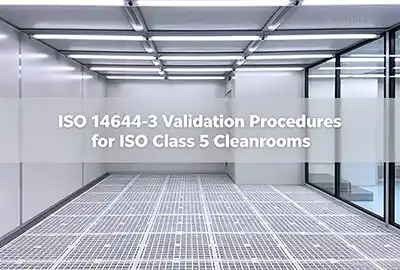
- iso 14644-3 addresses test methods.
- iso 14644-4 covers design, construction and start-up.
- iso 14644-5 deals with operations.
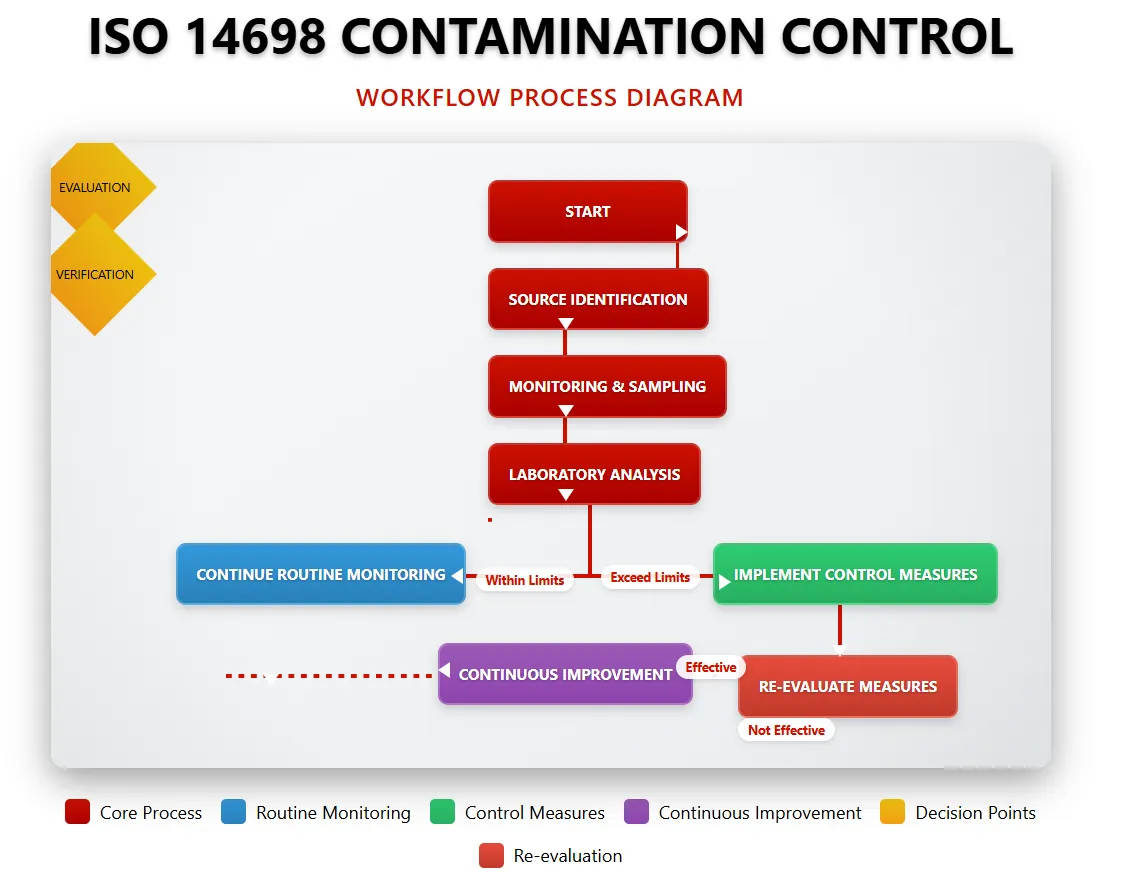
- iso 14698 addresses biocontamination control.
EU GMP Annex 1 and Grade A–D
For sterile medicinal products, EU GMP Annex 1 sets out Grade A through D environments and emphasizes a contamination control strategy that combines design, monitoring and procedural controls across the whole process. The current revision also expects that strategy to be documented and reviewed, which is where the clean room protocol and the monitoring data meet.
Industry-specific expectations
The physics of contamination control stays constant, but priorities shift. Sterile pharma emphasizes microbial control and gmp grades. Electronics and semiconductor work focus on particles and electrostatic discharge. Food and medical device environments lean toward hygiene and documented process control, and not every area needs a formal particle class.
Common Myths About Clean Room Principles
Myth 1: A HEPA filter alone guarantees a clean room.
A HEPA filter only handles the air passing through it. Gowning, pressure, airflow pattern, surfaces and behavior all still matter, and a blocked or poorly sealed filter can undermine the whole system.
Myth 2: The rules only matter during commissioning.
Commissioning proves the room can perform. Routine SOPs, monitoring and maintenance are what keep it performing every day after the project team leaves.
Myth 3: Every clean room must be positive pressure.
Positive pressure protects products. Rooms that contain hazardous biological or toxic materials may deliberately run negative so contaminants cannot escape.
Myth 4: Clean room principles are identical in every industry.
The mechanisms are shared, but limits, monitoring and the dominant risks differ. A sterile filling line and an electronics assembly room are not controlled the same way.
Myth 5: High air changes make people and activity irrelevant.
More airflow cannot fully offset excessive occupancy or poor behavior. A particle generated next to a critical product can reach it before dilution or sweep-away removes it.
How to Apply These Principles in Practice
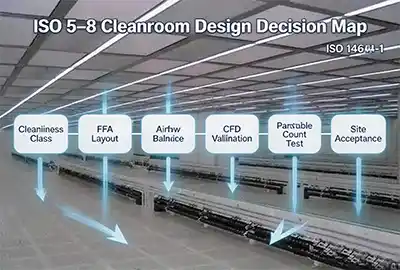
- Define the process and required class. Identify the product, its risks and the standards that apply before choosing a cleanliness level.
- Design layout, airflow and pressure. Separate flows, select the airflow pattern and establish a clear pressure hierarchy.
- Qualify and test before use. Verify filtration, airflow, pressure and particle performance against the design intent.
- Operate under SOP and monitoring. Run gowning, cleaning and occupancy procedures with active monitoring and clear limits.
- Review, clean and maintain over time. Track trends, maintain equipment and refresh procedures so performance does not drift.
Written down in that order, the same logic becomes a cleanroom checklist you can walk through with the project team: class and risk agreed, flows separated, pressure cascade set, verification completed, responsibilities assigned.
Verifying that the system actually works
| Method | What it verifies |
|---|---|
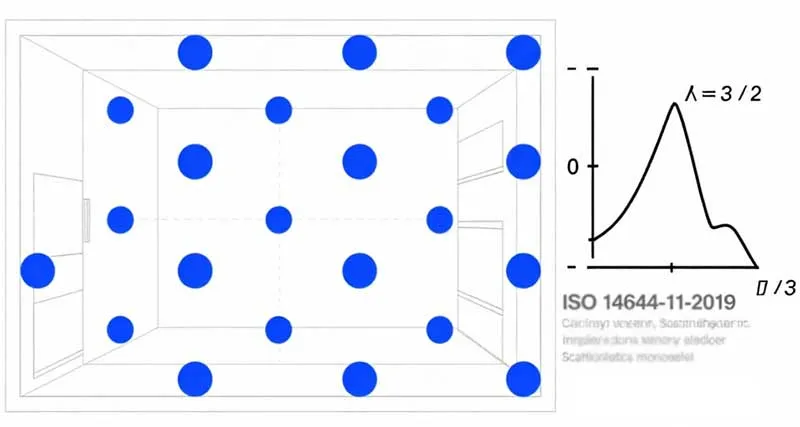
| Particle counting | Airborne concentration meets the target class |
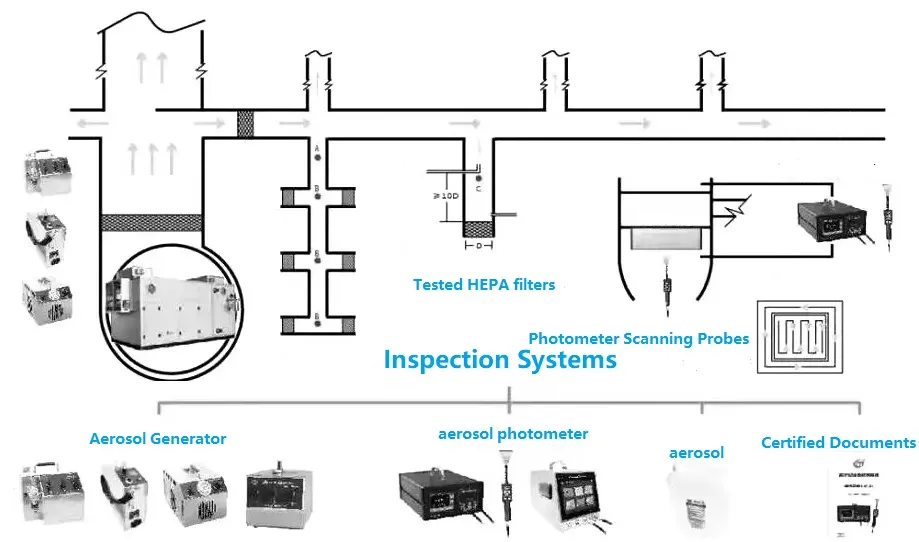
| HEPA filter leak testing | No bypass or leaks through the filter or seal |
| Airflow visualization (smoke) | Air moves as intended and no dead zones exist |
| Pressure differential monitoring | The pressure hierarchy and airflow direction hold |
| Air change / velocity measurement | Supply volume and airflow speed match design |
Particle counting
VerifiesAirborne concentration meets the target class
HEPA leak testing
VerifiesNo bypass or leaks through the filter or seal
Airflow visualization
VerifiesAir moves as intended and no dead zones exist
Pressure monitoring
VerifiesThe hierarchy and airflow direction hold
Air change / velocity
VerifiesSupply volume and speed match design
A real-world example
On a Deiiang project, a process machine placed close to a critical work area was interrupting the intended parallel airflow. Airflow visualization showed air recirculating behind the equipment instead of sweeping cleanly through the zone.
The team repositioned the machine and adjusted a supply diffuser, then repeated the smoke test and particle counts to confirm the path was restored. The change was small, but it only became visible because verification was done rather than assumed.
Frequently Asked Questions
What are the main clean room principles?
The core principles are preventing contamination from entering, limiting contamination generated inside, and continuously removing particles through filtered, organized airflow. Pressure control, gowning, cleaning and monitoring support these three functions.
What is the basic principle of cleanroom airflow?
Filtered air is delivered in a controlled pattern. unidirectional airflow moves in parallel lines to sweep particles away, while non-unidirectional airflow uses enough air changes to dilute and mix them.
Do clean rooms always need positive pressure?
No. Positive pressure protects the product by pushing air toward less clean areas. Rooms handling hazardous biological or toxic materials can use negative pressure to contain contaminants instead.
Who sets clean room principles and standards?
They are derived from frameworks such as ISO 14644 and EU GMP Annex 1, then applied through site-specific risk assessment, qualification and standard operating procedures.
How do clean room principles differ by industry?
The underlying control mechanisms are shared, but limits and priorities change. Sterile pharma focuses on microbial control and gmp grades, while electronics focus on particles and electrostatic control.
References and Further Reading
- ISO 14644-1: Cleanrooms and associated controlled environments — classification of air cleanliness by particle concentration.
- ISO 14644-2, -3, -4 and -5: monitoring, test methods, design and operation.
- ISO 14698-1: biocontamination control.
- EU GMP Annex 1: Manufacture of sterile medicinal products.
For more detail, explore our guides on cleanroom classes, HVAC and pressure control, environmental monitoring, and the day-to-day cleanroom maintenance routines that keep a room in grade.
Not sure which class or pressure scheme your process needs?
Talk to the Deiiang team about your layout, cleanliness target and compliance requirements. We can help you define a clean room that matches the actual risk — without over-building.